















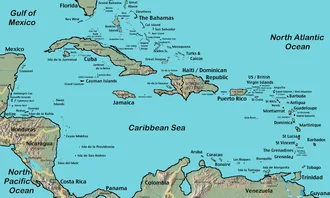
The Antillean islands are divided into two smaller archipelagos: the Greater Antilles and the Lesser Antilles. The Greater Antilles include the Cayman Islands and larger islands of Cuba, Hispaniola (subdivided into the nations of the Dominican Republic and Haiti), Navassa Island, Jamaica, and Puerto Rico. The Lesser Antilles contains the northerly Leeward Islands and the southeasterly Windward Islands, as well as the Leeward Antilles immediately north of Venezuela.
The Lucayan Archipelago, consisting of The Bahamas and the Turks and Caicos Islands, though a part of the West Indies, is generally not included among the Antillean islands.
Geographically, the Antillean islands are generally considered a subregion of North America. Culturally speaking, Cuba, the Dominican Republic, and Puerto Rico – and sometimes the whole of the Antilles – are included in Latin America, although some sources use the phrase "Latin America and the Caribbean" instead.
In terms of geology, the Greater Antilles are mostly made up of continental rock accreted on the North American Plate from relative movement of the Caribbean Plate. The Lesser Antilles are mostly young volcanic islands created by the Lesser Antilles subduction zone.
Background
The word Antilles originated in the period before the European colonization of the Americas, Antilia depicted on many medieval charts, sometimes as an archipelago, sometimes as continuous land of greater or lesser extent, its location fluctuating in mid-ocean between the Canary Islands and India.
After the 1492 arrival of Christopher Columbus's expedition in what was later called the West Indies, the European powers realized that the dispersed lands constituted an extensive archipelago in the Caribbean Sea and the Gulf of Mexico. The Antilles were called multiple names before their current name became the norm.
Early Spanish visitors called them the Windward Islands (today having a narrower definition). They were also called the Forward Islands by 18th-century British. Thereafter, the term Antilles was commonly assigned to the formation, and "Sea of the Antilles" became a common alternative name for the Caribbean Sea in various European languages.[citation needed]
Countries and territories by subregion and archipelago
Lucayan Archipelago
 The Bahamas
 Turks and Caicos Islands (United Kingdom)
Greater Antilles
 Cayman Islands (United Kingdom)
 Cuba
Cuba
- Isle of Youth
- Hispaniola
 Haiti
Haiti Dominican Republic
 Jamaica
 Puerto Rico (United States)
Lesser Antilles
Leeward Antilles
 Aruba (Kingdom of the Netherlands)
 Bonaire (Netherlands)
 Curaçao (Kingdom of the Netherlands)
 Federal Dependencies of Venezuela
- Aves Island
- Los Monjes Archipelago
- La Tortuga Island
- La Sola Island
- Los Testigos Islands
- Los Frailes Islands
- Patos Island
- Los Roques Archipelago
- Blanquilla Island
- Los Hermanos Archipelago
- Orchila Island
- Las Aves Archipelago
 Nueva Esparta (Venezuela)
- Margarita Island
- Coche
- Cubagua
Leeward Islands
 Anguilla (United Kingdom)
 Antigua and Barbuda
- Antigua
- Barbuda
- Redonda
 British Virgin Islands (United Kingdom)
 Guadeloupe (France)
- La Désirade
- Les Saintes
- Marie-Galante
 Montserrat (United Kingdom)
 Saba (Netherlands)
 Saint Barthélemy (France)
- Saint Martin
 Saint Martin (France)
 Sint Maarten (Kingdom of the Netherlands)
 Saint Kitts and Nevis
- Saint Kitts
- Nevis
 Sint Eustatius (Netherlands)
- Spanish Virgin Islands (Puerto Rico)
 United States Virgin Islands (United States)
- Saint Croix
- Saint Thomas
- Saint John
Windward Islands
 Dominica
 Grenada
 Martinique (France)
 Saint Lucia
 Saint Vincent and the Grenadines
Other islands
 Barbados
 Trinidad and Tobago
- Tobago
- Trinidad