The practice of architecture itself, which began in the prehistoric era, has been used as a way of expressing culture by civilizations on all seven continents. For this reason, architecture is considered to be a form of art. Texts on architecture have been written since ancient times. The earliest surviving text on architectural theories is the 1st century BC treatise De architectura by the Roman architect Vitruvius, according to whom a good building embodies firmitas, utilitas, and venustas (durability, utility, and beauty).
Centuries later, Leon Battista Alberti developed his ideas further, seeing beauty as an objective quality of buildings to be found in their proportions. In the 19th century, Louis Sullivan declared that "form follows function". "Function" began to replace the classical "utility" and was understood to include not only practical but also aesthetic, psychological, and cultural dimensions. The idea of sustainable architecture was introduced in the late 20th century.
Architecture began as rural, oral vernacular architecture that developed from trial and error to successful replication. Ancient urban architecture was preoccupied with building religious structures and buildings symbolizing the political power of rulers until Greek and Roman architecture shifted focus to civic virtues.
Indian and Chinese architecture influenced forms all over Asia and Buddhist architecture in particular took diverse local flavors. During the Middle Ages, pan-European styles of Romanesque and Gothic cathedrals and abbeys emerged while the Renaissance favored Classical forms implemented by architects known by name. Later, the roles of architects and engineers became separated.
Modern architecture began after World War I as an avant-garde movement that sought to develop a completely new style appropriate for a new post-war social and economic order focused on meeting the needs of the middle and working classes. Emphasis was put on modern techniques, materials, and simplified geometric forms, paving the way for high-rise superstructures.
Many architects became disillusioned with modernism which they perceived as ahistorical and anti-aesthetic, and postmodern and contemporary architecture developed. Over the years, the field of architectural construction has branched out to include everything from ship design to interior decorating.
Definitions
Architecture can mean:
- A general term to describe buildings and other physical structures.
- The art and science of designing buildings and (some) nonbuilding structures; sometimes called "architectonics."
- The style of design and method of construction of buildings and other physical structures.
- A unifying or coherent form or structure.
- The knowledge of art, science, technology, and humanity.
- The design activity of the architect, from the macro-level (urban design, landscape architecture) to the micro-level (construction details and furniture).
- The practice of the architect where architecture means offering or rendering professional services in connection with the design and construction of buildings or built environments.
Theory
The philosophy of architecture is a branch of the philosophy of art, dealing with aesthetic value of architecture, its semantics and its relation to the development of culture. Many philosophers and theoreticians from Plato to Michel Foucault, Gilles Deleuze, Robert Venturi and Ludwig Wittgenstein have concerned themselves with the nature of architecture and whether or not architecture is distinguished from building.
Historic treatises
The earliest surviving written work on the subject of architecture is De architectura by the Roman architect Vitruvius in the early 1st century BC. According to Vitruvius, a good building should satisfy the three principles of firmitas, utilitas, venustas, commonly known by the original translation – firmness, commodity and delight. An equivalent in modern English would be:
- Durability – a building should stand up robustly and remain in good condition
- Utility – it should be suitable for the purposes for which it is used
- Beauty – it should be aesthetically pleasing
According to Vitruvius, the architect should strive to fulfill each of these three attributes as well as possible. Leon Battista Alberti, who elaborates on the ideas of Vitruvius in his treatise, De re aedificatoria, saw beauty primarily as a matter of proportion, although ornament also played a part. For Alberti, the rules of proportion were those that governed the idealized human figure, the golden mean.
The most important aspect of beauty was, therefore, an inherent part of an object, rather than something applied superficially, and was based on universal, recognizable truths. The notion of style in the arts was not developed until the 16th century, with the writing of Giorgio Vasari. By the 18th century, his Lives of the Most Excellent Painters, Sculptors, and Architects had been translated into Italian, French, Spanish, and English.
In the 16th century, Italian Mannerist architect, painter and theorist Sebastiano Serlio wrote Tutte L'Opere D'Architettura et Prospetiva (Complete Works on Architecture and Perspective). This treatise exerted immense influence throughout Europe, being the first handbook that emphasized the practical rather than the theoretical aspects of architecture, and it was the first to catalog the five orders.
In the early 19th century, Augustus Welby Northmore Pugin wrote Contrasts (1836) that, as the title suggested, contrasted the modern, industrial world, which he disparaged, with an idealized image of neo-medieval world. Gothic architecture, Pugin believed, was the only "true Christian form of architecture." The 19th-century English art critic, John Ruskin, in his Seven Lamps of Architecture, published 1849, was much narrower in his view of what constituted architecture.
Architecture was the "art which so disposes and adorns the edifices raised by men ... that the sight of them" contributes "to his mental health, power, and pleasure". For Ruskin, the aesthetic was of overriding significance. His work goes on to state that a building is not truly a work of architecture unless it is in some way "adorned".
For Ruskin, a well-constructed, well-proportioned, functional building needed string courses or rustication, at the very least.
On the difference between the ideals of architecture and mere construction, the 20th-century architect Le Corbusier wrote: "You employ stone, wood, and concrete, and with these materials you build houses and palaces: that is construction. Ingenuity is at work. But suddenly you touch my heart, you do me good.
I am happy and I say: This is beautiful. That is Architecture". Le Corbusier's contemporary Ludwig Mies van der Rohe is said to have stated in a 1959 interview that "architecture starts when you carefully put two bricks together. There it begins."
Modern concepts
The notable 19th-century architect of skyscrapers, Louis Sullivan, promoted an overriding precept to architectural design: "Form follows function". While the notion that structural and aesthetic considerations should be entirely subject to functionality was met with both popularity and skepticism, it introduced the concept of "function" in place of Vitruvius' "utility". "Function" came to be seen as encompassing all criteria of the use, perception and enjoyment of a building, not only practical but also aesthetic, psychological and cultural.
Nunzia Rondanini stated, "Through its aesthetic dimension architecture goes beyond the functional aspects that it has in common with other human sciences. Through its own particular way of expressing values, architecture can stimulate and influence social life without presuming that, in and of itself, it will promote social development....
To restrict the meaning of (architectural) formalism to art for art's sake is not only reactionary; it can also be a purposeless quest for perfection or originality which degrades form into a mere instrumentality".
The aesthetics of architecture remain a contested topic. Differences in aesthetic preferences between architects and the public were found. Studies generally find that there is a strong public preference for traditional and classical architectural styles over modernist designs. James Stevens Curl argues that modernist architects often favour designs that are alienating and environmentally damaging.
Léon Krier frames the dominance of traditional styles in private architecture as an "overwhelming democratic reality," contrasting with the prevalence of modernist designs in public commissions.
Among the philosophies that have influenced modern architects and their approach to building design are Rationalism, Empiricism, Structuralism, Poststructuralism, Deconstruction[citation needed] and Phenomenology.
In the late 20th century a new concept was added to those included in the compass of both structure and function, the consideration of sustainability, hence sustainable architecture. To satisfy the contemporary ethos, a building should be constructed in a manner which is environmentally friendly in terms of the production of its materials, its impact upon the natural and built environment of its surrounding area and the demands that it makes upon the natural environment for heating, ventilation and cooling, water use, waste products and lighting.
History
Origins and vernacular architecture
Building first evolved out of the dynamics between needs (e.g. shelter, security, and worship) and means (available building materials and attendant skills). As human cultures developed and knowledge began to be formalized through oral traditions and practices, building became a craft, and architecture became the term used to describe the highly formalized and respected aspects of the craft.
It is widely assumed[citation needed] that architectural success was achieved through trial and error, with progressively less trial and more replication as results became satisfactory over time.
However, vernacular architecture, in essence a rudimentary, non-academic form of building construction based on cultural traditions, continues to be produced in many parts of the world.
Prehistoric architecture
Early human settlements were mostly rural. Expanding economies resulted in the creation of proto-cities or urban areas, which in some cases grew and evolved very rapidly, such as Çatalhöyük in modern-day Turkey and Mohenjo-daro in modern-day Pakistan.
Neolithic archaeological sites include Göbekli Tepe and Çatalhöyük in Turkey, Jericho in the Levant, Mehrgarh in Pakistan, Skara Brae in Orkney, and Cucuteni-Trypillian culture settlements in Romania, Moldova and Ukraine.
Classical era
In many ancient civilizations, such as those of Egypt and Mesopotamia, architecture and urbanism reflected the constant engagement with the divine and the supernatural, and many ancient cultures resorted to monumentality in their architecture to symbolically represent the political power of the ruler or the state itself.
In Egypt, the education of state architects was closely linked to the priestly class, and trade secrets were passed from father to son. Plans were drawn and then implemented using the ruler, square, and triangle.
The architecture and urbanism of classical civilizations such as the Greek and Roman civilizations evolved from civic ideals rather than religious or empirical ones. New building types emerged and architectural style developed in the form of the classical orders. Roman architecture was influenced by Greek architecture as they incorporated many Greek elements into their building practices.
Texts on architecture have been written since ancient times—these texts provided both general advice and specific formal prescriptions or canons. Some examples of canons are found in the writings of Vitruvius in the 1st century BC. Some of the most important early examples of canonic architecture are religious.
Asian architecture
Asian architecture developed differently from European architecture, and the Buddhist, Hindu and Sikh architectural styles have different characteristics. Unlike Indian and Chinese architecture, which had great influence on the surrounding regions, Japanese architecture did not. Some Asian architecture showed great regional diversity, in particular Buddhist architecture.
Moreover, another architectural achievement in Asia is the Hindu temple architecture, which developed from around the 5th century CE. It is, in theory, governed by concepts laid down in the Shastras, and is concerned with expressing both the macrocosm and the microcosm.
In many Asian countries, pantheistic religion led to architectural forms that were designed specifically to enhance the natural landscape. Also, the grandest houses were relatively lightweight structures mainly using wood until recent times, and there are few survivals of great age. Buddhism was associated with a move to stone and brick religious structures, probably beginning as rock-cut architecture, which has often survived very well.
Early Asian writings on architecture include the Kao Gong Ji of China from the 7th–5th centuries BC, the Shilpa Shastras of ancient India, Manjusri Vasthu Vidya Sastra of Sri Lanka, and Araniko of Nepal.
African Architecture
The Architecture of Africa is very diverse, reflecting the continent's many climates, cultures, and histories. Traditional African architecture mixes building traditions, using a wide arrange of materials like mud, stone, and wood. Fractal scaling is commonly used in designs, making smaller parts of a structure mirror the overall design. This concept can be seen in village layouts and decorative elements.
Historical stone structures like the great Zimbabwe walls show the long lasting and durable construction. Wattle and Daub is a technique used in many areas that take wooden frames covered in mud to create rounded structures that help to regulate the temperature inside. Architecture in West Africa such as Porto-Novo in Benin, Lagos Island and Zaria in Nigeria and Dakar in Senegal is dominated by the Sudano-Sahelian, Afro-modernist designs and Sobrado styles. This is a form of multi-storied, Portuguese-Brazilian baroque architecture.
These buildings are suited for dry, hot climates, as they often have central or rear courtyard, stuccoed façades, symmetrical layouts, tiled roofs for heat insulation, and prominent balconies. Along the Swahili Coast of East Africa many homes are made out of coral stone with mangrove pole roofs. The architecture is a mix of local, Arabic and Islamic styles due to trade across the Indian Ocean.
Ethiopia also has stunning architectural traditions like the rock-hewn churches like the 13th century churches of Lalibela which were carved directly into the ground. Together, these styles highlight the creativity, adaptability, and cultural depth of African architectural traditions.
Islamic architecture
Islamic architecture began in the 7th century, incorporating architectural forms from the ancient Middle East and Byzantium, but also developing features to suit the religious and social needs of the society. Examples can be found throughout the Middle East, Africa, Iberian Peninsula, the Mediterranean islands, the Indian Sub-continent and later in Eastern parts of Europe, such as the Balkan States, as the result of the expansion of the Ottoman Empire.
European medieval architecture
In Europe during the Medieval period, guilds were formed by craftsmen to organize their trades and written contracts have survived, particularly in relation to ecclesiastical buildings. The role of architect was usually one with that of master mason, or Magister lathomorum as they are sometimes described in contemporary documents.
The major architectural undertakings were the building of abbeys and cathedrals. From about 900 onward, the movements of both clerics and tradesmen carried architectural knowledge across Europe, resulting in the pan-European styles Romanesque and Gothic.
A significant part of the Middle Ages architectural heritage is numerous fortifications across the continent. From the Balkans to Spain, and from Malta to Estonia, these buildings represent an important part of European heritage.
Renaissance architecture
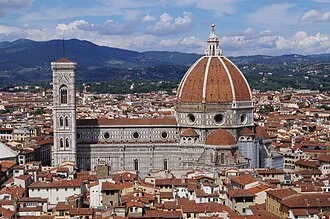
In Renaissance Europe, from about 1400 onwards, there was a revival of Classical learning accompanied by the development of Renaissance humanism, which placed greater emphasis on the role of the individual in society than had been the case during the Medieval period. Buildings were ascribed to specific architects – Brunelleschi, Alberti, Michelangelo, Palladio – and the cult of the individual had begun.
There was still no dividing line between artist, architect, engineer, or any of the related vocations, and the appellation was often one of regional preference.
A revival of the Classical style in architecture was accompanied by a burgeoning of science and engineering, which affected the proportions and structure of buildings. At this stage, it was still possible for an artist to design a bridge as the level of structural calculations involved was within the scope of the generalist.
Early modern and the industrial age
With the emerging knowledge in scientific fields and the rise of new materials and technology, architecture and engineering began to separate, and the architect began to concentrate on aesthetics and the humanist aspects, often at the expense of technical aspects of building design. There was also the rise of the "gentleman architect" who usually dealt with wealthy clients and concentrated predominantly on visual qualities derived usually from historical prototypes, typified by the many country houses of Great Britain that were created in the Neo Gothic or Scottish baronial styles.
Formal architectural training in the 19th century, for example, at École des Beaux-Arts in France, gave much emphasis to the production of beautiful drawings and little to context and feasibility.
Meanwhile, the Industrial Revolution laid open the door for mass production and consumption. Aesthetics became a criterion for the middle class as ornamented products, once within the province of expensive craftsmanship, became cheaper under machine production.
Vernacular architecture became increasingly ornamental. Housebuilders could use current architectural design in their work by combining features found in pattern books and architectural journals.
Modernism
Around the beginning of the 20th century, general dissatisfaction with the emphasis on revivalist architecture and elaborate decoration gave rise to many new lines of thought that served as precursors to Modern architecture. Notable among these is the Deutscher Werkbund, formed in 1907 to produce better quality machine-made objects.
The rise of the profession of industrial design is usually placed here. Following this lead, the Bauhaus school, founded in Weimar, Germany in 1919, redefined the architectural bounds prior set throughout history, viewing the creation of a building as the ultimate synthesis – the apex – of art, craft, and technology.