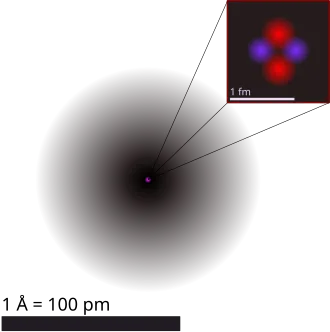
Atoms are extremely small, typically around 100 picometers across. A human hair is about a million carbon atoms wide. Atoms are smaller than the shortest wavelength of visible light, which means humans cannot see atoms with conventional microscopes. They are so small that accurately predicting their behavior using classical physics is not possible due to quantum effects.
More than 99.94% of an atom's mass is in the nucleus. Protons have a positive electric charge and neutrons have no charge, so the nucleus is positively charged. The electrons are negatively charged, and this opposing charge is what binds them to the nucleus. If the numbers of protons and electrons are equal, as they normally are, then the atom is electrically neutral as a whole.
A charged atom is called an ion. If an atom has more electrons than protons, then it has an overall negative charge and is called a negative ion (or anion). Conversely, if it has more protons than electrons, it has a positive charge and is called a positive ion (or cation).
The electrons of an atom are attracted to the protons in an atomic nucleus by the electromagnetic force. The protons and neutrons in the nucleus are attracted to each other by the nuclear force. This force is usually stronger than the electromagnetic force that repels the positively charged protons from one another. Under certain circumstances, the repelling electromagnetic force becomes stronger than the nuclear force. In this case, the nucleus splits and leaves behind different elements. This is a form of nuclear decay.
Atoms can attach to one or more other atoms by chemical bonds to form chemical compounds such as molecules or crystals. The ability of atoms to attach and detach from each other is responsible for most of the physical changes observed in nature. Chemistry is the science that studies these changes.
History of atomic theory
The word atom is derived from the ancient Greek word Atomos, which means "uncuttable". However, this ancient idea was based in philosophical reasoning rather than scientific reasoning. Modern atomic theory is not based on these old concepts. In the early 19th century, the scientist John Dalton found evidence that matter really is composed of discrete units, and so applied the word atom to those units.
Philosophy
The basic idea that matter is made up of tiny indivisible particles is an idea that appeared in many ancient cultures. These ancient ideas were based on philosophical reasoning rather than scientific evidence, and modern atomic theory is not based on these old concepts. That said, the word atom is derived from the term atomos ("uncuttable") used by the Greek philosophers Leucippus and his pupil Democritus, who developed this idea in the 5th century BC.
Dalton's law of multiple proportions
In the early 1800s, John Dalton compiled experimental data gathered by him and other scientists and discovered a pattern now known as the "law of multiple proportions". He noticed that in any group of chemical compounds which all contain two particular chemical elements, the amount of Element A per measure of Element B will differ across these compounds by ratios of small whole numbers.
This pattern suggested that each element combines with other elements in multiples of a basic unit of weight, with each element having a unit of unique weight. Dalton decided to call these units "atoms".
For example, there are two types of tin oxide: one is a grey powder that is 88.1% tin and 11.9% oxygen, and the other is a white powder that is 78.7% tin and 21.3% oxygen. Adjusting these figures, in the grey powder there is about 13.5 g of oxygen for every 100 g of tin, and in the white powder there is about 27 g of oxygen for every 100 g of tin. 13.5 and 27 form a ratio of 1:2.
Dalton concluded that in the grey oxide there is one atom of oxygen for every atom of tin, and in the white oxide there are two atoms of oxygen for every atom of tin (SnO and SnO2).
Dalton also analyzed iron oxides. There is one type of iron oxide that is a black powder which is 78.1% iron and 21.9% oxygen; and there is another iron oxide that is a red powder which is 70.4% iron and 29.6% oxygen. Adjusting these figures, in the black powder there is about 28 g of oxygen for every 100 g of iron, and in the red powder there is about 42 g of oxygen for every 100 g of iron. 28 and 42 form a ratio of 2:3.
Dalton concluded that in these oxides, for every two atoms of iron, there are two or three atoms of oxygen respectively. These substances are known today as iron(II) oxide and iron(III) oxide, and their formulas are FeO and Fe2O3 respectively. Iron(II) oxide's formula is normally written as FeO, but since it is a crystalline substance we could alternately write it as Fe2O2, and when we contrast that with Fe2O3, the 2:3 ratio for the oxygen is plain to see.
As a final example: nitrous oxide is 63.3% nitrogen and 36.7% oxygen, nitric oxide is 44.05% nitrogen and 55.95% oxygen, and nitrogen dioxide is 29.5% nitrogen and 70.5% oxygen. Adjusting these figures, in nitrous oxide there is 80 g of oxygen for every 140 g of nitrogen, in nitric oxide there is about 160 g of oxygen for every 140 g of nitrogen, and in nitrogen dioxide there is 320 g of oxygen for every 140 g of nitrogen. 80, 160, and 320 form a ratio of 1:2:4. The respective formulas for these oxides are N2O, NO, and NO2.
Discovery of the electron
In 1897, J. J. Thomson discovered that cathode rays can be deflected by electric and magnetic fields, which meant that cathode rays are not a form of light but made of electrically charged particles, and their charge was negative given the direction the particles were deflected in. He measured these particles to be 1,700 times lighter than hydrogen (the lightest atom).
He called these new particles corpuscles but they were later renamed electrons since these are the particles that carry electricity. Thomson also showed that electrons were identical to particles given off by photoelectric and radioactive materials. Thomson explained that an electric current is the passing of electrons from one atom to the next, and when there was no current the electrons embedded themselves in the atoms.
This in turn meant that atoms were not indivisible as scientists thought. The atom was composed of electrons whose negative charge was balanced out by some source of positive charge to create an electrically neutral atom. Ions, Thomson explained, must be atoms which have an excess or shortage of electrons.
Discovery of the nucleus
The electrons in the atom logically had to be balanced out by a commensurate amount of positive charge, but Thomson had no idea where this positive charge came from, so he tentatively proposed that it was everywhere in the atom, the atom being in the shape of a sphere. This was the mathematically simplest hypothesis to fit the available evidence, or lack thereof.
Following from this, Thomson imagined that the balance of electrostatic forces would distribute the electrons throughout the sphere in a more or less even manner. Thomson's model is popularly known as the plum pudding model, though neither Thomson nor his colleagues used this analogy. Thomson's model was incomplete, it was unable to predict any other properties of the elements such as emission spectra and valencies. It was soon rendered obsolete by the discovery of the atomic nucleus.
Between 1908 and 1913, Ernest Rutherford and his colleagues Hans Geiger and Ernest Marsden performed a series of experiments in which they bombarded thin foils of metal with a beam of alpha particles. They did this to measure the scattering patterns of the alpha particles. They spotted a small number of alpha particles being deflected by angles greater than 90°.
This shouldn't have been possible according to the Thomson model of the atom, whose charges were too diffuse to produce a sufficiently strong electric field. The deflections should have all been negligible. Rutherford proposed that the positive charge of the atom is concentrated in a tiny volume at the center of the atom and that the electrons surround this nucleus in a diffuse cloud.
This nucleus carried almost all of the atom's mass. Only such an intense concentration of charge, anchored by its high mass, could produce an electric field that could deflect the alpha particles so strongly.
Bohr model
A problem in classical mechanics is that an accelerating charged particle radiates electromagnetic radiation, causing the particle to lose kinetic energy. Circular motion counts as acceleration, which means that an electron orbiting a central charge should spiral down into that nucleus as it loses speed. In 1913, the physicist Niels Bohr proposed a new model in which the electrons of an atom were assumed to orbit the nucleus but could only do so in a finite set of orbits, and could jump between these orbits only in discrete changes of energy corresponding to absorption or radiation of a photon.
This quantization was used to explain why the electrons' orbits are stable and why elements absorb and emit electromagnetic radiation in discrete spectra. Bohr's model could only predict the emission spectra of hydrogen, not atoms with more than one electron.
Discovery of protons and neutrons
Back in 1815, William Prout observed that the atomic weights of many elements were multiples of hydrogen's atomic weight, which is in fact true for all of them if one takes isotopes into account. In 1898, J. J. Thomson found that the positive charge of a hydrogen ion is equal to the negative charge of an electron, and these were then the smallest known charged particles.
Thomson later found that the positive charge in an atom is a positive multiple of an electron's negative charge. In 1913, Henry Moseley discovered that the frequencies of X-ray emissions from an excited atom were a mathematical function of its atomic number and hydrogen's nuclear charge. In 1919, Rutherford bombarded nitrogen gas with alpha particles and detected hydrogen ions being emitted from the gas, and concluded that they were produced by alpha particles hitting and splitting the nuclei of the nitrogen atoms.
These observations led Rutherford to conclude that the hydrogen nucleus is a singular particle with a positive charge equal to the electron's negative charge. He named this particle "proton" in 1920. The number of protons in an atom (which Rutherford called the "atomic number") was found to be equal to the element's ordinal number on the periodic table and therefore provided a simple and clear-cut way of distinguishing the elements from each other.
The atomic weight of each element is higher than its proton number, so Rutherford hypothesized that the surplus weight was carried by unknown particles with no electric charge and a mass equal to that of the proton.
In 1928, Walter Bothe observed that beryllium emitted a highly penetrating, electrically neutral radiation when bombarded with alpha particles. It was later discovered that this radiation could knock hydrogen atoms out of paraffin wax. Initially it was thought to be high-energy gamma radiation, since gamma radiation had a similar effect on electrons in metals, but James Chadwick found that the ionization effect was too strong for it to be due to electromagnetic radiation, so long as energy and momentum were conserved in the interaction.
In 1932, Chadwick exposed various elements, such as hydrogen and nitrogen, to the mysterious "beryllium radiation", and by measuring the energies of the recoiling charged particles, he deduced that the radiation was actually composed of electrically neutral particles which could not be massless like the gamma ray, but instead were required to have a mass similar to that of a proton. Chadwick now claimed these particles as Rutherford's neutrons.
The current consensus model
In 1925, Werner Heisenberg published the first consistent mathematical formulation of quantum mechanics (matrix mechanics). One year earlier, Louis de Broglie had proposed that all particles behave like waves to some extent, and in 1926 Erwin Schrödinger used this idea to develop the Schrödinger equation, which describes electrons as three-dimensional waveforms rather than points in space.
A consequence of using waveforms to describe particles is that it is mathematically impossible to obtain precise values for both the position and momentum of a particle at a given point in time. This became known as the uncertainty principle, formulated by Werner Heisenberg in 1927. In this concept, for a given accuracy in measuring a position one could only obtain a range of probable values for momentum, and vice versa.
Thus, the planetary model of the atom was discarded in favor of one that described atomic orbital zones around the nucleus where a given electron is most likely to be found. This model was able to explain observations of atomic behavior that previous models could not, such as certain structural and spectral patterns of atoms larger than hydrogen.
Structure
Subatomic particles
Though the word atom originally denoted a particle that cannot be cut into smaller particles, in modern scientific usage the atom is composed of various subatomic particles. The constituent particles of an atom are the electron, the proton, and the neutron.
The electron is the least massive of these particles by four orders of magnitude at 9.11×10⁻³¹ kg, with a negative electrical charge and a size that is too small to be measured using available techniques.
It was the lightest particle with a positive rest mass measured, until the discovery of neutrino mass. Under ordinary conditions, electrons are bound to the positively charged nucleus by the attraction created from opposite electric charges. Electrons have been known since the late 19th century, mostly thanks to J.J. Thomson; see history of subatomic physics for details.
Protons have a positive charge and a mass of 1.6726×10⁻²⁷ kg. The number of protons in an atom is called its atomic number. Ernest Rutherford (1919) observed that nitrogen under alpha-particle bombardment ejects what appeared to be hydrogen nuclei. By 1920, he had accepted that the hydrogen nucleus is a distinct particle within the atom and named it proton.
Neutrons have no electrical charge and have a mass of 1.6749×10⁻²⁷ kg. Neutrons are the heaviest of the three constituent particles, but their mass can be reduced by the nuclear binding energy.
Neutrons and protons (collectively known as nucleons) have comparable dimensions—on the order of 2.5×10⁻¹⁵ m—although the 'surface' of these particles is not sharply defined. The neutron was discovered in 1932 by the English physicist James Chadwick.
In the Standard Model of physics, electrons are truly elementary particles with no internal structure, whereas protons and neutrons are composite particles composed of elementary particles called quarks. There are two types of quarks in atoms, each having a fractional electric charge. Protons are composed of two up quarks (each with charge +2/3) and one down quark (with a charge of −1/3).
Neutrons consist of one up quark and two down quarks. This distinction accounts for the difference in mass and charge between the two particles.
The quarks are held together by the strong interaction (or strong force), which is mediated by gluons. The protons and neutrons, in turn, are held to each other in the nucleus by the nuclear force, which is a residuum of the strong force that has somewhat different range-properties (see the article on the nuclear force for more). The gluon is a member of the family of gauge bosons, which are elementary particles that mediate physical forces.
Nucleus
All the bound protons and neutrons in an atom make up a tiny atomic nucleus, and are collectively called nucleons. The radius of a nucleus ranges from 2 to 7 femtometres starting with hydrogen and ending with uranium. The radius scale with where is the total number of nucleons.
![{\displaystyle {\sqrt[{3}]{A}}}](https://wikimedia.org/api/rest_v1/media/math/render/svg/1fca955055dc8a4677a1b5e293d527561c2f9fff)

This is much smaller than the radius of the atom, which is on the order of 105 fm. The nucleons are bound together by a short-ranged attractive potential called the residual strong force. At distances smaller than 2.5 fm this force is much more powerful than the electrostatic force that causes positively charged protons to repel each other.
Atoms of the same element have the same number of protons, called the atomic number. Within a single element, the number of neutrons may vary, determining the isotope of that element. The total number of protons and neutrons determine the nuclide. The number of neutrons relative to the protons determines the stability of the nucleus, with certain isotopes undergoing radioactive decay.
The proton, the electron, and the neutron are classified as fermions. Fermions obey the Pauli exclusion principle which prohibits identical fermions, such as multiple protons, from occupying the same quantum state at the same time. Thus, every proton in the nucleus must occupy a quantum state different from all other protons, and the same applies to all neutrons of the nucleus and to all electrons of the electron cloud.
A nucleus that has a different number of protons than neutrons can potentially drop to a lower energy state through a radioactive decay that causes the number of protons and neutrons to more closely match. As a result, atoms with matching numbers of protons and neutrons are more stable against decay, but with increasing atomic number, the mutual repulsion of the protons requires an increasing proportion of neutrons to maintain the stability of the nucleus.
The number of protons and neutrons in the atomic nucleus can be modified, although this can require very high energies because of the strong force. Nuclear fusion occurs when multiple atomic particles join to form a heavier nucleus, such as through the energetic collision of two nuclei. For example, at the core of the Sun protons require energies of 3 to 10 keV to overcome their mutual repulsion—the coulomb barrier—and fuse together into a single nucleus.
Nuclear fission is the opposite process, causing a nucleus to split into two smaller nuclei—usually through radioactive decay. The nucleus can also be modified through bombardment by high energy subatomic particles or photons. If this modifies the number of protons in a nucleus, the atom changes to a different chemical element.
If the mass of the nucleus following a fusion reaction is less than the sum of the masses of the separate particles, then the difference between these two values can be emitted as a type of usable energy (such as a gamma ray, or the kinetic energy of a beta particle), as described by Albert Einstein's mass–energy equivalence formula, E = mc2, where m is the mass loss and c is the speed of light. This deficit is part of the binding energy of the new nucleus, and it is the non-recoverable loss of the energy that causes the fused particles to remain together in a state that requires this energy to separate.
The fusion of two nuclei that create larger nuclei with lower atomic numbers than iron and nickel—a total nucleon number of about 60—is usually an exothermic process that releases more energy than is required to bring them together. It is this energy-releasing process that makes nuclear fusion in stars a self-sustaining reaction.
For heavier nuclei, the binding energy per nucleon begins to decrease. That means that a fusion process producing a nucleus that has an atomic number higher than about 26, and a mass number higher than about 60, is an endothermic process. Thus, more massive nuclei cannot undergo an energy-producing fusion reaction that can sustain the hydrostatic equilibrium of a star.
Electron cloud
The electrons in an atom are attracted to the protons in the nucleus by the electromagnetic force. This force binds the electrons inside an electrostatic potential well surrounding the smaller nucleus, which means that an external source of energy is needed for the electron to escape. The closer an electron is to the nucleus, the greater the attractive force.
Hence electrons bound near the center of the potential well require more energy to escape than those at greater separations.
Electrons, like other particles, have properties of both a particle and a wave. The electron cloud is a region inside the potential well where each electron forms a type of three-dimensional standing wave—a wave form that does not move relative to the nucleus. This behavior is defined by an atomic orbital, a mathematical function that characterises the probability that an electron appears to be at a particular location when its position is measured.
Only a discrete (or quantized) set of these orbitals exist around the nucleus, as other possible wave patterns rapidly decay into a more stable form. Orbitals can have one or more ring or node structures, and differ from each other in size, shape and orientation.
Each atomic orbital corresponds to a particular energy level of the electron. The electron can change its state to a higher energy level by absorbing a photon with sufficient energy to boost it into the new quantum state. Likewise, through spontaneous emission, an electron in a higher energy state can drop to a lower energy state while radiating the excess energy as a photon.
These characteristic energy values, defined by the differences in the energies of the quantum states, are responsible for atomic spectral lines.