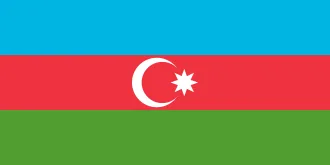
The territory of what is now Azerbaijan was ruled first by Caucasian Albania and later by various Persian empires. Until the 19th century, it remained part of Qajar Iran, but the Russo-Persian wars of 1804–1813 and 1826–1828 forced the Qajar Empire to cede its Caucasian territories to the Russian Empire; the treaties of Gulistan in 1813 and Turkmenchay in 1828 defined the border between Russia and Iran.
The region north of the Aras was part of Iran until it was conquered by Russia in the 19th century, where it was administered as part of the Caucasus Viceroyalty.
By the late 19th century, an Azerbaijani national identity emerged, and the Azerbaijan Democratic Republic proclaimed its independence from the Transcaucasian Democratic Federative Republic in 1918, a year after the Russian Empire collapsed, and became the first secular democratic Muslim-majority state in the world. In 1920, the country was conquered and incorporated into the Soviet Union as the Azerbaijan SSR.
The modern Republic of Azerbaijan proclaimed its independence on 30 August 1991, shortly before the dissolution of the Soviet Union. In September 1991, the ethnic Armenian majority of the Nagorno-Karabakh region formed the self-proclaimed Republic of Artsakh, which became de facto independent with the end of the First Nagorno-Karabakh War in 1994, although the region and seven surrounding districts remained internationally recognized as part of Azerbaijan.
Following the Second Nagorno-Karabakh War in 2020, the seven districts and parts of Nagorno-Karabakh were returned to Azerbaijani control. An Azerbaijani offensive in 2023 ended the Republic of Artsakh and resulted in the expulsion of Nagorno-Karabakh Armenians.
Azerbaijan is a unitary semi-presidential republic. It is one of six independent Turkic states and an active member of the Organization of Turkic States and the TÜRKSOY community. Azerbaijan has diplomatic relations with 182 countries and holds membership in 38 international organizations, including the United Nations, the Council of Europe, the Non-Aligned Movement, the Organization for Security and Co-operation in Europe (OSCE), and the NATO PfP program.
It is one of the founding members of GUAM, the Commonwealth of Independent States, and the OPCW. Azerbaijan is an observer state of the World Trade Organization.
The vast majority of the country's population (97%) is Muslim. The Constitution of Azerbaijan does not declare an official religion, and all major political forces in the country are secular. Azerbaijan is a developing country and ranks 81st on the Human Development Index. The ruling New Azerbaijan Party, in power since 1993, has been accused of authoritarianism under presidents Heydar Aliyev and his son Ilham Aliyev.
The ruling Aliyev family has been criticized on Azerbaijan's human rights record, including media restrictions and repression of its Shia Muslim population.
Etymology
The term Azerbaijan derives from Atropates, a Persian satrap under the Achaemenid Empire who was reinstated as the satrap of Media under Alexander the Great. The original etymology of this name is thought to have its roots in the once-dominant Zoroastrianism. In the Avesta's Frawardin Yasht ("Hymn to the Guardian Angels"), there is a mention of âterepâtahe ashaonô fravashîm ýazamaide, which translates from Avestan as "we worship the fravashi of the holy Atropatene".
The name "Atropates" is the Greek transliteration of an Old Iranian, probably Median, compounded name with the meaning "Protected by the (Holy) Fire" or "The Land of the (Holy) Fire". The Greek name was mentioned by Diodorus Siculus and Strabo. Over the span of millennia, the name evolved to Āturpātākān (Middle Persian), then to Ādharbādhagān, Ādhorbāygān, Āzarbāydjān (New Persian) and present-day Azerbaijan.
The name Azerbaijan was first adopted by the government of Musavat in 1918 after the collapse of the Russian Empire, when the independent Azerbaijan Democratic Republic was established. Until then, the designation had been used exclusively to identify the adjacent region of contemporary northwestern Iran, while the area of the Azerbaijan Democratic Republic was formerly referred to as Arran and Shirvan. On that basis Iran protested the newly adopted country name.
During Soviet rule, the country was also spelled in Latin from the Russian transliteration as Azerbaydzhan (Russian: Азербайджа́н). The country's name was also spelled in Cyrillic script from 1940 to 1991 as Азәрбајҹан.
History
Antiquity
The earliest evidence of human settlement in the territory of Azerbaijan dates back to the late Stone Age and is related to the Guruchay culture of Azykh Cave. Early settlements included the Scythians during the 9th century BC. Following the Scythians, Iranian Medes came to dominate the area to the south of the Aras river.
The Medes forged a vast empire between 900 and 700 BC, which was integrated into the Achaemenid Empire around 550 BC. The area was conquered by the Achaemenids leading to the spread of Zoroastrianism.
From the Sasanid period to the Safavid period
The Sasanian Empire turned Caucasian Albania into a vassal state in 252, while King Urnayr officially adopted Christianity as the state religion in the 4th century. Despite Sassanid rule, Caucasian Albania remained an entity in the region until the 9th century, while fully subordinate to Sassanid Iran, and retained its monarchy.
Despite being one of the chief vassals of the Sasanian emperor, the Albanian king had only a semblance of authority, and the Sasanian marzban (military governor) held most civil, religious, and military authority.
In the first half of the 7th century, Caucasian Albania, as a vassal of the Sasanians, came under nominal Muslim rule with the Muslim conquest of Persia. The Umayyad Caliphate repulsed both the Sasanians and Byzantines from the South Caucasus and turned Caucasian Albania into a vassal state after Christian resistance led by King Juansher was suppressed in 667.
The power vacuum left by the decline of the Abbasid Caliphate was filled by numerous local dynasties such as the Sallarids, Sajids, and Shaddadids. At the beginning of the 11th century, the territory was gradually seized by the waves of migrating Oghuz Turks from Central Asia, who adopted a Turkoman ethnonym at the time. The first of these Turkic dynasties established was the Seljuk Empire, which entered the area by 1067.
The pre-Turkic population spoke several Indo-European and Caucasian languages, among them Armenian and an Iranian language, Old Azeri, which was gradually replaced by a Turkic language, the early precursor of the Azerbaijani language of today. Some linguists have also stated that the Tati dialects of Iranian Azerbaijan and the Republic of Azerbaijan, like those spoken by the Tats, are descended from Old Azeri.
Locally, the possessions of the subsequent Seljuk Empire were ruled by Eldiguzids, technically vassals of the Seljuk sultans, but sometimes de facto rulers themselves. Under the Seljuks, local poets such as Nizami Ganjavi and Khaqani gave rise to a blossoming of Persian literature in the region.
Shirvanshahs, the local dynasty of Arabic origin that was later Persianized, became a vassal state of Timurid Empire of Timur and assisted him in his war with the ruler of the Golden Horde Tokhtamysh. Following Timur's death, two independent and rival Turkoman states emerged: Qara Qoyunlu and Aq Qoyunlu. The Shirvanshahs returned, maintaining for numerous centuries to come a high degree of autonomy as local rulers and vassals as they had done since 861.
In 1501, the Safavid dynasty of Iran subdued the Shirvanshahs and gained its possessions. In the course of the next century, the Safavids converted the formerly Sunni population to Shia Islam, as they did with the population in what is modern-day Iran. The Safavids allowed the Shirvanshahs to remain in power under Safavid suzerainty until 1538, when Safavid King Tahmasp I completely deposed them and made the area into the Safavid province of Shirvan.
The Sunni Ottomans briefly managed to occupy present-day Azerbaijan as a result of the Ottoman–Safavid War of 1578–1590; by the early 17th century, they were ousted by Safavid Iranian ruler Abbas I. In the wake of the demise of the Safavid dynasty, Baku and its environs were briefly occupied by the Russians as a consequence of the Russo-Persian War of 1722–1723.
Remainder of present Azerbaijan was occupied by the Ottomans from 1722 to 1736. Despite brief intermissions such as these by Safavid Iran's neighboring rivals, the land remained under Iranian rule from the earliest advent of the Safavids up to the course of the 19th century.
Modern history
After the Safavids, the area was ruled by the Iranian Afsharid dynasty. After the death of Nader Shah in 1747, many of his former subjects capitalized on the eruption of instability. Numerous khanates with various forms of autonomy emerged. The rulers of these khanates were directly related to the ruling dynasties of Iran and were vassals and subjects of the Iranian shah.
The khanates exercised control over their affairs via international trade routes between Central Asia and the West.
Thereafter, the area was under the successive rule of the Iranian Zands and Qajars. From the late 18th century, Imperial Russia switched to a more aggressive geo-political stance towards Iran and the Ottoman Empire. Russia actively tried to gain possession of the Caucasus region which was, for the most part, in the hands of Iran.
In 1804, the Russians invaded and sacked the Iranian town of Ganja, sparking the Russo-Persian War of 1804–1813. The militarily superior Russians ended the war with a victory. Following Qajar Iran's loss, it was forced to concede suzerainty over most of the khanates, along with Georgia and Dagestan to the Russian Empire, per the Treaty of Gulistan.
The area to the north of the Aras River was Iranian territory until Russia occupied it in the 19th century. About a decade later, in violation of the Gulistan treaty, the Russians invaded Iran's Erivan Khanate. This sparked the final bout of hostilities between the two, the Russo-Persian War of 1826–1828. The resulting Treaty of Turkmenchay forced Qajar Iran to cede sovereignty over the Erivan Khanate, the Nakhchivan Khanate and the remainder of the Talysh Khanate.
After the incorporation of all Caucasian territories from Iran into Russia, the border between the two was set at the Aras River.
Despite the Russian conquest, throughout the entire 19th century, preoccupation with Iranian culture, literature, and language remained widespread among Shia and Sunni intellectuals in the Russian-held cities of Baku, Ganja and Tiflis (Tbilisi, now Georgia). Within the same century, in post-Iranian Russian-held East Caucasia, an Azerbaijani national identity emerged at the end of the 19th century.
As a result of the Russian conquest, the Azerbaijanis are nowadays parted between two nations: Iran and Azerbaijan.
After the collapse of the Russian Empire during World War I, the short-lived Transcaucasian Democratic Federative Republic was declared, constituting the present-day republics of Azerbaijan, Georgia, and Armenia. It was followed by the March Days massacres that took place between 30 March and 2 April 1918 in Baku and adjacent areas of the Baku Governorate.
When the republic dissolved in May 1918, the leading Musavat party declared independence as the Azerbaijan Democratic Republic (ADR), adopting the name of "Azerbaijan", a name that prior to the proclamation of the ADR was solely used to refer to the adjacent northwestern region of contemporary Iran. The ADR was the first modern parliamentary republic in the Muslim world.
Among the important accomplishments of the Parliament was the extension of suffrage to women, making ADR the first Muslim nation to grant women equal political rights with men. Baku State University, first modern university founded in the Muslim East, was established during this period.
Independent Azerbaijan lasted only 23 months until the Bolshevik 11th Soviet Red Army invaded it, establishing the Azerbaijan Soviet Socialist Republic on 28 April 1920. Although the bulk of the newly formed Azerbaijani army was engaged in putting down an Armenian revolt that had broken out in Karabakh, Azerbaijanis did not surrender their brief independence of 1918–20 quickly or easily.
As many as 20,000 Azerbaijani soldiers died resisting what was effectively a Russian reconquest. Within the ensuing early Soviet period, the Azerbaijani national identity was forged.
On 13 October 1921, the Soviet republics of Russia, Armenia, Azerbaijan, and Georgia signed an agreement with Turkey known as the Treaty of Kars. The previously independent Republic of Aras would also become the Nakhchivan Autonomous Soviet Socialist Republic within the Azerbaijan SSR by the treaty of Kars. On the other hand, Armenia was awarded the region of Zangezur and Turkey agreed to return Gyumri (then known as Alexandropol).
During World War II, Azerbaijan played a crucial role in the strategic energy policy of the Soviet Union, with 80 percent of the Soviet Union's oil on the Eastern Front being supplied by Baku. By decree of the Supreme Soviet of the Soviet Union in February 1942, the commitment of more than 500 workers and employees of the oil industry of Azerbaijan were awarded orders and medals.
Operation Edelweiss carried out by the German Wehrmacht targeted Baku because of its importance as the energy (petroleum) dynamo of the USSR. A fifth of all Azerbaijanis fought in the Second World War from 1941 to 1945. Approximately 681,000 people (with over 100,000 women) went to the front, while the total population of Azerbaijan was 3.4 million at the time.
Some 250,000 people from Azerbaijan were killed on the front. More than 130 Azerbaijanis were named heroes of the Soviet Union. Azerbaijani Major-General Azi Aslanov was twice awarded the Hero of the Soviet Union.
Independence
Following the politics of glasnost initiated by Mikhail Gorbachev, civil unrest and ethnic strife grew in various regions of the Soviet Union, including Nagorno-Karabakh, an autonomous region of the Azerbaijan SSR. The disturbances in Azerbaijan, in response to Moscow's indifference to an already heated conflict, resulted in calls for independence and secession, which culminated in the Black January events in Baku.
Later in 1990, the Supreme Council of the Azerbaijan SSR dropped the words "Soviet Socialist" from the title, adopted the "Declaration of Sovereignty of the Azerbaijan Republic" and restored the flag of the Azerbaijan Democratic Republic as the state flag. As a consequence of the failed 1991 Soviet coup attempt in Moscow, the Supreme Council of Azerbaijan adopted a Declaration of Independence on 18 October 1991 which was affirmed by a nationwide referendum in December, while the Soviet Union officially ceased to exist on 26 December. The country celebrates its Day of Restoration of Independence on 18 October.
The early years of independence were overshadowed by the First Nagorno-Karabakh war with the ethnic Armenian majority of Nagorno-Karabakh backed by Armenia. By the end of the hostilities in 1994, Armenians controlled 14–16 percent of Azerbaijani territory, including Nagorno-Karabakh. During the war many atrocities and pogroms by both sides were committed including the massacres at Malibeyli, Gushchular and Garadaghly and the Khojaly massacre, along with the Baku pogrom, the Maraga massacre and the Kirovabad pogrom.
Furthermore, an estimated 30,000 people were killed and more than a million people were displaced (more than 800,000 Azerbaijanis and 300,000 Armenians). Four United Nations Security Council resolutions (822, 853, 874, and 884) demand for "the immediate withdrawal of all Armenian forces from all occupied territories of Azerbaijan." Many Russians and Armenians fled Azerbaijan as refugees during the 1990s. According to the 1970 census, there were 510,000 ethnic Russians and 484,000 Armenians in Azerbaijan.
Aliyev family rule, 1993–present
In 1993, democratically elected President Abulfaz Elchibey was overthrown by a military insurrection led by Colonel Surat Huseynov, which resulted in the rise to power of the former leader of Soviet Azerbaijan, Heydar Aliyev. In 1994, Huseynov, by that time the prime minister, attempted another military coup against Heydar Aliyev, but he was arrested and charged with treason.
In 1995 another coup was attempted against Aliyev, this time by the commander of the Russian OMON special police unit, Rovshan Javadov. The coup was averted, resulting in the death of Javadov and disbanding of Azerbaijan's OMON units. At the same time, the country was tainted by rampant corruption in the governing bureaucracy. In October 1998, Aliyev was re-elected for a second term.