The name Albania is derived from the Ancient Greek name Ἀλβανία and Latin Albanía, created from Greek sources that incorrectly translated the Armenian language. The prefix "Caucasian" is used to avoid confusion with Albania in the Balkans, which has no geographical or historical connections to Caucasian Albania.
Little is known of the region's prehistory, including the origins of Caucasian Albania as a geographical and/or ethnolinguistic concept. In the 1st century BC and the 1st century AD, the area south of the Greater Caucasus and north of the Lesser Caucasus was divided between Caucasian Albania in the east, Caucasian Iberia in the center, Colchis in the west, Armenia in the southwest and Atropatene to the southeast.
In 252, Caucasian Albania acknowledged the suzerainty of the Sasanian Empire, appearing among its provinces in Shapur I's inscription at the Ka'ba-ye Zartosht. The kingdom would remain an integral part of the empire until its fall. By the end of the 3rd century, the kings of Caucasian Albania were replaced with an Arsacid family, and would later be succeeded by another Iranian royal family in the 5th century AD, the Mihranids.
Geonyms
Aghuank (Old Armenian: Աղուանք Ałuankʿ, Modern Armenian: Աղվանք Aġvank’) is the Armenian name for Caucasian Albania. Armenian authors mention that the name derived from the word "ału" («աղու») meaning amiable in Armenian. The term Aghuank is polysemous and is also used in Armenian sources to denote the region between the Kur and Araxes rivers as part of Armenia.[better source needed] In the latter case it is sometimes used in the form "Armenian Aghuank" or "Hay-Aghuank".
The Armenian historian of the region, Movses Kaghankatvatsi, who left the only more or less complete historical account about the region, explains the name Aghvank as a derivation from the word ału (Armenian for sweet, soft, tender), which, he said, was the nickname of Caucasian Albania's first governor Arran and referred to his lenient personality.
Movses Kaghankatvatsi and other ancient sources explain Arran or Arhan as the name of the legendary founder of Caucasian Albania (Aghvan) or even of the Iranian tribe known as Alans (Alani), who in some versions was a son of Noah's son Yafet. James Darmesteter, translator of the Avesta, compared Arran with Airyana Vaego which he also considered to have been in the Araxes-Ararat region, although modern theories tend to place this in the east of Iran.
The Parthian name for the region was Ardhan (Middle Persian: Arran). The Arabic was ar-Rān. In Georgian, it was known as რანი (Rani). In Ancient Greek, it was called Ἀλβανία Albanía. What its inhabitants were called is unknown.
Geography
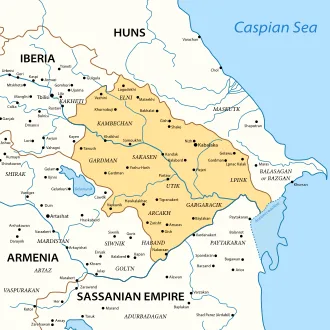
In pre-Islamic times, Caucasian Albania/Arran was a wider concept than that of post-Islamic Arran. Ancient Arran covered all of eastern Transcaucasia, which included most of the territory of the modern-day Azerbaijan Republic and part of the territory of Dagestan. However, in post-Islamic times the geographic notion of Arran reduced to the territory between the Kura and Aras rivers.
Ancient Caucasian Albania lay on the south-eastern part of the Greater Caucasus mountains. It was bounded by Caucasian Iberia (present-day Georgia) to the west, by Sarmatia to the north, by the Caspian Sea to the east, and by the provinces of Artsakh and Utik in Armenia to the west along the Kura river. These boundaries, though, were probably never static—at times the territory of Caucasian Albania included land to the west of the Kura river.
Albania or Arran in Islamic times was a triangle of land, lowland in the east and mountainous in the west, formed by the junction of the Kura and Aras rivers,[dubious – discuss] Mil plain and parts of the Mughan plain, and in the pre-Islamic times, corresponded roughly to the territory of the modern-day Republic of Azerbaijan.
The districts of Albania were:
- Cambysene
- Getaru
- Elni/Xeni
- Begh
- Shake
- Xolmaz
- Kapalak
- Hambasi
- Gelavu
- Hejeri
- Kaladasht
The kingdom's capital in antiquity was Qabala (Gabala; Kapalak).
Classical sources are unanimous in making the Kura River (Cyros) the frontier between Armenia and Albania after the conquest of the territories on the right bank of Kura by Armenians in the 2nd century BC.
The original territory of Albania was approximately 23,000 km2. After 387 AD the territory of Caucasian Albania, sometimes referred to by scholars as "Greater Albania," grew to about 45,000 km2. In the 5th century the capital was transferred to Partav in Utik', reported to have been built in the mid-5th century by the King Vache II of Albania, but according to M. L. Chaumont, it existed earlier as an Armenian city.
In a medieval chronicle "Ajayib-ad-Dunia", written in the 13th century by an unknown author, Arran is said to have been 30 farsakhs (200 km) in width, and 40 farsakhs (270 km) in length. All the right bank of the Kura River until it joined with the Aras was attributed to Arran (the left bank of the Kura was known as Shirvan).
The boundaries of Arran have shifted throughout history, sometimes encompassing the entire territory of the present-day Republic of Azerbaijan, and at other times only parts of the South Caucasus. In some instances, Arran was a part of Armenia.
Medieval Islamic geographers gave descriptions of Arran in general, and of its towns, which included Barda, Beylagan, and Ganja, along with others.
Ethnogenesis
 Azerbaijan portal
Originally, at least some of the Caucasian Albanians probably spoke Lezgic languages close to those found in modern Dagestan; overall, though, as many as 26 different languages may have been spoken in Caucasian Albania.
According to the linguist Jost Gippert, the ancestors of the peoples of the Lezgic language group—including the Budukhs, Kryts, Lezgins, Rutulians, Tsakhurs, and others—historically lived in the territory of Caucasian Albania.
After the Caucasian Albanians were Christianized in the 4th century, part of the population was assimilated by the Armenians (who dominated in the provinces of Artsakh and Utik that were earlier detached from the Kingdom of Armenia) and Georgians (in the north), while the eastern parts of Caucasian Albania were Islamized and absorbed by Iranian and subsequently Turkic peoples (modern Azerbaijanis).
Small remnants of this group continue to exist independently, and are known as the Udi people. The pre-Islamic population of Caucasian Albania might have played a role in the ethnogenesis of a number of modern ethnicities, including the Azerbaijanis of Qabala, Zaqatala, Shaki, and Oguz; the Armenians of Oghuz and Shaki; the Georgians of Kakhetia and Hereti (Ingiloy); the Rutulians, the Laks, the Lezgins and the Tsakhurs of Daghestan.
Alphabet and languages
Caucasian Albanian language
According to Armenian medieval historians Movses Khorenatsi, Movses Kaghankatvatsi and Koryun, the Caucasian Albanian (the Armenian name for the language is Aghvaneren, the native name of the language is unknown) alphabet was created by Mesrob Mashtots, the Armenian monk, theologian and translator who is also credited with creating the Armenian alphabet. This alphabet was used to write down the Udi language, which was probably the main language of the Caucasian Albanians.
Koryun, a pupil of Mesrob Mashtots, in his book The Life of Mashtots, wrote about how his tutor created the alphabet:
Then there came and visited them an elderly man, an Albanian named Benjamin. And he (Mashtots) inquired and examined the barbaric diction of the Albanian language, and then through his usual God-given keenness of mind invented an alphabet, which he, through the grace of Christ, successfully organized and put in order.
A Caucasian Albanian alphabet of fifty-two letters, bearing resemblance to Georgian, Ethiopian and Armenian characters, survived through a few inscriptions, and an Armenian manuscript dating from the 15th century. This manuscript, Matenadaran No. 7117, first published by Ilia Abuladze in 1937 is a language manual, presenting different alphabets for comparison – Armenian alphabet, Greek, Latin, Syriac, Georgian, Coptic, and Caucasian Albanian among them.
The alphabet was titled: "Ałuanicʿ girn ē" (Armenian: Աղուանից գիրն Է, meaning, "These are Albanian letters").
In 1996, Zaza Aleksidze of the Georgian Centre of Manuscripts discovered at Saint Catherine's Monastery at Mount Sinai, Egypt, a text written on parchment that had been reused in a Georgian palimpsest. In 2001 Aleksidze identified its script as Caucasian Albanian, and the text as an early lectionary dating to perhaps before the 6th century.
Many of the letters discovered in it were not in the Albanian alphabet listed in the 15th-century Armenian manuscript.
Muslim geographers Al-Muqaddasi, Ibn-Hawqal and Estakhri recorded that a language which they called Arranian was still spoken in the capital Barda and the rest of Arran in the 10th century.
Iranian languages
Iranian contact in the region goes back to the Median and Achaemenid times. During this Arsacid dynasty of Caucasian Albania, the Parthian language spread in the region. It is possible that the language and literature for administration and record-keeping of the imperial chancellery for external affairs naturally became Parthian, based on the Aramaic alphabet.
According to Toumanoff: "the predominance of Hellenism, as under the Artaxiads, was now followed by a predominance of "Iranianism", and, symptomatically, instead of Greek, as before, Parthian became the language of the educated".
With the establishment of the Sassanids, Middle Persian, a closely related language to Parthian, became an official language of the Sassanid Empire. At this time, Persian enjoyed even more success than the Caucasian Albanian language and the region was greatly affected by Iran. According to Vladimir Minorsky: "The presence of Iranian settlers in Transcaucasia, and especially in the proximity of the passes, must have played an important role in absorbing and pushing back the aboriginal inhabitants.
Such names as Sharvan, Layzan, Baylaqan, etc., suggest that the Iranian immigration proceeded chiefly from Gilan and other regions on the southern coast of the Caspian". The presence of the Persian language and Iranian culture continued during the Islamic era.
Religion
The original population of the Caucasus followed different pagan religions. Under Achaemenid, Parthian and especially Sassanid influence, Zoroastrianism also grew in the region. Christianity started to spread in the late 4th century in the Sassanid era.
The Arab conquest and the Chalcedonian crisis led to severe disintegration of the Church of Caucasian Albania. Starting from the 8th century, much of the local population converted to Islam. By the 11th century there already were conciliar mosques in Partaw, Qabala and Shaki; the cities that were the creed of Caucasian Albanian Christianity.
These Islamised groups would later be known as Lezgins and Tsakhurs or mix with the Turkic and Iranian population to form present-day Azeris, whereas those that remained Christian were gradually absorbed by Armenians or continued to exist on their own and be known as the Udi people.
The Caucasian Albanian tribes of Hereti were converted to Eastern Orthodoxy by Dinar, Queen of Hereti in the 10th century. The religious affairs of this small principality were now officially administered by the Georgian Orthodox Church. In 1010, Hereti became absorbed into the neighbouring Georgian kingdom of Kakheti.
Eventually, in the early 12th century, these lands became part of the Georgian Kingdom under David the Builder finalising the process of their Georgianisation.
History
The history of Albania before the 6th century BC is unknown.
Median and Achaemenid era
According to one hypothesis, Caucasian Albania was incorporated in the Median empire, as early as the 7th or 6th century BC. However, an increasing Persian influence on the region is usually believed to be connected with the defence of Persia's northern frontiers, from invading nomads. As early as the Achaemenid Empire, measures may have been taken to fortify the Caucasian passes.
By the mid-6th century BC, Albania has been incorporated in the Achaemenid Empire; it was later controlled by the Achaemenid satrapy of Media. The building of fortifications and gates in and around Darband is traditionally ascribed to the Sassanid Empire.