















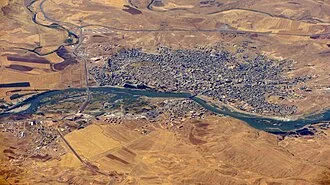
Cizre was founded as Jazirat Ibn ʿUmar in the 9th century by Al-Hasan ibn Umar, Emir of Mosul, on a manmade island in the Tigris. The city benefited from its situation as a river crossing and port in addition to its position at the end of an old Roman road which connected it to the Mediterranean Sea, and thus became an important commercial and strategic centre in Upper Mesopotamia.
By the 12th century, it had adopted an intellectual and religious role, and sizeable Christian and Jewish communities are attested. Cizre suffered in the 15th century from multiple sackings and ultimately came under the control of the Ottoman Empire after 1515.
Under Ottoman control, Cizre stagnated and was left as a small district centre dominated by ruins by the end of the 19th century. The city's decline continued, exacerbated by the state-orchestrated destruction of its Christian population in the Armenian genocide and Sayfo in 1915, and exodus of its Jewish population to Israel in 1951.
It began to recover in the second half of the 20th century through urban redevelopment, and its population saw a massive increase as a place of refuge from 1984 onwards as many fled the Kurdish–Turkish conflict. At the close of the 20th century and beginning of the 21st century, Cizre has emerged as a battleground between Kurdish militants and the Turkish state, which inflicted significant devastation on the city to retain control.
Etymology
The various names for the city of Cizre descend from the original Arabic name Jazirat Ibn ʿUmar, which is derived from 'jazira' (island), "ibn" (son of), and the name Umar, thus Jazirat Ibn ʿUmar translates to 'island of the son of Umar'. The city's alternative Arabic name Madinat al-Jazira is composed of "madinat" ('city') and 'al-Jazira' (the island), and therefore translates to 'the island city'.
Cizre was known in Syriac as Gāzartā d'Beṯ Zabdaï (island of Zabdicene), from 'gazarta' (island) and 'Beṯ Zabdaï' (Zabdicene).
History
Hamdanid ???–978
Buyid 978–984
Marwanid 984–990
Uqaylid 990–???
Under Buyid suzerainty 990–996
Marwanid ???–1096
Under Seljuk suzerainty 1056–1096
Zengid 1127–1251
Under Ayyubid suzerainty 1183–1251
Luluid 1251–1261
Under Mongol suzerainty 1252–1261
Bohtan 1336/1337–1456
Aq Qoyunlu 1456–1495/1496
Bohtan 1496–1847
Under Safavid suzerainty 1507–1515
Under Ottoman suzerainty 1515–1847
Turkey 1923–present
Classical and early medieval period
Cizre is identified as the location of Ad flumen Tigrim, a river crossing depicted on the Tabula Peutingeriana, a Roman 4th/5th century map. The river crossing lay at the end of a Roman road that connected it with Nisibis, and was part of the region of Zabdicene.
It was previously assumed by most scholars that Bezabde was located at the same site of what would later become Cizre, but is now agreed to be at Eski Hendek, 13 km (8.1 mi) northwest of Cizre.
Cizre was originally known as Jazirat Ibn ʿUmar, and was founded by and named after al-Hasan ibn Umar ibn al-Khattab al-Taghlibi (d. c. 865), Emir of Mosul, in the early 9th century, as recorded by Yaqut al-Hamawi in Mu'jam al-Buldan.
The city was constructed in a bend in the river Tigris, and al-Hasan ibn Umar built a canal across the bend, placing the city on an island in the river, hence the city's name. Eventually, the original course of the river disappeared due to sedimentation and shifted to the canal, leaving the city on the west bank of the Tigris.
Jazirat Ibn ʿUmar was situated to take advantage of trade routes from the direction of Amid to the northwest, Nisibin to the west, and Iran to the northeast. The city also functioned as a river port, and goods were transported by raft down the Tigris to Mosul and further south. Jazirat Ibn ʿUmar supplanted the neighbouring city of Bezabde as its inhabitants gradually left for the new city, and was likely abandoned in the early 10th century.
Medieval Islamic scholars recorded competing theories of the founder of the city as al-Harawi noted in Ziyarat that it was believed that Jazirat Ibn ʿUmar was the second city founded by Nuh (Noah) after the Great Flood. This belief rests on the identification of nearby Mount Judi as the apobaterion (place of descent) of Noah's Ark.
The shahanshah Ardashir I of Iran (180–242) was also considered a potential founder. In Wafayāt al-Aʿyān, Ibn Khallikan reported that Yusuf ibn Umar al-Thaqafi (d. 744) was considered by some to be responsible for the city's foundation, whilst he argued that Abd al-Aziz ibn Umar was the founder and namesake of Jazirat Ibn ʿUmar.
The city was fortified in the 10th century at the latest. In the 10th century, Ibn Hawqal in Surat al-Ard described Jazirat Ibn ʿUmar as an entrepôt engaged in trade with the Byzantine Empire, Armenia, and the districts of Mayyafariqin, Arzen, and Mosul. Abu Taghlib, Hamdanid Emir of Mosul, allied himself with the Buyid Emir Izz al-Dawla Bakhtiyar of Iraq in his civil war against his cousin Emir 'Adud al-Dawla of Fars in 977 on the condition that Bakhtiyar hand over Abu Taghlib's younger brother Hamdan, who had conspired against him.
Although Abu Taghlib had secured his reign by executing his rival brother Hamdan, the alliance quickly backfired following Adud al-Dawla's victory over Abu Taghlib and Bakhtiyar at Samarra in the spring of 978 as he then annexed Hamdanid territory in upper Mesopotamia, and thus Jazirat Ibn ʿUmar came under Buyid rule, forcing Abu Taghlib to go into exile.
Buyid control of Jazirat Ibn ʿUmar was cut short by the civil war that followed the death of Adud al-Dawla in 983 as it allowed the Kurdish chief Badh ibn Dustak to seize Buyid territory in upper Mesopotamia in the following year, and he was acknowledged as its ruler by the claimant Emir Samsam al-Dawla. Bādh attempted to conquer Mosul in 990, and the Hamdanid brothers Abu Abdallah Husayn and Abu Tahir Ibrahim were sent by the Buyid Emir Baha al-Dawla to repel the threat.
The Uqaylid clan agreed to aid the brothers against Bādh in return for the cities of Jazirat Ibn ʿUmar, Balad, and Nisibin, and Bādh was subsequently defeated and killed. The leader of the Uqaylids, Abu'l-Dhawwad Muhammad ibn al-Musayyab, secured control of the cities, and acknowledged Emir Baha al-Dawla as his sovereign.
On Muhammad's death in 996, his brother and successor as emir, al-Muqallad, asserted his independence, expelling the Buyid presence in the emirate, and thus ending Buyid suzerainty.
High medieval period
Turkmen nomads arrived in the vicinity of Jazirat Ibn ʿUmar in the summer of 1042, and carried out raids in Diyar Bakr and upper Mesopotamia. The Marwanid emirate became a vassal of the Seljuk Sultan Tughril in 1056.
In the summer of 1083, the former Marwanid vizier Fakhr al-Dawla ibn Jahir persuaded the Seljuk Sultan Malikshah to send him with an army against the Marwanid emirate, and eventually Jazirat Ibn ʿUmar, the last remaining Marwanid stronghold, was captured by the Seljuk Turks in 1085. Although the Marwanid emirate was severely reduced, its final emir, Nasir al-Dawla Mansur, was permitted to continue to rule solely Jazirat Ibn ʿUmar under the Seljuk Sultanate from 1085 onwards.
The mamluk Jikirmish seized Mansur and usurped the emirate of Jazirat Ibn ʿUmar on Mansur's death in January 1096. In late 1096, Jikirmish set out to relieve Kerbogha's siege of Mosul following a request for aid from the Uqaylid emir Ali ibn Sharaf al-Dawla of Mosul, but was defeated by Kerbogha's brother Altuntash, and submitted to him as a vassal.
Jikirmish was forced to aid in the ultimately successful siege against his former ally, and thus came under the suzerainty of Kerbogha as Emir of Mosul. Kerbogha died in 1102, and Sultan Barkiyaruq appointed Jikirmish as his replacement as emir. Jazirat Ibn ʿUmar was thereafter directly ruled over by a string of Seljuk emirs of Mosul until the appointment of Zengi.
Emir Aqsunqur al-Bursuqi of Mosul was murdered by Assassins in 1126, and was succeeded by his son Mas'ud. He died after several months, and his younger brother became emir with the mamluk Jawali serving as atabeg (regent). Jawali sent envoys to Sultan Mahmud II to receive official recognition for al-Bursuqi's son as emir of Mosul, but the envoys bribed the vizier Anu Shurwan to recommend Imad al-Din Zengi be appointed as emir of Mosul instead.
The sultan appointed Zengi as emir in the autumn of 1127, but he had to secure the emirate by force as forces loyal to al-Bursuqi's son resisted Zengi, and retained control of Jazirat Ibn ʿUmar. After taking Mosul, Zengi marched north and besieged Jazirat Ibn ʿUmar; in an attack, he ferried soldiers across the river whilst others swam to the city, and eventually the city surrendered.
Later, an Artuqid coalition of Da'ud of Hisn Kayfa, Timurtash of Mardin, and Ilaldi of Amid threatened Zengi's realm in 1130 whilst he campaigned in the vicinity of Aleppo in Syria, forcing him to return and defeat them at Dara. After the battle, Da'ud marched on Jazirat Ibn ʿUmar and pillaged its surroundings, thus Zengi advanced to counter him, and Da'ud withdrew to the mountains.
The dozdar (governor of the citadel) of Jazirat Ibn ʿUmar, Thiqat al-Din Hasan, was reported to have sexually harassed soldiers' wives whilst their husbands were on campaign, and thus Zengi sent his hajib (chamberlain) al-Yaghsiyani to handle the situation. To avoid a rebellion, al-Yaghsiyani told Hasan he was promoted to dozdar of Aleppo, so he arranged to leave the city, but was arrested, castrated, and crucified by al-Yaghsiyani upon leaving the citadel.
The Jewish scholar Abraham ibn Ezra visited the city in November 1142. On Zengi's death in 1146, his eldest son Sayf al-Din Ghazi I received the emirate of Mosul, including Jazirat Ibn ʿUmar, and Izz al-Dīn Abū Bakr al-Dubaysī was appointed as the city's governor. The city was transferred to Qutb al-Din Mawdud on his seizure of the emirate of Mosul after his elder brother Sayf al-Din's death in November 1149.
The Grand Mosque of Jazirat Ibn ʿUmar was constructed in 1155. After Qutb al-Din's death in September 1170, Jazirat Ibn ʿUmar was inherited by his son and successor Sayf al-Din Ghazi II as emir of Mosul. Michael the Syrian recorded that a Syriac Orthodox monastery was confiscated and the city's bishop Basilius was imprisoned in 1173.
Upon the death of Sayf al-Din Ghazi in 1180, Jazirat Ibn ʿUmar was granted as an iqta' to his son Mu'izz al-Din Sanjar Shah within the emirate of Mosul, however, in late 1183, Sanjar Shah recognised Saladin as his suzerain, thus becoming a vassal of the Ayyubid Sultanate of Egypt, and effectively forming an autonomous principality.
Sanjar Shah continued to mint coins in his own name, and copper dirhams were minted at Jazirat Ibn ʿUmar in 1203/1204.
Sanjar Shah ruled until his murder by his son Ghazi in 1208, and was succeeded by his son Mu'izz al-Din Mahmud. Mahmud successfully maintained Zengid control over Jazirat Ibn ʿUmar with the marriage of his son Al-Malik al-Mas'ud Shahanshah to the daughter of Badr al-Din Lu'lu', who had overthrown the Zengids at Mosul, and usurped power for himself in 1233.
The Grand Mosque of Jazirat Ibn ʿUmar was renovated during Mahmud's reign. In the early 13th century, the city's fort and madrasa are attested by Ibn al-Athir in Al-Tārīkh al-bāhir fī al-Dawlah al-Atābakīyah bi-al-Mawṣil, and its mosque by Ibn Khallikan in Wafayāt al-Aʿyān. According to the Arab scholar Izz al-Din ibn Shaddad, the Mongol Empire demanded 100,000 dinars in tribute from the ruler of Jazirat Ibn ʿUmar in 1251.
The end of the Zengid dynasty was heralded by the death of Mahmud in 1251, as Badr al-Din Lu'lu' had Mahmud's successor Al-Malik al-Mas'ud Shahanshah killed soon after, and assumed control of Jazirat Ibn ʿUmar.
Late medieval period
Badr al-Din Lu'lu' acknowledged Mongol suzerainty to secure his realm as early as 1252, and minted coins in the name of Great Khan Möngke Khan in 1255 at the latest. He is also known to have had a mosque built at Jazirat Ibn ʿUmar. Badr al-Din became subject to the Mongol Ilkhanate on Hulagu Khan's assumption of the title Ilkhan (subject khan) in 1256.
Badr al-Din Lu'lu' died in July/August 1259, and his realm was divided between his sons, and Jazirat Ibn ʿUmar was bequeathed to his son al-Malik Al-Mujahid Sayf al-Din Ishaq. The sons of Badr al-Din Lu'lu' chafed under Mongol rule and soon all had rebelled and travelled to Egypt seeking military assistance as al-Muzaffar Ala al-Din Ali left Sinjar in 1260, al-Salih Rukn al-Din Ismail left Mosul in June 1261, and finally Ishaq fled Jazirat Ibn ʿUmar for Mamluk Egypt shortly afterwards.
Prior to his flight, Ishaq extorted 700 dinars from the city's Christians, and news of his impending escape pushed the populace to riot against his decision to leave the city to the wrath of the Mongols.
In Ishaq's absence, 'Izz ad-Din 'Aibag, Emir of Amadiya, seized the city, and an attack by Abd Allah, Emir of Mayyafariqin, was repelled. Baibars, Sultan of Egypt, refused to provide an army to the sons of Badr al-Din against the Mongols, but they were permitted to accompany Caliph Al-Mustansir on his campaign to reconquer Baghdad from the Mongols.
The three brothers marched with the caliph's campaign until they split at Al-Rahba, and travelled to Sinjar, where Ali and Ishaq briefly remained whilst Ismail continued onwards to Mosul. However, the two brothers abandoned Sinjar and Jazirat Ibn ʿUmar to the Mongols, and returned to Egypt upon learning of the caliph's death and defeat in November.
Mosul was sacked and Ismail was killed by a Mongol army, after the Siege of Mosul (1261) from November to July/August 1262. After the sack of Mosul, the Mongol army led by Samdaghu besieged Jazirat Ibn ʿUmar until the summer of 1263; the siege was lifted and the city spared when the Church of the East bishop Henan Isho claimed to have knowledge of chrysopoeia, and offered to render his services.
Jemal ad-Din Gulbag was appointed to govern Jazirat Ibn ʿUmar, but he was later executed for conspiring with the city's former ruler Ishaq, and was replaced by Henan Isho, who was also executed in 1268, following accusations of impropriety.
In the second half of the 13th century, Mongol gold, silver, and copper coins were minted at Jazirat Ibn ʿUmar, and production there increased after Khan Ghazan's (r. 1295–1304) reforms. It was later attested that the vizier Rashid-al-Din Hamadani had planned to construct a canal from the Tigris by the city. Jazirat Ibn ʿUmar was visited by the Moroccan scholar Ibn Battuta in 1327, and he noted the city's mosque, bazaar, and three gates.
In 1326/1327, the city was granted as a fief to a Turkman chief, and Jazirat Ibn ʿUmar remained under his control until the disintegration of the Ilkhanate in 1335, soon after which it was seized by the Bohtan clan in 1336/1337 with the aid of al-Ashraf, Ayyubid Emir of Hisn Kayfa. In the 1330s, Hamdallah Mustawfi in Nuzhat Al Qulub reported that Jazirat Ibn ʿUmar had an annual revenue of 170,200 dinars.
The emirate of Hisn Kayfa had aimed to control Jazirat Ibn ʿUmar through the Bohtan clan in providing military assistance to its capture and the marriage of a daughter to Izz ad-Din, Emir of Bohtan, but this was unsuccessful as the Bohtan emirate developed the city and consolidated their rule, and eventually the emir of Hisn Kayfa attempted to take Jazirat Ibn ʿUmar by force in 1384/1385, but was repelled.
The emirate of Bohtan submitted to the Timurid Empire in 1400, after Timur sacked Jazirat Ibn ʿUmar in retribution for the emir having seized one of his baggage convoys. As punishment for the emir's refusal to participate in Timur's campaign in Iraq, the city was sacked by Timur's son Miran Shah.
Early modern period
Uzun Hasan usurped leadership of the Aq Qoyunlu from his elder brother Jahangir in a coup at Amid in 1452, and set about expanding his realm by seizing Jazirat Ibn ʿUmar in 1456, whilst the emir of Bohtan withdrew into the mountains. Rebellion and civil war followed the death of Uzun Hasan in 1478, and the emir of Bohtan retook Jazirat Ibn ʿUmar from the Aq Qoyunlu in 1495/1496.
Jazirat Ibn ʿUmar came under Safavid suzerainty in the first decade of the 16th century, but after the Ottoman victory at the battle of Chaldiran over Shah Ismail I in 1514, Sultan Selim I sent Idris Bitlisi to the city and he successfully convinced the emir of Bohtan to submit to the Ottoman Empire. The emirate of Bohtan was incorporated into the empire as a hükûmet (autonomous territory), and was assigned to the eyalet (province) of Diyarbekir upon its formation in 1515. Sayyid Ahmad ruled in 1535.
Christian families from Erbil found refuge and settled in Jazirat Ibn ʿUmar in 1566. In the mid-17th century, Evliya Çelebi visited Jazirat Ibn ʿUmar en route from Mosul to Hisn Kayfa, and noted the city possessed four muftis and a naqib al-ashraf, and its qadis (judges) received a daily salary of 300 akçes.
In the late 17th century, Jazirat Ibn ʿUmar is mentioned by Jean-Baptiste Tavernier in Les Six Voyages de J. B. Tavernier as a location on the route to Tabriz.