














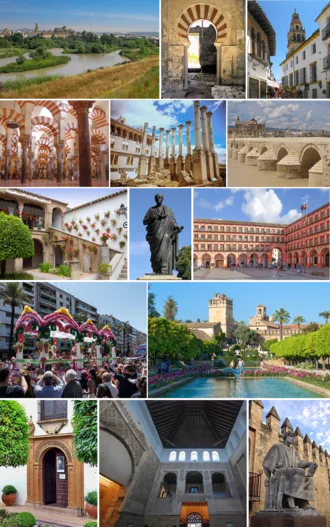
The city primarily lies on the right bank of the Guadalquivir in the south of the Iberian Peninsula. Once a Roman colony, it was taken over by the Visigothic Kingdom in the sixth century and then conquered by the Muslims in the eighth century. Córdoba became the capital of the Emirate and then Caliphate of Córdoba, from which the Umayyad dynasty ruled al-Andalus.
Under Umayyad rule, Córdoba was transformed into a centre of education and learning, and by the 10th century it had grown to be the second-largest city in Europe. The caliphate experienced a manifold political crisis in the early 11th century that brought about state collapse. Following the Christian conquest in 1236, Córdoba became part of the Crown of Castile as the head of the Kingdom of Córdoba.
Córdoba is the place with the most UNESCO World Heritage Sites in the world, with four separate UNESCO inscriptions. Córdoba is home to notable examples of Moorish architecture such as the Mezquita-Catedral, which was named as a UNESCO World Heritage Site in 1984 and is now a cathedral. The site has since been expanded to encompass the whole historic centre of Córdoba.
Madinat al-Zahra near the city is also a World Heritage Site while the Festival de los Patios has been recognized as UNESCO Intangible Cultural Heritage.
Córdoba has the highest summer temperatures in Spain and Europe, with average high temperatures around 37 °C (99 °F) in July and August. Summers are very dry whereas the mild winters have frequent rainfall.
Etymology
The name Córdoba has attracted fanciful explanations. One theory, suggested in 1799 by José Antonio Conde, is that the name comes from Punic qart ṭūbah 'good town'. C. F. Seybold and M. Ocaña Jiménez write, "The name is certainly not Semitic but Old Iberian." After the Roman conquest, the town's name was Latinised as Corduba. During the era of Muslim rule the city was known in Arabic as Qurṭubah (قرطبة).
History
Prehistory, antiquity and Roman foundation of the city
The first traces of human presence in the area are remains of a Neanderthal dating to c. 42,000 to 35,000 BC. Pre-urban settlements around the mouth of the Guadalquivir are known to have existed from the 8th century BC. The population gradually learned copper and silver metallurgy.[citation needed] The first historical mention of a settlement dates to the Carthaginian expansion across the Guadalquivir.[citation needed] Córdoba was conquered by the Romans in 206 BC.[citation needed]
In 169 BC, Roman consul Marcus Claudius Marcellus, the grandson of Marcus Claudius Marcellus, who had governed both Hispania Ulterior and Hispania Citerior respectively, founded a newer settlement alongside the pre-existing one. The date is contested; it could have been founded in 152 BC. Between 143 and 141 BC the town was besieged by Viriatus.
A forum is known to have existed in the city in 113 BC. The famous Cordoba Treasure, with mixed local and Roman artistic traditions, was buried in the city at this time; it is now in the British Museum.
Corduba became a colonia with the name Colonia Patricia between 46 and 45 BC. It was sacked by Julius Caesar in 45 because of its fealty to Pompey and resettled with veteran soldiers by Augustus. It became the capital of Baetica, with a forum and numerous temples, and was the main center of Roman intellectual life in Hispania Ulterior.
The Roman philosopher Seneca the Younger, his father, the orator Seneca the Elder, and his nephew, the poet Lucan came from Roman Córdoba.
In the late Roman period, Hosius of Corduba or "Bishop Ossius" was the dominant figure of the Latin Church throughout the earlier 4th century. Later, Corduba occupied an important place in the Provincia Hispaniae of the Byzantine Empire (552–572); the Visigoths conquered it in the late 6th century.
Umayyad rule
Córdoba was captured by the Muslims in 711 or 712. Unlike other Iberian towns, no capitulation was signed and the position was taken by storm. Córdoba was in turn governed by direct Arab rule. The new Umayyad commanders established themselves within the city and in 716 it became the provincial capital, subordinate to the Caliphate of Damascus, replacing Seville. In Arabic it was known as قرطبة (Qurṭuba).
The centre of the Roman and Visigothic cities became the walled medina. Over time, as many as 21 suburbs (رَبَض rabaḍ, pl. أَرْبَاض arbāḍ) developed around the city.
In 747, a battle took place in the surroundings of Córdoba, the Battle of Saqunda, pitting Arab Yemenites against northerner Qays.
Following the Abbasid ousting of the Umayyad Caliphate after 750, the surviving Umayyad Abd ar-Rahman crossed to the Iberian Peninsula in 756. He proclaimed himself Emir Abd ar-Rahman I and established his dynasty in Córdoba once the rump wāli Yusuf ibn Abd al-Rahman al-Fihri was defeated at a battle outside the city in May 756.
In 785–786 (169 AH) he ordered construction of the Great Mosque of Córdoba, which was completed the next year and underwent later expansions under his successors.
Historians' estimations of Córdoba's population during the 9th century range from 75,000 to 160,000. The ruthless repression of the 818 revolt in the southern suburb of Córdoba led to the destruction of the place. In the 10th and 11th centuries Córdoba was one of the most advanced cities in the world, and a great cultural, political, financial and economic centre.
Córdoba had a prosperous economy, with manufactured goods including leather, metal work, glazed tiles and textiles, and agricultural produce including a range of fruits, vegetables, herbs and spices, and materials such as cotton, flax and silk. It was also famous as a centre of learning, home to over 80 libraries and institutions of learning, with knowledge of medicine, mathematics, astronomy, botany far exceeding the rest of Europe at the time.
Later, the vizier al-Mansur – the de facto ruler of al-Andalus from 976 to 1002 – burned most of the books on philosophy from the library of Caliph al-Hakam II to appease Maliki jurists (ulama); most of the others were sold off or perished in the civil strife not long after.
After a period of weak central rule, Abd ar-Rahman III came to power as emir in 912 and campaigned lengthily and systematically to re-establish the authority of Córdoba across Al-Andalus. In 929, after years of military and diplomatic efforts, he felt confident enough to declare himself "caliph", a title challenging the Abbasid caliphs in Baghdad and the Fatimid caliphs in North Africa.
This inaugurated the height of Córdoba's power and influence in the 10th century. This century saw the construction of two palatine cities in the surroundings of Córdoba: Madīnat al-Zahrā to the west, built by Abd ar-Rahman III, and another one built later by al-Mansur (Medina Alzahira) to the east.
Isa al-Razi describes Cordoba as "surrounded by many beautiful estates" and many varied fruit trees. The inner city of Cordoba was surrounded by 11 palaces, 22 almuna and 12 arbad (or suburbs), mainly on the right bank of the Guadalquivir, and in particular to the north and west of the city. Not much later, Ibn Bashkuwal lists a total of 21 suburbs (two to the south, three to the north, seven to the east and nine to the west).
To the north, part of the rabad al-Rusafa was located just south of the present Parador of Arruzafa (or Parador of Cordoba), where excavations in the 1990s uncovered the remains of a variety of almuna, Roman villas and irrigation systems (with one aljibe of the early medieval period preserved in the basement of a private suburban house).
The economic historian J. Bradford DeLong estimates the city's population at 400,000 around 1000 AD, while estimates from other historians range from 100,000 to 1,000,000 during the same era. Whatever Córdoba's population was, the city's apogee came to an abrupt halt after the 1009 crisis.
On 15 February 1009, with Hisham II as caliph and Abd al-Rahman Sanchuelo as hajib (and de facto ruler), a revolution broke out in Córdoba, which led to the proclamation of an alternative caliph. This marked the beginning of a long period of civil war and conflict in Al-Andalus known as the Fitna. Berbers entered and sacked Córdoba in May 1013. Hisham III was routed from Córdoba on 30 November 1031 and an oligarchic republic replaced the caliphate.
High and Late Middle Ages
Under rule of the Banu Yahwar, Cordobese power did not extend far from the city, as other independent polities emerged in the rest of the former caliphate. An estimation of 65,000 inhabitants has been proposed for 11th-century Córdoba.
In 1070, forces from the Abbadid Taifa of Seville entered Córdoba to help in the defence of the city, which had been besieged by al-Mamun of Toledo, ruler of Toledo, yet they took control and expelled the last ruler of the taifa of Córdoba, Abd-Al Malik, forcing him to exile. Al-Mamun did not cease in his efforts to take the city, and making use of a Sevillian renegade who murdered the Abbadid governor, he triumphantly entered the city on 15 February 1075, only to die there barely five months later, apparently poisoned.
Córdoba was seized by force in March 1091 by the Almoravids. In 1121, the population revolted against the abuses of the Almoravid governor.
Sworn enemies of the Almoravid dynasty, the "Wolf King" Abū ʿAbd Allāh Muḥammad ibn Saʿd ibn Mardanīsh and his stepfather ibn Hamušk allied with Alfonso VIII of Castile and laid siege to Córdoba by 1158–1160, ravaging the surroundings but failing to take the city.
Almohad caliph Abdallah al-Adil appointed Al-Bayyasi (brother of Zayd Abu Zayd) as governor of Córdoba in 1224, only for the city to later become independent from Caliphal rule. Al-Bayyasi asked Ferdinand III of Castile for help and Córdoba revolted against him.
Years later, in 1229, the city submitted to the authority of Ibn Hud, disavowing him in 1233, joining instead the territories under Muhammad Ibn al-Aḥmar, ruler of Arjona and soon-to-be emir of Granada.
Ferdinand III entered the city on 29 June 1236, following a siege of several months. According to Arab sources, Córdoba fell on 23 Shawwal 633 (that is, on 30 June 1236, a day later than Christian tradition). Upon the city's conquest the mosque was converted into a Catholic cathedral dedicated to the Virgin Mary (Santa Maria).
This was also followed by the return to Santiago de Compostela of the church bells that had been looted by Almanzor and moved to Córdoba by Christian war prisoners in the late 10th century. Ferdinand III granted the city a fuero in 1241; it was based on the Liber Iudiciorum and in the customs of Toledo, yet formulated in an original way.
Unlike the case of other kingdoms of the Crown of Castile, the wider Kingdom of Córdoba distinctly lacked realengo (royal demesne) council towns other than the capital city itself. In addition, the military orders had a comparatively lesser presence across the realm. The city was divided into 14 colaciones,[citation needed] and numerous new church buildings were added.
By the end of the 13th century, the land belonging to the council of Córdoba peaked at about 12,000 km2. It progressively reduced upon creation of new lordships, amounting to about 9,000 km2 by the end of the middle ages.
The city's surrounding countryside was raided during the 1277–78 Marinid expedition in the Guadalquivir valley. In 1282, in the context of the problematic succession of Alfonso X of Castile, an army formed by the latter's supporters as well as Marinid forces laid siege to the city (where prince Sancho was) for 21 days.
The city council had indeed joined a newly created brotherhood in 1282 together with other councils of the Upper Guadalquivir defending Sancho's dynastic rights against Alfonso's regal authoritarianism.
Many decades after during the Third Siege of Gibraltar in 1333, a diversionary army from Granada raided the countryside of Cordoba and encamped on the far side of the Roman Bridge of Cordoba. However the diversionary army had to return to Gibraltar to help their Marinid counterparts so no further action was taken. In 1368, during the Castilian Civil War, the city, loyal to the Trastámara side, was attacked by forces supporting of Peter I, with Granadan backing.
Modern history
In the context of the Early Modern Period, the city experienced a golden age between 1530 and 1580, profiting from an economic activity based on the trade of agricultural products and the preparation of clothes originally from Los Pedroches, peaking at a population of about 50,000 by 1571. A period of stagnation and ensuing decline followed.
It was reduced to 20,000 inhabitants in the 18th century. The population and economy started to increase again only in the early 20th century. The second half of the 19th century saw the arrival of railway transport via the opening of the Seville–Córdoba line on 2 June 1859.
Córdoba was connected by railway to Jerez and Cádiz in 1861 and, in 1866, following the link with Manzanares, with Madrid. The city was eventually connected to Málaga and Belmez.
On 18 July 1936, the military governor of the province, Colonel Ciriaco Cascajo, launched the Nationalist coup in the city, bombing the civil government and arresting the civil governor, Rodríguez de León; these actions ignited the Spanish Civil War.
Following the orders of the putschist General Queipo de Llano, he declared a state of war. The putschists were met by the resistance of the political and social representatives who had gathered in the civil government headquarters, and remained there until the Nationalist rifle fire and the presence of artillery broke their morale.
When its defenders began fleeing the building, Rodríguez de León finally decided to surrender and was arrested.
In the following weeks, Queipo de Llano and Major Bruno Ibañez carried out a bloody repression in which 2,000 persons were executed. The ensuing Francoist repression in wartime and in the immediate post-war period (1936–1951) is estimated to have led to around 9,579 killings in the province.
The Mosque-Cathedral was declared a UNESCO World Heritage Site in 1984, and in 1994 this status was extended to the entire historic centre of Córdoba. The city has a number of modern areas, including the district of Zoco and the area surrounding the railway station.[citation needed]
The regional government (the Junta de Andalucía) has for some time[when?] been studying the creation of a Córdoba Metropolitan Area that would comprise, in addition to the capital itself, the towns of Villafranca de Córdoba, Obejo, La Carlota, Villaharta, Villaviciosa, Almodóvar del Río and Guadalcázar. The combined population of such an area would be around 351,000.[citation needed]
Geography
Córdoba is located in the south of the Iberian Peninsula, in the Guadalquivir depression formed by the Guadalquivir river, that cuts across the city in an east-north east to west-south west direction. The wider municipality extends across an area of 1,254.25 km2, making it the largest municipality in Andalusia and the fourth largest in Spain.
The city of Córdoba lies in the middle course of the river. Three major landscape units in the municipality include the Sierra (as in the southern reaches of Sierra Morena), the Valley proper and the Campiña.
The differences in elevation in the Valley are very small, ranging from 100 and 170 metres above sea level, with the city proper located at an average altitude of roughly 125 metres above sea level. The landscape of the valley is further subdivided in the piedmont connecting with the Sierra, the fluvial terraces and the most immediate vicinity of the river course.
The Miocene Campiña, located in the southern bank of the Guadalquivir, features a hilly landscape gently increasing in height up to about 200 m. In the Sierra, to the north of the city, the altitude increases relatively abruptly up to 500 meters. Both the Sierra and the Campiña display viewpoints over the valley.
Climate
Córdoba has a hot-summer Mediterranean climate (Köppen climate classification Csa). It has the highest summer average daily temperatures in Spain and Europe (with highs averaging 37 °C (99 °F) in July and August) and days with temperatures over 40 °C (104 °F) are common in the summer months.
August's 24-hour average of 28.3 °C (83 °F) is also one of the highest in Europe. On average, Córdoba has 16 days with maximum temperatures over 40 °C (104 °F) and 68 days with maximum temperatures over 35 °C (95 °F). These scorching summers occur due to its location in the Guadalquivir Valley, which is considered to be the region with the hottest summer in Europe and even one of the hottest summers in the world that is not located in a semi-arid or arid region.
Winters are mild, yet cooler than other low lying cities in southern Spain due to its interior location, wedged between the Sierra Morena and the Penibaetic System. Precipitation is concentrated in the coldest months; this is due to the dry summer climate pattern featured in large parts of the Iberian Peninsula. Precipitation is generated by storms from the west that occur most frequently from December to February.
This Atlantic characteristic then gives way to a hot summer with significant drought more typical of Mediterranean climates. Annual rain surpasses 550 mm (22 in), although it is recognized to vary from year to year.