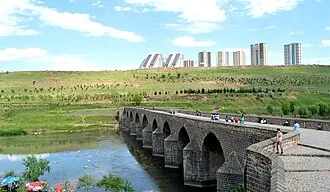
Situated around a high plateau by the banks of the Tigris river on which stands the historic Diyarbakır Fortress, it is the administrative capital of the Diyarbakır Province of southeastern Turkey. It is the second-largest city in the Southeastern Anatolia Region. As of December 2024, the Metropolitan Province population was 1,833,684, of whom 1,164,940 lived in the built-up (or metro) area made of the four urban districts (Bağlar, Kayapınar, Sur and Yenişehir).
Diyarbakır has been a main focal point of the conflict between the Turkish state and various Kurdish separatist groups, and is seen by many Kurds as the informal capital of Kurdistan. The city was intended to become the capital of an independent Kurdistan following the 1920 Treaty of Sèvres, but this was disregarded following subsequent political developments.
On 6 February 2023 Diyarbakır was affected by the twin Turkey–Syria earthquakes, which inflicted some damage on its city walls.
Names and etymology
In ancient times the city was known as Amida, a name which could derive from an older Assyrian toponym Amedi. The name Āmid was also used in Arabic. The name Amit is found in official documents of the Empire of Trebizond from 1358.
After the Muslim conquests of the 7th century, the city became known as Diyar Bakr (Arabic: ديار بكر, Diyār Bakr, 'the abode of [the tribe of] Bakr'), in reference to the territory of the Banu Bakr tribe, the Diyar Bakr.
That tribe had already settled in northern Mesopotomia during the pre-Islamic period. In the 7th century, during the caliphate of Uthman and under the regional governorship of Mu'awiya, a portion of the tribe was ordered to settle further north in the lands near the city. The city was later also known in Turkish as Kara Âmid ("Black Amid"), on account of its black basalt walls.
In November 1937, Turkish President Atatürk visited the city and after expressing uncertainty on the exact etymology of the city's name, "Diyarbekir", in December of the same year ordered that it be renamed "Diyarbakır", which means "land of copper" in Turkish after the abundant resources of copper around the city. This was one of the early examples of the Turkification process of non-Turkish place names, in which non-Turkish (Greek, Kurdish, Armenian, Arabic and other) geographical names were changed to Turkish alternatives.
The Armenian name of the city is Tigranakert/Dikranagerd (Տիգրանակերտ), in reference to the ancient capital of Tigranocerta founded by Tigranes the Great nearby. It is known as Amed in Kurdish and in Syriac as ܐܡܝܕ (Āmīd).
History
Antiquity
People have inhabited the area around Diyarbakır since the Stone Age. The first major civilization to establish itself in the region of Diyarbakır was the Hurrian kingdom of the Mitanni. It was then ruled by a succession of nearly every polity that controlled Upper Mesopotamia, including the Arameans, Assyrians, Urartu, Armenians, Achaemenid Persians, Medes, Seleucids, and Parthians.
The Roman Republic gained control of the city in 66 BC, by which stage it was named "Amida". In 359, Shapur II of Persia captured Amida after a siege of 73 days.
According to the Synecdemus of Hierocles, as Amida, Diyarbakır was the major city of the Roman province of Mesopotamia. It was the episcopal see of the Christian diocese of Mesopotamia. Ancient texts record that ancient Amida had an amphitheatre, thermae (public baths), warehouses, a tetrapylon monument, and Roman aqueducts supplying and distributing water.
The Roman historian Ammianus Marcellinus was serving in the late Roman army during the Siege of Amida by the Sasanian Empire under Shapur II (r. 309–379), and described the successful siege in detail. Amida was then enlarged by refugees from ancient Nisibis (Nusaybin), which the emperor Jovian (r. 363–364) was forced to evacuate and cede to Shapur's Persians after the defeat of his predecessor Julian's Persian War, becoming the main Roman stronghold in the region.
The chronicle attributed to Joshua the Stylite describes the capture of Amida by the Persians under Kavad I (r. 488–531) in the second Siege of Amida in 502–503, part of the Anastasian War.
Either the emperor Anastasius Dicorus (r. 491–518) or the emperor Justinian the Great (r. 527–565) rebuilt the walls of Amida, a feat of defensive architecture praised by the Greek historian Procopius. As recorded by the works of John of Ephesus, Zacharias Rhetor, and Procopius, the Romans and Persians continued to contest the area, and in the Byzantine–Sasanian War of 602–628 Amida was captured and held by the Persians for twenty-six years, being recovered in 628 for the Romans by the emperor Heraclius (r. 610–641), who also founded a church in the city on his return to Constantinople (Istanbul) from Persia the following year.
Ecclesiastical history
Syriac Christianity took hold in the region between the 1st and 4th centuries AD, particularly amongst the Assyrians of the city. The Byzantine Emperor Theodosius II (408–450) divided the Roman province of Mesopotamia into two, and made Amida the capital of Mesopotamia Prima, and thereby also the metropolitan see for all the province's bishoprics.
At some stage, Amida became a see of the Armenian Church. The bishops who held the see in 1650 and 1681 were in full communion with the Holy See, and in 1727 Peter Derboghossian sent his profession of faith to Rome. He was succeeded by two more bishops of the Armenian Catholic Church, Eugenius and Ioannes of Smyrna, the latter of whom died in Constantinople in 1785.
After a long vacancy, three more bishops followed. The diocese had some 5,000 Armenian Catholics in 1903, but it lost most of its population in the 1915 Armenian genocide. The last diocesan bishop of the see, Andreas Elias Celebian, was killed with some 600 of his flock in the summer of 1915.
An eparchy for the local members of the Syriac Catholic Church was established in 1862. Persecution of Christians in the Ottoman Empire during the First World War brought an end to the existence of both these Syrian residential sees.
Middle Ages
In 639, as part of the Muslim conquest of the Levant during the early Arab–Byzantine wars, Amida fell to the armies of the Rashidun Caliphate led by Iyad ibn Ghanm, and the Great Mosque of Amida was constructed afterwards in the city's centre, possibly on the site of the Heraclian Church of Saint Thomas. There were as many as five Christian monasteries in the city, including the Zuqnin Monastery and several ancient churches mentioned by John of Ephesus.
One of these, the Church of the Virgin Mary, remains the city's cathedral and the see of the bishop of Diyarbakır in the Syriac Orthodox Church. Another ancient church, the Church of Mar Cosmas, was seen by the British explorer Gertrude Bell in 1911 but was destroyed in 1930, while the former Church of Saint George, in the walled citadel, may originally have been built for Muslim use or for the Church of the East.
The city was part of the Umayyad Caliphate and then the Abbasid Caliphate, but then came under more local rule until its recovery in 899 by forces loyal to the caliph al-Mu'tadid (r. 892–902) before falling under the sway of first the Hamdanid dynasty and then the Buyid dynasty, followed by a period of control by the Marwanids.
From 983 to 1085, the Diyar Bakr region, including the city of Amida, was ruled by the Marwanid dynasty, a Kurdish dynasty, between 990 and 1085. The dynasty's foundation was laid by a chief from the Bohtan (Botkhti) tribe named Badh ibn Dustak, who captured Mayyafariqin (modern Silvan) and later Amida. After Badh was killed in 990, he was succeeded by his nephew, al-Hasan ibn Marwan, the son of his sister and a man named Marwan.
Al-Hasan is considered the true founder of the dynasty that bears his father's name. The Marwanid emirate reached its apogee under the 50-year reign of Nasr al-Dawla Ahmad (1011–1061). This period is remembered as one of peace, prosperity, and cultural flourishing. Nasr al-Dawla was a skilled diplomat, balancing relations with the era's great powers; the Buyid Emirs, the Fatimid Caliphs, and the Byzantine Empire, all of whom sent envoys and recognized his rule.
The Marwanid court, based primarily in Mayyafariqin and Amida, fostered a "pluralistic political rhetoric" that allowed for the coexistence of different ethnic and religious groups, attracting migration from surrounding regions. This period saw extensive public works, and Nasr al-Dawla left monumental inscriptions, still visible, on the Roman walls of Amida.[citation needed]
The city was taken by the Seljuks in 1085 and by the Ayyubids in 1183. Ayyubid control lasted until the Mongol invasions of Anatolia, with its last Ayyubid ruler Al-Kamil Muhammad. The Mongols of Hulagu captured of the city in 1260 (Siege of Mayyāfāriqīn), following a long siege with a small Mongol force and a much larger Georgian and Armenian force under the Georgian leader Hasan Brosh.
Between the Mongol occupation and conquest by the Safavid dynasty of Iran, the Kara Koyunlu and Aq Qoyunlu – two Turkoman confederations – were in control of the city in succession. Diyarbakır was conquered by the Ottoman Empire in 1514 by Bıyıklı Mehmed Pasha, in the reign of the sultan Selim I (r. 1512–1520).
Mohammad Khan Ustajlu, the Safavid governor of Diyarbakir, was evicted from the city and killed in the following Battle of Chaldiran in 1514.
Safavids and Ottomans
The Classical Age of the Ottoman Empire saw it expand into Western Armenia and all but the eastern regions of Kurdistan at the expense of the Safavids. From the early 16th century, the city and the wider region was the source of intrigue between the Safavids and the Ottoman Empire, both of whom sought the support of the Kurdish chieftains around Idris Bitlisi.
It was conquered by the Ottoman Empire in 1514 in the campaigns of Bıyıklı Mehmed Pasha, under the rule of Sultan Selim I. Mohammad Khan Ustajlu, the Safavid Governor of Diyarbakir, was evicted from the city and killed in the following Battle of Chaldiran in 1514.
Following their victory, the Ottomans established the Diyarbekir Eyalet with its administrative centre in Diyarbakır. The Eyalet of Diyarbakır corresponded to today's Turkish Kurdistan, a rectangular area between the Lake Urmia to Palu and from the southern shores of Lake Van to Cizre and the beginnings of the Syrian Desert, although its borders saw some changes over time.
The city was an important military base for controlling the region and at the same time a thriving city noted for its craftsmen, producing glass and metalwork. For example, the doors of Rumi's tomb in Konya were made in Diyarbakır, as were the gold and silver decorated doors of the tomb of Ebu Hanife in Baghdad. Ottoman rule was confirmed by the 1555 Peace of Amasya which followed the Ottoman–Safavid War (1532–1555).
Concerned with independent-mindedness of the Kurdish principalities, the Ottomans sought to curb their influence and bring them under the control of the central government in Constantinople. However, removal from power of these hereditary principalities led to more instability in the region from the 1840s onwards. In their place, sufi sheiks and religious orders rose to prominence and spread their influence throughout the region.
One of the prominent Sufi leaders was Shaikh Ubaidalla Nahri, who began a revolt in the region between Lakes Van and Urmia. The area under his control covered both Ottoman and Qajar territories. Shaikh Ubaidalla is regarded as one of the earliest proponents of Kurdish nationalism. In a letter to a British Vice-Consul, he declared: "The Kurdish nation is a people apart... we want our affairs to be in our hands."[citation needed]
In 1895 an estimated 25,000 Armenians and Assyrians were massacred in Diyarbekir Vilayet, including in the city. At the turn of the 19th century, the Christian population of the city was mainly made up of Armenians and Syriac Orthodox Christians. The city was also a site of ethnic cleansing during the 1915 Armenian and Assyrian genocide (see: 1915 genocide in Diyarbekir); nearly 150,000 were expelled from the city to the death marches in the Syrian Desert.
Republic of Turkey
In January 1928, Diyarbakır became the center of the First Inspectorate-General, a regional subdivision for an area containing the provinces of Hakkari, Van, Şırnak, Mardin, Siirt, Bitlis and Şanlıurfa. In a reorganization of the provinces in 1952, Diyarbakır city was made the administrative capital of the Diyarbakır Province.
In 1993, Diyarbakir was established as a Metropolitan Municipality. Its districts are Bağlar, Bismil, Ergani, Hazro, Kayapinar, Çermik, Çinar, Eğil, Dicle, Kulp, Kocaköy, Lice, Silvan, Sur, Yenişehir, Hani and Çüngüş.
The American-Turkish Pirinçlik Air Force Base near Diyarbakır was operational from 1956 to 1997.
Diyarbakır has seen much violence in recent years, involving Turkish security forces, the Kurdistan Workers Party (PKK), and the Islamic State of Iraq and the Levant (ISIL). Between 8 November 2015 and 15 May 2016 large parts of Sur were destroyed in fighting between the Turkish military and the PKK. In early November 2015, Kurdish lawyer and human rights activist Tahir Elçi was killed in the Sur district during a press statement in which he had been calling for a de-escalation in violence between the PKK and the Turkish state.
A 2018 report by Arkeologlar Derneği İstanbul found that, since 2015, 72% of the city's historic Sur district had been destroyed through demolition and redevelopment, and that laws designed to protect historic monuments had been ignored. They found that the city's "urban regeneration" policy was one of demolition and redevelopment rather than one of repairing cultural assets damaged during the recent civil conflict, and because of that many registered historic buildings had been completely destroyed.
The extent of the loss of non-registered historic structures is unknown because any historic building fragments revealed during the demolition of modern structures were also demolished. As of 2021, large parts of the city and district were restored and government officials were looking towards tourism again.
Many residences and buildings collapsed or suffered substantial damage in the 2023 Turkey–Syria earthquakes around 200 miles (300 km) from the epicentre. A Turkish professor and former journalist from the country commented, "It is like having an epicenter of an earthquake in Harrisburg and buildings in New York City are collapsing."
Sports
The most notable football clubs of the city are Diyarbakırspor (established 1968) and Amed S.F.K. (established 1990), with Deniz Naki being one of the most notable footballers from the city. The women's football team Amed S.K. were promoted at the end of the 2016–17 Turkish Women's Second Football League season to the Women's First League.
Diyarbakırspor competed in the Süper Lig for 11 seasons, and Amed S.F.K. tried to repeat this success by advancing to the TFF 1. Lig in the 2023–24 season.