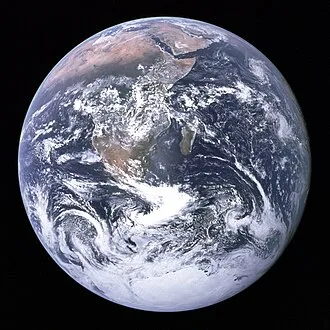
Earth has a dynamic atmosphere, which sustains Earth's surface conditions and protects it from most meteoroids and ultraviolet light at entry. It is composed primarily of nitrogen and oxygen. Water vapor is widely present in the atmosphere, forming clouds that cover most of the planet. The water vapor acts as a greenhouse gas and, together with other greenhouse gases in the atmosphere, particularly carbon dioxide (CO2), creates the conditions for both liquid surface water and water vapor to persist via the capturing of energy from the Sun's light.
This process maintains the current average surface temperature of 14.76 °C (58.57 °F), at which water is liquid under normal atmospheric pressure. Differences in the amount of captured energy between geographic regions (as with the equatorial region receiving more sunlight than the polar regions) drive atmospheric and ocean currents, producing a global climate system with different climate regions, and a range of weather phenomena such as precipitation, allowing components such as carbon and nitrogen to cycle.
Earth is rounded into an ellipsoid with a circumference of about 40,000 kilometres (24,900 miles). It is the densest planet in the Solar System. Of the four rocky planets, it is the largest and most massive. Overall, Earth is the sixth largest object in the Solar System after the Sun and the outer planets. Earth is about eight light-minutes (1 AU) away from the Sun and orbits it, taking a year (about 365.25 days) to complete one revolution.
Earth rotates around its own axis in slightly less than a day (in about 23 hours and 56 minutes). Earth's axis of rotation is tilted with respect to the perpendicular to its orbital plane around the Sun, producing seasons. Earth is orbited by one permanent natural satellite, the Moon, which orbits Earth at 384,400 km (238,855 mi)—1.28 light seconds—and is roughly a quarter as wide as Earth.
The Moon's gravity helps stabilize Earth's axis, causes tides, and gradually slows Earth's rotation. Likewise, Earth's gravitational pull has already made the Moon's rotation tidally locked, keeping the same near side facing Earth.
Earth, like most other bodies in the Solar System, formed about 4.5 billion years ago from gas and dust in the early Solar System. The formation of the ocean and the subsequent development of life occurred during the first billion years of Earth's history. Life spread globally and has been altering Earth's atmosphere and surface, leading to the Great Oxidation Event two billion years ago.
Humans emerged 300,000 years ago in Africa and have spread across every continent on Earth. Humans depend on Earth's biosphere and natural resources for their survival, but have increasingly impacted the planet's environment. Humanity's current impact on Earth's climate and biosphere is unsustainable, threatening the livelihood of humans and many other forms of life, and causing widespread extinctions.
Etymology
The Modern English word Earth developed, via Middle English, from an Old English noun most often spelled eorðe. It has cognates in every Germanic language, from which *erþō has been reconstructed.
In its earliest attestation, the word eorðe was used to translate the many senses of Latin terra and Greek gē: the ground, its soil, dry land, the human world, the surface of the world (including the sea), and the globe itself.
As with Roman Terra (or Tellus) and Greek Gaia, Earth may have been a personified goddess in Germanic paganism: late Norse mythology included Jörð ('Earth'), a giantess often given as the mother of Thor.
Historically, Earth has been written in lowercase. During the Early Middle English period, its definite sense as "the globe" began being expressed using the phrase the earth. By the period of Early Modern English, capitalization of nouns began to prevail, and the earth was also written the Earth, particularly when referenced along with other heavenly bodies.
More recently, the name is sometimes simply given as Earth, by analogy with the names of the other planets, though earth and forms with the earth remain common. House styles now vary: Oxford spelling recognizes the lowercase form as the more common, with the capitalized form an acceptable variant.
Another convention capitalizes Earth when appearing as a name, such as a description of the "Earth's atmosphere", but employs the lowercase when it is preceded by the, such as "the atmosphere of the earth". It almost always appears in lowercase in colloquial expressions such as "what on earth are you doing?"
The name Terra /ˈtɛrə/ TERR-ə is occasionally used in scientific writing; it also sees use in science fiction to distinguish humanity's inhabited planet from others, while in poetry Tellus /ˈtɛləs/ TELL-əs has been used to denote personification of the Earth. Terra is also the name of the planet in some Romance languages, languages that evolved from Latin, like Italian and Portuguese, while in other Romance languages the word gave rise to names with slightly altered spellings, like the Spanish Tierra and the French Terre. The Latinate form Gaea (English: /ˈdʒiː.ə/ DJEE-ə) of the Greek poetic name Gaia ([ɡâi̯.a] or [ɡâj.ja]) is rare, though the alternative spelling Gaia has become common due to the Gaia hypothesis, in which case its pronunciation is /ˈɡaɪ.ə/ GYE-ə rather than the more traditional English /ˈɡeɪ.ə/ GAY-ə.
There are a number of adjectives for the planet Earth. The word earthly is derived from Earth. From the Latin Terra comes terran /ˈtɛrən/ TERR-ən, terrestrial /təˈrɛstriəl/ tərr-EHST-ree-əl, and (via French) terrene /təˈriːn/ tə-REEN, and from the Latin Tellus comes tellurian /tɛˈlʊəriən/ teh-LUURR-ee-ən and telluric.
Natural history
Formation
The oldest material found in the Solar System is dated to 4.5682+0.0002
−0.0004 Ga (billion years) ago.
By 4.54±0.04 Ga, the primordial Earth had formed. The bodies in the Solar System formed and evolved with the Sun. In theory, a solar nebula partitions a volume out of a molecular cloud by gravitational collapse, which begins to spin and flatten into a circumstellar disk, and then the planets grow out of that disk with the Sun.
A nebula contains gas, ice grains, and dust (including primordial nuclides). According to nebular theory, planetesimals formed by accretion, with the primordial Earth being estimated as likely taking anywhere from 70 to 100 million years to form.
Estimates of the age of the Moon range from 4.5 Ga to significantly younger. The leading hypothesis is that it was formed by accretion from material loosed from Earth after a Mars-sized object with about 10% of Earth's mass, named Theia, collided with Earth. It hit Earth with a glancing blow, and some of its mass merged with Earth.
Between approximately 4.0 and 3.8 Ga, numerous asteroid impacts during the Late Heavy Bombardment caused significant changes to the greater surface environment of the Moon and, by inference, to that of Earth.
After formation
Earth's atmosphere and oceans were formed by volcanic activity and outgassing. Water vapor from these sources condensed into the oceans, augmented by water and ice from asteroids, protoplanets, and comets. Sufficient water to fill the oceans may have been on Earth since it formed. In this model, atmospheric greenhouse gases kept the oceans from freezing when the newly forming Sun had only 70% of its current luminosity.
By 3.5 Ga, Earth's magnetic field was established, which helped prevent the atmosphere from being stripped away by the solar wind.
As the molten outer layer of Earth cooled, it formed the first solid crust, which is thought to have been mafic in composition. The first continental crust, which was more felsic in composition, formed by the partial melting of this mafic crust. Hadean-aged zircon grains found in Western Australia, dating back as far as 4.4 Ga, provide the oldest direct evidence of Earth's surface, indicating that felsic continental crust and liquid water existed within 140–160 million years of the planet's formation.
There are two main models of how this initial small volume of continental crust evolved to reach its current abundance: (1) a relatively steady growth up to the present day, which is supported by the radiometric dating of continental crust globally and (2) an initial rapid growth in the volume of continental crust during the Archean, forming the bulk of the continental crust that now exists, which is supported by isotopic evidence from hafnium in zircons and neodymium in sedimentary rocks.
The two models and the data that support them can be reconciled by large-scale recycling of the continental crust, particularly during the early stages of Earth's history.
New continental crust forms as a result of plate tectonics, a process ultimately driven by the continuous loss of heat from Earth's interior. Over the period of hundreds of millions of years, tectonic forces have caused areas of continental crust to group together to form supercontinents that have subsequently broken apart.
At approximately 750 Ma, one of the earliest known supercontinents, Rodinia, began to break apart. The continents later recombined to form Pannotia at 600–540 Ma, then finally Pangaea, which also began to break apart at 180 Ma.
The most recent pattern of ice ages began about 40 Ma, and then intensified during the Pleistocene about 3 Ma. High- and middle-latitude regions have since undergone repeated cycles of glaciation and thaw, repeating about every 21,000, 41,000, and 100,000 years. The Last Glacial Period, colloquially called the "last ice age", covered large parts of the continents, to the middle latitudes, in ice and ended about 11,700 years ago.
Origin of life and evolution
Chemical reactions led to the first self-replicating molecules about four billion years ago. A half billion years later, the last common ancestor of all current life arose. The evolution of photosynthesis allowed the Sun's energy to be harvested directly by life forms. The resultant molecular oxygen (O2) accumulated in the atmosphere and, due to interaction with ultraviolet solar radiation, formed a protective ozone layer (O3) in the upper atmosphere.
The incorporation of smaller cells within larger ones resulted in the development of complex cells called eukaryotes. True multicellular organisms formed as cells within colonies became increasingly specialized. Aided by the absorption of harmful ultraviolet radiation by the ozone layer, life colonized Earth's surface.
Among the earliest fossil evidence for life are microbial mat fossils found in 3.48 billion-year-old sandstone in Western Australia, biogenic graphite found in 3.7 billion-year-old metasedimentary rocks in Western Greenland, and remains of biotic material found in 4.1 billion-year-old rocks in Western Australia.
The earliest direct evidence of life on Earth is contained in 3.45 billion-year-old Australian rocks showing fossils of microorganisms.
During the Neoproterozoic, 1000 to 539 Ma, much of Earth might have been covered in ice. This hypothesis has been termed "Snowball Earth", and it is of particular interest because it preceded the Cambrian explosion, when multicellular life forms significantly increased in complexity.
Following the Cambrian explosion, 535 Ma, there have been at least five major mass extinctions and many minor ones. Apart from the proposed current Holocene extinction event, the most recent was 66 Ma, when an asteroid impact triggered the extinction of non-avian dinosaurs and other large reptiles, but largely spared small animals, such as insects, mammals, lizards, and birds.
Mammalian life has diversified over the past 66 million years, and several million years ago, an African ape species gained the ability to stand upright. This facilitated tool use and encouraged communication that provided the nutrition and stimulation needed for a larger brain, which led to the evolution of humans. The development of agriculture, and then civilization, led to humans having an influence on Earth and the nature and quantity of other life forms that continues to this day.