
















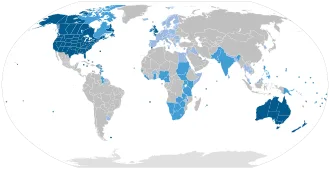
English is either the official language, or one of the official languages, of 57 sovereign states and 30 dependent territories, making it the most geographically widespread language in the world. In the United Kingdom, the United States and Australia, it is the dominant language for historical reasons without being explicitly defined by law.
It is a co‑official language of the United Nations, the European Union, and many other international and regional organisations. It has also become the de facto lingua franca of diplomacy, science, technology, international trade, logistics, tourism, aviation, entertainment, and the Internet. Ethnologue estimated that there were over 1.4 billion speakers worldwide as of 2021[update].
Old English emerged from a group of West Germanic dialects spoken by the Anglo-Saxons. Early inscriptions were written with runes before a Latin‑based alphabet was adopted for longer texts. Late Old English borrowed some grammar and core vocabulary from Old Norse, a North Germanic language. An evolution of the Latin alphabet, the English alphabet, fully supplanted the runic alphabet by the High Middle Ages, coinciding with the emergence of Middle English in England under Norman control.
Middle English borrowed vocabulary extensively from French dialects, which are the source of approximately 28 per cent of Modern English words, and from Latin, which is the source of an additional 28 per cent. While Latin and the Romance languages are thus the source for a majority of its lexicon taken as a whole, English's grammar and phonology remain Germanic, as does most of its basic everyday vocabulary.
Finally, Middle English transformed, in part through the Great Vowel Shift, into Modern English, which exists on a dialect continuum with Scots; it is next most closely related to Low Saxon and Frisian.
Classification
English is a member of the Indo-European language family, belonging to the West Germanic branch of Germanic languages. Owing to their descent from a shared ancestor, Proto-Germanic, English and other Germanic languages – which include Dutch, German, and Swedish – share characteristic features, including a division of verbs into strong and weak classes, the use of modal verbs, and sound changes affecting Proto-Indo-European consonants known as Grimm's and Verner's laws.
Old English was one of several Ingvaeonic languages, which emerged from a dialect continuum spoken by West Germanic peoples during the 5th century in Frisia, on the coast of the North Sea. Old English emerged among the Ingvaeonic speakers on the British Isles following their migration to the region, while the other Ingvaeonic languages (Frisian and Old Low German) developed in parallel on the European continent.
Old English evolved into Middle English, which in turn evolved into Modern English. Particular dialects of Old and Middle English also developed into other Anglic languages, including Scots and the extinct Fingallian and Yola dialects of Ireland.
English was isolated from other Germanic languages on the continent and diverged considerably in vocabulary, syntax, and phonology as a result. It is not mutually intelligible with any continental Germanic language – though some, such as Dutch and Frisian, share strong affinities with it, particularly in its earlier stages.[page needed] English and Frisian were traditionally considered more closely related to one another than they were to other West Germanic languages, but most modern scholarship does not recognise a particular affinity between them.
Though they shared similar sound changes that were found nowhere else around the North Sea at that time, the specific changes appeared in English and Frisian at different times – a pattern that is uncharacteristic of languages that share a unique phylogenetic ancestor.
History
Proto-Germanic to Old English
Old English (also called Anglo-Saxon) was the earliest form of the English language, spoken from c. 450 to c. 1150. Old English developed from a set of West Germanic dialects, sometimes identified as Anglo-Frisian or North Sea Germanic, originally spoken along the coasts of Frisia, Lower Saxony and southern Jutland by the Germanic peoples known from historical records as the Angles, Saxons, and Jutes.
From the 5th century, the Anglo-Saxons settled Britain as the Roman economy and administration collapsed. By the 7th century, Old English had become dominant in Britain – replacing the Common Brittonic and British Latin previously spoken during the Roman occupation, which left little influence on English. England and English (originally Ænglaland and Ænglisc) are both named after the Angles.
Old English was divided into two Anglian dialects (Mercian and Northumbrian) and two Saxon dialects (Kentish and West Saxon). Through the influence of the kingdom of Wessex and the educational reforms instated by King Alfred during the 9th century, the West Saxon dialect became the standard written variety. The epic poem Beowulf is written in West Saxon, and the earliest English poem, Cædmon's Hymn, is written in Northumbrian.
Modern English developed mainly from Mercian, but the Scots language developed from Northumbrian. During the earliest period of Old English, a few short inscriptions were made using a runic alphabet. By the 7th century, a Latin alphabet had been adopted. Written with half-uncial letterforms, it included the runic letters wynn ⟨ƿ⟩ and thorn ⟨þ⟩, and the modified Latin letters eth ⟨ð⟩ and ash ⟨æ⟩.
Old English is markedly different from Modern English; 21st‑century English speakers are entirely unable to understand Old English without special training. Its grammar was similar to that of modern German: nouns, adjectives, pronouns, and verbs had many more inflectional endings and forms, and word order was much freer than in Modern English.
Modern English has case forms in pronouns (he, him, his) and a few verb inflections (speak, speaks, speaking, spoke, spoken), but Old English had case endings in nouns as well, and verbs had more person and number endings.
Influence of Old Norse
Between the 8th and 11th centuries, the English spoken in some regions underwent significant changes due to contact with Old Norse, a North Germanic language. Several waves of Norsemen colonising the northern British Isles in the 8th and 9th centuries brought Old English speakers into constant contact with Old Norse. Norse influence was strongest in the north‑eastern varieties of Old English spoken in the Danelaw surrounding York; today these features are still particularly evident in Scots and Northern English.
The centre of Norse influence was Lindsey, located in the Midlands. After Lindsey was incorporated into the Anglo‑Saxon polity in 920, English spread extensively throughout the region. One element of Norse influence that persists in all English varieties today is the third‑person pronoun group beginning with th- (they, them, their), which replaced the Anglo‑Saxon pronouns with h- (hie, him, hera).
Other Norse loanwords include give, get, sky, skirt, egg, and cake, typically displacing a native Anglo‑Saxon equivalent. Old Norse in this era remained largely mutually intelligible with some dialects of Old English, particularly northern ones.
Middle English
Englischmen þeyz hy hadde fram þe bygynnyng þre manner speche, Souþeron, Northeron, and Myddel speche in þe myddel of þe lond, ... Noþeles by comyxstion and mellyng, furst wiþ Danes, and afterward wiþ Normans, in menye þe contray longage ys asperyed, and som vseþ strange wlaffyng, chyteryng, harryng, and garryng grisbytting.
[Although, from the beginning, Englishmen had three manners of speaking, southern, northern and midlands speech in the middle of the country, ... Nevertheless, through intermingling and mixing, first with Danes and then with Normans, amongst many the country language has arisen, and some use strange stammering, chattering, snarling, and grating gnashing.]
The Middle English period is often defined as beginning with the Norman Conquest in 1066. During the centuries that followed, English was heavily influenced by the form of Old French spoken by the new Norman ruling class that had migrated to England (known as Old Norman). Over the following decades of contact, members of the middle and upper classes, whether native English or Norman, became increasingly bilingual.
By 1150 at the latest, bilingual speakers represented a majority of the English aristocracy, and monolingual French speakers were nearly non‑existent. The French spoken by the Norman elite in England eventually developed into the Anglo‑Norman language. The transition from Old to Middle English can also be placed during the composition of the Ormulum (c. late 12th century), a work by the Augustinian canon Orrm which highlights the blending of Old English and Anglo‑Norman elements in the language for the first time.
As the lower classes, who represented the vast majority of the population, remained monolingual English speakers, the primary influence of Norman was as a lexical superstratum, introducing a wide range of loanwords related to politics, legislation, and prestigious social domains. For instance, the French word trône appears for the first time, from which the English word throne is derived.
Middle English also greatly simplified the inflectional system, probably in order to reconcile Old Norse and Old English, which were inflectionally different but morphologically similar. The distinction between nominative and accusative cases was lost except in personal pronouns; the instrumental case was dropped; and the use of the genitive case was limited to indicating possession.
The inflectional system regularised many irregular inflectional forms, and gradually simplified the system of agreement, making word order less flexible.
Middle English literature includes Geoffrey Chaucer's Canterbury Tales (c. 1400) and Thomas Malory's Le Morte d'Arthur (1485). During the Middle English period, the use of regional dialects in writing proliferated, and dialect traits were even used for effect by authors such as Chaucer.
In the first translation of the entire Bible into English by John Wycliffe (1382), Matthew 8:20 reads: "Foxis han dennes, and briddis of heuene han nestis." Here the plural suffix -n on the verb have is still retained, but none of the case endings on the nouns are present.
Early Modern English
The period of Early Modern English, lasting from 1500 to 1700, was characterised by the Great Vowel Shift (1350–1700), inflectional simplification, and linguistic standardisation. The Great Vowel Shift affected the stressed long vowels of Middle English. It was a chain shift, meaning that each shift triggered a subsequent shift in the vowel system.
Mid and open vowels were raised, and close vowels were broken into diphthongs. For example, the word bite was originally pronounced as the word beet is today, and the second vowel in the word about was pronounced as the word boot is today. The Great Vowel Shift explains many irregularities in spelling, since English retains many spellings from Middle English, and it also explains why English vowel letters have very different pronunciations from the same letters in other languages.
English began to rise in prestige relative to Norman French during the reign of Henry V. Around 1430, the Court of Chancery in Westminster began using English in its official documents, and a new standard form of Middle English, known as Chancery Standard, developed from the dialects of London and the East Midlands. In 1476, William Caxton introduced the printing press to England and began publishing the first printed books in London, thereby expanding the influence of this form of English.
Literature in Early Modern English includes the works of William Shakespeare and the 1611 King James Version (KJV) of the Bible. Even after the vowel shift, the language still sounded different from Modern English: for example, the consonant clusters /kn ɡn sw/ in knight, gnat, and sword were still pronounced.
Many of the grammatical features that a modern reader of Shakespeare might find quaint or archaic represent the distinct characteristics of Early Modern English. Matthew 8:20 in the KJV reads: "The Foxes have holes and the birds of the ayre have nests." This exemplifies the loss of case and its effects on sentence structure (replacement with subject–verb–object word order and the use of of instead of the non‑possessive genitive), as well as the introduction of loanwords from French (ayre) and word replacements (bird, originally meaning 'nestling', which had replaced Old English fugol).
Spread of Modern English
By the late 18th century, the British Empire had spread English through its colonies and geopolitical dominance. Commerce, science and technology, diplomacy, art, and formal education all contributed to English becoming the first truly global language. English also facilitated worldwide international communication. English was adopted in parts of North America, parts of Africa, Oceania, and many other regions.
When they obtained political independence, some of the newly independent states that had multiple indigenous languages opted to continue using English as the official language, in order to avoid the political and other difficulties inherent in promoting any one indigenous language above the others. In the 20th century, the growing economic and cultural influence of the United States and its status as a superpower following the Second World War – along with worldwide broadcasting in English by the BBC and other broadcasters – has caused the language to spread across the planet much faster.
In 1951, the International Civil Aviation Organization (ICAO) recommended to the International Chicago Convention that Aviation English be universally adopted for "international aeronautical radiotelephony communications". In 2001, the International Maritime Organization (IMO) developed a set of key phrases, named Standard Marine Communication Phrases (SMCP), in English, to be the recognised language supported by the international maritime community for use at sea. In the 21st century, English is more widely spoken and written than any other language in history.
As Modern English developed, explicit norms for standard usage were published and spread through official media such as public education and state‑sponsored publications. In 1755, Samuel Johnson published his Dictionary of the English Language, which introduced standard spellings of words and usage norms. In 1828, Noah Webster published the American Dictionary of the English Language to establish a norm for speaking and writing American English independent of the British standard.
Within Britain, non‑standard or lower‑class dialect features were increasingly stigmatised, leading to the rapid spread of the prestige varieties among the middle classes.
In modern English, the loss of grammatical case is almost complete (it is now found only in pronouns, such as he and him, she and her, who and whom), and subject–verb–object word order is largely fixed. Some changes, such as the use of do-support, have become universalised. (Earlier English did not use the word do as a general auxiliary as Modern English does; at first it was used only in question constructions, and even then it was not obligatory.
Now, do-support with the verb have is becoming increasingly standardised.) The use of progressive forms ending in -ing appears to be spreading to new constructions, and forms such as "had been being built" are becoming more common. Regularisation of irregular forms also continues slowly (e.g. dreamed instead of dreamt), and analytical alternatives to inflectional forms are becoming more common (e.g. more polite instead of politer).
British English is also undergoing change under the influence of American English, fuelled by the strong presence of American English in the media.
Geographical distribution
As of 2016[update], 400 million people spoke English as their first language, and 1.1 billion spoke it as a second language. English is the largest language by number of speakers, spoken by communities on every continent.
Estimates of second‑language and foreign‑language speakers vary greatly depending on how proficiency is defined, ranging from 470 million to more than 1 billion. In 2003, David Crystal estimated that non‑native speakers outnumbered native speakers by a ratio of three to one.
Three circles model
Braj Kachru has categorised countries into the Three Circles of English model, according to how the language historically spread in each country, how it is acquired by the population, and the range of uses it has there – with a country's classification being able to change over time.
"Inner‑circle" countries have large communities of native English speakers; these include the United Kingdom, the United States, Australia, Canada, Ireland, and New Zealand (where the majority speaks English), as well as South Africa (where a significant minority speaks English). The countries with the most native English speakers are, in descending order: the United States (at least 231 million), the United Kingdom (60 million), Canada (19 million), Australia (at least 17 million), South Africa (4.8 million), Ireland (4.2 million), and New Zealand (3.7 million).
In these countries, children of native speakers learn English from their parents; citizens with other first languages, as well as incoming immigrants, learn English in order to communicate in local English‑speaking neighbourhoods and workplaces. Inner‑circle countries are the base from which English spreads to other regions of the world.