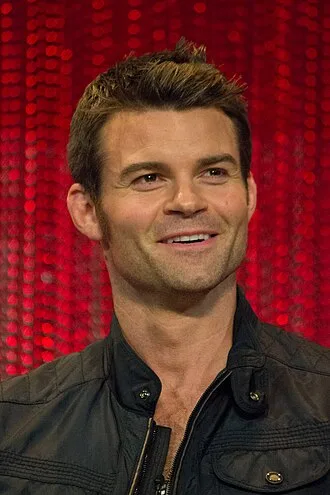
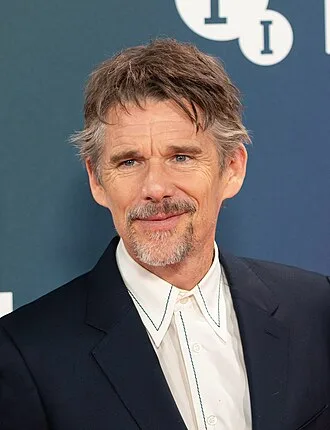
Ethan Hawke
Hawke made his film debut at age fourteen in Explorers (1985) and gained recognition for starring in Dead Poets Society (1989). He established himself as a leading man with the films Reality Bites (1994), Gattaca (1997), and Great Expectations (1998). He received nominations for the Academy Award for Best Supporting Actor for his roles in the crime thriller Training Day (2001) and coming-of-age drama Boyhood (2014); the latter garnered him BAFTA and Golden Globe nominations in the same category.
Hawke was Oscar-nominated twice for screenwriting two films from Before trilogy (1995–2013), in which he also starred. He earned Best Actor nominations at the Oscars, BAFTAs, and Golden Globes for portraying lyricist Lorenz Hart in the biopic Blue Moon (2025).
Hawke garnered commercial success with Sinister (2012), The Purge (2013), The Magnificent Seven (2016), and the Black Phone films (2021–2025), and was praised for Maudie (2016) and First Reformed (2017). He directed the films Chelsea Walls (2001), The Hottest State (2006), Blaze (2018), and Wildcat (2023), as well as the documentaries Seymour: An Introduction (2014), The Last Movie Stars (2022), and Highway 99: A Double Album (2025).
He portrayed abolitionist John Brown in the miniseries The Good Lord Bird (2020), for which he received a Golden Globe nomination, and appeared as Arthur Harrow in the Marvel miniseries Moon Knight (2022).
Hawke has appeared in many theater productions. He made his Broadway debut in 1992 in Anton Chekhov's The Seagull and was nominated for a Tony Award for Best Featured Actor in a Play in 2007 for his performance in Tom Stoppard's The Coast of Utopia. In 2010, he was nominated for the Drama Desk Award for Outstanding Director of a Play for directing Sam Shepard's A Lie of the Mind.
Divorced from actress Uma Thurman, he has been married to Ryan Shawhughes since 2008; he has two children from each marriage, including actors Maya and Levon Hawke.
Early life
Ethan Green Hawke was born in Austin, Texas, on November 6, 1970. His father, James Hawke, was an insurance actuary, while his mother, Leslie (née Green), was a charity worker and teacher. Hawke's parents were high school sweethearts from Fort Worth, Texas, and married when his mother was seventeen. Hawke was born a year later, while both of his parents were attending the University of Texas in Austin. His parents separated and later divorced in 1974.
After his parents separated, Hawke was raised by his mother. Hawke recalled first donning different personas as a child trying to please his parents, by pretending to be an "artistic, literary, conscientious political thinker" for his mother and a well-mannered, religious football lover when visiting his father. Hawke and his mother moved several times before settling in the Brooklyn borough of New York City, where he attended the Packer Collegiate Institute.
Hawke often shifted his personality to fit in with different groups of peers that he encountered in their moves. When Hawke was 10 or 12, his mother remarried and the family relocated to West Windsor Township, New Jersey. There, he attended West Windsor Plainsboro High School before transferring to the Hun School of Princeton, a boarding school from which he graduated in 1988.
Around this time, Hawke volunteered with his mother's organization, the Alex Fund, a charity that supported educational opportunities for underprivileged children in Romania.
In high school, Hawke aspired to become a writer while also developing a strong interest in acting. During his time at the Hun School, he also studied acting at the McCarter Theatre on the Princeton University campus. He made his stage debut at age thirteen in the theater's production of George Bernard Shaw's Saint Joan.
He later performed in his high school's productions of Meet Me in St. Louis and You Can't Take It with You. After graduating, Hawke continued to study acting at Carnegie Mellon University in Pittsburgh but left after being cast in Dead Poets Society (1989). He later enrolled in New York University's English program for two years before leaving to pursue acting full-time.
Career
1985–1993: Early years and breakthrough
Discovered through the production of Saint Joan, Hawke was invited to attend his first casting call at age 14 and secured a role as a misfit schoolboy in Joe Dante's Explorers (1985). The film received mixed reviews and performed poorly at the box office, leading Hawke to step away from acting for a time.
He later described the experience as difficult to handle at such a young age, remarking, "I would never recommend that a kid act". In 1989, Hawke had his breakthrough role as a shy boarding school student in Peter Weir's Dead Poets Society. The film was critically and commercially successful and won the BAFTA Award for Best Film.
Reflecting on the impact of its success, Hawke later said, "I didn't want to be an actor and I went back to college. But then the film's success was so monumental that I was getting offers to be in such interesting movies and be in such interesting places and it seemed silly to pursue anything else." After filming Dead Poets Society, he auditioned for his next project, the comedy-drama Dad (1989), and settled in New York City due to its prominent theater industry and variety of opportunities.
In 1991, Hawke co-founded Malaparte, a Manhattan-based theater company that operated until 2000. His first leading role came with Randal Kleiser's film White Fang (1991), an adaptation of Jack London's novel of the same name, in which he portrayed a young Klondike gold prospector who befriends a wolfdog. A writer for The Oregonian appreciated how he kept the film from "being ridiculous or overly sentimental", while Roger Ebert praised how he was "properly callow at the beginning and properly matured at the end"; Hawke himself later called it the "single best experience of my acting life".
In A Midnight Clear (1992), his character leads a group of American soldiers during World War II, tasked with capturing a small squad of German troops stationed in the Ardennes forest in France. Hawke made his Broadway debut in 1992, portraying the playwright Konstantin Treplev in Anton Chekhov's The Seagull at the Lyceum Theater in Manhattan.
He then played Nando Parrado, one of the survivors of the Uruguayan Air Force Flight 571 crash in the Andes, in the survival drama Alive (1993), adapted from Piers Paul Read's 1974 non-fiction book.
1994–2000: Established leading man
In 1993, actress Winona Ryder offered Hawke a leading role in Ben Stiller's Generation X drama Reality Bites (1994). Hawke was reluctant to accept the offer due to his dislike of the characters, but he reconsidered it because he admired Ryder and appreciated the script. The film grossed $41 million on a budget of $11 million and later became a cult classic; of Hawke's performance, Owen Gleiberman said he had "suddenly grown up into a magnetic performer".
With Reality Bites, Hawke attained celebrity status and became known as an alternative heartthrob, a perception fueled by his blue eyes, well-defined jaw, goatee, and tousled hair. His portrayal of a disillusioned musician in the film led to him being strongly associated with the character and deemed the poster boy of Generation X, with journalist Vanessa Grigoriadis describing his image at the time as "the sensitive pretty boy hanging around a patchouli-scented dorm hall discussing the meaning of life".
Hawke felt initially irked by the label, believing it to be a restricting marketing term, but he embraced it later in his career.
Instead of accepting roles in big-budget Hollywood films offered to him, Hawke chose to collaborate with directors whom he believed "could stoke his creativity", starring in Richard Linklater's Before Sunrise (1995) among others. Linklater said that, at the time, he had been searching for actors as well as creative partners, inviting Hawke and co-star Julie Delpy to contribute to the dialogue and character development with their own personal experiences.
The first installment of the Before film trilogy, Before Sunrise follows an American man (Hawke) and a French woman (Delpy) who meet on a train and disembark together in Vienna. The film received positive reviews praising Hawke and Delpy's performances; The Hollywood Reporter retrospectively called it "one of cinema's most sustained explorations of love and the passage of time".
Hawke directed the music video for Lisa Loeb's US Billboard Hot 100 number-one single "Stay (I Missed You)"; Loeb was then a member of Hawke's theater company. Spin magazine named the video its Video of the Year in 1994. Hawke appeared in a 1995 production of Sam Shepard's Buried Child, directed by Gary Sinise at the Steppenwolf Theater in Chicago.
In 1996 he published his first novel, titled The Hottest State, which tells the story of a love affair between a young actor and a singer. He described writing the book as both the "scariest [... but also] one of the best things I ever did." Entertainment Weekly said Hawke "opens himself to rough literary scrutiny in The Hottest State.
If Hawke is serious [...] he'd do well to work awhile in less exposed venues." The New York Times thought Hawke did "a fine job of showing what it's like to be young and full of confusion", concluding The Hottest State was ultimately "a sweet love story".
"Writing the book had to do with dropping out of college and with being an actor. I didn't want my whole life to go by and not do anything but recite lines. I wanted to try making something else. It was definitely the scariest thing I ever did. And it was just one of the best things I ever did."
Hawke called his script in Andrew Niccol's science fiction film Gattaca (1997) "one of the more interesting" ones he had read in "a number of years". In it, he played the role of a man who infiltrates a society of genetically perfect humans by assuming another man's identity. Ebert called him a good choice for the lead role, stating that he "combin[es] the restless dreams of a 'Godchild' with the plausible exterior of a lab baby".
Alongside Gwyneth Paltrow and Robert De Niro, he starred as a modern-day Pip in Great Expectations (1998), a contemporary film adaptation of Charles Dickens's 1861 novel of the same name, directed by Alfonso Cuarón. Hawke criticized the film's time of release, stating that "nobody gave a shit about anything but Titanic for about nine months after [...] particularly another romance".
He collaborated with Linklater once again on The Newton Boys (1998), based on the true story of the Newton Gang. The film saw generally negative reception; Rotten Tomatoes' consensus said the "sharp" cast made up for "the frustrations of a story puzzlingly short on dramatic tension".
In 1999, he starred as Kilroy in the Tennessee Williams play Camino Real at the Williamstown Theater Festival in Massachusetts. That year, Hawke starred in Snow Falling on Cedars, adapted from David Guterson's novel of the same name. Set in the 1950s, he played a young reporter who covers the murder trial of a fisherman.
The film received a tepid response, with Entertainment Weekly commenting that "Hawke scrunches himself into such a dark knot that we have no idea who [his character] Ishmael is or why he acts as he does". Hawke then portrayed the titular character in Michael Almereyda's Hamlet (2000), set in contemporary New York City, a choice Hawke said made the story feel more "accessible and vital".
The summer before filming, Hawke attended three study sessions a week with a friend who had played the part. Of his performance, Manohla Dargis said that "Hawke's intimate, precise and quietly moving delivery brings you closer to the character", while The Times commented that his "moping slows things down too much".
2001–2006: Training Day and further Linklater films
In 2001, Hawke appeared in two more Linklater films: Waking Life and Tape, both critically acclaimed. In the animated Waking Life, he shared a single scene with former co-star Delpy continuing conversations begun in Before Sunrise. The real-time drama Tape, based on a play by Stephen Belber, took place entirely in a single motel room with three characters played by Hawke, his Dead Poets Society co-star Robert Sean Leonard and his wife Uma Thurman.
Hawke then portrayed rookie cop Jake Hoyt alongside Denzel Washington, as part of a pair of narcotics detectives from the Los Angeles Police Department spending a day in the gang-infested neighborhoods of South Los Angeles, in Training Day (2001). The film saw favorable critical reception; Paul Clinton of CNN described Hawke's performance as "totally believable as a doe-eyed rookie going toe-to-toe with a legend [Washington]".
Hawke later called Training Day his "best experience in Hollywood". His performance earned him nominations for the Screen Actors Guild Award for Outstanding Performance by a Male Actor in a Supporting Role and the Academy Award for Best Supporting Actor.
Hawke explored several projects outside of acting in the early 2000s. He made his directorial debut with Chelsea Walls (2002), an independent drama about five struggling artists living in New York City's Hotel Chelsea. The New Yorker commented that Hawke managed to capture "the woozy, dissolute atmosphere of the place", but "the movie sink[ed] with its script".
That same year, he published his second novel, Ash Wednesday (2002), which appeared on The New York Times Best Seller list. Centered on an AWOL soldier and his pregnant girlfriend, the novel earned praise from critics. The Guardian described it as "sharply and poignantly written [...] an intense one-sitting read", while James noted that Hawke showed "a novelist's innate gifts [...] a sharp eye, a fluid storytelling voice and the imagination to create complicated individuals", though it found him "weaker at narrative tricks that can be taught".
Returning to Broadway, he played Henry Percy (Hotspur) in Jack O'Brien's 2003 production of Henry IV. Ben Brantley, writing in The New York Times, opined that Hawke's interpretation of Hotspur might be "too contemporary for some tastes", but allowed "great fun to watch as he fumes and fulminates".
Hawke returned to film in 2004 with two releases: the psychological thriller Taking Lives and the romantic drama Before Sunset. Upon release, Taking Lives received broadly negative reviews, though Hawke's performance as a serial killer who takes on the identities of his victims was favored by a critic from the Star Tribune, who said that he played the "complex character persuasively".
He then reunited with Linklater for Before Sunset, the second installment of the Before trilogy. Co-written by Hawke, Linklater and Delpy, the film follows a young man and woman who reunite in Paris nine years after meeting in Vienna. A Hartford Courant writer remarked that the screenwriting collaboration between the three "[kept] Jesse and Celine iridescent and fresh, one of the most delightful and moving of all romantic movie couples".
Hawke called it one of his favorite films, a "romance for realists". Before Sunset was nominated for an Academy Award for Best Adapted Screenplay.
Hawke starred in the 2005 action thriller Assault on Precinct 13, a loose remake of John Carpenter's 1976 film of the same name with an updated storyline. He played a police sergeant who must band together with criminals to defend a police precinct from a siege by corrupt cops. While numerous critics found it inferior to the original, they enjoyed Hawke's performance, with Jami Bernard from New York Daily News stating that Hawke and co-star Laurence Fishburne made the film work, "supported by a mostly strong cast".
In 2006, he directed his second feature film, The Hottest State, based on his 1996 novel of the same name. It saw poor reception from critics, largely for being too self-conscious and overly pretentious. From November 2006 to May 2007, Hawke starred as Mikhail Bakunin in Tom Stoppard's trilogy play The Coast of Utopia, an eight-hour-long production at the Lincoln Center Theater in New York. The performance earned Hawke a Tony Award nomination for the Best Featured Actor in a Play.
2007–2012: Continued acclaim
Hawke starred alongside Philip Seymour Hoffman, Marisa Tomei, and Albert Finney in the crime drama Before the Devil Knows You're Dead (2007), the final direction of Sidney Lumet. Hawke prepared for his role by working closely with Lumet during a two-week rehearsal period, which allowed the cast to make creative decisions before filming began.
On-set, Lumet intentionally pitted Hawke and Hoffman against each other to heighten the tension. In Before the Devil Knows You're Dead, Hawke played the younger brother of a debt-ridden broker who entices him into a plan to rob their parents' bank, but the scheme goes awry. USA Today's Claudia Puig deemed the film "highly entertaining", describing Hawke and Hoffman's performances as excellent, while Peter Travers, writing for Rolling Stone, stated that Hawke "[dug] deep to create a haunting portrayal of loss".
📚 Source: Wikipedia