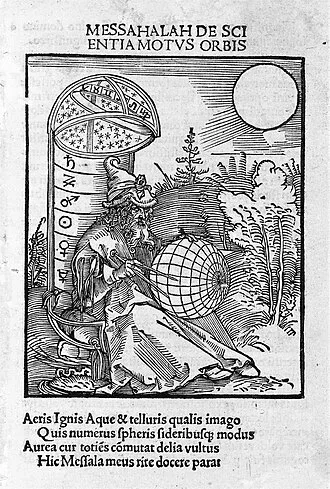
The distinction between the quantitative exact sciences and those sciences that deal with the causes of things is due to Aristotle, who distinguished mathematics from natural philosophy and considered the exact sciences to be the "more natural of the branches of mathematics." Thomas Aquinas employed this distinction when he said that astronomy explains the spherical shape of the Earth by mathematical reasoning while physics explains it by material causes.
This distinction was widely, but not universally, accepted until the Scientific Revolution of the 17th century. Edward Grant has proposed that a fundamental change leading to the new sciences was the unification of the exact sciences and physics by Johannes Kepler, Isaac Newton, and others, which resulted in a quantitative investigation of the physical causes of natural phenomena.