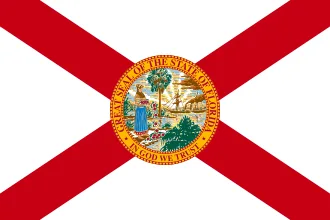
Various Native American groups have inhabited Florida for at least 14,000 years. In 1513, Spanish explorer and conquistador Juan Ponce de León became the first European to make landfall in the region. He called the peninsula La Pascua Florida in recognition of the verdant landscape and because it was the Easter season, which the Spaniards called Pascua Florida (Festival of Flowers). giving the territory its present name.
Spain subsequently incorporated Florida into the Spanish Empire in the early 16th century. In 1565, it founded St. Augustine, the oldest continuously inhabited European-established settlement in the United States. The region was frequently coveted and attacked by Great Britain throughout the 18th century. Britain briefly gained control of Florida in 1763, but Spain recovered it in 1783 following the British defeat in the American Revolutionary War.
Florida remained under Spanish rule until it was ceded to the United States in 1821, in exchange for U.S. recognition of Spanish sovereignty in Texas and the resolution of the border dispute along the Sabine River. Florida was admitted as the 27th state on March 3, 1845, and was the principal location of the Seminole Wars (1816–1858), the longest and most extensive of the American Indian Wars.
The state seceded from the Union on January 10, 1861, becoming one of the seven original Confederate States, and was readmitted to the Union after the Civil War on June 25, 1868.
Since the mid-20th century, Florida has experienced rapid demographic and economic growth. Its economy, with a gross state product (GSP) of $1.647 trillion, is the fourth largest of any U.S. state and the fifteenth-largest in the world; the main sectors are tourism, hospitality, agriculture, real estate, and transportation.
Florida is world-renowned for its beach resorts, amusement parks, warm and sunny climate, and nautical recreation; attractions such as Walt Disney World, the Kennedy Space Center, and Miami Beach draw tens of millions of visitors annually. Florida is a popular destination for retirees, seasonal vacationers, and both domestic and international migrants.
The state's close proximity to the ocean has shaped its culture, identity, and daily life; its colonial history and successive waves of migration are reflected in European, Latino, African, Indigenous, and Asian influences. Florida has attracted or inspired some of the most prominent American writers, including Ernest Hemingway, Marjorie Kinnan Rawlings, and Tennessee Williams, and continues to attract celebrities and athletes, especially in golf, tennis, auto racing, and water sports.
Initially a battleground state in American presidential elections, it has turned increasingly Republican in recent years.
Florida's climate varies from subtropical in the north to tropical in the south. It is the only state besides Hawaii to have a tropical climate, and the only continental state with a coral reef. Florida has several unique ecosystems, including Everglades National Park, the largest tropical wilderness in the U.S. and among the largest in the Americas.
Unique wildlife includes the American alligator, American crocodile, American flamingo, roseate spoonbill, Florida panther, bottlenose dolphin, and manatee. The Florida Reef is the only living coral barrier reef in the continental United States, and the third-largest coral barrier reef system in the world, after the Great Barrier Reef and the Belize Barrier Reef.
History
The first inhabitants, the Paleo-Indians, entered Florida at least 14,000 years ago. By the 16th century, the earliest time for which there is a historical record, major groups of people living in Florida included the Apalachee of the Florida Panhandle, the Timucua of northern and central Florida, the Ais of the central Atlantic coast, the Mayaimi of the Lake Okeechobee area, the Tequesta of southeastern Florida, and the Calusa of southwest Florida.
European arrival
Florida was the first region of what is now the contiguous United States to be visited and settled by Europeans. The first recorded European explorers to reach Florida were Spaniards led by Juan Ponce de León, who sighted the peninsula on April 2, 1513, and came ashore the next day to seek information and take possession of this new land.
Differing theories state he named the region La Florida in recognition of the region's abundant flora or La Pascua Florida a Spanish name for the Easter season in which it was thought they first landed The story that he was searching for the Fountain of Youth is apocryphal and appeared only long after his death.
In May 1539, Hernando de Soto skirted the coast of Florida, searching for a deep harbor to land. He described a thick wall of red mangroves spread mile after mile, some reaching as high as 70 feet (21 m), with intertwined and elevated roots making landing difficult. Europeans introduced Christianity, cattle, horses, sheep, the Spanish language, and more to Florida.
During the 1520s, an estimated 700,000 Native Americans lived in Florida, but by 1700, the number decreased to only around 2,000 people.
In the 1500s, Spain established several settlements in Florida, like in 1559 when Don Tristán de Luna y Arellano established a settlement at present-day Pensacola, making it one of the first settlements in Florida. It was mostly abandoned by 1561. In 1564–1565, there was a French settlement at Fort Caroline, in present Duval County, which was destroyed by the Spanish.
Today a reconstructed version of the fort stands in its location within Jacksonville, constructed in the mid-1960s.
In 1565, the settlement of St. Augustine (San Agustín) was established under the leadership of admiral and governor Pedro Menéndez de Avilés, creating what would become the oldest continuously occupied European settlements in the continental U.S. and establishing the first generation of Floridanos and the Government of Florida.
The marriage between Luisa de Abrego, a free black domestic servant from Seville, and Miguel Rodríguez, a white Segovian, occurred in 1565 in St. Augustine. It is the first recorded Christian marriage in the continental United States.
Some Floridanos married or had unions with Pensacola, Creek, or African women, both slave and free, and their descendants created a mixed-race population of mestizos and mulattoes. The Spanish encouraged slaves from the Thirteen Colonies to come to Florida as a refuge, promising freedom in exchange for conversion to Catholicism.
King Charles II of Spain issued a royal proclamation freeing all slaves who fled to Florida and accepted conversion and baptism. Most went to the area around St. Augustine, but escaped slaves also reached Pensacola. St. Augustine had mustered an all-black militia unit defending Florida as early as 1683.
The region was frequently coveted and attacked, with English colonists and buccaneers launching several attacks on St. Augustine in the 17th and 18th centuries. Spain built the Castillo de San Marcos in 1672 and Fort Matanzas in 1742 to defend Florida's capital city from attacks, and to maintain its strategic position in the defense of the Captaincy General of Cuba and the Spanish West Indies.
Established in 1738 by governor Manuel de Montiano, Fort Gracia Real de Santa Teresa de Mose (near St. Augustine) became the first legally sanctioned, free Black settlement in North America, where escaped slaves gained freedom in exchange for militia service.
In 1763, as part of the Treaty of Paris ending the Seven Years' War, Spain traded Florida with Britain in exchange for Havana, Cuba, which the British had taken previously; in compensation Spain received Louisiana from France, and many residents, along with much of the remaining Indigenous population, departed for Cuba.
The British built the King's Road from St. Augustine to the Georgia line, crossing the St. Johns River at Wacca Pilatka, later known as 'Cow Ford', which is now the core of Downtown Jacksonville. They split Las Floridas into East Florida and West Florida, a division later kept by Spain, and used land grants to attract settlers, establishing English-speaking communities in what are now Duval, Baker, St.
Johns, and Nassau counties. The British promoted the cultivation of sugarcane, indigo, and fruit; expanded lumber exports; and introduced common law, including trial by jury, habeas corpus, and county government. Neither East nor West Florida sent delegates to draft the Declaration of Independence, and the Floridas remained a Loyalist stronghold during the American Revolution.
In 1783, Spain regained both East and West Florida after Britain's defeat in the Revolutionary War and the subsequent Treaty of Versailles, and continued the provincial divisions until 1821.
Statehood and Indian removal
Americans of English and Scots Irish descent began moving into northern Florida from the backwoods of Georgia and South Carolina. Despite Spanish territorial restrictions, authorities lacked the resources to effectively police the region, allowing settlers from the United States to continually immigrate into Florida unchecked.
These migrants intermingled with remaining British loyalists, ultimately forming the population known as Florida Crackers.
The American settlers established a permanent foothold in the area. The British settlers who had remained also resented Spanish governance, leading to a rebellion in 1810 and the establishment for ninety days of the so-called Free and Independent Republic of West Florida on September 23. After meetings beginning in June, rebels overcame the garrison at Baton Rouge in present-day Louisiana and unfurled the flag of the new republic: a single white star on a blue field. This flag would later become known as the "Bonnie Blue Flag".
In 1810, parts of West Florida were annexed by the proclamation of President James Madison, who claimed the region as part of the Louisiana Purchase. These parts were incorporated into the newly formed Territory of Orleans. The U.S. annexed the Mobile District of West Florida to the Mississippi Territory in 1812. Spain continued to dispute the area, though the United States gradually increased the area it occupied.
In 1812, a group of settlers from Georgia, with de facto support from the U.S. federal government, attempted to overthrow the Floridan government in the province of East Florida. The settlers hoped to convince Floridians to join their cause and proclaim independence from Spain, but the settlers lost their tenuous support from the federal government and abandoned their cause by 1813.
Traditionally, historians argued that Seminoles based in East Florida began raiding Georgia settlements and offering havens for runaway slaves. The United States Army led increasingly frequent incursions into Spanish territory, including the 1817–1818 campaign against the Seminole Indians by Andrew Jackson that became known as the First Seminole War.
The United States now effectively controlled East Florida. Control was necessary according to Secretary of State John Quincy Adams because Florida had become "a derelict open to the occupancy of every enemy, civilized or savage, of the United States, and serving no other earthly purpose than as a post of annoyance to them."
More recent historians describe that after U.S. independence, settlers in Georgia increased pressure on Seminole lands, and skirmishes near the border led to the First Seminole War (1816–1819). The United States purchased Florida from Spain by the Adams-Onis Treaty (1819) and took possession in 1821. The Seminole were moved out of their rich farmland in northern Florida and confined to a large reservation in the interior of the Florida peninsula by the Treaty of Moultrie Creek (1823).
Passage of the Indian Removal Act (1830) led to the Treaty of Payne's Landing (1832), which called for the relocation of all Seminole to Indian Territory (now Oklahoma).
Some resisted, leading to the Second Seminole War, the bloodiest war against Native Americans in United States history. By 1842, most Seminoles and Black Seminoles, facing starvation, were removed to Indian Territory west of the Mississippi River. Perhaps fewer than 200 Seminoles remained in Florida after the Third Seminole War (1855–1858), having taken refuge in the Everglades, from where they never surrendered to the US. They fostered a resurgence in traditional customs and a culture of staunch independence.
Florida had become a burden to Spain, which could not afford to send settlers or troops due to the devastation caused by the Peninsular War. Madrid, therefore, decided to cede the territory to the United States through the Adams–Onís Treaty, which took effect in 1821. President James Monroe was authorized on March 3, 1821, to take possession of East Florida and West Florida for the United States and provide for initial governance.
On behalf of the U.S. government, Andrew Jackson, whom Jacksonville is named after, served as a military commissioner with the powers of governor of the newly acquired territory for a brief period. On March 30, 1822, the U.S. Congress merged East Florida and part of West Florida into the Florida Territory.
By the early 1800s, Indian removal was a significant issue throughout the southeastern U.S. and also in Florida. In 1830, the U.S. Congress passed the Indian Removal Act and as settlement increased, pressure grew on the U.S. government to remove the Indians from Florida. Seminoles offered sanctuary to black people, who became known as the Black Seminoles; clashes between whites and Indians grew with the influx of new settlers.
In 1832, the Treaty of Payne's Landing promised to the Seminoles lands west of the Mississippi River if they agreed to leave Florida. Many Seminoles left at this time.
Some Seminoles remained, and the U.S. Army arrived in Florida, leading to the Second Seminole War (1835–1842). Following the war, approximately 3,000 Seminole and 800 Black Seminole were removed to Indian Territory. A few hundred Seminole remained in Florida in the Everglades.
On March 3, 1845, only one day before the end of President John Tyler's term in office, Florida became the 27th state, admitted as a slave state and no longer a sanctuary for runaway slaves. Initially its population grew slowly.