
















Frankish mythology was the belief system of the Frankish people with roots in Germanic paganism. Over the centuries this mythology was introduced to both Greco-Roman elements and Christianity in the Early Middle Ages. With the conversion to Christianity of King Clovis I of the Merovingian dynasty (around the year 500), the traditional religion among the Franks was gradually replaced by a new belief system.
However, this change did not occur at the same pace everywhere. Until the late 7th century, there were still communities with pagan beliefs in Frankish settlements in the Toxandria region.
The beliefs of the Franks before Christianity were quite similar to those of other Germanic peoples. Thanks to these common features, it is possible to reconstruct, at least partially, the ancient religion of the Franks. During the migration period, the Franks considered forests, hills or waterfronts as sacred places and set up altars in these places.
They were deeply connected to nature and attributed sacredness to forests. Germanic gods were seen as powerful beings who were worshiped by each tribe in their own cult centers and were limited to that place only. The Franks are also thought to have had an "All-Father" figure who was omnipotent and was believed to reside in sacred groves.
This god corresponded to Wuotan, known as Odin in many Germanic societies. They also worshiped gods related to the sky, such as Donar (Thor), the god of thunder, and Zio (Tyr), the god of war. According to Herbert Schutz, the gods of the Franks were beings that had physical forms and were directly associated with worldly objects, unlike the abstract and single God of Christianity.
Animal symbolism also had an important place among the Franks. For example, bulls strong enough to pull the throne were considered sacred, and stealing these animals was even subject to severe penalties under Salian law. Researcher Eduardo Fabbro suggested that the Germanic goddess Nerthus mentioned by Tacitus (the goddess believed to travel around the country riding a chariot pulled by cows) may have been the source of inspiration for Merovech, the legendary founder of the Merovingian dynasty.
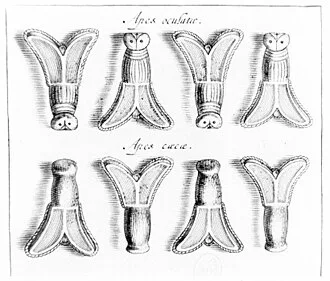
According to this theory, when the Merovingian kings traveled around their country on an oxcart, they were actually symbolizing the divine journey of their ancestors. The golden bull head found in the tomb of Childeric I (died in 481) can also be interpreted as a symbol of these ancient fertility rituals. According to Fabbro, the Frankish pantheon was a variation on the Germanic structure, focusing specifically on fertility gods.
Traces of Frankish mythology are evident in legends and archaeological finds. Narratives similar to the stories of Aeneas and Romulus in Roman mythology were also found among the Franks. These epic stories lived in the collective memory of the people, shaping both their identities and the heroic ideal. The mythological past of the Franks was not just about religious beliefs; it also affected their social structures, laws, and even the origin stories of their dynasties.