
















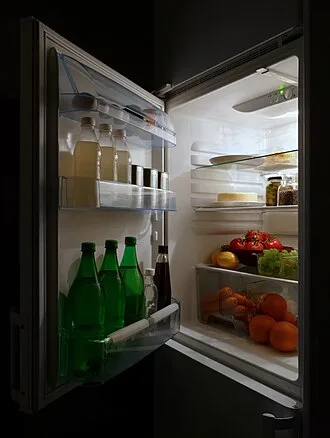
A refrigerator or freezer can be defined as a white appliance that keeps food cold to maintain its freshness for a long time. While most models are based on the vapor compression cycle, lower-efficiency options also include systems based on absorption and the Peltier effect. It keeps the interior cool thanks to a thermal insulation layer and a heat pump (mechanical, electronic or chemical); In this way, our products can be stored for a long time without spoiling. Depending on the area of use, there are household, industrial and commercial refrigerators.
The cold environment slows down the growth rate of microorganisms and prevents food from rotting. A refrigerator maintains an internal temperature just above the freezing point of water, usually between 3–5°C (37–41°F); This range is most suitable for perishable products. The freezer section allows long-term storage of food by providing a temperature below the freezing point of water within the same device.
The main purpose is to lower a closed area below the temperature of the external environment and to make this difference permanent. Since the molecules in the hot region have higher kinetic energy, heat spontaneously flows from the hot region to the cold region; This flow continues until balance is achieved. To obtain the desired low temperature, additional energy is given to the system and thus the balance is disrupted.
Today, refrigeration machines undertake this task; These machines are classified according to the temperature ranges in which they operate and the cooling principles used. The refrigerator is an example of a household cooling machine and is based on a heat pump based on the reverse Carnot cycle. Devices such as air conditioners and refrigerators transfer three to five units of heat while consuming one unit of energy; The fact that their efficiency appears to be greater than one unit is due to the additional heat taken from the environment.
The first cooling methods emerged by storing naturally occurring ice and snow and using them during hot periods. B.C. It has been documented that in the 1000s BC, ice stored in the winter was used to cool food in the summer, and this practice is still observed in some regions. The ancient Egyptians also recorded that they achieved a form of natural cooling by cooling water in the clear sky at night; This phenomenon can be explained by the fact that the night temperature is very low and the heat spreads into space through radiation.
The history of artificial cooling begins in 1755 with a small cooling machine designed by Scottish professor William Cullen, using a pump to create a partial vacuum on a dietetic ether container.