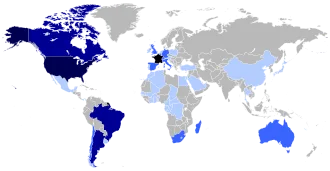
The French people are primarily descended from Gallo-Romans (Romanized Celts) and Germanic peoples such as the Franks, the Visigoths, the Suebi and the Burgundians who settled in Gaul from east of the Rhine after the fall of the Roman Empire, as well as various later waves of lower-level irregular migration that have continued to the present day.
The Norsemen also settled in Normandy in the 10th century and contributed significantly to the ancestry of the Normans. Furthermore, regional ethnic minorities also exist within France that have distinct lineages, languages and cultures such as Bretons in Brittany, Occitans in Occitania, Basques in the French Basque Country, Catalans in northern Catalonia, Germans in Alsace, Corsicans in Corsica and Flemings in French Flanders.
France has long been a patchwork of local customs and regional differences, and while most French people still speak the French language as their mother tongue, languages like Picard, Poitevin-Saintongeais, Franco-Provencal, Occitan, Auvergnat, Corsican, Basque, Lorraine Franconian, Alsatian, Norman, Breton, french flemish and Catalan remain spoken in their respective regions. Arabic is also widely spoken, arguably the largest minority language in France as of the 21st century (a spot previously held by Breton and Occitan).
Modern French society is a melting pot. From the middle of the 19th century, it experienced a high rate of inward migration, mainly consisting of Italians, Portuguese, Spaniards, Berbers, Arabs, Jews, Sub-Saharan Africans, Chinese, and other peoples from the Middle East and East Asia, and the government, defining France as an inclusive nation with universal values, advocated assimilation through which immigrants were expected to adhere to French values and cultural norms.
Nowadays, while the government has let newcomers retain their distinctive cultures since the mid-1980s and requires from them a mere integration, French citizens still equate their nationality with citizenship as does French law.
As of 2025,[update] the total population in France was estimated about 68.6 million. In addition to mainland France, French people and people of French descent can be found internationally, in overseas departments and territories of France such as the French West Indies (French Caribbean), and in foreign countries with significant French-speaking population groups or not, such as the United States (French Americans), Canada (French Canadians), Argentina (French Argentines), Brazil (French Brazilians), Mexico (French Mexicans), Chile (French Chileans) and Uruguay (French Uruguayans).
Citizenship and legal residence
To be French, according to the first article of the French Constitution, is to be a citizen of France, regardless of one's origin, race, or religion (sans distinction d'origine, de race ou de religion). According to its principles, France has devoted itself to the destiny of a proposition nation, a generic territory where people are bounded only by the French language and the assumed willingness to live together, as defined by Ernest Renan's "plébiscite de tous les jours" ('everyday plebiscite') on the willingness to live together, in Renan's 1882 essay "Qu'est-ce qu'une nation?").
The debate concerning the integration of this view with the principles underlying the European Community remains open.
France has been historically open to immigration, although this has changed in recent years. Referring to this perceived openness, Gertrude Stein, wrote: "America is my country but Paris is my home". Indeed, the country has long valued its openness, tolerance and the quality of services available. Application for French citizenship is often interpreted as a renunciation of previous state allegiance unless a dual citizenship agreement exists between the two countries (for instance, this is the case with Switzerland: one can be both French and Swiss).
The European treaties have formally permitted movement and European citizens enjoy formal rights to employment in the state sector (though not as trainees in reserved branches, e.g., as magistrates).
Seeing itself as an inclusive nation with universal values, France has always valued and strongly advocated assimilation. However, the success of such assimilation has recently been called into question. There is increasing dissatisfaction with, and within, growing ethno-cultural enclaves (communautarisme). The 2005 French riots in some troubled and impoverished suburbs (les quartiers sensibles) were an example of such tensions.
However they should not be interpreted as ethnic conflicts (as appeared before in other countries like the US and the UK) but as social conflicts born out of socioeconomic problems endangering proper integration.
History
Historically, the heritage of the French people is mostly of Celtic or Gallic, Latin (Romans) origin, descending from the ancient and medieval populations of Gauls or Celts from the Atlantic to the Rhone Alps, Germanic tribes that settled France from east of the Rhine and Belgium after the fall of the Roman Empire such as the Franks, Burgundians, Allemanni, Visigoths, and Suebi, Latin and Roman tribes such as Ligurians and Gallo-Romans, Basques, and Norse populations largely settling in Normandy at the beginning of the 10th century as well as "Bretons" (Celtic Britons) settling in Brittany in Western France.
The name "France" etymologically derives from the word Francia, the territory of the Franks. The Franks were a Germanic tribe that overran Roman Gaul at the end of the Roman Empire.
Celtic and Roman Gaul
In the pre-Roman era, Gaul (an area of Western Europe that encompassed all of what is known today as France, Belgium, part of Germany and Switzerland, and Northern Italy) was inhabited by a variety of peoples who were known collectively as the Gaulish tribes. Their ancestors were Celts who came from Central Europe in the 7th century BCE or earlier, and non-Celtic peoples including the Ligures, Aquitanians and Basques in Aquitaine.
The Belgae, who lived in the northern and eastern areas, may have had Germanic admixture; many of these peoples had already spoken Gaulish by the time of the Roman conquest.
Gaul was militarily conquered in 58–51 BCE by the Roman legions under the command of General Julius Caesar, except for the south-east which had already been conquered about one century earlier. Over the next six centuries, the two cultures intermingled, creating a hybridized Gallo-Roman culture. In the late Roman era, in addition to colonists from elsewhere in the Empire and Gaulish natives, Gallia also became home to some immigrant populations of Germanic and Scythian origin, such as the Alans.
The Gaulish language is thought to have survived into the 6th century in France, despite considerable Romanization of the local material culture. Coexisting with Latin, Gaulish helped shape the Vulgar Latin dialects that developed into French, with effects including loanwords and calques (including oui, the word for "yes"), sound changes, and influences in conjugation and word order.
Today, the last redoubt of Celtic language in France can be found in the northwestern region of Brittany, although this is not the result of a survival of Gaulish language but of a 5th-century AD migration of Brythonic speaking Celts from Britain.
The Vulgar Latin in the region of Gallia took on a distinctly local character, some of which is attested in graffiti, which evolved into the Gallo-Romance dialects which include French and its closest relatives.
Frankish Kingdom
With the decline of the Roman Empire in Western Europe, a federation of Germanic peoples entered the picture: the Franks, from which the word "French" derives. The Franks were Germanic pagans who began to settle in northern Gaul as laeti during the Roman era. They continued to filter across the Rhine River from present-day Netherlands and Germany between the 3rd and 7th centuries.
Initially, they served in the Roman army and obtained important commands. Their language is still spoken as a kind of Dutch (French Flemish) in northern France (French Flanders). The Alamans, another Germanic people immigrated to Alsace, hence the Alemannic German now spoken there. The Alamans were competitors of the Franks, and their name is the origin of the French word for "German": Allemand.
By the early 6th century, the Franks, led by the Merovingian king Clovis I and his sons, had consolidated their hold on much of modern-day France. The other major Germanic people to arrive in France, after the Burgundians and the Visigoths, were the Norsemen or Northmen. Known by the shortened name "Norman" in France, these were Viking raiders from modern Denmark and Norway.
They settled with Anglo-Scandinavians and Anglo-Saxons from the Danelaw in the region known today as Normandy in the 9th and 10th centuries. This later became a fiefdom of the Kingdom of France under King Charles III. The Vikings eventually intermarried with the local people, converting to Christianity in the process. The Normans, two centuries later, went on to conquer England and Southern Italy.
Eventually, though, the largely autonomous Duchy of Normandy was incorporated back into the royal domain (i. e. the territory under direct control of the French king) in the Middle Ages. In the crusader Kingdom of Jerusalem, founded in 1099, at most 120,000 Franks, who were predominantly French-speaking Western Christians, ruled over 350,000 Muslims, Jews, and native Eastern Christians.
Kingdom of France
Unlike elsewhere in Europe, France experienced relatively low levels of emigration to the Americas, with the exception of the Huguenots, due to a lower birthrate than in the rest of Europe. However, significant emigration of mainly Roman Catholic French populations led to the settlement of the Province of Acadia, Canada (New France) and Louisiana, all (at the time) French possessions, as well as colonies in the West Indies, Mascarene islands and Africa.
On 30 December 1687, a community of French Huguenots settled in South Africa. Most of these originally settled in the Cape Colony, but have since been quickly absorbed into the Afrikaner population. After Champlain's founding of Quebec City in 1608, it became the capital of New France. Encouraging settlement was difficult, and while some immigration did occur, by 1763 New France only had a population of some 65,000.
From 1713 to 1787, 30,000 colonists immigrated from France to the Saint-Domingue. In 1805, when the French were forced out of Saint-Domingue (Haiti), 35,000 French settlers were given lands in Cuba.
By the beginning of the 17th century, some 20% of the total male population of Catalonia was made up of French immigrants. In the 18th century and early 19th century, a small migration of French emigrated by official invitation of the Habsburgs to the Austro-Hungarian Empire, now the nations of Austria, Czech Republic, Hungary, Slovakia, Serbia, and Romania.
Some of them, coming from French-speaking communes in Lorraine or being French Swiss Walsers from the Valais canton in Switzerland, maintained for some generations the French language and a specific ethnic identity, later labelled as Banat (French: Français du Banat). By 1788, there were eight villages populated by French colonists.
French Republic
The French First Republic appeared following the 1789 French Revolution. It replaced the ancient kingdom of France, ruled by the divine right of kings.
The 1870 Franco-Prussian War, which led to the short-lived Paris Commune of 1871, was instrumental in bolstering patriotic feelings; until World War I (1914–1918), French politicians never completely lost sight of the disputed Alsace-Lorraine region which played a major role in the definition of the French nation and therefore of the French people.
The decrees of 24 October 1870 by Adolphe Crémieux granted automatic and massive French citizenship to all Jewish people of Algeria.
20th century
Successive waves of immigrants during the 19th and 20th centuries were rapidly assimilated into French culture. France's population dynamics began to change in the middle of the 19th century, as France joined the Industrial Revolution. The pace of industrial growth attracted millions of European immigrants over the next century, with especially large numbers arriving from Poland, Belgium, Portugal, Italy, and Spain.
In the period from 1915 to 1950, many immigrants came from Czechoslovakia, Hungary, Russia, Scandinavia and Yugoslavia. Small but significant numbers of Frenchmen in the North and Northeast regions have relatives in Germany and Great Britain.
Between 1956 and 1967, about 235,000 North African Jews from Algeria, Tunisia, and Morocco also immigrated to France due to the decline of the French empire and following the Six-Day War. Hence, by 1968, Jews of North African origin comprised the majority of the Jewish population of France. As these new immigrants were already culturally French they needed little time to adjust to French society.
French law made it easy for thousands of settlers (colons in French), national French from former colonies of North and East Africa, India and Indochina to live in mainland France. It is estimated that 20,000 settlers were living in Saigon in 1945, and there were 68,430 European settlers living in Madagascar in 1958. 1.6 million European pieds noirs settlers migrated from Algeria, Tunisia and Morocco.
In just a few months in 1962, 900,000 pied noir settlers left Algeria in the most massive relocation of population in Europe since the World War II. In the 1970s, over 30,000 French settlers left Cambodia during the Khmer Rouge regime as the Pol Pot government confiscated their farms and land properties.
In the 1960s, a second wave of immigration came to France, which was needed for reconstruction purposes and for cheaper labour after the devastation brought on by World War II. French entrepreneurs went to Maghreb countries looking for cheap labour, thus encouraging work-immigration to France. Their settlement was officialized with Jacques Chirac's family regrouping act of 1976 (regroupement familial).
Since then, immigration has become more varied, although France stopped being a major immigration country compared to other European countries. The large impact of North African and Arab immigration is the greatest and has brought racial, socio-cultural and religious questions to a country seen as homogenously European, French and Christian for thousands of years.
Nevertherless, according to Justin Vaïsse, professor at Sciences Po Paris, integration of Muslim immigrants is happening as part of a background evolution and recent studies confirmed the results of their assimilation, showing that "North Africans seem to be characterized by a high degree of cultural integration reflected in a relatively high propensity to exogamy" with rates ranging from 20% to 50%.
According to Emmanuel Todd the relatively high exogamy among French Algerians can be explained by the colonial link between France and Algeria.
A small French descent group also subsequently arrived from Latin America (Argentina, Chile and Uruguay) in the 1970s.