














German is one of the major languages of the world, with nearly 100 million native speakers and over 130 million total speakers as of 2024. It is the most spoken native language within the European Union. German is the second-most widely spoken Germanic language, after English, both as a first and as a second language.
German is also widely taught as a foreign language, especially in continental Europe (where it is the third most taught foreign language after English and French) and in the United States (where it is the third most commonly learned second language in K-12 education and among the most studied foreign languages in higher education after Spanish and French).
Overall, German is the fourth most commonly learned second language globally. The language has been influential in the fields of philosophy, theology, science, and technology. It is the second most commonly used language in science and the third most widely used language on websites. The German-speaking countries are ranked fifth in terms of annual publication of new books, with one-tenth of all books (including e-books) in the world being published in German.
German is most closely related to other West Germanic languages, namely Afrikaans, Dutch, English, the Frisian languages, and Scots. It also contains close similarities in vocabulary to some languages in the North Germanic group, such as Danish, Norwegian, and Swedish. Modern German gradually developed from Old High German, which in turn developed from Proto-Germanic during the Early Middle Ages.
German is an inflected language, with four cases for nouns, pronouns, and adjectives (nominative, accusative, genitive, dative); three genders (masculine, feminine, neuter) and two numbers (singular, plural). It has strong and weak verbs. The majority of its vocabulary is derived from the ancient Germanic branch of the Indo-European language family, while a smaller share is partly derived from Latin and Greek, along with fewer words borrowed from French and Modern English. English, however, is the main source of more recent loanwords.
German is a pluricentric language; the three standardised variants are German, Austrian, and Swiss Standard German. Standard German is sometimes called High German, which refers to its regional origin. German is also notable for its broad spectrum of dialects, with many varieties existing in Europe and other parts of the world. Some of these non-standard varieties have become recognised and protected by regional or national governments.
Since 2004, heads of state of the German-speaking countries have met every year, and the Council for German Orthography has been the main international body regulating German orthography.
Classification
German is an Indo-European language that belongs to the West Germanic group of the Germanic languages. The Germanic languages are traditionally subdivided into three branches: North Germanic, East Germanic, and West Germanic. The first of these branches survives in modern Danish, Swedish, Norwegian, Faroese, and Icelandic, all of which are descended from Old Norse.
The East Germanic languages are now extinct, and Gothic is the only language in this branch which survives in written texts. The West Germanic languages, however, have undergone extensive dialectal subdivision and are now represented in modern languages such as English, German, Dutch, Yiddish, Afrikaans, and others.
Within the West Germanic language dialect continuum, the Benrath and Uerdingen lines (running through Düsseldorf-Benrath and Krefeld-Uerdingen, respectively) serve to distinguish the Germanic dialects that were affected by the High German consonant shift (south of Benrath) from those that were not (north of Uerdingen).
The various regional dialects spoken south of these lines are grouped as High German dialects, while those spoken to the north comprise the Low German and Low Franconian dialects. As members of the West Germanic language family, High German, Low German, and Low Franconian have been proposed to be further distinguished historically as Irminonic, Ingvaeonic, and Istvaeonic, respectively.
This classification indicates their historical descent from dialects spoken by the Irminones (also known as the Elbe group), Ingvaeones (or North Sea Germanic group), and Istvaeones (or Weser–Rhine group).
Standard German is based on a combination of Thuringian-Upper Saxon and Upper Franconian dialects, which are Central German and Upper German dialects belonging to the High German dialect group. German is therefore closely related to the other languages based on High German dialects, such as Luxembourgish (based on Central Franconian dialects) and Yiddish.
Also closely related to Standard German are the Upper German dialects spoken in the southern German-speaking countries, such as Swiss German (Alemannic dialects) and the various Germanic dialects spoken in the French region of Grand Est, such as Alsatian (mainly Alemannic, but also Central–and Upper Franconian dialects) and Lorraine Franconian (Central Franconian).
After these High German dialects, standard German is less closely related to languages based on Low Franconian dialects (e.g., Dutch and Afrikaans), Low German or Low Saxon dialects (spoken in northern Germany and southern Denmark), neither of which underwent the High German consonant shift. As has been noted, the former of these dialect types is Istvaeonic and the latter Ingvaeonic, whereas the High German dialects are all Irminonic; the differences between these languages and standard German are therefore considerable.
Also related to German are the Frisian languages—North Frisian (spoken in Nordfriesland), Saterland Frisian (spoken in Saterland), and West Frisian (spoken in Friesland)—as well as the Anglic languages of English and Scots. These Anglo-Frisian dialects did not take part in the High German consonant shift, and the Anglic languages also adopted much vocabulary from both Old Norse and the Norman language.
History
Old High German
The history of the German language begins with the High German consonant shift during the Migration Period, which separated Old High German dialects from Old Saxon. This sound shift involved a drastic change in the pronunciation of both voiced and voiceless stop consonants (b, d, g, and p, t, k, respectively). The primary effects of the shift were the following below.
- Voiceless stops became long (geminated) voiceless fricatives following a vowel;
- Voiceless stops became affricates in word-initial position, or following certain consonants;
- Voiced stops became voiceless in certain phonetic settings.
- /p/→/ff/ — /p/→/pf/ — /b/→/p/
- /t/→/ss/ — /t/→/ts/ — /d/→/t/
- /k/→/xx/ — /k/→/kx/ — /g/→/k/
While there is written evidence of the Old High German language in several Elder Futhark inscriptions from as early as the sixth century AD (such as the Pforzen buckle), the Old High German period is generally seen as beginning with the Abrogans (written c. 765–775), a Latin-German glossary supplying over 3,000 Old High German words with their Latin equivalents.
After the Abrogans, the first coherent works written in Old High German appear in the ninth century, chief among them being the Muspilli, Merseburg charms, and Hildebrandslied, and other religious texts (the Georgslied, Ludwigslied, Evangelienbuch, and translated hymns and prayers).
The Muspilli is a Christian poem written in a Bavarian dialect offering an account of the soul after the Last Judgment, and the Merseburg charms are transcriptions of spells and charms from the pagan Germanic tradition. Of particular interest to scholars, however, has been the Hildebrandslied, a secular epic poem telling the tale of an estranged father and son unknowingly meeting each other in battle.
Linguistically, this text is highly interesting due to the mixed use of Old Saxon and Old High German dialects in its composition. The written works of this period stem mainly from the Alamanni, Bavarian, and Thuringian groups, all belonging to the Elbe Germanic group (Irminones), which had settled in what is now southern-central Germany and Austria between the second and sixth centuries, during the great migration.
In general, the surviving texts of Old High German (OHG) show a wide range of dialectal diversity with very little written uniformity. The early written tradition of OHG survived mostly through monasteries and scriptoria as local translations of Latin originals; as a result, the surviving texts are written in highly disparate regional dialects and exhibit significant Latin influence, particularly in vocabulary.
At this point monasteries, where most written works were produced, were dominated by Latin, and German saw only occasional use in official and ecclesiastical writing.
Middle High German
While there is no complete agreement over the dates of the Middle High German (MHG) period, it is generally seen as lasting from 1050 to 1350. This was a period of significant expansion of the geographical territory occupied by Germanic tribes, and consequently of the number of German speakers. Whereas during the Old High German period the Germanic tribes extended only as far east as the Elbe and Saale rivers, the MHG period saw a number of these tribes expanding beyond this eastern boundary into Slavic territory (known as the Ostsiedlung).
With the increasing wealth and geographic spread of the Germanic groups came greater use of German in the courts of nobles as the standard language of official proceedings and literature. A clear example of this is the mittelhochdeutsche Dichtersprache employed in the Hohenstaufen court in Swabia as a standardised supra-dialectal written language.
While these efforts were still regionally bound, German began to be used in place of Latin for certain official purposes, leading to a greater need for regularity in written conventions.
While the major changes of the MHG period were socio-cultural, High German was still undergoing significant linguistic changes in syntax, phonetics, and morphology as well (e.g., diphthongisation of certain vowel sounds: hus (OHG & MHG "house")→haus (regionally in later MHG)→Haus (NHG), and weakening of unstressed short vowels to schwa [ə]: taga (OHG "days")→tage (MHG)).
A great wealth of texts survives from the MHG period. Significantly, these texts include a number of impressive secular works, such as the Nibelungenlied, an epic poem telling the story of the dragon-slayer Siegfried (c. thirteenth century), and the Iwein, an Arthurian verse poem by Hartmann von Aue (c. 1203), lyric poems, and courtly romances such as Parzival and Tristan.
Also noteworthy is the Sachsenspiegel, the first book of laws written in Middle Low German (c. 1220). The abundance and especially the secular character of the literature of the MHG period demonstrate the beginnings of a standardised written form of German, as well as the desire of poets and authors to be understood by individuals on supra-dialectal terms.
The Middle High German period is generally seen as ending when the 1346–53 Black Death decimated Europe's population.
Early New High German
Modern High German begins with the Early New High German (ENHG) period, which Wilhelm Scherer dates 1350–1650, terminating with the end of the Thirty Years' War. This period saw the further displacement of Latin by German as the primary language of courtly proceedings and, increasingly, of literature in the German states.
While these states were still part of the Holy Roman Empire, and far from any form of unification, the desire for a cohesive written language that would be understandable across the many German-speaking principalities and kingdoms was stronger than ever. As a spoken language German remained highly fractured throughout this period, with a vast number of often mutually incomprehensible regional dialects being spoken throughout the German states; the invention of the printing press c. 1440 and the publication of Luther's vernacular translation of the Bible in 1534, however, had an immense effect on standardising German as a supra-dialectal written language.
The ENHG period saw the rise of several important cross-regional forms of chancery German, one being gemeine tiutsch, used in the court of the Holy Roman Emperor Maximilian I, and the other being Meißner Deutsch, used in the Electorate of Saxony in the Duchy of Saxe-Wittenberg.
Alongside these courtly written standards, the invention of the printing press led to the development of a number of printers' languages (Druckersprachen) aimed at making printed material readable and understandable across as many diverse dialects of German as possible. The greater ease of production and increased availability of written texts brought about increased standardisation in the written form of German.
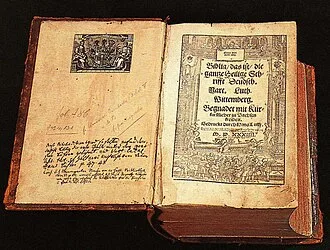
One of the central events in the development of ENHG was the publication of Luther's translation of the Bible into High German (the New Testament was published in 1522; the Old Testament was published in parts and completed in 1534). Luther based his translation primarily on the Meißner Deutsch of Saxony, spending much time among the population of Saxony researching the dialect so as to make the work as natural and accessible to German speakers as possible.
Copies of Luther's Bible featured a long list of glosses for each region, translating words which were unknown in the region into the regional dialect. Luther said the following concerning his translation method:
One who would talk German does not ask the Latin how he shall do it; he must ask the mother in the home, the children on the streets, the common man in the market-place and note carefully how they talk, then translate accordingly. They will then understand what is said to them because it is German. When Christ says 'ex abundantia cordis os loquitur,' I would translate, if I followed the papists, aus dem Überflusz des Herzens redet der Mund.
But tell me is this talking German? What German understands such stuff? No, the mother in the home and the plain man would say, Wesz das Herz voll ist, des gehet der Mund über.
Luther's translation of the Bible into High German was also decisive for the German language and its evolution from Early New High German to modern Standard German. The publication of Luther's Bible was a decisive moment in the spread of literacy in early modern Germany, and promoted the development of non-local forms of language and exposed all speakers to forms of German from outside their own area.
With Luther's rendering of the Bible in the vernacular, German asserted itself against the dominance of Latin as a legitimate language for courtly, literary, and now ecclesiastical subject-matter. His Bible was ubiquitous in the German states: nearly every household possessed a copy. Nevertheless, even with the influence of Luther's Bible as an unofficial written standard, a widely accepted standard for written German did not appear until the middle of the eighteenth century.
Habsburg Empire
German was the language of commerce and government in the Habsburg Empire, which encompassed a large area of Central and Eastern Europe. Until the mid-nineteenth century, it was essentially the language of townspeople throughout most of the Empire. Its use indicated that the speaker was a merchant or someone from an urban area, regardless of nationality.
Prague (German: Prag) and Budapest (Buda, German: Ofen), to name two examples, were gradually Germanised in the years after their incorporation into the Habsburg domain. However, Prague had a large German-speaking population since the Middle Ages, as had Pressburg (Pozsony, now Bratislava), which was settled by Germans in the 10th century.
Significant portions of Bohemia and Moravia, now part of the Czech Republic, had become German-speaking during Ostsiedlung. During the Habsburg time, Budapest and cities like Zagreb (German: Agram) or Ljubljana (German: Laibach), contained significant German minorities.