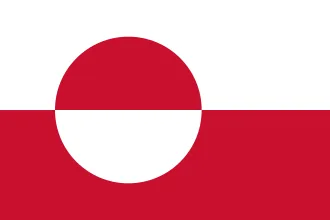
Though a part of the continent of North America, Greenland was politically and culturally associated with the European kingdom of Norway from 986 until the early 15th century. From the 18th century, following the union of Denmark and Norway and the establishment of the Nuuk settlement, Greenland gradually became associated with Denmark.
Greenland has been inhabited at intervals over at least the last 4,500 years by circumpolar peoples whose forebears migrated there from what is now Canada. Norsemen from Norway settled the uninhabited southern part of Greenland beginning in the 10th century (having previously settled Iceland), and their descendants lived in Greenland for 400 years until disappearing in the late 15th century.
From the late 15th century, the Portuguese attempted to find the northern route to Asia, which ultimately led to the earliest cartographic depiction of the coastline. In the 17th century, Dano-Norwegian explorers reached Greenland again, finding their earlier settlement extinct and reestablishing a permanent Scandinavian presence.
When Denmark and Norway separated in 1814, Greenland was transferred from the Norwegian to the Danish crown. The 1953 Constitution of Denmark ended Greenland's status as a colony, integrating it fully into the Danish state. In the 1979 Greenlandic home rule referendum, Denmark granted home rule to Greenland. In the 2008 Greenlandic self-government referendum, Greenlanders voted for the Self-Government Act which transferred more power from the Danish government to the local Naalakkersuisut (Greenlandic government).
Under this structure, Greenland gradually assumed responsibility for governmental services and areas of competence. The Danish government retains control of citizenship, monetary policy, security policies, and foreign affairs. With the melting of the ice due to global warming, its abundance of mineral wealth, and its strategic position between Eurasia, North America, and the Arctic zone, Greenland holds strategic importance for the Kingdom of Denmark, NATO, and the European Union. Since 2025, the United States has pursued threats to annex Greenland, triggering the Greenland crisis.
Most residents of Greenland are Inuit. The population is concentrated mainly on the southwest coast, strongly influenced by climatic and geographical factors, and the rest of the island is sparsely populated. With a population of 56,583 (2022), Greenland is the least densely populated country in the world. Greenland is socially progressive, like metropolitan Denmark; education and healthcare are free, and LGBTQ rights in Greenland are some of the most extensive in the world. Sixty-seven percent of its electricity production comes from renewable energy, mostly from hydropower.
Etymology
The early Norse settlers named the island Greenland. In the Icelandic sagas, the Norwegian Erik the Red was exiled from Iceland with his father, Thorvald Asvaldsson, who had committed manslaughter. With his extended family and his thralls (slaves or serfs), he set out in ships to explore an icy land known to lie to the northwest.
After finding a habitable area and settling there, he named it Grœnland (translated as "Greenland"), supposedly in the hope that the pleasant name would attract settlers. The Saga of Erik the Red states: "In the summer, Erik left to settle in the country he had found, which he called Greenland, as he said people would be attracted there if it had a favourable name." The name of the territory in the Greenlandic language is Kalaallit Nunaat, 'land of the Kalaallit', the Kalaallit being the principal group of Greenlandic Inuit who inhabit the territory's western region. The Greenlandic Inuit term Nunaat does not include waters and ice.
History
Early Palaeo-Inuit cultures
In prehistoric times, Greenland was home to several successive Palaeo-Inuit cultures known primarily through archaeological finds. The earliest entry of the Palaeo-Inuit into Greenland is thought to have occurred about 2500 BC. From about 2500 BC to 800 BC, southern and western Greenland was inhabited by the Saqqaq culture.
Most finds of remains from that period have been around Disko Bay, including the site of Saqqaq, for which the culture is named.
From 2400 BC to 1300 BC, the Independence I culture existed in northern Greenland. It was a part of the Arctic small-tool tradition. Towns including Deltaterrasserne appeared. About 800 BC the Saqqaq culture disappeared, and the Early Dorset culture emerged in western Greenland and the Independence II culture in northern Greenland.
It is unknown whether the Dorset people ever encountered the later Thule people. The people of the Dorset culture lived mainly by hunting seals and reindeer.
Norse settlement
From 986, the west coast was settled by Icelanders and Norwegians, through a contingent of 14 boats led by Erik the Red. They formed three settlements – the Eastern Settlement, the Western Settlement, and the Middle Settlement – on fjords near the southwestern tip of the island. They shared the island with the late Dorset culture inhabitants, who occupied the northern and western parts, and later with those of the Thule culture who entered from the north.
Norse Greenlanders submitted to Norwegian rule in 1261 under the Kingdom of Norway. The Kingdom of Norway entered a personal union with Denmark in 1380, and from 1397 was a part of the Kalmar Union.
Norse settlements such as Brattahlíð thrived for centuries before disappearing in the 15th century, perhaps at the onset of the Little Ice Age. Except for some runic inscriptions, the only contemporary records or historiography that survive from the Norse settlements are of their contact with Iceland or Norway. Medieval Norwegian sagas and historical works mention Greenland's economy, the bishops of Gardar, and the collection of tithes.
A chapter in the Konungs skuggsjá (The King's Mirror) describes Norse Greenland's exports, imports, and grain cultivation.
Icelandic saga accounts of life in Greenland were composed in the 13th century and later but are not primary sources for the history of early Norse Greenland. Those accounts are closer to primary for more contemporaneous accounts of late Norse Greenland. Modern understanding therefore mostly depends on the physical data from archaeological sites.
Interpretation of ice-core and clam-shell data suggests that between AD 800 and 1300 the regions around the fjords of southern Greenland had a relatively mild climate, several degrees Celsius warmer than usual in the North Atlantic with trees and herbaceous plants growing and livestock being farmed. Barley was grown as a crop up to the 70th parallel.
The ice cores show that Greenland has had dramatic temperature shifts many times in the past 100,000 years. Similarly the Icelandic Book of Settlements records famines during the winters, in which "the old and helpless were killed and thrown over cliffs".
These Norse settlements vanished during the 14th and early 15th centuries. The demise of the Western Settlement coincides with a decrease in summer and winter temperatures. A study of North Atlantic seasonal temperature variability during the Little Ice Age showed a significant decrease in maximum summer temperatures beginning about the turn of the 14th century – as much as 6 to 8 °C (11 to 14 °F) lower than modern summer temperatures.
The study also found that the lowest winter temperatures of the last 2,000 years occurred in the late 14th century and early 15th century. The Eastern Settlement was probably abandoned in the early to mid-15th century, during this cold period.
Theories drawn from archaeological excavations at Herjolfsnes in the 1920s suggest that the condition of human bones from this period indicates that the Norse population was malnourished, possibly because of soil erosion resulting from the Norsemen's destruction of natural vegetation in the course of farming, turf-cutting, and wood-cutting.
Malnutrition may also have resulted from widespread deaths from pandemic plague; the decline in temperatures during the Little Ice Age; and armed conflicts with the Skrælings (Norse word for Inuit, meaning "wretches"). The Icelandic Annals record that in 1379, the Skrælings killed 18 Norse Greenlanders.
Recent archaeological studies somewhat challenge the general assumption that the Norse colonization had a dramatic negative environmental effect on the vegetation. Data support traces of a possible Norse soil amendment strategy. More recent evidence suggests that the Norse, who never numbered more than about 2,500, gradually abandoned the Greenland settlements over the 15th century as walrus ivory, the most valuable export from Greenland, decreased in price because of competition with other sources of higher-quality ivory, and that there was actually little evidence of starvation or difficulties.
Other explanations of the disappearance of the Norse settlements have been proposed:
- Lack of support from the homeland.
- Ship-borne marauders (such as Basque, English, or German pirates), rather than Skrælings, could have plundered and displaced the Greenlanders.
- They were "the victims of hidebound thinking and of a hierarchical society dominated by the Church and the biggest land owners. In their reluctance to see themselves as anything but Europeans, the Greenlanders failed to adopt the kind of apparel that the Inuit employed as protection against the cold and damp or to borrow any of the Eskimo hunting gear."
- That portion of the Greenlander population willing to adopt Inuit ways and means intermarried with and assimilated into the Inuit community.
- The structure of Norse society created a conflict between the short-term interests of those in power, and the long-term interests of the society as a whole.[page needed]
Thule culture
The Thule people are the ancestors of the current Greenlandic population. No genes from the Palaeo-Inuit Dorset culture have been found in the present population of Greenland. The Thule culture migrated eastward from what is now known as Alaska around 1000 AD, reaching Greenland around 1300. The Paleo-Eskimos had been completely replaced by the Thule people (the ancestors of the Inuit), who were descended from people of the Birnirk culture of Siberia.
The Thule culture was the first to introduce technological innovations such as dog sleds and toggling harpoons to Greenland.[citation needed] There is an account of contact and conflict with the Norse population, as told by the Inuit.
It is republished in The Norse Atlantic Sagas, by Gwyn Jones. Jones reports that there is also an account of perhaps the same incident, of more doubtful provenance, told by the Norse side.
European interest
In 1500, King Manuel I of Portugal sent Gaspar Corte-Real to Greenland in search of a Northwest Passage to Asia which, according to the Treaty of Tordesillas, was part of Portugal's sphere of influence. In 1501, Corte-Real returned with his brother, Miguel Corte-Real. After finding the sea frozen, they headed south and arrived in Labrador and Newfoundland.
Upon the brothers' return to Portugal, the cartographic information supplied by Corte-Real was incorporated into a map of the world which was presented to Ercole I d'Este, Duke of Ferrara, by Alberto Cantino in 1502. The Cantino planisphere, made in Lisbon, accurately depicts the southern coastline of Greenland.
In 1605–1607, King Christian IV of Denmark and Norway sent a series of expeditions to Greenland and Arctic waterways to locate the lost eastern Norse settlement and assert Danish-Norwegian sovereignty over Greenland. The expeditions were mostly unsuccessful, partly due to leaders who lacked experience with the difficult Arctic ice and weather conditions, and partly because the expedition leaders were given instructions to search for the Eastern Settlement on the east coast of Greenland just north of Cape Farewell, which is almost inaccessible due to southward drifting ice. The pilot on all three trips was English explorer James Hall.
After the Norse settlements died off the various Inuit groups prevailed, but the Dano-Norwegian government never forgot or relinquished the claims to Greenland that it had inherited from the Norse. When it re-established access to Greenland in the early 17th century, Denmark-Norway asserted its sovereignty claims over the island.
In 1721 a joint mercantile and clerical expedition led by Dano-Norwegian missionary Hans Egede was sent to Greenland, not knowing whether a Norse civilization remained there. This expedition was part of the Dano-Norwegian colonization of the Americas. After 15 years in Greenland, Hans Egede left his son Paul Egede in charge of the mission there and returned to Denmark, where he established a Greenland Seminary.
The colony was centred at Godthåb ("Good Hope", today's Nuuk) on the southwest coast. Gradually, Greenland was opened up to Danish merchants but closed to those from other countries.
Treaty of Kiel to World War II (1814–1945)
When the union between the crowns of Denmark and Norway was dissolved in 1814, the Treaty of Kiel severed Norway's former colonies and left them under the control of the Danish monarch. Norway occupied the uninhabited eastern Greenland as Erik the Red's Land in July 1931, claiming that it constituted terra nullius.
Norway and Denmark agreed to submit the matter in 1933 to the Permanent Court of International Justice, which decided against Norway.
Greenland's connection to Denmark was severed on 9 April 1940, early in World War II, after Denmark was occupied by Nazi Germany. On 8 April 1941, the United States occupied Greenland to defend it against a possible invasion by Germany. The United States' occupation of Greenland continued until 1945. Greenland was able to buy goods from the United States and Canada by selling cryolite from the mine at Ivittuut.
The United States military used Bluie as a code name for Greenland, where they kept several bases named "Bluie (East or West) (sequential numeral)". The major air bases were Bluie West-1 at Narsarsuaq and Bluie West-8 at Søndre Strømfjord (Kangerlussuaq), both of which are still used as international airports.
During this war, the system of government changed: Governor Eske Brun ruled the island under a law of 1925 that allowed governors to take control under extreme circumstances; Governor Aksel Svane was transferred to the United States to lead the commission to supply Greenland. The Danish Sirius Patrol guarded the northeastern shores of Greenland in 1942 using dog sleds.
They detected several German weather stations and alerted American troops, who destroyed the facilities. After the collapse of the Third Reich, Albert Speer briefly considered escaping in a small aeroplane to hide out in Greenland but changed his mind and decided to surrender to the United States Armed Forces.
Greenland had a protected and very isolated society until 1940. It was a colony, and it was believed that its society would be subject to exploitation or even eradication if the country was opened up. The Danish government had maintained a strict monopoly of Greenlandic trade, allowing no more than small scale barter trading with British whalers.
In wartime Greenland developed a sense of self-reliance through self-government and independent communication with the outside world. Despite this change, in 1946 a commission including the highest Greenlandic council, the Landsrådene, recommended patience and no radical reform of the system.
United States and the Cold War
The United States offered to buy Greenland from Denmark for US$100 million in 1946 (equivalent to US$1.7 billion in 2025). Denmark firmly rejected the offer, as the island was seen as an integral part of the Danish kingdom, important to its history and national identity.
In 1951 Denmark and the United States signed the Greenland Defense Agreement, which allowed the United States to keep its military bases in Greenland, and to establish new bases or "defence areas" if Denmark agreed, and if deemed necessary by NATO. The US military could freely use and move between these defence areas, but was not to infringe upon Danish sovereignty in Greenland.
The United States greatly expanded Thule Air Base between 1951 and 1953 as part of a unified NATO defence strategy. The local population of three nearby villages was moved more than 100 km (62 miles) away in the winter. The United States tried to construct a subterranean network of secret nuclear missile launch sites in the Greenlandic ice cap, named Project Iceworm.
According to documents declassified in 1996, this project was managed from Camp Century from 1960 to 1966 before abandonment as unworkable. The missiles were never fielded, and necessary consent from the Danish Government to do so was never sought. The Danish government was not aware of the programme's mission until 1997, when they discovered it while looking in the declassified documents for records related to the crash of a nuclear-equipped B-52 bomber near the Thule air base in 1968.
Home rule and self-rule (1945–present)
The first step towards a change of government was initiated with the Greenland Commission, which operated from 1948 to 1950. With its final report, the G-50, the first steps toward the modernization of Greenland were taken. The report recommended that Greenland become a modern welfare state, modelled after Denmark proper and with Denmark's development as sponsor, and the trade monopoly was abolished.
With the 1953 Danish constitution, Greenland's colonial status ended, and the island was incorporated into the Danish realm as an amt ('county'), and thus fully integrated into Denmark like all other Danish counties.
Danish citizenship was extended to Greenlanders. Danish policies toward Greenland consisted of a strategy of cultural assimilation, fostered by a campaign of social modernization that included a large expansion of housing and infrastructure in the Danish mold to encourage the populace to move from traditional villages and trading posts into urban centers; the Greenland Provincial Council supported this expansion.
One such project, the housing development Blok P in Nuuk, Denmark's largest, came to house nearly 1% of the population before its unsuitability to its many Inuit residents led the government to demolish it in 2012. The Danish government also allowed the introduction of the Danish custom of drinking alcohol, till then not sold in Greenland.
During this period, the Danish government promoted the exclusive use of the Danish language in official matters, and required Greenlanders to go to Denmark for their post-secondary education. Many Greenlandic children grew up in boarding schools in southern Denmark, and some lost their cultural ties to Greenland. While the policies "succeeded" in the sense of shifting Greenlanders from being primarily subsistence hunters into being urbanized wage earners, the Greenlandic elite began to reassert a Greenlandic cultural identity.
A movement developed in favour of Greenlandic independence, reaching its peak in the 1970s. A spectrum of local political parties, broadly along European rightist-to-leftist lines, has also formed, at least one (the Inuit Ataqatigiit) asserting independence.
In 1973, an amicable border dispute between Denmark and Canada arose over the ownership of Hans Island, a small island in Nares Strait directly between Greenland and the Canadian Northwest Territories (in present-day Nunavut). The island remained in dispute until 2022, when both countries agreed to split the disputed island roughly in half.
Due to political complications in relation to Denmark's entry into the European Common Market in 1972, Denmark began to seek a different status for Greenland, resulting in the Home Rule Act of 1979. A referendum was held on 17 January 1979. This gave Greenland limited autonomy, with its own legislature taking control of some internal policies, while the Parliament of Denmark maintained full control of external policies, security, and natural resources.
The law came into effect on 1 May 1979. The Danish monarch remains Greenland's head of state. In 1985, Greenland left the European Economic Community (EEC), as it did not agree with the EEC's commercial fishing regulations and an EEC ban on sealskin products.
As in metropolitan Denmark, Greenland has seen significant expansion of the welfare state in the postwar era. Education and healthcare are free, and LGBTQ rights in Greenland are some of the most extensive in the Americas and the world. In 1987, the University of Greenland was founded to provide Greenlanders with higher education in their own language and country.