
















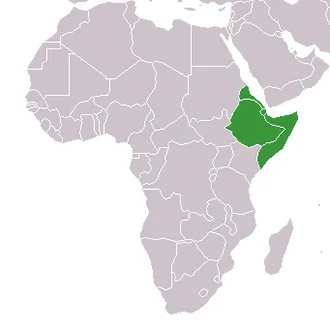
The Horn of Africa commonly is referred to simply as "the Horn," while inhabitants are sometimes colloquially termed Horn Africans or Horners. The term Horn Africans or Horners, aside from its geographic context, is considered a coherent population label. Anthropologically, "Horn Africans" is used in a stricter sense, reserved for the Cushitic and Ethio‑Semitic speaking peoples, who constitute the core historical and demographical population of the Horn, rather than all groups living within the peninsula's borders.
Regional studies on the Horn of Africa are carried out in the fields of Ethiopian studies and Somali studies.
Names
The peninsula has been known by various names. The Ancient Romans referred to it as Regio Aromatica or Regio Cinnamonifora after the aromatic plants found there, or as Regio Incognita for its poor coverage by classical Mediterranean cartography. In ancient and medieval times, the Horn of Africa was referred to as Bilad al Barbar ("Land of the Berbers").
It is also known as the Somali Peninsula, or in the Somali language as Geeska Afrika or Jasiiradda Soomaali. In other local languages it is called the direct equivalent of "Horn of Africa" or "African Horn": in Amharic: የአፍሪካ ቀንድ, yäafrika qänd, in Arabic: القرن الأفريقي, al-qarn al-'afrīqī, in Oromo: Gaanfaa Afrikaa, and in Tigrinya: ቀርኒ ኣፍሪቃ, q'ärnī afīrīqa.
Usage
Geographic and geopolitical
The region geographically consists of Djibouti, Eritrea, Ethiopia, Somalia, and the partially recognised state of Somaliland. These nations protrude from the continent in the shape resembling a horn. Geopolitically, the region consists of these same nations. The term is occasionally used to be inclusive of neighbouring southeast African countries to distinguish the broader geopolitical definition of the Horn of Africa from narrower peninsular definitions.
Population
In genetics, linguistic and anthropological studies, the term is used as a label for those with a shared, distinct, commonality in their genetic structure, historical trajectories, cultural traits, and Afroasiatic languages. Genome‑wide studies of these populations identify two ancestry components largely restricted to the Horn: a differentiated African component termed 'Ethiopic' and a differentiated non‑African component termed 'Ethio‑Somali', which represent East African plus West Eurasian related admixture.
Peoples
Demographics and linguistics
The main groups are the Cushitic-speaking Cushitic peoples, traditionally centered in the lowlands, and the Ethio-semitic-speaking Habesha peoples, who inhabit the Ethiopian and Eritrean highlands. The most spoken Cushitic languages are: Oromo with ~30 million speakers, Somali with ~28 million speakers,Sidama with ~3 million speakers, and Afar with ~3 million speakers.
The most spoken Ethio-semitic languages are: Amharic with ~32 million speakers, and Tigrinya with ~10 million speakers. Other Afroasiatic languages with a significant number of speakers include the Cushitic Saho, Hadiyya, and Agaw languages; the Semitic Tigre, Arabic, Gurage, Harari, Silt'e and Argobba tongues
Languages belonging to the Nilo-Saharan language family are spoken in some areas by Nilotic ethnic minorities in Ethiopia and Eritrea. These tongues include the Nilo-Saharan Me'en and Mursi languages used in southwestern Ethiopia, and Kunama and Nara idioms spoken in parts of southern Eritrea. Omotic languages are also spoken by Omotic communities inhabiting Ethiopia's southern regions. Among these languages are Aari, Dizi, Gamo, Kafa, Hamer and Wolaytta.
The Horn has, both modern and historically, utilised several indigenous writing systems. Among these is Ge'ez script (ግዕዝ Gəʿəz) (also known as Ethiopic), which has been written in for at least 2000 years.
It is an abugida script that was originally developed to write the Ge'ez language. In speech communities that use it, such as the Amharic and Tigrinya, the script is called fidäl (ፊደል), which means "script" or "alphabet".
The Somali language was, for centuries, written using an adapted Arabic script known as wadaad's script. In the early 20th century, in response to a national campaign to settle on a writing script for the Somali language, which had since lost its ancient script, Osman Yusuf Kenadid, a Somali poet and cousin of the Sultan Yusuf Ali Kenadid, devised a phonetically sophisticated alphabet called Osmanya (also known as far soomaali; Osmanya: 𐒍𐒖𐒇 𐒈𐒝𐒑𐒛𐒐𐒘) for representing the sounds of Somali.
Though no longer the official writing script in Somalia, the Osmanya script is available in the Unicode range 10480-104AF [from U+10480 – U+104AF (66688–66735)].
Genetics
Autosomal
Modern studies consistently show that Horn of Africans, those speaking Cushitic and Ethio‑Semitic, form a distinct cluster, deriving their genomes from a mix of local East African ancestry dubbed "Ethiopic" and substantial non‑African, West Eurasian, ancestry which Hodgson et al dub "Ethio-Somali"".
"The Semitic-Cushitic Ethiopians stand out as a relatively uniform set of individuals characterized by a strong (40%–50%) non-African component and an African component split between a broad East African and an apparently Ethiopia-specific component"
— Pagani et al, Ethiopian Genetic Diversity Reveals Linguistic Stratification and Complex Influences on the Ethiopian Gene Pool
Genome‑wide analyses indicate that HOAs carry 40–60 % or more of this non‑African component, detectable in ADMIXTURE and principal component analyses setting them apart from other sub‑Saharan African populations. This non‑African component is often represented in analyses as a distinct "Ethio‑Somali" ancestral component, interpreted as an ancient back‑migration into northeast Africa, tied to the Afro‑Asiatic linguistic dispersal.
This back‑migration signal shows affinities to ancestries typical of the Levant and North Africa; in combination with the "Ethiopic" African component, this places Horn populations in an intermediate genetic position between sub‑Saharan Africans and Middle Eastern/European populations in PCA space.
In addition to this Cushitic, Ethio-Somali, Eurasian component, HOAs carry a secondary southern Arabian related component that entered via the Red Sea corridor. This component is detectable in autosomal studies as a distinct West Eurasian ancestry not overlapping with the older Ethio‑Somali signal.
"Thus, it is more likely that the genetic-geographic HOA-Arabia distance gradient reflects secondary admixture of Arabian migrants into HOA populations already carrying substantial non-African ancestry"
— Hodgson et al, Early Back-to-Africa Migration into the Horn of Africa
Unipaternal
Y-DNA
Haplogroup E-M35 has the highest frequency in Horners, particularly its descendent E-M78 with a high diversity of subclades suggesting an ancient presence in the region, followed by various lineages belonging to Haplogroup J, specifically J1 and J2, as well as Haplogroup T-M184. Cruciani et al found E-M35 in approximately 57% of both Oromo and Amhara individuals.
The second most prevalent lineage Haplogroup J, has been found to exist at levels as high as 35.4% in the Amhara, of which 33.3% is of the type J1, while 2.1% is of J2 type. These lineages are also found in the neighbouring Tigrayans. Amongst Somalis, Haplogroup E-M78, specifically E-V32 is found in roughly 2/3 of the population with most of the remaining belonging either to T-M70 or J-P58.
mtDNA
Maternal ancestry in northern Ethiopian populations, including Tigrayans, is dominated by African L haplogroups, which comprise about 60% of lineages. Consistent with other regions and groups like Somalis where it also comprises around 60% of lineages. The remaining 40% belong primarily to Eurasian-associated lineages such as M1 and subclades of haplogroup N.
History
Prehistory
Some of the earliest Homo sapiens fossils, the Omo remains (from ca. 233,000 years ago) and the Herto skull (from ca. 160,000 ago) have been found in the region, both in Ethiopia.
The findings of the Earliest Stone Tipped Projectiles from the Ethiopian Rift dated to more than 279,000 years ago "in combination with the existing archaeological, fossil and genetic evidence, isolate East Africa as a source of modern cultures and biology."
According to the Southern Dispersal scenario, the Southern route of the Out of Africa migration occurred in the Horn of Africa through the Bab el Mandeb. Today at the Bab-el-Mandeb straits, the Red Sea is about 12 miles (19 kilometres) wide, but 50,000 years ago it was much narrower and sea levels were 70 meters lower.
Though the straits were never completely closed, there may have been islands in between which could be reached using simple rafts. Shell middens 125,000 years old have been found in Eritrea, indicating the diet of early humans included seafood obtained by beachcombing.
Ethiopian and Eritrean agriculture established the earliest known use of the seed grass teff (Poa abyssinica) between 4000 and 1000 BCE. Teff is used to make the flatbread injera/taita. Coffee originated in Ethiopia and has become a worldwide beverage.
Historian Christopher Ehret, cited genetic evidence which had identified the Horn of Africa as a source of a genetic marker "M35/215" Y-chromosome lineage for a significant population component which moved north from that region into Egypt and the Levant. Ehret argued that this genetic distribution paralleled the spread of the Afrasian language family with the movement of people from the Horn of Africa into Egypt and added a new demic component to the existing population of Egypt 17,000 years ago.
Ancient history
The area comprising Somaliland, Somalia, Djibouti, the Red Sea coast of Eritrea and Sudan is considered the most likely location of the land known to the ancient Egyptians as Punt (or "Ta Netjeru", meaning god's land), whose first mention dates to the 25th century BCE.
Dʿmt was a kingdom located in Eritrea and northern Ethiopia, which existed during the 8th and 7th centuries BCE. With its capital probably at Yeha, the kingdom developed irrigation schemes, used plows, grew millet, and made iron tools and weapons. After the fall of Dʿmt in the 5th century BCE, the plateau came to be dominated by smaller successor kingdoms, until the rise of one of these kingdoms during the 1st century, the Aksumite Kingdom, which was able to reunite the area.
The Kingdom of Aksum (also known as the Aksumite Empire) was an ancient state located in the Eritrea and Ethiopian Highlands, which thrived between the 1st and 7th centuries CE. A major player in the commerce between the Roman Empire and Ancient India, Aksum's rulers facilitated trade by minting their own currency. The state established its hegemony over the declining Kingdom of Kush and regularly entered the politics of the kingdoms on the Arabian Peninsula, eventually extending its rule over the region with the conquest of the Himyarite Kingdom.
Under Ezana (fl. 320–360), the kingdom of Aksum became the first major empire to adopt Christianity, and was named by Mani as one of the four great powers of his time, along with Persia, Rome and China.
Somalia was an important link in the Horn, connecting the region's commerce with the rest of the ancient world. Somali sailors and merchants were the main suppliers of frankincense, myrrh and spices, all of which were valuable luxuries to the Ancient Egyptians, Phoenicians, Mycenaeans, Babylonians and Romans. The Romans consequently began to refer to the region as Regio Aromatica.
In the classical era, several flourishing Somali city-states such as Opone, Mosylon and Malao competed with the Sabaeans, Parthians and Axumites for the rich Indo-Greco-Roman trade.
The birth of Islam opposite the Horn's Red Sea coast meant that local merchants and sailors living on the Arabian Peninsula gradually came under the influence of the new religion through their converted Arab Muslim trading partners. With the migration of Muslim families from the Islamic world to the Horn in the early centuries of Islam, and the peaceful conversion of the local population by Muslim scholars in the following centuries, the ancient city-states eventually transformed into Islamic Mogadishu, Berbera, Zeila, Barawa and Merka, which were part of the Barbara civilization.
The city of Mogadishu came to be known as the "City of Islam" and controlled the East African gold trade for several centuries.
Middle Ages and Early Modern era
During the Middle Ages, several powerful empires dominated the regional trade in the Horn, including the Adal Sultanate, the Ajuran Sultanate, the Ethiopian Empire, the Zagwe dynasty, and the Sultanate of the Geledi.
The Sultanate of Showa, established in 896, was one of the oldest local Islamic states. It was centered in the former Shewa province in central Ethiopia. The polity was succeeded by the Sultanate of Ifat around 1285. Ifat was governed from its capital at Zeila in Somaliland and was the easternmost district of the former Shewa Sultanate.
The Adal Sultanate was a medieval multi-ethnic Muslim state centered in the Horn region. At its height, it controlled large parts of Somalia, Ethiopia, Djibouti and Eritrea. Many of the historic cities in the region, such as Amud, Maduna, Abasa, Berbera, Zeila and Harar, flourished during the kingdom's golden age. This period that left behind numerous courtyard houses, mosques, shrines and walled enclosures.
Under the leadership of rulers such as Sabr ad-Din II, Mansur ad-Din, Jamal ad-Din II, Shams ad-Din, General Mahfuz and Ahmad ibn Ibrahim al-Ghazi, Adalite armies continued the struggle against the Solomonic dynasty, a campaign historically known as the Conquest of Abyssinia or Futuh al Habash.
Through a strong centralized administration and an aggressive military stance towards invaders, the Ajuran Sultanate successfully resisted an Oromo invasion from the west and a Portuguese incursion from the east during the Gaal Madow and the Ajuran-Portuguese wars. Trading routes dating from the ancient and early medieval periods of Somali maritime enterprise were strengthened or re-established, and the state left behind an extensive architectural legacy.
Many of the hundreds of ruined castles and fortresses that dot the landscape of Somalia today are attributed to Ajuran engineers, including a lot of the pillar tomb fields, necropolises and ruined cities built during that era. The royal family, the House of Gareen, expanded its territories and established its hegemonic rule through a combination of warfare, trade linkages and alliances.
The Zagwe dynasty ruled many parts of modern Ethiopia and Eritrea from approximately 1137 to 1270. The name of the dynasty comes from the Cushitic-speaking Agaw people of northern Ethiopia. From 1270 onwards for many centuries, the Solomonic dynasty ruled the Ethiopian Empire.
In 1270, the Amhara nobleman Yekuno Amlak, who claimed descent from the last Aksumite king and ultimately the Queen of Sheba, overthrew the Agaw Zagwe dynasty at the Battle of Ansata, ushering his reign as Emperor of Ethiopia. While initially a rather small and politically unstable entity, the empire managed to expand significantly during the crusades of Amda Seyon I (1314–1344) and his successors, becoming the dominant force in East Africa.
In the early 15th century, Ethiopia sought to make diplomatic contact with European kingdoms for the first time since Aksumite times. A letter from King Henry IV of England to the Emperor of Abyssinia survives. In 1428, the Emperor Yeshaq sent two emissaries to Alfonso V of Aragon, who sent return emissaries who failed to complete the return trip.
The first continuous relations with a European country began in 1508 with Portugal under Emperor Lebna Dengel, who had just inherited the throne from his father. This proved to be an important development, for when Abyssinia was subjected to the attacks of the Adal Sultanate General and Imam Ahmad ibn Ibrahim al-Ghazi (called "Gurey" or "Grañ", both meaning "the Left-handed"), Portugal assisted the Ethiopian emperor by sending weapons and four hundred men, who helped his son Gelawdewos defeat Ahmad and re-establish his rule.
This Ethiopian–Adal War was one of the first proxy wars in the region as the Ottoman Empire, and Portugal took sides in the conflict.
When Emperor Susenyos converted to Roman Catholicism in 1624, years of revolt and civil unrest followed resulting in thousands of deaths. The Jesuit missionaries had offended the Orthodox faith of the local Ethiopians. On 25 June 1632, Susenyos's son, Emperor Fasilides, declared the state religion to again be Ethiopian Orthodox Christianity, and expelled the Jesuit missionaries and other Europeans.