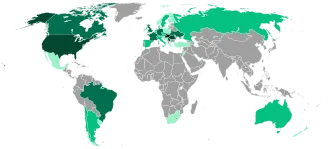
There are an estimated 14.5 million ethnic Hungarians and their descendants worldwide, of whom 9.6 million live in today's Hungary. About 2 million Hungarians live in areas that were part of the Kingdom of Hungary before the Treaty of Trianon in 1920 and are now parts of Hungary's seven neighbouring countries, Slovakia, Ukraine, Romania, Serbia, Croatia, Slovenia, and Austria.
In addition, significant groups of people with Hungarian ancestry live in various other parts of the world, most of them in the United States, Canada, Germany, France, the United Kingdom, Chile, Brazil, Australia, and Argentina, and therefore constitute the Hungarian diaspora (Hungarian: magyar diaszpóra).
The diaspora can be divided into several subgroups according to local linguistic and cultural characteristics; subgroups include the Székelys (in eastern Transylvania as well as a few in Suceava County, Bukovina), the Csángós (in Western Moldavia), the Palóc, the Matyó and the Magyarabs (in Nubia).
Name
The Hungarians' own ethnonym to denote themselves in the Early Middle Ages is uncertain. The exonym "Hungarian" is believed to have derived from the Huns and the Oghur-Turkic Onoğur (literally "Ten Arrows" or "Ten Tribes").
Prior to the Hungarian conquest of the Carpathian Basin when the Hungarian conquerors lived east of the Carpathian Mountains, on the Pontic-Caspian Steppe, written sources called the Hungarians: "Ungri" by Georgius Monachus in 837, "Ungri" by Annales Bertiniani in 862, and "Ungari" by the Annales ex Annalibus Iuvavensibus in 881.
The Hungarians probably belonged to the Onoğur tribal alliance, and it is possible that they became its ethnic majority. In the Early Middle Ages, the Hungarians had many names, including "Węgrzy" (Polish), "Ungherese" (Italian), "Ungar" (German), and "Hungarus".
In the Hungarian language, the Hungarian people name themselves as "Magyar". "Magyar" possibly derived from the name of the most prominent Hungarian tribe, the "Megyer". The tribal name "Megyer" became "Magyar" in reference to the Hungarian people as a whole.
The Greek cognate of "Tourkia" (Greek: Τουρκία) was used by the scholar and Byzantine Emperor Constantine VII Porphyrogenitus in his De Administrando Imperio of c. AD 950, though in his use, "Turks" always referred to Magyars. However, although the Magyars do have some Turkic genetic and cultural influence, including their historical social structure being of Turkic origin, they still are not widely considered as part of the Turkic people.
The obscure name kerel or keral, found in the 13th-century work The Secret History of the Mongols, possibly referred to Hungarians and derived from the Hungarian title király ('king').
The historical Latin phrase "Natio Hungarica" ("Hungarian nation") had a wider and political meaning because it once referred to all nobles of the Kingdom of Hungary, regardless of their ethnicity or mother tongue.
History
Origin
The origin of Hungarians, the place and time of their ethnogenesis, has been a matter of debate. Due to the classification of the Hungarian language in the Ugric family, they are sometimes regarded as an Ugric people originating in Siberia. However, Fóthi et al. 2022 suggests that the conquering Hungarians have origins in three distinct regions on the Eurasian steppe: the Lake Baikal-Altai Mountains, spanning present-day northwestern Mongolia and southern Siberia, the Southern Urals-Western Siberia and the Black Sea-Northern Caucasus.
Meanwhile, Neparáczki et al. 2018 proposes that over a third of the Hungarian conquerors' maternal lineages derive from Inner Asia, centred in present-day eastern Mongolia and southern Siberia, while the remainder is derived from the Pontic-Caspian Steppe. Maróti et al. 2022 highlights the arrival of three successive tribes in the Carpathian Basin between the 5th and 9th centuries, the Huns, Avars and conquering Hungarians.
The study concludes that the Huns and related Avars likely originated in present-day Mongolia and were descendants of the Xiongnu, while the conquering Hungarians derived from an admixture of Ugrians, Sarmatians and Huns.
"Hungarian pre-history", i.e. the history of the "ancient Hungarians" before their arrival in the Carpathian basin at the end of the 9th century, is thus a "tenuous construct", based on linguistics, analogies in folklore, archaeology and subsequent written evidence. In the 21st century, historians have argued that "Hungarians" did not exist as a discrete ethnic group or people for centuries before their settlement in the Carpathian basin.
Instead, the formation of the people with its distinct identity was a process. According to this view, Hungarians as a people emerged by the 9th century, subsequently incorporating other, ethnically and linguistically divergent, peoples.
Pre-4th century AD
During the 4th millennium BC, the Uralic-speaking peoples who were living in the central and southern regions east of the Ural Mountains split up. Some dispersed towards the west and northwest and came into contact with Turkic and Iranian speakers who were spreading northwards. From at least 2000 BC onwards, the Ugric-speakers became distinguished from the rest of the Uralic community, of which the ancestors of the Magyars, being located farther south, were the most numerous.
Judging by evidence from burial mounds and settlement sites, they interacted with the Indo-Iranian Andronovo culture and Baikal-Altai Asian cultures.
4th century to c. 830
In the 4th and 5th centuries AD, the Hungarians moved to the west of the Ural Mountains, to the area between the southern Ural Mountains and the Volga River, known as Bashkiria (Bashkortostan) and Perm Krai. In the early 8th century, some of the Hungarians moved to the Don River, to an area between the Volga, Don and the Seversky Donets rivers. Meanwhile, the descendants of those Hungarians who stayed in Bashkiria remained there as late as 1241.
The Hungarians around the Don River were subordinates of the Khazar Khaganate. Their neighbours were the archaeological Saltov culture, i.e. Bulgars (Proto-Bulgarians, Onogurs) and the Alans, from whom they learned gardening, elements of cattle breeding and of agriculture. Tradition holds that the Hungarians were organized in a confederacy of seven tribes: Jenő, Kér, Keszi, Kürt-Gyarmat, Megyer, Nyék, and Tarján.
c. 830 to c. 895
Around 830, a rebellion broke out in the Khazar khaganate. As a result, three Kabar tribes of the Khazars joined the Hungarians and moved to what the Hungarians call the Etelköz, the territory between the Carpathians and the Dnieper River. The Hungarians faced their first attack by the Pechenegs around 854. The new neighbours of the Hungarians were the Varangians and the eastern Slavs.
From 862 onwards, the Hungarians (already referred to as the Ungri) along with their allies, the Kabars, started a series of looting raids from the Etelköz into the Carpathian Basin, mostly against the Eastern Frankish Empire (Germany) and Great Moravia, but also against the Balaton principality and Bulgaria.
Entering the Carpathian Basin (c. 862–895)
The Hungarians arrived in the Carpathian Basin, a geographically unified but politically divided land, after acquiring thorough local knowledge of the area from the 860s onwards.
After the end of the Avar Kaganate (c. 822), the Eastern Franks asserted their influence in Transdanubia, the Bulgarians to a small extent in the Southern Transylvania and the interior regions housed the surviving Avar population in their stateless state. The downfall of the Avar Khaganate at the beginning of the 9th century did not mean the extinction of the Avar population, contemporary written sources report surviving Avar groups.
According to the archaeological evidence, the Avar population survived the time of the Hungarian conquest of the Carpathian Basin.
In 862, Prince Rastislav of Moravia rebelled against the Franks, and after hiring Hungarian troops, won his independence; this was the first time that Hungarians expeditionary troops entered the Carpathian Basin. In 862, Archbishop Hincmar of Reims records the campaign of unknown enemies called "Ungri", giving the first mention of the Hungarians in Western Europe.
In 881, the Hungarian forces fought together with the Kabars in the Vienna Basin. According to historian György Szabados and archeologist Miklós Béla Szőke, a group of Hungarians were already living in the Carpathian Basin at that time, so they could quickly intervene in the events of the Carolingian Empire. The number of recorded battles increased from the end of the 9th century.
In the late Avar period, a part of Hungarians was already present in the Carpathian Basin in the 9th century, this has been supported by genetic and archaeological research, because there are graves in which Avar descendants are buried in Hungarian clothes. An important segment of this Avar era Hungarians is that the Hungarian county system of King Saint Stephen I may be largely based on the power centers formed during the Avar period.
According to some genetic studies, there is a genetic continuity from the Bronze Age, a continuous migration of the Steppe peoples from east of the Carpathian Basin.
The foundation of the Hungarian state is connected to the Hungarian conquerors, who arrived from the Pontic steppes as a confederation of seven tribes. The Hungarians arrived in the frame of a strong centralized steppe-empire under the leadership of Grand Prince Álmos and his son Árpád, they became founders of the Árpád dynasty, the Hungarian ruling dynasty and the Hungarian state.
The Árpád dynasty claimed to be a direct descendant of the great Hun leader Attila. Medieval Hungarian chronicles from the Hungarian royal court like the Gesta Hungarorum, Gesta Hunnorum et Hungarorum, Chronicon Pictum, Buda Chronicle, Chronica Hungarorum claimed that the Árpád dynasty and the Aba clan are the descendants of Attila.
Árpád, Grand Prince of the Hungarians, says in the Gesta Hungarorum:
The land stretching between the Danube and the Tisza used to belong to my forefather, the mighty Attila.
— Anonymus: Gesta Hungarorum
The Hungarians took possession of the Carpathian Basin in a pre-planned manner, with a long move-in between 862 and 895. This is confirmed by the archaeological findings, in the 10th-century Hungarian cemeteries, the graves of women, children and elderly people are located next to the warriors, they were buried according to the same traditions, wore the same style of ornaments, and belonged to the same anthropological group.
The Hungarian military events of the following years prove that the Hungarian population that settled in the Carpathian Basin was not a weakened population without a significant military power. Other theories assert that the move of the Hungarians was forced or at least hastened by the joint attacks of Pechenegs and Bulgarians.
According to eleventh-century tradition, the road taken by the Hungarians under Prince Álmos took them first to Transylvania in 895. This is supported by an eleventh-century Russian tradition that the Hungarians moved to the Carpathian Basin by way of Kiev. Prince Álmos, the sacred leader of the Hungarian Great Principality died before he could reach Pannonia, he was sacrificed in Transylvania.
In 895/896, under the leadership of Árpád, some Hungarians crossed the Carpathians and entered the Carpathian Basin. The tribe called Megyer was the leading tribe of the Hungarian alliance that conquered the centre of the basin. At the same time (c. 895), due to their involvement in the 894–896 Bulgaro-Byzantine war, Hungarians in Etelköz were attacked by Bulgaria and then by their old enemies the Pechenegs.
The Bulgarians won the decisive battle of Southern Buh. It is uncertain whether or not those conflicts contributed to the Hungarian departure from Etelköz.
From the upper Tisza region of the Carpathian Basin, the Hungarians intensified their campaigns across continental Europe. In 900, they moved from the upper Tisza river to Transdanubia, which later became the core of the arising Hungarian state. By 902, the borders were pushed to the South-Moravian Carpathians and the Principality of Moravia collapsed.
At the time of the Hungarian migration, the land was inhabited only by a sparse population of Slavs, numbering about 200,000, who were either assimilated or enslaved by the Hungarians.
Archaeological findings (e.g. in the Polish city of Przemyśl) suggest that many Hungarians remained to the north of the Carpathians after 895/896. There is also a consistent Hungarian population in Transylvania, the Székelys, who comprise 40% of the Hungarians in Romania. The Székely people's origin, and in particular the time of their settlement in Transylvania, is a matter of historical controversy.
After 900
In 907, the Hungarians destroyed a Bavarian army in the Battle of Pressburg and laid the territories of present-day Germany, France, and Italy open to Hungarian raids, which were fast and devastating. The Hungarians defeated the Imperial Army of Louis the Child, son of Arnulf of Carinthia and last legitimate descendant of the German branch of the house of Charlemagne, near Augsburg in 910.
From 917 to 925, Hungarians raided through Basel, Alsace, Burgundy, Saxony, and Provence. Hungarian expansion was checked at the Battle of Lechfeld in 955, ending their raids against Western Europe, but raids on the Balkan Peninsula continued until 970.
The Pope approved Hungarian settlement in the area when their leaders converted to Christianity, and Stephen I (Szent István, or Saint Stephen) was crowned King of Hungary in 1001. The century between the arrival of the Hungarians from the eastern European plains and the consolidation of the Kingdom of Hungary in 1001 was dominated by pillaging campaigns across Europe, from Dania (Denmark) to the Iberian Peninsula (contemporary Spain and Portugal).[citation needed] After the acceptance of the nation into Christian Europe under Stephen I, Hungary served as a bulwark against further invasions from the east and south, especially by the Turks.
At this time, the Hungarian nation numbered around 400,000 people.
Ottoman period
The Magyarab people are a small Magyar (Hungarian) community living within Nubia, along the Nile in Sudan and Egypt. They have distant Hungarian ancestors who intermarried with locals. The Ottoman Empire had to recruit troops from conquered Christian people, most notably through the devşirme system, a special "tribute in blood", by which the Janissary corps was primarily staffed.
In this system, Christian youths were taken, or children were kidnapped during Ottoman raids, primarily from the Balkan provinces, then converted to Islam and drafted into Ottoman service. The Hungarian population experienced the recruitment of its people under the Ottoman regime. The Hungarians who were relocated from Hungary to the banks of the Nile were soldiers in the Ottoman army, brought there by Sultan Selim to serve as border guards.
These groups of Hungarians ended up in Egypt-Sudan after retiring from military service, concluding their army careers there.
In the 16th and 17th centuries, the Ottoman conquest turned the Kingdom of Hungary into a battlefield. According to Hungarian historiography, the ethnic pattern of Hungary changed significantly due to the century's long wars. During the Ottoman occupation, the Principality of Transylvania maintained the continuity of Hungarian statehood.
The Habsburg–Wallachian military campaigns between 1599 and 1604, and Ottoman–Tatar military campaigns between 1657 and 1661 were destructive for the Hungarians living in the region and the Hungarian settlements connecting the Hungarian ethnic blocks of the Partium and Székely Land suffered the most extensive destruction.
Between the Battle of Mohács in 1526 and the suppression of Rákóczi's War of Independence in 1711, the Hungarian and Catholic dominated population structure of the Late Medieval Kingdom of Hungary was broken up, in Transylvania the Romanians became majority and the Hungarians became a minority population, and in the more sheltered mountainous regions, the Romanian population steadily grew, benefiting from additional immigration from Wallachia and Moldavia.
Early modern period
The first accurate measurements of the population of the Kingdom of Hungary including ethnic composition were carried out in 1850–51. There is a debate among Hungarian and non-Hungarian (especially Slovak and Romanian) historians about the possible changes in the ethnic structure of the region throughout history. According to Hungarian historians, the proportion of Hungarians in the Carpathian Basin was at an almost constant 80% during the Middle Ages.
The Hungarian population began to decrease only at the time of the Ottoman conquest, reaching as low as around 39% by the end of the 18th century.
The decline of the Hungarians was due to the constant wars, Ottoman raids, famines, and plagues during the 150 years of Ottoman rule. The main zones of war were the territories inhabited by the Hungarians, so the death toll depleted them at a much higher rate than among other nationalities. In the 18th century, their proportion declined further because of the influx of new settlers from Europe, especially Slovaks, Serbs and Germans.
In 1715 (after the Ottoman occupation), the Southern Great Plain was nearly uninhabited but now has 1.3 million inhabitants, nearly all of them Hungarians. As a consequence, having also the Habsburg colonization policies, the country underwent a great change in ethnic composition as its population more than tripled to 8 million between 1720 and 1787, while only 39% of its people were Hungarians, who lived primarily in the centre of the country.
19th century to present
In the 19th century, the proportion of Hungarians in the Kingdom of Hungary rose gradually, reaching over 50% by 1900 due to higher natural growth and Magyarization. Between 1787 and 1910 the number of ethnic Hungarians rose from 2.3 million to 10.2 million, accompanied by the resettlement of the Great Hungarian Plain and Délvidék by mainly Roman Catholic Hungarian settlers from the northern and western counties of the Kingdom of Hungary.
Spontaneous assimilation was an important factor, especially among the German and Jewish minorities and the citizens of the bigger towns. On the other hand, about 1.5 million people (about two-thirds non-Hungarian) left the Kingdom of Hungary between 1890–1910 to escape from poverty.