The club was founded on 9 March 1908 after a split within the Milan Foot-Ball and Cricket Club (now AC Milan), and won its first championship in 1910. Since its formation, the club has won 39 domestic trophies, including 21 league titles, 10 Coppa Italia, and 8 Supercoppa Italiana. From 2006 to 2010, the club won five successive league titles, equaling the all-time record at that time.
It has won the European Cup/Champions League three times. Its latest win in 2010 completed an unprecedented Italian seasonal treble, with Inter also winning the Serie A title and the Coppa Italia in the same year. The club has also won three UEFA Cups, two Intercontinental Cups, and one FIFA Club World Cup.
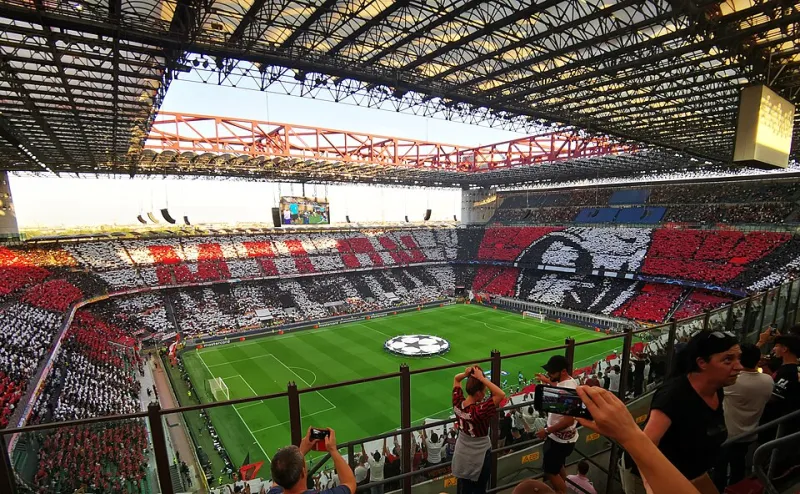
Inter has the highest home game attendance in Italy and the fourth-highest attendance in Europe. Since May 2024, the club has been owned by American asset management company Oaktree Capital Management.
History
Foundation and early years (1908–1960)
The club was founded on 9 March 1908 as Football Club Internazionale, when a group of players left the Milan Cricket and Football Club (now AC Milan) to form a new club because they wanted to accept more foreign players. The name of the club derives from the wish of its founding members to accept foreign players as well as Italians.
The club won its first championship in 1910 and its second in 1920. The captain and coach of the first championship winning team was Virgilio Fossati, who was later killed in battle while serving in the Italian army during World War I.
In 1922, Inter was at risk of relegation to the Second Division of Northern League, but they remained in the top league after winning two play-offs.
Six years later, during the Fascist era, the club merged with the Unione Sportiva Milanese and, for political reasons, was renamed Società Sportiva Ambrosiana. During the 1928–29 season, the team wore white jerseys with a red cross emblazoned on it; the jersey's design was inspired by the flag and coat of arms of the city of Milan.
In 1929, the new club chairman Oreste Simonotti changed the club's name to Associazione Sportiva Ambrosiana and restored the previous black-and-blue jerseys; however, supporters continued to call the team Inter, and in 1931, new chairman Pozzani succumbed to shareholder pressure and changed the name to Associazione Sportiva Ambrosiana-Inter.
Inter won its third championship titles in 1930 with the Hungarian coach Arpad Weisz in the first ever edition of Serie A, and the fourth in 1938 with former player Armando Castellazzi as a 33 years old coach, that set the record for the youngest coach ever to win the national title that lasts to this day. Inter also got their first Coppa Italia (Italian Cup) in 1939 with the decisive goal in the final scored by Olympic gold medal and top scorer in 1936 Olympics Annibale Frossi.
Inter's main star and the captain of the team in this period was Giuseppe Meazza, one of the greatest Italian players of all time with two World Cups won with the National team and the greatest scorer in Inter history with 284 goals, and after whom the San Siro stadium is officially named after his death in 1980. 38 goals scored by Meazza in 39 matches in 1929-1930 is a seasonal record in Inter history still unbeaten today.
Inter ended also three consecutive times in 2nd place between 1933 and 1935; in those years many South Americans of Italian origin arrived in Milan to circumvent the regime's rules that prohibit the hiring of foreign players: Uruguayan players like World Cup Winner in 1930 Hector Scarone and Ernesto Mascheroni and also Ricardo Faccio and Francesco Frione, and Argentinian like Attilio Demaría that stayed 10 seasons with the club.
A fifth championship followed in 1940, that ended a decade dominated by three teams: Inter, Bologna and the historic rival Juventus, while AC Milan didn't win a title for 44 years from 1907 to 1951 and didn't win a single derby for a record 17 matches from 1928 to 1938.
In the 1930s Inter also played for seven times in one of the first major European football cups, the Central European Cup, with Meazza that was a record three times topscorer of the competition; coached by Árpád Weisz Inter reached the final in 1933, when after had won the first leg in Milan 2–1, lost 3–1 in 9 men against Austria Vienna. 4 out of 11 players of that team: Meazza, Luigi Allemandi, Attilio Demaría and Armando Castellazzi would go on to win the 1934 World Cup with Italian national team, while other five Inter players will contribute to the win of 1938 World Cup with Italy: Meazza, Ugo Locatelli, Giovanni Ferrari, Pietro Ferraris and Renato Olmi.
After the end of World War II, the club's name changed back to its original one, Internazionale, and it come close to win Serie A title in two occasions, one in the last season of Grande Torino in 1949, against whom Inter were the last team to face them on 30 April 1949 five days before the Superga air disaster, and in 1951 for just one point, with the contribution of great players acquired by president Carlo Masseroni in these years, like Gino Armano, Amedeo Amadei, the first Dutch player in club history Faas Wilkes and the Hungarian István Nyers from Stade Français; Inter will win its sixth championship in 1953 and its seventh in 1954, for the first time in two consecutive years, coached by Alfredo Foni and led by two of the most prolific strikers in club history: István Nyers and Benito Lorenzi with the Swedish Lennart Skoglund that completed the offensive trio. One of the crucial matches of the 1954 Scudetto was the direct clash for the title, that saw Inter victory over Juventus for 6-0, the club's biggest victory in the Derby d'Italia.
In May 1955, Angelo Moratti became the new owner of Inter, and in the first years of his presidency got disappointing results despite strong players like forwards, Eddie Firmani and the Argentinian Angelillo who scored an all-time record in a season in Serie A with 18 teams: 33 goals in 33 matches in 1958-1959 season, tied also Meazza seasonal record of 38 goals in 39 matches.[citation needed]
Moratti in the following years put foundations to one of the greatest teams in football history starting from the debut of a 16 years old Mario Corso and the acquisition of Aristide Guarneri in 1958, and under Argentinian coach Helenio Herrera in 1960 with the signing of Giacinto Facchetti and Armando Picchi.
Grande Inter (1960–1967)
In 1960, manager Helenio Herrera joined Inter from Barcelona and in his first season as a coach in Milan, after having led the table for most of the season, lost the title in the last games of the season, with the infamous episode during Juventus–Inter held in Turin in April 1961 when the match was stopped after 30 minutes when Juventus supporters invaded the pitch, with Inter being awarded the game 2–0. Then, after two months, in June before the last decisive match of Serie A with the two teams tied in first place, the Italian Football Federation, presided by Juventus president Umberto Agnelli, decided that the match between the two teams had to be replayed after the last game scheduled for the season; with Inter loss and a draw for Juventus, the following match became useless and in open contestation Angelo Moratti ordered Herrera to put the Inter youth team against the Turinese squad: the match ended 9–1 for Juventus, with the only goal scored for Inter by an 18-year-old, the son of Valentino Mazzola, Sandro Mazzola who later would become one of the greatest legends in the history of the club.[citation needed]
After his first season in Milan, Herrera brought with him for a record fee of 25 million pesetas Spanish midfielder Luis Suárez who won the European Footballer of the Year in 1960 for his role in Barcelona's La Liga/Fairs Cup double. Herrera would transform Inter into one of the leading teams in Europe that would win three Serie A titles in four years, two European Cups and two Intercontinental Cups in a row.
He modified a 5–3–2 tactic known as the "Verrou" ("door bolt"), which created greater flexibility for counterattacks. The catenaccio system was invented by an Austrian coach, Karl Rappan. Rappan's original system was implemented with four fixed defenders, playing a strict man-to-man marking system, plus a playmaker in the middle of the field, who plays the ball together with two midfield wings.
Herrera would modify it by adding a fifth defender, the sweeper or libero, behind the two centre backs. The sweeper or libero, who acted as the free man, would deal with any attackers who went through the two centre backs. Inter finished third in the Serie A in his first season, second the next year and first in his third season.
Then followed a back-to-back European Cup victory in 1964 and 1965, earning him the title "il Mago" ("the Wizard"). The core of Herrera's team were the goalkeeper Giuliano Sarti, the full-backs Tarcisio Burgnich and Giacinto Facchetti, Armando Picchi the sweeper, Suárez the playmaker, the Brazilian Jair the right winger, Mario Corso the left winger and Sandro Mazzola, who played on the inside-right.
After the Serie A title won in the previous season, in 1964 Inter reached the European Cup Final by beating Borussia Dortmund in the semi-final and Partizan in the quarter-final. In the final in Praterstadion, Vienna, they met Real Madrid, a team that had reached seven out of the nine finals to date. Mazzola scored two goals and one from Milani in a 3–1 victory, becoming also the first ever team to win the tournament without losing a single game.
The team also won the Intercontinental Cup; after having lost the first match in Argentine against Independiente 1–0, Inter won second leg 2–0 in San Siro with goals from Mazzola and Corso, in the third decisive match played at the Santiago Bernabeu, Inter won in extra-time with a goal from Mario Corso, the first Italian club to win the trophy and become club world champion.
In 1964, Inter added other important players Angelo Domenghini, Gianfranco Bedin and another Spanish Joaquín Peiró, who played with consistency and was decisive in European Cup where three foreign players could play at the same time, while in Serie A only two were allowed to play.[citation needed]
A year later, after have defeated Liverpool in the semi-final second leg 3–0 recovering from a 3–1 defeat at Anfield, with Facchetti scoring the decisive goal, Inter repeated the feat by beating two-time winner Benfica in the final held at home, from a Jair goal, and then again beat Independiente in the Intercontinental Cup with a 3–0 win in San Siro, with two goals from Mazzola and one from Peirò, and a draw in Argentine, becoming the first European team to win two times in a row the competition. Inter came close to winning the Treble for the first time in European football history that year, after having also won the Serie A title, but lost the Coppa Italia final against Juventus in a game played in the last days of August 1965.[citation needed]
Facchetti was voted second in 1965 Ballon d'Or rankings, just missing out the chance to become the first defender to win the award.[citation needed]
Inter again reached semi-finals of the European cup in 1966, but this time lost against a Real Madrid team that would go on to win the tournament, while in national championship Herrera's squad won the tenth scudetto in club history, the first Star.[citation needed]
At the end of the season, Moratti signed two of the greatest players of all time: Franz Beckenbauer and Eusebio; but, after 1966 World Cup when Italian National Team was eliminated by North Korea, the Italian Federation decided to block new signings of foreign players, a ban which lasted until 1980; thus, the contracts with the two players were cancelled.
In 1967, after Inter eliminated Real Madrid in quarter-finals, with Suárez and Jair injured, Inter lost the European Cup final in Lisbon 2–1 to Celtic; a week later, despite the first position, with a lost against Mantova in the last match of the championship, Inter lost also the Serie A title and, a week later, the Coppa Italia semi-final against Padova, putting an end de facto to the Grande Inter cicle with the first season without trophy since 1961–1962. During that year, the club changed its name to Football Club Internazionale Milano, and in 1968 after 13 years Angelo Moratti sold the team to Ivanoe Fraizzoli, and also Helenio Herrera left the team.
Subsequent achievements (1967–1991)
Facchetti, captain of Italian National team for an all-time record of 11 years, Burnich and Guarneri formed also the defence of Italy that won UEFA Euro 1968 with Mazzola and Domenghini, and that with the addition of Inter players Roberto Boninsegna and Mario Bertini also reached final of 1970 World Cup against Brazil, tournament known also for the famous semifinal match, the so-called "Game of the Century" against West Germany.[citation needed]
Following the golden era of the 1960s, Inter managed to win their eleventh league title in 1971 under the coach Giovanni Invernizzi who took over the job during the season with the team that made a great comeback after have had a difficult start, with 23 consecutive matches without a loss, with Roberto Boninsegna, one of the greatest strikers in club history, who led the league with 24 goals in that seasons and repeated the feat the following season with 22.
Inter reached for the second time in five years the European Cup final in 1972 after have defetead Borussia Mönchengladbach, Standard Liège and Celtic in the semi-final, with a team which still featured Facchetti, Mazzola, Burnich, Jair, Bedin and Corso (the latter who could not play in the remain matches of the competition for disqualification after the red card at the end of the first match against Mönchengladbach) and also a young Gabriele Oriali.
The final held in Rotterdam saw the victory for 2–0 of Johan Cruyff's Ajax that won the trophy for the second consecutive season.
The return of Helenio Herrera in 1973 as Inter coach lasted only 16 matches, for a heart attack that obliged him to leave the coaching job. Mazzola retired in 1977 and Facchetti, the last member of La Grande Inter, retired in 1978 as the most prolific defender in the history of Serie A with 59 goals scored and after having won the last trophy of his career, the Coppa Italia.
Inter won their twelfth scudetto in 1980, the last one won in the history of Serie A by a team composed entirely of Italian players, and also added two to its Coppa Italia tally, in 1977–78 (with the future captain Graziano Bini who scored the decisive goal in the final against Napoli) and in 1981–82, both under coach Eugenio Bersellini.
Alessandro Altobelli, who later became the all-time leading scorer in Coppa Italia and in International competition for the club and played for Inter for 11 seasons, scored 209 goals, second only to Giuseppe Meazza. Altobelli also scored three goals against Juventus in a 4-0 victory on 11 November 1979, a feat which was repeated again five years later on the same day on 11 November 1984, with the same result, this time with the first two goals in Serie A for Karl-Heinz Rummenigge.
In this period, AC Milan were relegated two times in Serie B, the first time in 1980 for implications involved in the Totonero scandal and then again after the team ended its 1981–82 campaign in third-last place.[citation needed]
In 1981, Inter reached for the sixth time in six participations the semi-final of the European Cup, this time against Real Madrid, a classic match, and who they would encounter again in three different European competitions throughout the 1980s: in UEFA Cup Winners' Cup quarter-finals in 1983 and in Uefa Cup semi-finals in 1985 and 1986.
Karl-Heinz Rummenigge considered one of the greatest player in the world and one of the five Germans who played for Inter in the 1980sGiuseppe Bergomi, the youngest player to make his professional debut in first team in the history of the club at 16 years old, one month and eight days in January 1980, remained at Inter for all his career for a record 20 seasons, till the end of 1998-1999 season. Bergomi with Oriali, Altobelli, Gianpiero Marini and Ivano Bordon were part of Italy squad that won 1982 FIFA World Cup.[citation needed]
The Italian federation reopened the possibility to sign foreign players in 1980; in the following years, Inter signed among others: Herbert Prohaska, Hansi Müller from VfB Stuttgart, two times Ballon d'Or winner Karl-Heinz Rummenigge from Bayern Munich (who formed a deadly duo with Altobelli), Liam Brady and Argentinian Daniel Passarella. Other important players in that time were Italians Walter Zenga (voted as World's Best Goalkeeper by IFFHS for three years in a row in 1989, 1990 and 1991) and the defenders Giuseppe Baresi, Bergomi and Riccardo Ferri.[citation needed]