















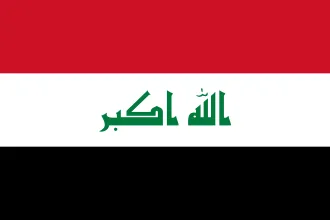
Starting in the 6th millennium BC, the fertile plains between Iraq's Tigris and Euphrates rivers, referred to as Mesopotamia, fostered the rise of early cities, civilisations, and empires including Sumer, Akkad, Babylonia, and Assyria. Known as the cradle of civilisation, Mesopotamia saw the invention of astrology, mathematics, navigation, timekeeping, writing systems, the wheel, the sailboat, a calendar, and a law code.
After the Arab conquest of Mesopotamia in the 7th century, Iraq became the metropole of the Abbasid Caliphate with Baghdad emerging as a global cultural and intellectual hub during the Islamic Golden Age, home to institutions such as the House of Wisdom. Following Baghdad's destruction by the Mongols in 1258, Iraq came under successive empires, and from the 16th until the 20th century, it was governed within the Ottoman system as a defined region known administratively as Ottoman Iraq.
Since independence in 1932 after the defeat of the Ottoman Empire in World War I, Iraq has experienced spells of significant economic and military growth alongside periods of instability and conflict. Iraq emerged as a hashemite monarchy after centuries of Ottoman rule and a period under British administration. In 1958, a military coup led by Abdul Karim Qasim overthrew the monarchy and established a republic.
Later, the Ba'ath Party took power in 1968, establishing a one-party state under Ahmed Hassan al-Bakr and later Saddam Hussein, who presided over war against Iran from 1980 to 1988 and then invaded Kuwait in 1990. In 2003, U.S.-led coalition forces invaded and occupied Iraq, overthrowing the government and triggering an insurgency and sectarian violence during the Iraq War, which ended in 2011.
From 2013 to 2017, Iraq faced another major conflict with the rise and defeat of the Islamic State. Today post-war conflict continues at a lower scale, hampering stability alongside the influence of Iran. However, recently Iraq has begun to rein in Iranian influence and advance its own state authority.
A federal parliamentary republic, Iraq is considered an emerging middle power. It is home to a diverse population, geography and wildlife. Most Iraqis are Muslims, while significant religious minorities include Christians, Jews, Mandaeans, Yarsanis, and Yazidis. Iraqis are ethnically diverse; mostly Iraqi Arabs, as well as Kurds, Turkmens, Yazidis, Assyrians, Armenians, Doms, and Shabaks.
Arabic and Kurdish are the official languages of Iraq, while Assyrian (Suret), Turkmen and Mandaic are spoken regionally. Iraq, home to one of the largest oil reserves in the world, has a significant oil and gas industry. It is also popular for its agriculture and tourism. At present, Iraq is in the process of reconstruction.
Etymology
There are several suggested origins for the name. One dates to the Sumerian city of Uruk and is thus ultimately of Sumerian origin. Another possible etymology for the name is from the Middle Persian word erāg, meaning "lowlands". An Arabic folk etymology for the name is "deeply rooted, well-watered; fertile".
The name al-ʿIrāq is attested as a common toponym in pre-Islamic Arabic poetry. The sixth-century poet Adi ibn Zayd, from the Lakhmid court at al-Ḥirah, used the name in a demographic context, speaking of the "people of Iraq" (ahl al-ʿIrāq), and in a geographical sense, referring to the "central area of Iraq" (ṣaḥn al-ʿIrāq).
His contemporary, Imruʾ al-Qais, used the name in social contexts, mentioning "the abundant food of Iraq" (ṭaʿām al-ʿIrāq al-mustafīḍ) and "the patterned fabric of Iraq" (ḥawkk al-ʿIrāq al-munammaq), and in a political context, stating "his kingdom stretches from Iraq to Oman" (lahu mulk al-ʿIrāq ilā ʿUmān).
This usage continued into the early Islamic period. The tenth-century geographer al-Maqdisi, defending his use of "Iraq" instead of the ancient name "Babylonia", noted that it was the only name used in his time. He cited the precedent Abu Bakr, who reportedly said, "For Allah to grant a victory, even a handspan, of the Holy Land by my hand is more beloved to me than a district from the districts of Iraq" (rustāq min rasātīq al-ʿIrāq), and al-Maqdisi specifically pointed out that Abu Bakr did not say "Babylonia".
During the medieval period, there was a region called ʿIrāq ʿArabī ("Arabian Iraq") for Mesopotamia and ʿIrāq ʿAjamī ("Persian Iraq"), for the region now situated in Central and Western Iran. According to some historians, the term historically included the plain south of the Hamrin Mountains and did not include the northernmost and westernmost parts of the modern territory of Iraq.
However, contemporary medieval definitions of Iraq's extent varied. The 13th-century geographer Yaqut al-Hamawi, for example, defined Iraq as stretching "from Mosul to Abadan in length, and from Al-Qadisiyyah to Halwan in width". Prior to the middle of the 19th century, the term Eyraca Arabica was commonly used to describe Iraq.
The term Sawad was also used in early Islamic times for the region of the alluvial plain of the Tigris and Euphrates rivers.
As an Arabic word, عراق ʿirāq means "hem", "shore", "bank", or "edge", so that the name by folk etymology came to be interpreted as "the escarpment", such as at the south and east of the Jazira Plateau, which forms the northern and western edge of the "al-Iraq arabi" area.
The Arabic pronunciation is [ʕiˈrɑːq]. In English, it is either /ɪˈrɑːk/ (the only pronunciation listed in the Oxford English Dictionary and the first one in Merriam-Webster's Online Dictionary) or /ɪˈræk/ (listed first by MQD, the American Heritage Dictionary, and the Random House Dictionary.)
When the British established the Hashemite king on 23 August 1921, Faisal I of Iraq, the official English name of the country changed from Mesopotamia to the endonymic Iraq. Since January 1992, the official name of the state is "Republic of Iraq" (Jumhūriyyat al-ʿIrāq), reaffirmed in the 2005 Constitution.
History
Iraq largely coincides with the ancient region of Mesopotamia, often referred to as the cradle of civilisation. The history of Mesopotamia extends back to the Lower Paleolithic period, with significant developments continuing through the establishment of the Caliphate in the late 7th century AD, after which the region became known as Iraq.
Bronze and Iron Age
Within its borders lies the ancient land of Sumer, which emerged between 6000 and 5000 BC during the Neolithic Ubaid period. Sumer is recognised as the world's earliest civilisation, marking the beginning of urban development, written language, and monumental architecture. Sumer also had advanced canal systems. Iraq's territory also includes the heartlands of the Akkadian, Neo-Sumerian, Babylonian, Neo-Assyrian, and Neo-Babylonian empires, which dominated Mesopotamia and much of the Ancient Near East during the Bronze and Iron Ages.
Antiquity
Following the Achaemenid conquest of Babylon in 539 BCE, Mesopotamia remained a core region of the Achaemenid Empire, with its existing population and local institutions continuing in use. Maintaining Mesopotamian royal tradition, Cyrus the Great adopted titles such as King of Babylon, King of Sumer and Akkad, and King of the Four Corners, while continuing the Assyrian-derived imperial title King of Kings, which remained in use into late antiquity.
Babylon became an imperial capital of the empire, and Aramaic, long established in Mesopotamia, became the lingua franca of the empire for administration and interregional communication.
After Mesopotamia came under Macedonian control following Alexander the Great's campaign in 331 BCE, Babylon surrendered without resistance. Alexander intended to make Babylon the capital of his empire, but this plan was abandoned after his death in 323 BCE, with Seleucia established as the imperial capital in Mesopotamia.
Following the founding of Seleucia, the population of Babylon was resettled to it. Under Seleucid rule, administrative and economic power remained centered in Mesopotamia. Babylonian economic traditions persisted during this period, including the continued use of the silver shekel. Babylonian chronicle fragments record Seleucid rulers engaging with local institutions, while temple authorities, scholarly traditions, and cuneiform writing continued to function during the Seleucid period.
Archaeological evidence from Uruk indicates that Babylonian religious institutions and architectural traditions continued to function during this period. In Babylonian contexts, Seleucid rulers were described as kings in Babylonia.
In late antiquity, Mesopotamia formed part of the decentralized Parthian Empire, which contained numerous semi-autonomous kingdoms and maintained Aramaic as a lingua franca alongside Mesopotamian religious traditions. During the Parthian and Sasanian periods, Ctesiphon gradually merged with Seleucia to form a cosmopolitan metropolis that served as the Sasanian capital, later known as al-Madāʾin.
Under Sasanian rule this territory was organized as the province of Āsōristān, corresponding to the geography of Babylonia which Arabic-writing geographers referred to as al-ʿIrāq, a regional designation that continued into the Islamic period.
The capitals of Iranic empires shifted toward Mesopotamia, from Susa to Ctesiphon. The Iranic state came to be dependent on the Iraqi Sawad for its state revenues and centralized administration. When the Sasanians lost the Mesopotamian capital at Ctesiphon during the Arab conquests, Sasanian rule came to an end. Following the conquest, Iraq emerged as politically and culturally distinct from Syria, a division noted by Byzantine authors such as Theophanes, who referred to their inhabitants respectively as “Herakites” and “Isamites”.
Middle Ages
In the decades after the conquest, the Rashidun caliph Ali ibn Abi Talib strengthened Iraq's political importance by transferring the seat of the caliphate from Medina to Kufa. Under Umayyad rule, the governor of Iraq frequently exercised authority over much of the empire's eastern provinces. After the Battle of Karbala in 680, Iraq became the primary locus of Alid political opposition, a legacy that the Abbasid Caliphate later mobilized when establishing their rule from Iraq.
Iraq was the metropole of the Abbasid Caliphate even before Baghdad was founded, and following earlier Mesopotamian precedents, Abbasid rulers spent large sums on restoring and extending canal systems and cultivating land. With the founding of Baghdad in 762, Iraq became the political, economic, and intellectual core during the Islamic Golden Age, housing institutions such as the House of Wisdom.
Abbasid Iraq generated the highest state revenues of the caliphate, reaching four times that of Egypt, the second richest province, drawing largely on the agricultural productivity of southern Iraq. During this period, large quantities of opaque glazed pottery were produced in Iraq and exported as mass-produced commercial goods across the Indian Ocean.
Abbasid literary culture in Iraq reflected long-term Mesopotamian narrative continuities, appearing across Muslim and Jewish texts despite religious and political change. In his court narratives, al-Masʿūdī presents Iraq as a distinct regional point of comparison, including contrasts between Iraqi and Syrian officials in matters of administration, accounts in which the people of Iraq are cited as rejecting Egyptian claims of environmental advantage, and anecdotes in which legal practice in Mecca is discussed in terms of how it would be ridiculed by the Iraqis.
From the tenth century onward, Iraq entered a period of political fragmentation as effective power shifted from the Abbasid caliphs to regional dynasties. Authority within Iraq was exercised by a succession of local dynasties, including the Hamdanids, Buyids, Uqaylids, and Mazyadids, which competed and negotiated for control of Iraqi cities and territories.
During this period, regional rulers exercised authority in Iraq while receiving formal recognition from the Abbasid caliphs in Baghdad. This period of decentralized rule in Iraq ended with the rise of the Seljuk Empire, whose capture of Baghdad in 1055 ended Buyid dominance and left the Abbasid caliphs as largely ceremonial figures under Seljuk rule.
The existing pattern of regional rule in Iraq was disrupted by the Mongol conquest in the thirteenth century. In 1258, Mongol forces captured and sacked Baghdad, bringing Abbasid political rule in Iraq to an end and causing widespread destruction. Iraq was subsequently incorporated into the Ilkhanate as a territorial province within the Mongol Empire.
Under Ilkhanid rule, elements of agricultural production and urban life in Iraq gradually recovered, and Iraq remained a populated and economically active region into the late medieval period.
After the collapse of Mongol rule in the 14th century, Iraq came under the control of the Jalayirids, a dynasty of Mongol origin that ruled from Baghdad following the breakup of the Ilkhanate.Their authority was eventually replaced by the Qara Qoyunlu, a Turkoman confederation that captured Baghdad in the early 15th century and extended its rule over much of Iraq.
In the later 15th century, the Aq Qoyunlu defeated the Qara Qoyunlu and established control over Iraq as part of a wider regional empire. This period of Turkmen rule ended in 1508 when Shah Ismail I conquered Baghdad and incorporated Iraq into the Safavid Empire.
Early Modern Period
Iraq was conquered by Sultan Suleiman I in 1534 and became part of the Ottoman Empire. During the 16th and 17th centuries, Iraq was a major frontier of the Ottoman–Safavid wars, with Baghdad changing hands several times until the Treaty of Zuhab in 1639 confirmed Ottoman control. Administratively, Iraq was organised into the provinces of Baghdad, Basra, Mosul, and Shahrizor, which the Ottomans collectively referred to as Hıtta-i Irakiyye (“the Iraq region”).
From 1749 to 1831, Iraq was ruled by a Mamluk dynasty of Georgian origin with considerable autonomy while maintaining nominal allegiance to the Ottoman sultan. After the dynasty was overthrown in 1831, the centralisation of Iraq under Baghdad began. Under the two-time Ottoman Viceroy, Namık Pasha, Baghdad's authority was expanded through military and administrative reforms.
Midhat Pasha introduced further reforms in taxation, land registration, infrastructure, education, and communications, reforms often seen as laying the groundwork for the modern Iraq.
Iraq remained under Ottoman control until the First World War, when the British launched the Mesopotamian campaign. The campaign led to the occupation of Baghdad in 1917, and in 1920 Ottoman Iraq was formally dissolved with the establishment of the British Mandate of Mesopotamia.
Modern Iraq
Iraq's modern history began in the wake of World War I, as the region emerged from the collapse of the Ottoman Empire. Arab forces, inspired by the promise of independence, had helped dismantle the Ottoman hold on the Middle East, but the dream of a united, sovereign Arab state was soon dashed. Despite agreements made with Hussein bin Ali, the Sharif of Makkah, the European powers had different plans for the region.
Following the British withdrawal of support for a unified Arab state, Hussein's son, Faisal, briefly declared the Kingdom of Syria in 1920, encompassing parts of what are now Lebanon, Palestine, Jordan, and Syria. However, the kingdom was short-lived, crushed by local opposition and the military might of France, which had been granted a mandate over Syria.
The British unified three former Ottoman provinces—Mosul, Baghdad, and Basra—into the Mandate of Mesopotamia, which became Iraq. Under the British, tensions were rising as locals increasingly resisted foreign control. An anti-British rebellion erupted across the country, beginning with Baghdad. The British military responded by air bombing across the capital, where thousands of residents were killed.
The need of a new strategy became clear. In 1921, the Cairo Conference, led by British officials including Winston Churchill and T.E. Lawrence, decided that Faisal, now exiled in London, would become the king of Iraq. The decision was seen as a way to maintain British influence in the region while placating local demands for leadership.
Upon his coronation as king, Faisal focused on laying foundation of Iraq. He worked hard to gain support of Iraq's diverse population and paid special attention to the Shi'a community, symbolically choosing the date of his coronation to coincide with Eid al-Ghadeer, a key day for Shiite Muslims.