















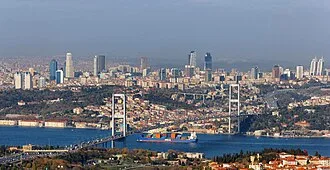
The city developed to become one of the most significant cities in history. Byzantium was founded on the (present-day) Sarayburnu promontory by Greek colonists in the seventh century BC. Over nearly 16 centuries following its reestablishment as Constantinople in 330 AD, it served as the capital of four empires: the Roman Empire (330–395), the Eastern Roman (Byzantine) Empire (395–1204 and 1261–1453), the Latin Empire (1204–1261), and the Ottoman Empire (1453–1922).
It was instrumental in the advancement of Christianity during Roman and Byzantine times, before the Ottomans conquered the city in 1453 and transformed it into an Islamic stronghold and the seat of its caliphate. Although the Republic of Turkey established its capital in Ankara, palaces and imperial mosques still line Istanbul's hills as visible reminders of the city's previous central role. The historic centre of Istanbul is a UNESCO World Heritage Site.
Istanbul's strategic position along the historic Silk Road, rail networks to Europe and West Asia, and the only sea route between the Black Sea and the Mediterranean have helped foster an eclectic populace, although less so since the establishment of the Republic in 1923. Overlooked for the new capital during the interwar period, the city has since regained much of its prominence.
The population of the city has increased tenfold since the 1950s, as migrants from across Anatolia have flocked to the metropolis and city limits have expanded to accommodate them. The majority of Istanbul’s Turkish citizens are of ethnic Turkish origin, whereas ethnic Kurds represent the largest ethnic minority in the city.
Considered an alpha global city, Istanbul accounts for about thirty percent of Turkey's economy. The Istanbul-İzmit area is one of the main industrial regions in Turkey. In 2025, Euromonitor International ranked Istanbul as the fifth most visited city in the world. Istanbul is home to two international airports, multiple ports, and numerous universities.
It is among the top 100 science and technology clusters in the world. The city hosts a large part of Turkish football and sports in general, with clubs such as Galatasaray, Fenerbahçe and Beşiktaş. Istanbul is vulnerable to earthquakes as it is in close proximity to the North Anatolian Fault.
Names
The first known name of the city is Byzantium (Ancient Greek: Βυζάντιον, Byzántion), the name given to it at its foundation by Megarian colonists around 657 BC. Megarian colonists claimed a direct line back to the founders of the city, Byzas, the son of the god Poseidon and the nymph Ceroëssa.
Modern excavations have raised the possibility that the name Byzantium might reflect the sites of native Thracian settlements that preceded the fully-fledged town. Constantinople (Greek: Κωνσταντινούπολις, Kōnstantinoupolis; Latin: Constantinopolis) comes from the Latin name Constantinus, after Constantine the Great, the Roman emperor who refounded the city in 324 AD.
Constantine had initially called the city New Rome (Ancient Greek: Νέα Ῥώμη; Nea Rhomē; Latin: Nova Roma). Constantinople remained the most common name for the city in the West until the 1930s, when Turkish authorities began to press for the use of Istanbul in foreign languages. Ḳosṭanṭīnīye (Ottoman Turkish: قسطنطينيه) and İstanbul were the names used alternatively by the Ottomans during their rule.
The name İstanbul (Ottoman Turkish: استانبول; [isˈtanbuɫ] ⓘ or colloquially pronounced [ɯsˈtambuɫ]) is commonly held to derive from the Medieval Greek phrase eis tḕn Pólin (εἰς τὴν Πόλιν, pronounced [is tim ˈbolin]), literally "to the city", and is how Constantinople was referred to by the local Greeks.
This reflected its status as the only major city in the vicinity. The importance of Constantinople in the Ottoman world was also reflected by its nickname Dersaadet (Ottoman Turkish: درساعدت) meaning the 'Gate to Prosperity' in Ottoman Turkish.
An alternative view is that the name evolved directly from "Constantinople", with the first and third syllables dropped. Some Ottoman sources of the 17th century, such as Evliya Çelebi, describe it as the common Turkish name of the time; between the late 17th and late 18th centuries, it was also in official use. The first use of the word Islambol (Ottoman Turkish: اسلامبول) on coinage was in 1730 during the reign of Sultan Mahmud I.
In modern Turkish, the name is written as İstanbul, with a dotted İ, as the Turkish alphabet distinguishes between a dotted and dotless I. In English, the stress is on the first or last syllable, but in Turkish it is on the second syllable. A person from the city is an İstanbullu (plural İstanbullular); Istanbulite is used in English.
History
Neolithic artifacts, uncovered by archeologists at the beginning of the 21st century, indicate that Istanbul's historic peninsula was settled as far back as the 6th millennium BC. That early settlement, important in the spread of the Neolithic Revolution from the Near East to Europe, lasted for almost a millennium before being inundated by rising water levels.
The first human settlement on the Asian side, the Fikirtepe mound, is from the Copper Age period, with artifacts dating from 5500 to 3500 BC, On the European side, near the point of the peninsula (Sarayburnu), there was a Thracian settlement during the early 1st millennium BC. Modern authors have linked it to the Thracian toponym Lygos, mentioned by Pliny the Elder as an earlier name for the site of Byzantium.
The history of the city proper begins around 660 BC, when Greek settlers from Megara established Byzantium on the European side of the Bosporus. The settlers built an acropolis adjacent to the Golden Horn on the site of the early Thracian settlements, fueling the nascent city's economy. The city experienced a brief period of Persian rule at the turn of the 5th century BC, but the Greeks recaptured it during the Greco-Persian Wars.
Byzantium then continued as part of the Athenian League and its successor, the Second Athenian League, before gaining independence in 355 BC. Long allied with the Romans, Byzantium officially became a part of the Roman Empire in 73 AD. Byzantium's decision to side with the Roman usurper Pescennius Niger against Emperor Septimius Severus cost it dearly; by the time it surrendered at the end of 195 AD, two years of siege had left the city devastated.
Five years later, Severus began to rebuild Byzantium, and the city regained – and, by some accounts, surpassed – its previous prosperity.
Byzantine era
Constantine the Great effectively became the emperor of the whole of the Roman Empire in September 324. Two months later, he laid out the plans for a new, Christian city to replace Byzantium. As the eastern capital of the empire, the city was named Nova Roma; most called it Constantinople, a name that persisted into the 20th century.
On 11 May 330, Constantinople was proclaimed the capital of the Roman Empire, which was later permanently divided between the two sons of Theodosius I upon his death on 17 January 395, when the city became the capital of the eastern empire. During the following millennium of Roman history the state was commonly referred to as the "Byzantine Empire".
The establishment of Constantinople was one of Constantine's most lasting accomplishments, shifting Roman power eastward as the city became a center of Greek culture and Christianity. Numerous churches were built across the city, including Hagia Sophia which was built during the reign of Justinian I and remained the world's largest cathedral for a thousand years.
Constantine also undertook a major renovation and expansion of the Hippodrome of Constantinople; accommodating tens of thousands of spectators, the hippodrome became central to civic life and, in the 5th and 6th centuries, the center of episodes of unrest, including the Nika riots. Constantinople's location also ensured its existence would stand the test of time; for many centuries, its walls and seafront protected Europe against invaders from the east and the advance of Islam.
During most of the Middle Ages, the latter part of the Byzantine era, Constantinople was the largest and wealthiest city on the European continent and at times the largest in the world. Constantinople is generally considered to be the center and the "cradle of Orthodox Christian civilization".
Constantinople began to decline continuously after the end of the reign of Basil II in 1025. The Fourth Crusade was diverted from its purpose in 1204, and the city was sacked and pillaged by the crusaders. They established the Latin Empire in place of the Orthodox Byzantine Empire. Hagia Sophia was converted to a Catholic church in 1204.
The Byzantine Empire was restored, albeit weakened, in 1261. Constantinople's churches, defenses, and basic services were in disrepair, and its population had dwindled to a hundred thousand from half a million during the 8th century. After the reconquest of 1261, however, some of the city's monuments were restored, and some, like the two Deesis mosaics in Hagia Sophia and Kariye, were created.
Various economic and military policies instituted by Andronikos II Palaiologos, such as the reduction of military forces, weakened the empire and left it vulnerable to attack. In the mid-14th-century, the Ottoman Turks began a strategy of gradually taking smaller towns and cities, cutting off Constantinople's supply routes and strangling it slowly.
On 29 May 1453, after a 55-day siege during which the last Roman emperor, Constantine XI, was killed, Sultan Mehmed II "the Conqueror" captured Constantinople.
Ottoman Empire
Sultan Mehmed declared Constantinople the new capital of the Ottoman Empire. Hours after the fall of the city, the sultan rode to the Hagia Sophia and summoned an imam to proclaim the shahada, converting the grand cathedral into an imperial mosque due to the city's refusal to surrender peacefully. Mehmed declared himself as the new Kayser-i Rûm, the Ottoman Turkish equivalent of the Caesar of Rome, and the Ottoman state was reorganized into an empire.
Following the capture of Constantinople, Mehmed II immediately set out to revitalize the city. Cognizant that revitalization would fail without the repopulation of the city, Mehmed II welcomed everyone–foreigners, criminals, and runaways– showing extraordinary openness and willingness to incorporate outsiders that came to define Ottoman political culture.
He also invited people from all over Europe to his capital, creating a cosmopolitan society that persisted through much of the Ottoman period. Revitalizing Istanbul also required a massive program of restorations, of everything from roads to aqueducts. Like many monarchs before and since, Mehmed II transformed Istanbul's urban landscape with the wholesale redevelopment of the city center.
There was a huge new palace to rival, if not overshadow, the old one, a new covered market (still standing as the Grand Bazaar), porticoes, pavilions, walkways, as well as more than a dozen new mosques. Mehmed II turned the ramshackle old town into something that looked like an imperial capital.
Social hierarchy was ignored by the rampant plague, which killed the rich and the poor alike in the 16th century. Money could not protect the rich from all the discomforts and harsher sides of Istanbul. Although the Sultan lived at a safe remove from the masses, and the wealthy and poor tended to live side by side, for the most part Istanbul was not zoned as modern cities are.
Opulent houses shared the same streets and districts with tiny hovels. Those rich enough to have secluded country properties had a chance of escaping the periodic epidemics of sickness that blighted Istanbul.
The Ottoman dynasty claimed the status of caliphate in 1517, with Constantinople remaining the capital of this last caliphate for four centuries. Suleiman the Magnificent's reign from 1520 to 1566 was a period of especially great artistic and architectural achievement; chief architect Mimar Sinan designed several iconic buildings in the city, while Ottoman arts of ceramics, stained glass, calligraphy, and miniature flourished. The population of Constantinople was 570,000 by the end of the 18th century.
A period of rebellion at the start of the 19th century led to the rise of the progressive Sultan Mahmud II and eventually to the Tanzimat period, which produced political reforms and allowed new technology to be introduced to the city. Bridges across the Golden Horn were constructed during this period, and Constantinople was connected to the rest of the European railway network in the 1880s.
Modern facilities, such as a water supply network, electricity, telephones, and trams, were gradually introduced to Constantinople over the following decades, although later than to other European cities. The modernization efforts were not enough to forestall the decline of the Ottoman Empire.
With the Young Turk Revolution in 1908, the Ottoman Parliament, closed since 14 February 1878, was reopened 30 years later on 23 July 1908, which marked the beginning of the Second Constitutional Era. The civil strife and political uncertainties in the Ottoman Empire during the months after the revolution encouraged Austria-Hungary to annex Bosnia and Bulgaria to declare its independence in a jointly coordinated move on 5 October 1908.
Sultan Abdul Hamid II was deposed in 1909, following the counter-revolution attempt known as the 31 March incident. A series of wars in the early 20th century, such as the Italo-Turkish War (1911–1912) and the Balkan Wars (1912–1913), plagued the ailing empire's capital and resulted in the 1913 Ottoman coup d'état, which brought the regime of the Three Pashas.
The Ottoman Empire joined World War I (1914–1918) on the side of the Central Powers and was ultimately defeated. The deportation of Armenian intellectuals on 24 April 1915 was among the major events which marked the start of the Armenian genocide during WWI. Due to Ottoman and Turkish policies of Turkification and ethnic cleansing, the city's Christian population declined from 450,000 to 240,000 between 1914 and 1927.
During World War I, between 1916 and 1918, a number of aerial bombing raids by British aircraft took place in or near Istanbul. The Armistice of Mudros was signed on 30 October 1918. Less than a month later, on 12 November 1918, a ship carrying a French brigade entered the city, beginning the occupation of Constantinople.
It was followed by a fleet consisting of British, Italian, Greek, and French ships deploying soldiers on the ground the next day. The subsequent occupation of Smyrna (İzmir), which was back then the second-largest Ottoman city, on 15 May 1919 also marked the beginning of the Turkish War of Independence led by Mustafa Kemal Pasha and the Turkish National Movement, who convened in Erzurum and Sivas for consolidating the resistance groups in Anatolia.
The Ottoman Parliament was dissolved by the Allies on 11 April 1920, upon which many of its former members joined the Turkish National Movement headquartered in Ankara, where the Grand National Assembly of Turkey was established on 23 April 1920. Less than four months later, the representatives of the Istanbul-based Ottoman government led by Damat Ferid Pasha signed the Treaty of Sèvres on 10 August 1920, which was rejected by the GNAT in Ankara.
Following the Turkish War of Independence (1919–1922), the Grand National Assembly of Turkey in Ankara abolished the Sultanate on 1 November 1922, and the last Ottoman Sultan, Mehmed VI, was declared persona non grata. Leaving aboard the British warship HMS Malaya on 17 November 1922, he went into exile and died in Sanremo, Italy, on 16 May 1926.
The Treaty of Lausanne was signed on 24 July 1923, and the occupation of Constantinople ended with the departure of the last forces of the Allies from the city on 4 October 1923. Turkish forces of the Ankara government, commanded by Şükrü Naili Pasha (3rd Corps), entered the city with a ceremony on 6 October 1923, which has been marked as the "Liberation Day of Istanbul" (İstanbul'un Kurtuluşu), and has been commemorated annually since.
Turkish Republic
On 29 October 1923 the Grand National Assembly of Turkey declared the establishment of the Turkish Republic, with Ankara as its capital. Mustafa Kemal Atatürk became the Republic's first President. The name Constantinople, which remained in use for 1600 years, was officially changed as İstanbul on 28 March 1930; a decision which inspired the lyrics of the 1953 song Istanbul (Not Constantinople), written on the 500th anniversary of the conquest of the city by the Ottoman Turks in 1453.
Other city names that were changed with the Postal Services Law (Turkish: Posta Hizmetleri Kanunu) of 28 March 1930 include Angora which was renamed as Ankara, and Smyrna which was renamed as İzmir, among numerous other examples of internationally used city names that were replaced by officially standardized Turkish names.
From the 1930s onward, with large-scale urban planning efforts initially led by Henri Prost between 1936 and 1950 and continued by his colleagues such as Luigi Piccinato in later years, Istanbul underwent great structural change, as new public squares, boulevards, avenues and parks were constructed throughout the city, often at the expense of historical buildings; such as Taksim Square, Taksim Gezi Park, Vatan Caddesi, Atatürk Bulvarı, Kemeraltı Caddesi, Meclis-i Mebusan Caddesi, Barbaros Bulvarı, Cumhuriyet Caddesi and Tarlabaşı Bulvarı, among others.