James Stewart
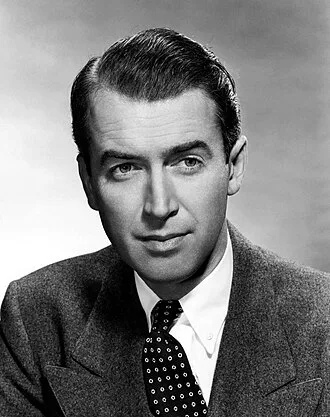
Born and raised in Indiana, Pennsylvania, Stewart started acting while at Princeton University. After graduating, he began a career as a stage actor, making his Broadway debut in 1932 in the play Carry Nation. He landed his first supporting role in The Murder Man (1935) and had his breakthrough in Frank Capra's ensemble comedy You Can't Take It with You (1938).
He later starred in Capra's political comedy Mr. Smith Goes to Washington (1939), and Ernst Lubitsch's romantic comedy The Shop Around the Corner (1940), Stewart went on to receive the Academy Award for Best Actor for his performance in the George Cukor romantic comedy The Philadelphia Story (1940).
After returning home from World War II, he went on to star in Capra's It's a Wonderful Life (1946), which was a critical and commercial disappointment upon its release, but has since become a beloved classic after its copyright expired in the early 1970s.
Stewart went on to star in four films directed by Alfred Hitchcock, Rope (1948), Rear Window (1954), The Man Who Knew Too Much (1956), and Vertigo (1958), as well as Anatomy of a Murder (1959), and The Man Who Shot Liberty Valance (1962).
With his private pilot's skills, he enlisted in the US Army Air Forces during the war, seeking combat duty and rose to be deputy commanding officer of the 2nd Bombardment Wing and commanding the 703d Bombardment Squadron from 1941 to 1947. He later transferred to the Air Force Reserve, and held various command positions until his retirement in 1968 as a brigadier general.
Early life and education
James Maitland Stewart was born on May 20, 1908, in Indiana, Pennsylvania, the eldest child and only son born to Elizabeth Ruth (née Jackson; 1875–1953) and Alexander Maitland Stewart (1872–1961). Stewart had two younger sisters, Mary (1912–1977) and Virginia (1914–1972). He was of Scottish and Ulster-Scots ancestry.
The Stewart family had lived in Pennsylvania for many generations. Stewart's father ran the family business, the J. M. Stewart and Company Hardware Store, which he hoped Stewart would take over as an adult after attending Princeton University, as was the family tradition. Raised a Presbyterian by his deeply religious father, Stewart was a devout churchgoer for much of his life.
Stewart's mother was a pianist, and music was an important part of family life. When a customer at the store was unable to pay his bill, Stewart's father accepted an old accordion as payment. Stewart learned to play the instrument with the help of a local barber. His accordion became a fixture offstage during his acting career.
A shy child, Stewart spent much of his time after school in the basement working on model airplanes, mechanical drawings, and chemistry—all with a dream of going into aviation. He attended the Wilson Model School for primary school and junior high school. He was not a gifted student and received average to low grades.
According to his teachers, this was not from a lack of intelligence, but due to being creative and having a tendency to daydream.
In the fall of 1923, Stewart began attending Mercersburg Academy prep school because his father did not believe he would be accepted into Princeton (his father was a member of the class of 1898) if he attended public high school. At Mercersburg, Stewart participated in a variety of extracurricular activities. He was a member of the track team (competing as a high jumper under coach Jimmy Curran), the art editor of the school yearbook, a member of the glee club, and a member of the John Marshall Literary Society. To his disappointment, he was relegated to the third-tier football team due to his slender physique.
Stewart made his first onstage appearance at Mercersburg, as Buquet in the play The Wolves in 1928. During summer breaks, he returned to Indiana, working first as a brick loader and then as a magician's assistant. Due to scarlet fever that turned into a kidney infection, he had to take time out from school in 1927, which delayed his graduation until 1928.
He remained passionate about aviation, with his interest enhanced by Charles Lindbergh's first solo transatlantic flight, but abandoned visions of becoming a pilot when his father steered him towards Princeton.
Stewart enrolled at Princeton in 1928 as a member of the class of 1932, majoring in architecture and becoming a member of the Princeton Charter Club. He excelled academically but also became attracted to the school's drama and music clubs, including the Princeton Triangle Club. Upon his graduation in 1932, he was awarded a scholarship for graduate studies in architecture for his thesis on an airport terminal design, but chose instead to join University Players, an intercollegiate summer stock company performing in West Falmouth, Massachusetts, on Cape Cod.
Career
1932–1937: Theater and early film roles
Stewart performed in bit parts in the University Players' productions in Cape Cod during the summer of 1932. The company's directors included Joshua Logan, Bretaigne Windust, and Charles Leatherbee, and amongst its other actors were married couple Henry Fonda and Margaret Sullavan, who became Stewart's close friends. At the end of the season, Stewart moved to New York with his Players friends Logan, Myron McCormick, and newly single Henry Fonda.
Along with McCormick, Stewart debuted on Broadway in the brief run of Carry Nation and a few weeks later – again with McCormick – appeared as a chauffeur in the comedy Goodbye Again, in which he had a walk-on line. The New Yorker commented, "Mr. James Stewart's chauffeur... comes on for three minutes and walks off to a round of spontaneous applause." Following the seven-month run of Goodbye Again, Stewart took a stage manager position in Boston, but was fired after frequently missing his cues.
Returning to New York, he then landed a small part in Spring in Autumn and a role in All Good Americans, where he was required to throw a banjo out of the window. Brooks Atkinson of The New York Times wrote, "Throwing a $250 banjo out of the window at the concierge is constructive abuse and should be virtuously applauded." Both plays folded after only short runs, and Stewart began to think about going back to his studies.
Stewart was convinced to continue acting when he was cast in the lead role of Yellow Jack, playing a soldier who becomes the subject of a yellow fever experiment. It premiered at the Martin Beck Theater in March 1934. Stewart received unanimous praise from the critics, but the play proved unpopular with audiences and folded by June.
During the summer, Stewart made his film debut with an unbilled appearance in the Shemp Howard comedy short Art Trouble (1934), filmed in Brooklyn, and acted in summer stock productions of We Die Exquisitely and All Paris Knows at the Red Barn Theater on Long Island. In the fall, he again received excellent reviews for his role in Divided by Three at the Ethel Barrymore Theatre, which he followed with the modestly successful Page Miss Glory and the critical failure A Journey by Night in spring 1935.
Soon after A Journey by Night ended, Stewart signed a seven-year contract with Metro-Goldwyn-Mayer (MGM), orchestrated by talent scout Bill Grady, who had been tracking Stewart's career since seeing him perform in Princeton. His first Hollywood role was a minor appearance in the Spencer Tracy vehicle The Murder Man (1935).
His performance was largely ignored by critics, although the New York Herald Tribune, remembering him in Yellow Jack, called him "wasted in a bit that he handles with characteristically engaging skill". MGM did not see leading-man material in Stewart, described by biographer Michael D. Rinella as a "lanky young bumpkin with a hesitant manner of speech".
During this time, his agent Leland Hayward decided that the best path for him would be through loan-outs to other studios.
Stewart had only a small role in his second MGM film, the hit musical Rose Marie (1936), but it led to his casting in seven other films within one year, including Next Time We Love and After the Thin Man. He also received crucial help from his University Players friend Margaret Sullavan, who campaigned for him to be her leading man in Next Time We Love, a Universal romantic comedy filmed right after Rose Marie.
Sullavan rehearsed extensively with him, boosting his confidence and helping him incorporate his mannerisms and boyishness into his screen persona. Next Time We Love was a box-office success and received mostly positive reviews, leading Stewart to be noticed by critics and MGM executives. Time stated that "the chief significance of [the film] in the progress of the cinema industry is likely to reside in the presence in its cast of James Stewart", and The New York Times called him "a welcome addition to the roster of Hollywood's leading men".
Stewart followed Next Time We Love with supporting roles in two commercially successful romantic comedies, Wife vs. Secretary (1936) with Clark Gable and Myrna Loy and Small Town Girl (1936). In both, he played the betrayed boyfriend of the leading lady, portrayed by Jean Harlow and Janet Gaynor, respectively.
Both films garnered him some good reviews. After an appearance in the short subject Important News (1936), Stewart had his first top-billed role in the low-budget "B" movie Speed (1936), in which he played a mechanic and speed driver competing in the Indianapolis 500. The film was a critical and commercial failure, although Frank Nugent of The New York Times stated that "Mr. Stewart [and the rest of the cast] perform as pleasantly as possible."
Stewart's last three film releases of 1936 were all box-office successes. He had only a bit part in The Gorgeous Hussy, but a starring role in the musical Born to Dance with Eleanor Powell. His performance in the latter was not well-received: The New York Times stated that his "singing and dancing will (fortunately) never win him a song-and-dance-man classification", and Variety called "his singing and dancing [...] rather painful on their own", although it otherwise found Stewart aptly cast in an "assignment [that] calls for a shy youth".
Stewart's last film to be released in 1936, After the Thin Man, features a shattering emotional climax rendered by Stewart. Kate Cameron of the New York Daily News wrote that he "has one grand scene in which he demonstrates most effectively that he is something more than a musical comedy juvenile".
For his next film, the romantic drama Seventh Heaven (1937), Stewart was loaned to 20th Century-Fox to play a Parisian sewer worker in a remake of Frank Borzage's silent classic released a decade earlier. He and co-star Simone Simon were miscast, and the film was a critical and commercial failure. William Boehnel of the New York World-Telegram called Stewart's performance emotionless, and Eileen Creelman of The New York Sun wrote that he made little attempt to look or sound French.
Stewart's next film, The Last Gangster (1937) starring Edward G. Robinson, was also a failure, but it was followed by a critically acclaimed performance in Navy Blue and Gold (1937) as a football player at the United States Naval Academy. The film was a box-office success and earned Stewart the best reviews of his career up to that point. The New York Times wrote "the ending leaves us with the conviction that James Stewart is a sincere and likable triple-threat man in the [MGM] backfield" and Variety called his performance "fine".
1938–1941: Leading man
Despite good reviews, Stewart was still a minor star, and MGM remained hesitant to cast him in leading roles, preferring to loan him out to other studios. After a well-received supporting part in Of Human Hearts (1938), he was loaned to RKO to act opposite Ginger Rogers in the romantic comedy Vivacious Lady (1938).
The production was shut down for months in 1937 as Stewart recovered from an undisclosed illness, during which he was hospitalized. RKO initially wanted to replace Stewart, but eventually the project was canceled. However, Rogers' success in a stage musical caused the film to be picked up again. Stewart was recast in Vivacious Lady at Rogers' insistence and due to his performance in Of Human Hearts.
It was a critical and commercial success, and showed Stewart's talent for performing in romantic comedies; The New York Herald called him "one of the most knowing and engaging young actors appearing on the screen at present".
Stewart's third film release of 1938, the First World War drama The Shopworn Angel, saw him collaborate again with Margaret Sullavan. In his performance, Stewart drew upon his own feelings of unrequited love towards Sullavan, who was married to his agent, Leland Hayward. Although the film was otherwise well-received, critics were mixed about Stewart.
Bland Johaneson of the New York Daily Mirror compared him to Stan Laurel in this melodramatic film, and Variety called his performance unfocused.
Stewart became a major star when he was loaned out to Columbia Pictures to play the lead role in Frank Capra's You Can't Take It with You (1938) opposite Jean Arthur. Stewart played the son of a banker who falls in love with a woman from a poor and eccentric family. Capra had recently completed several well-received films and was looking for a new type of leading man.
He had been impressed by Stewart's role in Navy Blue and Gold (1937). According to Capra, Stewart was one of the best actors ever to hit the screen, understood character archetypes intuitively, and required little directing. You Can't Take It With You became the fifth highest-grossing film of the year and won the Academy Award for Best Picture.
The film was also critically successful, but while Variety wrote that the performances of Stewart and Arthur garnered "much of the laughs", most of the critical acclaim went to Lionel Barrymore and Edward Arnold.
In contrast to the success of You Can't Take It With You, Stewart's first three film releases of 1939 were all commercial disappointments. In the melodrama Made for Each Other (1939), he shared the screen with Carole Lombard. Stewart blamed its directing and screenwriting for its poor box-office performance.
Regardless, the film received favorable reviews, with Newsweek writing that Stewart and Lombard were "perfectly cast in the leading roles". The other two films, The Ice Follies of 1939 and It's a Wonderful World, were critical failures.
In Stewart's fourth 1939 film, he worked with Capra and Arthur again in the political comedy-drama Mr. Smith Goes to Washington. Stewart played an idealist thrown into the political arena. It garnered critical praise and became the third-highest-grossing film of the year. The Nation stated "[Stewart] takes first place among Hollywood actors...Now he is mature and gives a difficult part, with many nuances, moments of tragic-comic impact." Later, critic Andrew Sarris qualified Stewart's performance as "lean, gangling, idealistic to the point of being neurotic, thoughtful to the point of being tongue-tied", describing him as "particularly gifted in expressing the emotional ambivalence of the action hero".
Stewart won the New York Film Critics Circle award and received his first nomination for the Academy Award for Best Actor.
Stewart's last screen appearance of 1939 came in the Western Destry Rides Again, in which he portrayed a pacifist lawman alongside Marlene Dietrich, a saloon girl who falls in love with him. It was critically and commercially successful. TIME magazine wrote, "James Stewart, who had just turned in the top performance of his cinematurity as Jefferson Smith in Mr.
Smith Goes to Washington, turns in as good a performance or better as Thomas Jefferson Destry." Between films, Stewart had begun a radio career and had become a distinctive voice on the Lux Radio Theater, The Screen Guild Theater, and other shows. So well-known had his slow drawl become that comedians began impersonating him.
Stewart and Sullavan reunited for two films in 1940. The Ernst Lubitsch romantic comedy The Shop Around the Corner starred them as co-workers who cannot stand each other but unknowingly become romantic pen-pals. It received good reviews and was a box-office success in Europe, but failed to find an audience in the US, where less-gentle screwball comedies were more popular.
Director Lubitsch assessed it to be the best film of his career, and it has been regarded highly by later critics, such as Pauline Kael and Richard Schickel.
The drama The Mortal Storm, directed by Frank Borzage, featured Sullavan and Stewart as lovers caught in turmoil upon Hitler's rise to power. It was one of the first blatantly anti-Nazi films to be produced in Hollywood, but according to film scholar Ben Urwand, "ultimately made very little impact" as it did not show the persecution experienced by Jews or name that ethnic group.
Despite being well received by critics, it failed at the box office. Ten days after filming The Mortal Storm, Stewart began filming No Time for Comedy (1940) with Rosalind Russell. Critics complimented Stewart's performance; Bosley Crowther of The New York Times called Stewart "the best thing in the show", yet the film was again not a box-office success.
Stewart's final film to be released in 1940 was George Cukor's romantic comedy The Philadelphia Story, in which he played an intrusive, fast-talking reporter sent to cover the wedding of a socialite (Katharine Hepburn) with the help of her ex-husband (Cary Grant). The film became one of the largest box-office successes of the year and received widespread critical acclaim. The New York Herald Tribune stated that "Stewart...contributes most of the comedy to the show...In addition, he contributes some of the most irresistible romantic moments." His performance earned him his only Academy Award in a competitive category for Best Actor, beating out Henry Fonda, for whom he had voted and with whom he had once roomed, both almost broke, in the early 1930s in New York.
Stewart himself assessed his performance in Mr. Smith to be superior and believed the academy was recompensing for not giving him the award the year prior. Moreover, Stewart's character was a supporting role, not the male lead. He gave the Oscar to his father, who displayed it at his hardware store alongside other family awards and military medals.
Stewart next appeared in two comedies: Come Live with Me (1941), which paired him with Hedy Lamarr, and Pot o' Gold (1941), featuring Paulette Goddard. Stewart considered the latter to be the worst film of his career. His last film before military service was the musical Ziegfeld Girl (1941), which co-starred Judy Garland, Hedy Lamarr, and Lana Turner. It was a critical failure, but also one of the best box-office performers of the year.
1941–1947: Military service
Stewart became the first major American movie star to enlist in the United States Army to fight in World War II. His family had deep military roots: both of his grandfathers had fought in the Civil War, and his father had served during both the Spanish–American War and World War I. After first being rejected for low weight in November 1940, he enlisted in February 1941.
As an experienced pilot, he reported for induction as a private in the Air Corps on March 22, 1941. Soon to be 33 years old, he was over the age limit for Aviation Cadet training—the normal path of commissioning for pilots, navigators and bombardiers—and therefore applied for an Air Corps commission as both a college graduate and a licensed commercial pilot. Stewart received his commission as a second lieutenant on January 1, 1942.
After enlisting, Stewart made no new commercial films, although he remained under contract to MGM. His public appearances were limited to engagements for the Army Air Forces. The Air Corps scheduled him on network radio with Edgar Bergen and Charlie McCarthy, and on the radio program We Hold These Truths, a celebration of the United States Bill of Rights, which was broadcast a week after the attack on Pearl Harbor.
Stewart also appeared in a First Motion Picture Unit short film, Winning Your Wings, to help recruit airmen. Nominated for an Academy Award for Best Documentary in 1942, it appeared in movie theaters nationwide beginning in late May 1942 and resulted in 150,000 new recruits.
Stewart was concerned that his celebrity status would relegate him to duties behind the lines. After spending over a year training pilots at Kirtland Army Airfield in Albuquerque, New Mexico, he appealed to his commander and in November 1943 was sent to England as part of the 703d Bomb Squadron to fly B-24 Liberators. He was based initially at RAF Tibenham, before moving to RAF Old Buckenham.
📚 Source: Wikipedia