Johnny Carson
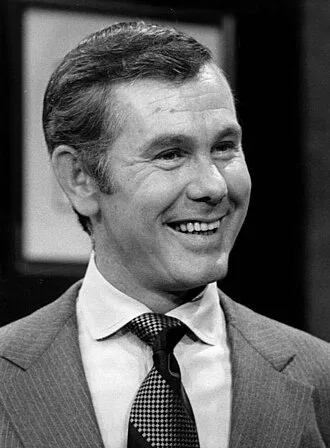
Born in Corning, Iowa, Carson was raised in Norfolk, Nebraska, graduating from Norfolk High School. During World War II, Carson served in the United States Navy. After the war, Carson graduated from the University of Nebraska with a Bachelor of Arts. Carson began his a career in radio and local television in Omaha, NE. He eventually took over as host of the late-night talk show Tonight from Jack Paar in 1962.
In a career spanning four decades, Carson received six Primetime Emmy Awards, the Television Academy's 1980 Governor's Award, and a 1985 Peabody Award. He was inducted into the Television Academy Hall of Fame in 1987. Carson was awarded the Presidential Medal of Freedom in 1992 and received a Kennedy Center Honor in 1993.
Carson remained an American cultural icon even after his retirement in 1992. He adopted a casual, conversational approach with extensive interaction with guests, an approach pioneered by Arthur Godfrey and previous Tonight Show hosts Paar and Steve Allen, but enhanced by Carson's lightning-quick wit. A cultural phenomenon, Carson is widely regarded as the King of Late Night Television. Former late-night host and friend David Letterman, as well as many others, have cited Carson's influence.
Early life and career
John William Carson was born on October 23, 1925, in Corning, Iowa, to Ruth Elizabeth Carson (née Hook; 1901–1985) and Homer Lloyd "Kit" Carson (1899–1983), a power company manager. Carson was the second of three children. He had an older sister, and a younger brother, Richard "Dick" Carson (1929–2021).
Growing up initially in Iowa, Carson lived in the towns of Avoca, Clarinda, and Red Oak before moving to Norfolk, Nebraska, at age eight. There, Carson began developing his talent for entertaining. At age 12, he found a book on magic at a friend's house and purchased a mail-order magician's kit. After purchasing the kit, Carson practiced his entertainment skills on family members with card tricks.
During this period, he would follow his family members around, saying, "Pick a card, any card." Carson's mother made him a cape, and his first performance was in front of the local Kiwanis Club. He debuted as "The Great Carsoni" at age 14 and was paid $3 a show.
After graduating from high school, Carson hitchhiked to Hollywood, Los Angeles. There, he was arrested and fined $50 for impersonating a midshipman, a story often regarded as apocryphal.
Military service
Carson joined the United States Navy on June 8, 1943, and received V-12 Navy College Training Program officer training at Columbia University and Millsaps College. Commissioned an ensign late in the war, Carson was assigned to USS Pennsylvania in the Pacific. He arrived on the Pennsylvania on August 14, 1945, the same day Imperial Japan announced its surrender. The ship was sent to Guam after a torpedo bomber attack damaged its stern prior to Carson's arrival.
Once in drydock, Carson, assigned to damage control, was given the task of supervising the removal of the bodies of 20 servicemen and their effects. He recounted the experience in an unpublished 1967 Time interview, stating "Jesus, that was an awful experience. They'd been down there for 18 days by the time, and I want to tell you, that was a terrible job." Carson returned stateside with the Pennsylvania to Seattle and was assigned to command a troop train for returning servicemen. He finished his service in Guam, decoding encrypted messages.
Carson later said that the high point of his military career was performing a magic trick for U.S. secretary of the Navy James V. Forrestal. In a conversation with Forrestal, the secretary asked Carson if he planned to stay in the Navy after the war. In response, Carson said no and told him he wanted to be a magician.
Forrestal asked him to perform, and Carson responded with a card trick. Carson discovered that he could entertain and amuse someone as cranky and sophisticated as Forrestal.
While in the Navy, Carson was an amateur boxer, with most of his bouts fought on board Pennsylvania.
Education
Taking advantage of educational opportunities from the Navy, Carson attended the University of Nebraska, where he joined the Phi Gamma Delta fraternity and continued performing magic, then paid $25 per appearance. Carson majored in journalism with the intention of becoming a comedy writer, but instead switched his major to speech and drama a few months later because he wanted to become a radio performer.
His college thesis, titled "How to Write Comedy for Radio", was a compilation of taped skits and jokes from popular radio shows with Carson explaining the comedic technique in a voiceover. It allowed him to graduate in three years. Carson graduated with a bachelor of arts degree in radio and speech with a minor in physics in 1949.
Early radio and television
Carson began his broadcasting career in 1950 at WOW-AM and WOW-TV (now WOWT-TV) in Omaha, Nebraska. He soon hosted a morning television program called The Squirrel's Nest. One of his routines involved interviewing pigeons on the roof of the local courthouse that would report on the political corruption they had seen.
Carson supplemented his income by serving as master of ceremonies at local church dinners—attended by some of the same politicians and civic leaders he had lampooned on the radio.
The wife of one of the Omaha political figures that Carson spoofed owned stock in a radio station in Los Angeles, and in 1951, referred Carson to her brother, who was influential in the emerging television market in Southern California. Carson joined CBS-owned Los Angeles television station KNXT (now KCBS-TV).
In 1953, comic Red Skelton—a fan of Carson's low-budget sketch comedy show, Carson's Cellar (1951–1953) on KNXT—asked Carson to join his show as a writer. In 1954, Skelton accidentally knocked himself unconscious during rehearsal, an hour before his live show began. Carson successfully filled in for him. In 1955, Jack Benny invited Carson to appear on one of his programs during the opening and closing segments.
Carson imitated Benny and claimed that Benny had copied his gestures. Benny predicted that Carson, who readily admitted Benny's substantial influence on aspects of his comedic delivery, would have a successful career as a comedian.
Carson hosted several shows besides Carson's Cellar, including the game show Earn Your Vacation (1954) and the variety show The Johnny Carson Show (1955–1956). He was a guest panelist on the original To Tell the Truth beginning in 1960, becoming a regular panelist from 1961 to 1962.
After the primetime Johnny Carson Show failed, Carson moved to New York City to host ABC's Who Do You Trust? (1957–1962). It was on Who Do You Trust? that Carson met his future sidekick and straight man, Ed McMahon. Although Carson believed moving to daytime television would hurt his career, Who Do You Trust? was a success.
It was the first show where he could ad lib and interview guests. Because of his on-camera wit, the show became "the hottest item on daytime television" during his six years at ABC. From his experience as a radio host, in 2000 Carson wrote a parody for The New Yorker of former talk-show host Dennis Miller having the new role at the time as an NFL sports announcer, titled "Proverbs of Dennis Miller".
The Tonight Show
NBC's Tonight was the late-night counterpart to its early-morning show Today. Originating in 1954 with host Steve Allen, Tonight was somewhat experimental at the time, as the only previous network late-night program was NBC's Broadway Open House (1950–51), which starred Jerry Lester and Dagmar. Tonight was successful. Allen moved to primetime comedy-variety shows in 1957 when Jack Paar became host of Tonight. Paar left the show in 1962.
Carson's success on Who Do You Trust? led NBC to invite him to take over Tonight a few months before Paar's departure. Carson declined the offer because he feared the difficulty of interviewing celebrities for 105 minutes each day. Bob Newhart, Jackie Gleason, Groucho Marx, and Joey Bishop also declined.
NBC finally convinced Carson to sign by early February 1962. He can be seen discussing his upcoming job for the first time on the February 11, 1962, episode of What's My Line? Because Carson had six months left on his ABC contract, NBC used multiple guest hosts until he could take over. Guest hosts included Bishop, Marx, Merv Griffin, Art Linkletter, Arlene Francis, Bob Cummings, Jerry Lewis, Donald O'Connor and others.
Although he continued to have doubts about his new job, Carson became the host of Tonight (later called The Tonight Show Starring Johnny Carson) on October 1, 1962. After a difficult first year, he overcame his fears. While Tonight under its previous hosts had been successful, especially under Paar, Carson's version eventually did very well in the ratings. Billy Wilder said of Carson:
By the simple law of survival, Carson is the best. He enchants the invalids and the insomniacs as well as the people who have to get up at dawn. He is the Valium and the Nembutal of a nation. No matter what kind of dead-asses are on the show, he has to make them funny and exciting. He has to be their nurse and their surgeon.
He has no conceit. He does his work and he comes prepared. If he's talking to an author, he has read the book. Even his rehearsed routines sound improvised. He's the cream of middle-class elegance, yet he's not a mannequin. He has captivated the American bourgeoisie without ever offending the highbrows, and he has never said anything that wasn't liberal or progressive.
Every night, in front of millions of people, he has to do the salto mortale [circus parlance for an aerial somersault performed on the tightrope]. What's more, he does it without a net. No rewrites. No retakes. The jokes must work tonight.
McMahon followed Carson from Who Do You Trust? as his announcer and sidekick, and Skitch Henderson was installed as the maestro of the NBC Orchestra. McMahon's famous introduction, "Heeeeere's Johnny!!!" was followed by a brief monologue by Carson. This was often followed by comedy sketches, interviews, and live music.
Carson's trademark was a phantom golf swing at the end of his monologues, aimed stage left toward the orchestra. (Guest hosts sometimes parodied that gesture. Newhart rolled an imaginary bowling ball toward the audience.)
Paul Anka wrote The Tonight Show's theme song, ("Johnny's Theme"), a reworking of his "Toot Sweet"; given lyrics, it was renamed "It's Really Love" and recorded by Annette Funicello in 1959. Before taking over The Tonight Show, Carson wrote lyrics for the song, and so claimed 50% of the song's performance royalties (though the lyrics were never used).
The theme is heard being played on sound recordings of Carson's first Tonight Show, and it was used without interruption through to his last broadcast on May 22, 1992.
The Tonight Show was originally produced at NBC's headquarters at 30 Rockefeller Plaza in New York City, with occasional stints in California. The program began videotaping in advance during the Jack Paar days, although during the 1970s NBC fed the live taping from Burbank to New York via satellite for editing (see below).
Carson had a talent for quick quips to deal with problems. If the opening monologue fared poorly, the band would start playing "Tea for Two" and Carson danced a softshoe to laughs from the studio audience. Alternatively, Carson might pull the boom microphone close to his face and announce, "Attention K-Mart shoppers, clean up in aisle four!"
Move to Burbank
On May 1, 1972, The Tonight Show moved from 30 Rockefeller Plaza to the NBC Studios in Burbank, California, because of the studio's proximity to celebrities.
From 1980, Carson stopped hosting five shows per week. Instead, Mondays featured a guest host, leaving Carson to host the other four weeknights. Shows were videotaped in Burbank at 5:30 pm, fed from there to the Central and Eastern Time Zone stations via cross-country television line at 8:30 pm Pacific time (11:30 pm Eastern time), and later sent from Burbank to the Pacific Time Zone stations at 11:30 pm Pacific time.
Since only two feeds originated from Burbank, Central Time Zone stations received the Eastern feed one hour earlier at 10:30 pm local time, and Mountain time stations received the Pacific time zone feed one hour later, at 12:30 am local time. [citation needed]
Carson announced in April 1979 that he was leaving The Tonight Show after 17 years hosting the program. At the time, media analysts estimated the show generated 17% of NBC's pretax profits. He negotiated a three-year deal to remain with the show in May 1980, reducing the program's length from 90 to 60 minutes, while decreasing his workload from four to three nights each week.
Tom Snyder's Tomorrow added a half-hour to fill the vacant time. Joan Rivers became the "permanent" guest host from September 1983 until 1986. The Tonight Show then returned to using rotating guest hosts, including comics George Carlin and Garry Shandling. Jay Leno became the exclusive guest host in fall 1987, later joking that although other guest hosts had upped their fees, he had kept his low, assuring himself more bookings.
Eventually, Monday night was reserved for Leno and Tuesday night was reserved for The Best of Carson—rebroadcasts usually dating from a year earlier, but occasionally from the 1970s.
Although Carson's work schedule became more abbreviated, The Tonight Show remained so successful that his compensation from NBC continued to rise; by the mid-1970s, he had become the highest-paid personality on television, earning about $4 million a year ($19,745,000 today), not including nightclub appearances and his other businesses.
Carson refused many offers to appear in films, including title roles in The Thomas Crown Affair and Gene Wilder's role in Blazing Saddles. He also declined director Martin Scorsese's offer to co-star with Robert De Niro in the 1983 film The King of Comedy, with the role of a TV talk-show host then going to Jerry Lewis.
In recognition of his 25th anniversary on The Tonight Show, Carson received a personal Peabody Award, the board saying he had "become an American institution, a household word, [and] the most widely quoted American". They also said they "felt the time had come to recognize the contributions that Johnny has made to television, to humor, and to America".
Uri Geller
In 1973, television personality and self-proclaimed psychic Uri Geller appeared on The Tonight Show. In the NOVA documentary, "James Randi – Secrets of the Psychics," magician and skeptical activist James Randi recalls that Carson "had been a magician himself and was skeptical" of Geller's claimed paranormal powers, so prior to the date of taping, Randi was personally asked "to help prevent any trickery".
Per Randi's advice, the show's staff prepared its own props without informing Geller and did not let Geller or his staff "anywhere near them." When Geller joined Carson on stage, he appeared surprised that he was not going to be interviewed, but instead was expected to display his abilities using the provided articles.
Geller was unable to display any paranormal abilities, saying, "I don't feel strong" and expressing displeasure at feeling like he was being "pressed" to perform by Carson. According to Adam Higginbotham's November 7, 2014, article in The New York Times:
The result was a legendary immolation, in which Geller offered up flustered excuses to his host as his abilities failed him again and again. "I sat there for 22 minutes, humiliated," Geller told me, when I spoke to him in September. "I went back to my hotel, devastated. I was about to pack up the next day and go back to Tel Aviv. I thought, That's it — I'm destroyed."
However, ironically, this appearance on The Tonight Show, which Carson and Randi had orchestrated to debunk Geller's claimed abilities, backfired. According to Higginbotham,
To Geller's astonishment, he was immediately booked on The Merv Griffin Show. He was on his way to becoming a paranormal superstar. "That Johnny Carson show made Uri Geller," Geller said. To an enthusiastically trusting public, his failure only made his gifts seem more real: If he were performing magic tricks, they would surely work every time.
Comic characters
Carson played several continuing characters on sketches during the show, including:
- Art Fern was the "Tea Time Movie" announcer, whose theme song was "Hooray for Hollywood". Carson once admitted on camera that this was his favorite character, based on late-afternoon movie broadcasts and TV hosts who delivered live commercials throughout the movie. Each sketch usually featured three long commercials interrupted by four-second clips from old silent films. When the camera returned from each clip, Art was always caught off-guard and immediately reminded viewers that they were watching a film favorite. The movies always had unlikely casts and even less likely titles: "Slim Pickens, Patti Page, Duke Wayne, and Charlton Heston in another classic Western: Kiss My Saddle Horn! Carson originally played the fast-talking huckster in his own voice (as Honest Bernie Schlock or Ralph Willie (parodying California used-car dealer Ralph Williams), and the sketch was called "The Big Flick". Carson finally settled on a nasal, high-pitched, smarmy drone, reminiscent of Jackie Gleason's "Reginald Van Gleason III" character. The sketch was renamed "Tea Time Movie" and the host became Art Fern, wearing a lavish toupee, loud jackets, and a pencil mustache. Actress Carol Wayne became famous for her 100-plus appearances (1971–1984) as Art's buxom assistant, the Matinée Lady. While Art gave his spiel, she would enter the stage behind him. Art would react to her attractive body by wincing, loudly shouting "Ho — leeeee!" and turning almost everything she said into a sexual double entendre. After Carol Wayne's accidental death in 1985, Carson kept Art Fern off the air for most of the next year, and finally hired Danuta Wesley and then Teresa Ganzel to play the Matinée Lady. Carson also used these sketches to poke fun at the intricate Los Angeles interstate system, using a pointer and map to give confusing directions to shoppers, often including points where he would unfold the cardboard map to point out, via the appropriate picture, when the shopper would arrive at "the fork in the road". Another freeway routine in the same theme centered on the "Slauson Cutoff", a slang term Carson popularized to describe the truncated Marina Freeway (which ended abruptly at Slauson Avenue in Culver City). Art Fern would advise drivers to take a series of freeways until they reached the Slauson Cutoff, and would then advise them to "Get out of your car, cut off your slauson, get back in your car," often followed by peals of laughter from the audience, led by McMahon.
- Carnac the Magnificent, a turbaned psychic, could answer questions before seeing them. The character was taken from Steve Allen's essentially identical "Answer Man", which Allen performed during his tenure as host of Tonight in the 1950s. As Allen acknowledged in his book The Question Man, this bit had been created in Kansas City in 1951 by Bob Arbogast and used on The Tom Poston Show in New York, where it eventually ended up on The Steve Allen Show, much to the surprise of both Bob and Steve. Carnac had a trademark entrance in which he always turned the wrong direction when coming onstage and then tripped on the step up to Carson's desk. (In one episode, technicians rigged Carson's desk to fall apart when Carnac fell into it.) These comedic missteps were an indication of Carnac's true prescient abilities. McMahon would hand Carson a series of envelopes containing questions, said to have been "hermetically sealed and kept in a mayonnaise jar on Funk and Wagnalls' porch since noon today". Carson would place each envelope against his forehead and predict the answer, such as "Gatorade". Then, he would read the question: "What does an alligator get on welfare?" Some of the jokes were feeble, and McMahon used pauses after terrible puns and audience groans to make light of Carson's lack of comic success ("Carnac must be used to quiet surroundings"), prompting Carson to return an equal insult. McMahon would always announce near the end, "I hold in my hand the last envelope," at which the audience would applaud wildly, prompting Carnac to pronounce a comedic "curse" on the audience, such as, "May a flock of wild geese leave a deposit on your breakfast!", "May your sister elope with a camel!", or "May a diseased yak take a liking to your sister". Staff writer Pat McCormick wrote some of the zaniest Carnac material. One joke had McMahon and Carson nearly rolling on the floor with sustained laughter. The answer was "Sis boom bah". The question: "Describe the sound made when a sheep explodes."
- Floyd R. Turbo American (with no pause between words) was a stereotypical common working man, wearing a plaid hunting coat and cap, who offered "editorial responses" to left-leaning causes or news events. Railing against women's rights in the workplace, for example, Turbo would shout: "This raises the question: kiss my Dictaphone!"
- Aunt Blabby, a cantankerous and sometimes amorous old lady, was an obvious copy of Jonathan Winters' most famous creation, Maude Frickert, including her black spinster dress and wig. Aunt Blabby was invariably interviewed by straight man Ed McMahon about elder affairs. McMahon would innocently use a common expression such as "check out", only to have Aunt Blabby warn him: "Don't say 'check out' to an old person!"
- El Mouldo, a mentalist, was a revival of Carson's 1960s character the Amazing Dillinger, burlesquing mentalist Joseph Dunninger. El Mouldo would attempt to perform mind-reading and mind-over-matter feats, all of which failed. Often, his tricks would include an attempt to bilk money from Ed McMahon or would end with his begging the audience for a dollar, or at least bus fare.
- The Maharishi, whose theme song was "Song of India", was a frizzy-haired "holy man" who spoke in a high-pitched, tranquil tone, greeted announcer McMahon with a flower and answered philosophical questions. This was a take-off on Maharishi Mahesh Yogi.
- Doctor Dilly as a feeble-minded physician who dispensed rambling medical advice. Carson imitated stage and radio comedian Ed Wynn for this character, using a high, cracked voice and a silly giggle.
One time-honored routine was used whenever Carson and a guest toasted each other with glasses of water on the air. Carson would telegraph the joke to the guest: "The king is dead!" Then both would shout "Long live the king!" and take a mouthful of water. Offscreen, Ed McMahon cried, "The king lives!", prompting Carson and the guest to do a spit-take in mock terror.
Don Adams, Don Rickles, Mel Brooks, and Dom DeLuise engaged in this routine; one of Adams's Get Smart episodes was even titled "The King Lives?"
📚 Source: Wikipedia