As of 31 December 2024, the province had a population of 1,452,458 of whom 1,210,983 lived in the four urban districts (Melikgazi, Kocasinan, Talas, Incesu), excluding İncesu which is not conurbated, meaning it is not contiguous and has a largely non-protected buffer zone.
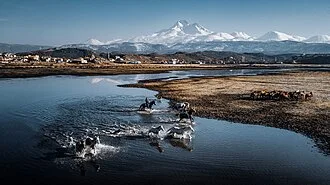
Kayseri sits at the foot of Mount Erciyes (Turkish: Erciyes Dağı), a dormant volcano that reaches an altitude of 3,917 metres (12,851 feet), more than 1,500 metres above the city's mean altitude. It contains a number of historic monuments, particularly from the Seljuk period. Tourists often pass through Kayseri en route to the attractions of Cappadocia to the west.
Kayseri is known for local dishes such as sucuk, pastırma, and mantı, which are commonly associated with the region.
Kayseri is served by Erkilet International Airport and is home to Erciyes University.
Etymology
Kayseri has been equated with the early Hittite kingdom of Kussara, referenced sporadically in early Assyrian trading records. It was called Mazaka or Mazaca (Armenian: Մաժաք, Mažak'; according to Armenian tradition, it was founded by and named after Mishak) and was known as such to the geographer Strabo, during whose time it was the capital of the Roman province of Cappadocia, known also as Eusebia at the Argaeus (Εὐσέβεια ἡ πρὸς τῷ Ἀργαίῳ in Greek), after Ariarathes V Eusebes, King of Cappadocia (r. 163–130 BC).
In 14 AD its name was changed by Archelaus (d. 17 AD), the last King of Cappadocia (r. 36 BC–14 AD) and a Roman vassal, to "Caesarea in Cappadocia" (to distinguish it from other cities with the name Caesarea in the Roman Empire) in honour of Caesar Augustus upon his death. This name was rendered as Καισάρεια (Kaisáreia) in Koine Greek, the dialect of the later Byzantine (Eastern Roman) Empire, and it remained in use by the natives (nowadays known as Cappadocian Greeks, due to their spoken language, but then referred to as Rum due to their previous Roman citizenship) until their expulsion from Turkey in 1924. (Note that letter C in classical Latin was pronounced K. This pronunciation was adapted by the Arabs, who called the city Kaisariyah (قيصرية), and the Turks, who gave the city its current name Kayseri (قیصری)).
History
Kayseri experienced three golden ages. The first, dating to 2000 BC, was when the city formed a trade post between the Assyrians and the Hittites. The second came under Roman rule from the 1st to the 11th centuries. The third golden age was during the reign of the Seljuks (1178–1243), when the city was the second capital of the Seljuk Sultanate of Rum.
Ancient history
As Mazaca (Ancient Greek: Μάζακα), the city served as the residence of the kings of Cappadocia. In ancient times, it was on the crossroads of the trade routes from Sinope to the Euphrates and from the Persian Royal Road that extended from Sardis to Susa during the 200+ years of Achaemenid Persian rule. In Roman times, a similar route from Ephesus to the East also crossed the city.
In Late Antiquity, the city may have contained a population of around 50,000 inhabitants and it was the highest ranked diocese up to the council of Chalcedon. Nothing remains of it today. Basil of Caesarea, one of the Cappadocian Fathers, established a large complex containing charitable institutions, a monastery and churches, the Basiliad, in Caesarea Mazaca in the fourth century. Nothing remains of it today.
Hittites c. 1600–1200 BC
Phrygia c. 800–695 BC
Achaemenid Empire c. 547–333 BC
Macedonian Empire 333–323 BC
Kingdom of Cappadocia c. 320–17 BC
Roman Empire 17 BC–395 AD
Byzantine Empire 395–1071
Seljuk Empire 1071–1077
Sultanate of Rum 1077–1243
Ilkhanate 1243–1335
Eretna Beylik 1335–1381
Kadı Burhan al-Din 1381–1398
Ottoman Empire 1398–1922
Turkey 1923–present
The city was also situated on the main pilgrimage route from Constantinople to the Holy Land and had several shrines dedicated to local saints, such as St Mamas, St Merkourious and Basil of Caesarea, which continued to be venerated by the local population into the 17th century. The city was occupied by the Sassanids in 611/12 in the last war between the Byzantines and the Sassanids and became the headquarter of emperor Heraclius.
The city stood on a low spur on the north side of Mount Erciyes (Mount Argaeus in antiquity). Very few traces of the ancient site now survive.
Medieval history
From the mid-seventh century onwards, Arab attacks on Cappadocia and Caesarea became common and the city was besieged several times, diminishing in population and resources consequently. The Arab general, and later the first Umayyad Caliph, Muawiyah invaded Cappadocia and took Caesarea from the Byzantines temporarily in 647. By the mid-eight century, the area between Caesarea and Melitene was a no-mans land.
Though the city lost most of its importance by the tenth century, it probably still housed around 50,000 people. Alp Arslan's forces demolished the city and massacred its population in 1067. The shrine of Saint Basil was also sacked after the fall of the city. As a result, the city remained uninhabited for the next half century.
From 1074 to 1178 the area was under the control of the Danishmendids who rebuilt the city in 1134. The Sultanate of Rum controlled the city from 1178 to 1243 and it was one of their most important centres until it fell to the Mongols in 1243. The relatively short Seljuk period left a large number of historic landmarks including the Hunat Hatun Complex, the Kiliç Arslan Mosque, the Ulu Camii (Grand Mosque) and the Gevher Nesibe Hastanesi (Hospital).
Within the walls lies the greater part of Kayseri, rebuilt between the 13th and 16th centuries. Following his victory at the Battle of Elbistan against the Sultanate of Rum, in 1277 the Sultan Baybars marched into the city and massacred the Christians of Caesarea, but spared its Muslim inhabitants. The city fell to the Eretnids in the 14th century, before falling to the Ottomans in 1515.
It was the centre of a sanjak called initially the Rûm Eyalet (1515–1521) and then the Angora vilayet (founded as Bozok Eyalet, 1839–1923).
Modern era
The Grand Bazaar dates from the latter part of the 1800s, but the adjacent caravanserai, where merchant traders gathered before forming a caravan, dates from around 1500. The town's older districts which were filled with ornate mansion-houses mostly dating from the 18th and 19th centuries were subjected to wholesale demolition starting in the 1970s.
The building that hosted the Kayseri Lyceum was rearranged to host the Turkish Grand National Assembly during the Turkish War of Independence when the Greek army was advancing on Ankara, the base of the Turkish National Movement.
Geography
Climate
Kayseri has a humid continental climate (Köppen: Dsa, Trewartha: Dc). It experiences cold, snowy winters and hot, dry summers with cool nights. Precipitation occurs throughout the year, albeit with a marked decrease in late summer and early fall.
Districts
The city of Kayseri consists of sixteen metropolitan districts: Akkışla, Bünyan, Develi, Felâhiye, Hacılar, İncesu, Kocasinan, Melikgâzi, Özvatan, Pınarbaşı, Sarıoğlan, Sarız, Talas, Tomarza, Yahyâlı, and Yeşilhisar.
Notable sites
In Kayseri
Cumhuriyet Square is a central public space in Kayseri, surrounded by notable buildings. Inside the centre of Kayseri the most unmissable reminder of the past are the huge basalt walls that once enclosed the old city. Dating back to the sixth century and the reign of the Emperor Justinian, they have been repeatedly repaired, by the Seljuks, by the Ottomans and by the Turkish government. In 2019 Kayseri Archaeology Museum moved from an outlying location to a new site inside the walls.
The Grand Mosque (Turkish: Ulu Cami) was started by the Danişmend emir Melik Mehmed Gazi who is buried beside it; it was completed by the Seljuks after his death. The oldest surviving Seljuk place of worship and the oldest Seljuk mosque built in Turkey is the Hunat Hatun Mosque Complex which includes a functioning hamam with separate sections for men and women dating back to 1238.
Near the mosque is the Sahabiye Medresesi, a theological school dating back to 1267 with a portal typical of Seljuk architecture. In Mimar Sinan Park stands the Çifte Medresesi, a pair of Seljuk-era theological schools that eventually served as a hospital for those with psychiatric disorders. They were commissioned by the Seljuk sultan Giyasettin I Keyhüsrev and his sister, Gevher Nesibe Sultan, who is buried inside. The buildings house the Museum of Seljuk Civilisations.
The Seljuk Halikılıç Mosque complex has two entrance portals. It dates back to 1249 and was extensively restored three centuries later. The Güpgüpoğlu Mansion which dates back to the early 15th century is a museum with the furnishings it would have had in the late 19th century when it was home to the poet and politician Ahmed Midhad Güpgüpoğlu.
Close to the walls is Kayseri's own Kapalı Çarşı (Turkish: Kapalı Çarşı), a commercial centre. Inside it is the older Vezir Han which was commissioned in the early 18th century Damad İbrahim Paşa who was a grand vizier to Sultan Ahmed III before being assassinated in 1730.
Around Kayseri
The Kayseri suburb of Talas was the ancestral home of Calouste Gulbenkian, Aristotle Onassis and Elia Kazan. Once ruinous following the expulsion of its Armenian population in 1915 and then of its Greek population in 1923, it was largely reconstructed in the early 21st century. The Greek Orthodox Church of Saint Mary, built in 1888, has been converted into the Yaman Dede Mosque.
Similarly attractive is the suburb of Germir, home to three 19th-century churches and many fine old stone houses.
Mount Erciyes (Turkish: Erciyes Dağı) looms over Kayseri and serves as a trekking and alpinism centre. During the 2010s an erstwhile small, local ski resort was developed into more of an international attraction with big-name hotels and facilities suitable for all sorts of winter pastimes.
The archaeological site of Kanesh-Kültepe, one of the oldest cities in Asia Minor, is 20 km northeast of Kayseri.
Ağırnas, a small town with many lovely old houses, was the birthplace in 1490 of the great Ottoman architect Mimar Sinan, and a house traditionally associated with him is open to the public as a museum. Beneath it there is one of the 'underground cities' so typical of Cappadocia. The restored Church of Saint Procopius dates back to 1857 and serves as a cultural centre.
The small town of Develi also contains some attractive old houses. The 19th-century Armenian Church of Saint Mary has been turned into the Lower Everek Mosque (Turkish: Aşağı Everek Cami).
Economy
Kayseri received notable public investments in the 1920s and 1930s. Sümer Fabric Factory and Kayseri Tayyare Fabrikası (English: Kayseri Aeroplane Factory) were set up here in the Republican Era with the help of German and particularly Russian experts. The latter manufactured the first aircraft made in Turkey in the 1940s.
After the 1950s, the city suffered from a decrease in the amount of public investment. It was, however, during the same years that Kayseri businessmen and merchants transformed themselves into rural capitalists. Members of Turkish business families such as Sabancı, Has, Dedeman, Hattat, Kurmel, Özyeğin and Özilhan started out as small-scale merchants in Kayseri before becoming prominent actors in the Turkish economy.
Despite setting up their headquarters in cities such as Istanbul and Adana, they often returned to Kayseri to invest.
Thanks to the economic liberalisation policies introduced in the 1980s, a new wave of merchants and industrialists from Kayseri joined their predecessors. Most of these new industrialists choose Kayseri as a base of their operations. As a consequence of better infrastructure, the city has achieved remarkable industrial growth since 2000, causing it to be described as one of Turkey's Anatolian Tigers.
The pace of growth of the city was so fast that in 2004 the city applied to the Guinness Book of World Records for the most new manufacturing industries started in a single day: 139 factories. Kayseri also has emerged as one of the most successful furniture-making hub in Turkey earned more than a billion dollars in export revenues in 2007. Its environment is regarded as especially favourable for small and medium enterprises.
Kayseri Free Zone established in 1998 now has more than 43 companies with an investment of 140 million dollars. The Zone's main business activities include production, trading, warehouse management, mounting and demounting, assembly-disassembly, merchandising, maintenance and repair, engineering workshops, office and workplace rental, packing-repacking, banking and insurance, leasing, labelling and exhibition facilities. Kayseri FTZ is one of the cheapest land free zones in the world.
A group of social scientists have examined the economic development of Kayseri, through the framework of a modernist Islamic outlook often referred to as "Islamic Calvinism." The term draws on Max Weber's 1905 essay The Protestant Ethic and the Spirit of Capitalism, which argued that the "this-worldly asceticism" of Calvinist ethics contributed to the emergence of modern capitalism. In a similar conceptual approach, scholars studying Kayseri have suggested that certain religious and cultural practices in the city encourage values such as disciplined work habits, thrift, and entrepreneurship, which they associate with local economic growth.
An op-ed in The Irish Times reported that luxury consumption appears relatively restrained and that financial resources are often directed toward long-term investment rather than visible expenditure. The piece described Kayseri's more affluent areas as comparatively modest by European standards and noted that reinvestment in the local community is common.
Philanthropy constitutes another important component of local civic life. The city is known for privately funded schools, clinics, sports facilities, and community centers, which observers associate with longstanding traditions of charitable giving in Islamic practice and with broader patterns of community-based development.
Transport
The city is served by Erkilet International Airport (ASR) which is a short distance from the centre of Kayseri. It offers several flights a day to Istanbul.
Kayseri is connected to the rest of country by rail services. There are four trains a day to Ankara. To the east there are two train routes, one to Kars and the other to Tatvan at the western end of Lake Van.
As the city is located in central Turkey, road transportation is very efficient. It takes approximately three hours to reach Ankara, the same to the Mediterranean coast and 45 minutes to Cappadocia. A notable ski resort in winter and accessible for trekking in summer, Mt Erciyes is 30 minutes from the city centre.
Within the city transportation largely relies on buses and private vehicles although there is also a light rail transit (LRT) system called Kayseray which runs to the inter-city bus terminal and to Talas.
Sports
The city had two professional football teams competing in top-flight Turkish football. Kayserispor and Kayseri Erciyesspor simultaneously play in the Süper Lig, making Kayseri one of only two cities having more than one team in Spor Toto Süper Lig 2013–14 (the other being Istanbul). In 2006 Kayserispor became the only Turkish team to have won the UEFA Intertoto Cup. Kayserispor is the remaining professional team in the city, playing in the top flight as of 2023.