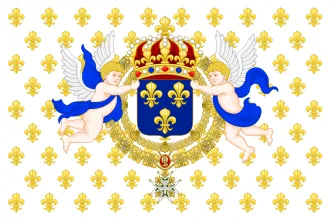
The Kingdom of France was descended directly from the western Frankish realm of the Carolingian Empire, which was ceded to Charles the Bald with the Treaty of Verdun (843). A branch of the Carolingian dynasty continued to rule until 987, when Hugh Capet was elected king and founded the Capetian dynasty. The territory remained known as Francia and its ruler as rex Francorum ('king of the Franks') well into the High Middle Ages.
The first king calling himself rex Francie ('King of France') was Philip II, in 1190, and officially from 1204. From then, France was continuously ruled by the Capetians and their cadet lines under the Valois and Bourbon until the monarchy was abolished in 1792 during the French Revolution.
The Kingdom of France was also ruled in personal union with the Kingdom of Navarre over two time periods, 1284–1328 and 1572–1620, after which the institutions of Navarre were abolished and it was fully annexed by France (though the King of France continued to use the title "King of Navarre" through the end of the monarchy).
France in the Middle Ages was a decentralised, feudal monarchy. In Brittany, Normandy, Lorraine, Provence, East Burgundy and Catalonia (the latter now a part of Spain), as well as Aquitaine, the authority of the French king was barely felt. West Frankish kings were initially elected by the secular and ecclesiastical magnates, but the regular coronation of the eldest son of the reigning king during his father's lifetime established the principle of male primogeniture.
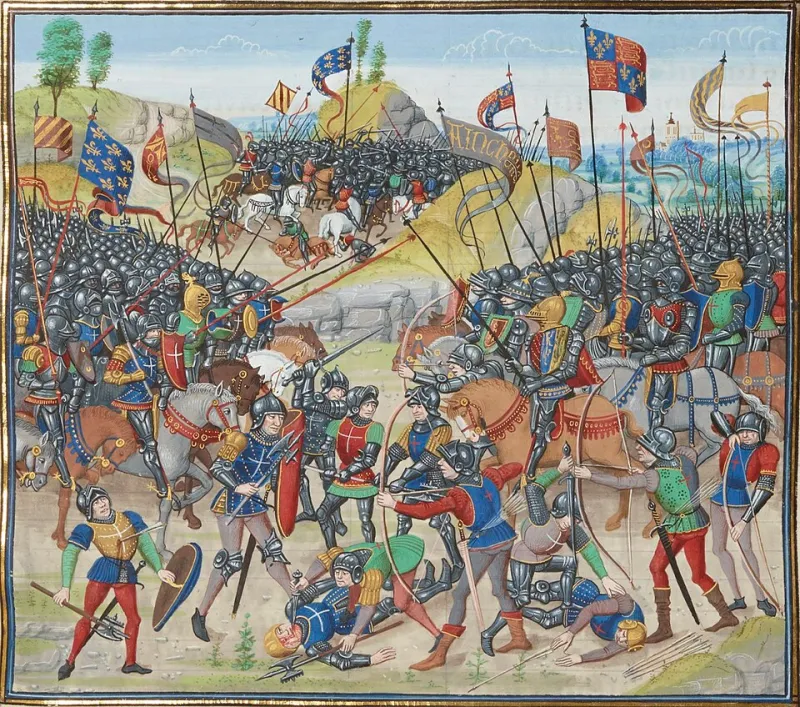
During the Late Middle Ages, rivalry between the Capetian dynasty, rulers of the Kingdom of France and their vassals the House of Plantagenet, who also ruled the Kingdom of England as part of their so-called competing Angevin Empire, resulted in many armed struggles. The most notorious of them all are the series of conflicts known as the Hundred Years' War (1337–1453) in which the kings of England laid claim to the French throne.
Emerging victorious from said conflicts, France subsequently sought to extend its influence into Italy, but after initial gains was defeated by Spain and the Holy Roman Empire in the ensuing Italian Wars (1494–1559).
France in the early modern era was increasingly centralised; the French language began to displace other languages from official use, and the monarch expanded his absolute power in an administrative system, known as the Ancien Régime, complicated by historic and regional irregularities in taxation, legal, judicial, and ecclesiastic divisions, and local prerogatives.
Religiously, France became divided between the Catholic majority and a Protestant minority, the Huguenots, which led to a series of civil wars, the Wars of Religion (1562–1598). Subsequently, France developed its first colonial empire in Asia, Africa, and in the Americas.
Colonial conflicts with Great Britain led to the loss of much of its North American holdings by 1763. French intervention in the American Revolutionary War helped the United States secure independence from King George III and the Kingdom of Great Britain, but was costly and achieved little for France. Through its colonial empire, large population, and centralized government, France became a superpower, lasting from the reign of King Louis XIV in the 17th century until Napoleon's defeat in 1815.
Following the French Revolution, which began in 1789, the Kingdom of France adopted a written constitution in 1791, but the Kingdom was abolished a year later and replaced with the French First Republic. The monarchy was restored by the other great powers in 1814 and, with the exception of the Hundred Days in 1815, lasted until the French Revolution of 1848.
Political history
West Francia
During the later years of Charlemagne's rule, the Vikings made advances along the northern and western perimeters of the Kingdom of the Franks. After Charlemagne's death in 814 his heirs were incapable of maintaining political unity and the empire began to crumble. The Treaty of Verdun of 843 divided the Carolingian Empire into three parts, with Charles the Bald ruling over West Francia, the nucleus of what would develop into the kingdom of France.
Charles the Bald was also crowned King of Lotharingia after the death of Lothair II in 869, but in the Treaty of Meerssen (870) was forced to cede much of Lotharingia to his brothers, retaining the Rhône and Meuse basins (including Verdun, Vienne and Besançon) but leaving the Rhineland with Aachen, Metz, and Trier in East Francia.
Viking incursions up the Loire, the Seine, and other inland waterways increased. During the reign of Charles the Simple (898–922), Vikings under Rollo from Scandinavia settled along the Seine, downstream from Paris, in a region that came to be known as Normandy.
High Middle Ages
The Carolingians were to share the fate of their predecessors: after an intermittent power struggle between the two dynasties, the accession in 987 of Hugh Capet, Duke of France and Count of Paris, established the Capetian dynasty on the throne. With its offshoots, the houses of Valois and Bourbon, it was to rule France for more than 800 years.
The old order left the new dynasty in immediate control of little beyond the middle Seine and adjacent territories, while powerful territorial lords such as the 10th- and 11th-century counts of Blois accumulated large domains of their own through marriage and through private arrangements with lesser nobles for protection and support.
The area around the lower Seine became a source of particular concern when Duke William of Normandy took possession of the Kingdom of England by the Norman Conquest of 1066, making himself and his heirs the king's equal outside France (where he was still nominally subject to the Crown).
Henry II inherited the Duchy of Normandy and the County of Anjou, and married France's newly single ex-queen, Eleanor of Aquitaine, who ruled much of southwest France, in 1152. After defeating a revolt led by Eleanor and three of their four sons, Henry had Eleanor imprisoned, made the Duke of Brittany his vassal, and in effect ruled the western half of France as a greater power than the French throne.
However, disputes among Henry's descendants over the division of his French territories, coupled with John, King of England's lengthy quarrel with Philip II, allowed Philip to recover influence over most of this territory. After the French victory at the Battle of Bouvines in 1214, the English monarchs maintained power only in southwestern Duchy of Aquitaine.
Late Middle Ages and the Hundred Years' War
The death of Charles IV of France in 1328 without male heirs ended the main Capetian line. Under Salic law the crown could not pass through a woman (Philip IV's daughter was Isabella, whose son was Edward III of England), so the throne passed to Philip VI, son of Charles of Valois. This, in addition to a long-standing dispute over the rights to Gascony in the south of France, and the relationship between England and the Flemish cloth towns, led to the Hundred Years' War of 1337–1453.
The following century was to see devastating warfare, the Armagnac–Burgundian Civil War, peasant revolts (the English peasants' revolt of 1381 and the Jacquerie of 1358 in France) and the growth of nationalism in both countries.
The losses of the century of war were enormous, particularly owing to the plague (the Black Death, usually considered an outbreak of bubonic plague), which arrived from Italy in 1348, spreading rapidly up the Rhône valley and thence across most of the country: it is estimated that a population of some 18–20 million in modern-day France at the time of the 1328 hearth tax returns had been reduced 150 years later by 50 percent or more.
Renaissance and Reformation
The Renaissance era was noted for the emergence of powerful centralized institutions, as well as a flourishing culture (much of it imported from Italy). The kings built a strong fiscal system, which heightened the power of the king to raise armies that overawed the local nobility. In Paris especially there emerged strong traditions in literature, art and music. The prevailing style was classical.
The Ordinance of Villers-Cotterêts was signed into law by Francis I in 1539. Largely the work of Chancellor Guillaume Poyet, it dealt with a number of government, judicial and ecclesiastical matters. Articles 110 and 111, the most famous, called for the use of the French language in all legal acts, notarised contracts and official legislation.
Italian Wars
After the Hundred Years' War, Charles VIII of France signed three additional treaties with Henry VII of England, Emperor Maximilian I, and Ferdinand II of Aragon respectively at Étaples (1492), Senlis (1493) and Barcelona (1493). These three treaties cleared the way for France to undertake the long Italian Wars (1494–1559), which marked the beginning of early modern France. French efforts to gain dominance resulted only in the increased power of the House of Habsburg.
Wars of Religion
Barely were the Italian Wars over, when France was plunged into a domestic crisis with far-reaching consequences. Despite the conclusion of a Concordat between France and the Papacy (1516), granting the crown unrivalled power in senior ecclesiastical appointments, France was deeply affected by the Protestant Reformation's attempt to break the hegemony of Catholic Europe.
A growing urban-based Protestant minority (later dubbed Huguenots) faced ever harsher repression under the rule of Francis I's son King Henry II. After Henry II's death in a joust, the country was ruled by his widow Catherine de' Medici and her sons Francis II, Charles IX and Henry III. Renewed Catholic reaction headed by the powerful dukes of Guise culminated in a massacre of Huguenots (1572), starting the first of the French Wars of Religion, during which English, German and Spanish forces intervened on the side of rival Protestant and Catholic forces.
Opposed to absolute monarchy, the Huguenot Monarchomachs theorized during this time the right of rebellion and the legitimacy of tyrannicide.
The Wars of Religion culminated in the War of the Three Henrys in which Henry III assassinated Henry de Guise, leader of the Spanish-backed Catholic League, and the king was murdered in return. After the assassination of both Henry of Guise (1588) and Henry III (1589), the conflict was ended by the accession of the Protestant king of Navarre as Henry IV (first king of the Bourbon dynasty) and his subsequent abandonment of Protestantism (Expedient of 1592) effective in 1593, his acceptance by most of the Catholic establishment (1594) and by the Pope (1595), and his issue of the toleration decree known as the Edict of Nantes (1598), which guaranteed freedom of private worship and civil equality.
Early modern period
Colonial France
France's pacification under Henry IV laid much of the ground for the beginnings of France's rise to European hegemony. France was expansive during all but the end of the seventeenth century: the French began trading in India and Madagascar, founded Quebec and penetrated the North American Great Lakes and Mississippi, established plantation economies in the West Indies and extended their trade contacts in the Levant and enlarged their merchant marine.
Thirty Years' War
Henry IV's son Louis XIII and his minister (1624–1642) Cardinal Richelieu elaborated a policy against Spain and the Holy Roman Empire during the Thirty Years' War (1618–1648) which had broken out in Germany. After the death of both king and cardinal, the Peace of Westphalia (1648) secured universal acceptance of Germany's political and religious fragmentation, but the Regency of Anne of Austria and her minister Cardinal Mazarin experienced a civil uprising known as the Fronde (1648–1653) which expanded into a Franco-Spanish War (1635–1659).
The Treaty of the Pyrenees (1659) formalised France's seizure (1642) of the Spanish territory of Roussillon after the crushing of the ephemeral Catalan Republic and ushered a short period of peace.
Administrative structures
The Ancien Régime, a French term rendered in English as "Old Rule", or simply "Former Regime", refers primarily to the aristocratic, social and political system of early modern France under the late Valois and Bourbon dynasties. The administrative and social structures of the Ancien Régime were the result of years of state-building, legislative acts (like the Ordinance of Villers-Cotterêts), internal conflicts and civil wars, but they remained a confusing patchwork of local privilege and historic differences until the French Revolution brought about a radical suppression of administrative incoherence.
Louis XIV, the Sun King
For most of the reign of Louis XIV (1643–1715), ("The Sun King"), France was the dominant power in Europe, aided by the diplomacy of Cardinal Richelieu's successor as the King's chief minister, (1642–61) Cardinal Jules Mazarin, (1602–1661). Cardinal Mazarin oversaw the creation of a French Royal Navy that rivalled England's, expanding it from 25 ships to almost 200.
The size of the French Royal Army was also considerably increased. Renewed wars (the War of Devolution, 1667–1668 and the Franco-Dutch War, 1672–1678) brought further territorial gains (Artois and western Flanders and the free County of Burgundy, previously left to the Empire in 1482), but at the cost of the increasingly concerted opposition of rival royal powers, and a legacy of an increasingly enormous national debt.
An adherent of the theory of the "Divine Right of Kings", which advocates the divine origin of temporal power and any lack of earthly restraint of monarchical rule, Louis XIV continued his predecessors' work of creating a centralized state governed from the capital of Paris. He sought to eliminate the remnants of feudalism still persisting in parts of France and, by compelling the noble elite to regularly inhabit his lavish Palace of Versailles, built on the outskirts of Paris, succeeded in pacifying the aristocracy, many members of which had participated in the earlier "Fronde" rebellion during Louis' minority.
By these means he consolidated a system of absolute monarchy in France that endured 150 years until the French Revolution. McCabe says critics used fiction to portray the degraded Turkish court, using "the harem, the Sultan court, oriental despotism, luxury, gems and spices, carpets, and silk cushions" as an unfavorable analogy to the corruption of the French royal court.
The king sought to impose total religious uniformity on the country, repealing the Edict of Nantes in 1685. It is estimated that anywhere between 150,000 and 300,000 Protestants fled France during the wave of persecution that followed the repeal, (following "Huguenots" beginning a hundred and fifty years earlier until the end of the 18th century) costing the country a great many intellectuals, artisans, and other valuable people.
Persecution extended to unorthodox Roman Catholics like the Jansenists, a group that denied free will and had already been condemned by the popes. In this, he garnered the friendship of the papacy, which had previously been hostile to France because of its policy of putting all church property in the country under the jurisdiction of the state rather than that of Rome.
In November 1700, King Charles II of Spain died, ending the Habsburg line in that country. Louis had long planned for this moment, but these plans were thrown into disarray by the will of King Charles, which left the entire Spanish Empire to Louis's grandson Philip, Duke of Anjou, (1683–1746). Essentially, Spain was to become a perpetual ally and even obedient satellite of France, ruled by a king who would carry out orders from Versailles.
Realizing how this would upset the balance of power, the other European rulers were outraged. However, most of the alternatives were equally undesirable. For example, putting another Habsburg on the throne would end up recreating the grand multi-national Empire of Charles V; of the Holy Roman Empire, Spain, and the Spanish territories in Italy, which would also grossly upset the power balance.
However, the rest of Europe would not stand for his ambitions in Spain, and so the long War of the Spanish Succession began (1701–1714), a mere three years after the War of the Grand Alliance (1688–1697, a.k.a. "War of the League of Augsburg") had just concluded.
Dissent and revolution
The reign (1715–1774) of Louis XV saw an initial return to peace and prosperity under the regency (1715–1723) of Philippe II, Duke of Orléans, whose policies were largely continued (1726–1743) by Cardinal Fleury, prime minister in all but name. The exhaustion of Europe after two major wars resulted in a long period of peace, only interrupted by minor conflicts like the War of the Polish Succession from 1733 to 1735.
Large-scale warfare resumed with the War of the Austrian Succession (1740–1748). But alliance with the traditional Habsburg enemy (the "Diplomatic Revolution" of 1756) against the rising power of Britain and Prussia led to costly failure in the Seven Years' War (1756–63) and the loss of France's North American colonies.
On the whole, the 18th century saw growing discontent with the monarchy and the established order. Louis XV was a highly unpopular king for his sexual excesses, overall weakness, and for losing New France to the British. The writings of the philosophes such as Voltaire were a clear sign of discontent, but the king chose to ignore them.
He died of smallpox in 1774, and the French people shed few tears at his death. While France had not yet experienced the Industrial Revolution that was beginning in Britain, the rising middle class of the cities felt increasingly frustrated with a system and rulers that seemed silly, frivolous, aloof, and antiquated, even if true feudalism no longer existed in France.
Upon Louis XV's death, his grandson Louis XVI became king. Initially popular, he too came to be widely detested by the 1780s. He was married to an Austrian archduchess, Marie Antoinette. French intervention in the American War of Independence was also very expensive.