















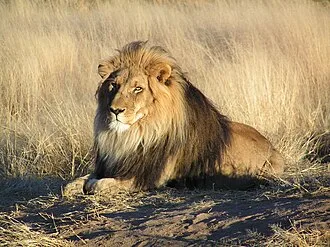
The lion (*Panthera leo*) is an impressive predator known for its strong physique and lives only in the wide grasslands of Africa and the Gir Forest of India. It attracts attention with its muscular structure, broad chest and short but round head; The thick manes on the men's necks give them a majestic appearance. Its round ears and the tassel at the tip of its tail can also be counted among its distinguishing features. Females, on the other hand, are smaller than males and have an elegant structure without manes.
Lions, among nature's most social cats, live in groups called "prides". These groups usually consist of several males, related females, and offspring. While females stand out in hunting, males mostly undertake the defense of the group. Lions tend to be active at night, neutralizing the animals they hunt with their strong claws and sharp teeth.
Lions, which have lived in a wide geography throughout history, now survive only in some parts of Sub-Saharan Africa and the Gir Forest in western India. While this magnificent animal was widely found from Europe to America during the Ice Age about 10,000 years ago, its numbers have rapidly decreased due to human activities and the shrinking of its natural habitat.
The survival of lions, which are classified as vulnerable by international conservation organizations, depends on the protection of their habitats.
The male lion's mane has become not only a physiological feature, but also a major element of cultural symbols. The lion, which appears in every field from works of art to national symbols, continues to be a figure admired by people from past to present. Lions raised in zoos within the scope of conservation programs are seen as a source of hope for the continuation of their species.