















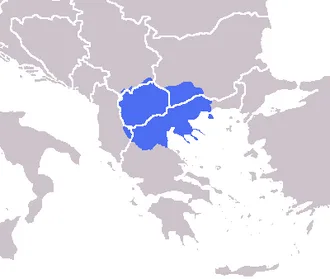
In classical antiquity, the kingdom of Macedon rose into an empire under Alexander the Great during the second half of the 4th century BC, signaling the start of the Hellenistic period. In the 2nd century BC Macedonia became a province of the Roman empire. During the medieval period, a Byzantine theme under the name of Macedonia was carved out mostly in Thrace.
Macedonia came to be defined by European authors as the modern geographical region by the mid-19th century while under Ottoman rule.
Etymology
Both proper nouns Makedṓn and Makednós are morphologically derived from the Ancient Greek adjective makednós meaning "tall, slim", and are related to the term Macedonia.
Boundaries and Terminology
Prior to its expansion under Philip II, the ancient kingdom of Macedonia, to which the modern region owes its name, lay within the central and western parts of the current Greek province of Macedonia.[need quotation to verify] The Roman province of Macedonia consisted of what is today northern and central Greece, much of the geographical area of the Republic of North Macedonia and southeast Albania. In late Roman times, the provincial boundaries were reorganized to form the Diocese of Macedonia, consisting of most of modern mainland Greece, Crete, southern Albania, southwest Bulgaria, and most of Republic of North Macedonia.
In the Byzantine Empire, a province under the name of Macedonia was carved out of the original Theme of Thrace, which was well east of the Struma River. This thema variously included parts of Thrace and gave its name to the Macedonian dynasty. Hence, Byzantine documents of this era that mention Macedonia are most probably referring to the Macedonian theme.
The parts of Macedonia, on the other hand, which were ruled by the First Bulgarian Empire throughout the 9th and the 10th century, were incorporated into the Byzantine Empire in 1018 as the Themе of Bulgaria. With the gradual conquest of southeastern Europe by the Ottomans in the late 14th century, the name of Macedonia disappeared as an administrative designation for several centuries and was rarely displayed on maps.
The name was again revived to mean a distinct geographical region in the 19th century, defining the region bounded by Mount Olympus, the Pindus range, mounts Shar and Osogovo, the western Rhodopes, the lower course of the river Mesta (Greek Nestos) and the Aegean Sea, developing roughly the same borders that it has today.
History
Neolithic period
While Macedonia shows signs of human habitation as old as the Paleolithic period (among which is the Petralona cave with the oldest European humanoid), the earliest known settlements, such as Nea Nikomedeia in Imathia (today's Greek Macedonia), date back 9,000 years. The houses at Nea Nikomedeia were constructed—as were most structures throughout the Neolithic in northern Greece—of wattle and daub on a timber frame.
The cultural assemblage includes well-made pottery in simple shapes with occasional decoration in white on a red background, clay female figurines of the 'rod-headed' type known from Thessaly to the Danube Valley, stone axes and adzes, chert blades, and ornaments of stone including curious 'nose plugs' of uncertain function.
The assemblage of associated objects differs from one house to the next, suggesting some degree of craft specialisation had already been established from the beginning of the site's history. The farming economy was based on the cultivation of cereal crops such as wheat and barley and pulses and on the herding of sheep and goats, with some cattle and pigs.
Hunting played a relatively minor role in the economy. Surviving from 7000 to 5500 BCE, this Early Neolithic settlement was occupied for over a thousand years.
The Middle Neolithic period (c. 5500 to 4500 BCE) is at present best represented at Servia in the Haliacmon Valley in western Macedonia, where the typical red-on-cream pottery in the Sesklo style emphasises the settlement's southern orientation. Pottery of this date has been found at a number of sites in Central and Eastern Macedonia but so far none has been extensively excavated.
The Late Neolithic period (c. 4500 to 3500 BCE) is well represented by both excavated and unexcavated sites throughout the region (though in Eastern Macedonia levels of this period are still called Middle Neolithic according to the terminology used in the Balkans).
Rapid changes in pottery styles, and the discovery of fragments of pottery showing trade with quite distant regions, indicate that society, economy and technology were all changing rapidly. Among the most important of these changes were the start of copper working, convincingly demonstrated by Renfrew to have been learnt from the cultural groups of Bulgaria and Roumania to the North.
Principal excavated settlements of this period include Makryialos and Paliambela near the western shore of the Thermaic gulf, Thermi to the south of Thessaloniki and Sitagroi and Dikili Tas in the Drama plain. Some of these sites were densely occupied and formed large mounds (known to the local inhabitants of the region today as 'toumbas').
Others were much less densely occupied and spread for as much as a kilometer (Makryialos). Both types are found at the same time in the same districts and it is presumed that differences in social organisation are reflected by these differences in settlement organisation. Some communities were clearly concerned to protect themselves with different kinds of defensive arrangements: ditches at Makryialos and concentric walls at Paliambela.
The best preserved buildings were discovered at Dikili Tas, where long timber-framed structures had been organised in rows and some had been decorated with bulls' skulls fastened to the outside of the walls and plastered over with clay.
Remarkable evidence for cult activity has been found at Promachonas-Topolnica, which straddles the Greek Bulgarian border to the north of Serres. Here a deep pit appeared to have been roofed to make a subterranean room; in it were successive layers of debris including large numbers of figurines, bulls' skulls, and pottery, including several rare and unusual shapes.
The farming economy of this period continued the practices established at the beginning of the Neolithic, although sheep and goats were less dominant among the animals than they had previously been, and the cultivation of vines (Vitis vinifera) is well attested.
Only a few burials have been discovered from the whole of the Neolithic period in northern Greece and no clear pattern can be deduced. Grave offerings, however, seem to have been very limited.
History from the 7th century BC to Roman conquest
In classical times, the modern region of Macedonia comprised parts of what at the time was known as Lower Macedonia, Upper Macedonia, Paionia, Illyria and Thrace. Among others, in its lands were located the kingdom of Macedon, the kingdom of Paeonia and historical tribes like the Agrianes, Pelagonia and part of Dardania, the Chalcidian League and other Greek colonies like Amphipolis.
Prior to the Macedonian ascendancy, parts of southern Macedonia were populated by the Bryges, while western, (i. e., Upper) Macedonia, was inhabited by Macedonian and Illyrian tribes. Whilst numerous wars are later recorded between the Illyrian and Macedonian Kingdoms, the Bryges might have co-existed peacefully with the Macedonians.
In the time of Archaic Greece, Paeonia, whose exact boundaries are obscure, originally included the whole Axius river valley and the surrounding areas, in what is now the northern part of the Greek region of Macedonia, most of the Republic of North Macedonia, and a small part of western Bulgaria.
Expansion of the kingdom of Macedon
Prior to its expansion under Philip II, the ancient kingdom of Macedonia, to which the modern region owes its name, lay entirely within the central and western parts of the current Greek province of Macedonia.
By 500 BCE, the ancient kingdom of Macedon was centered somewhere between the southern slopes of Lower Olympus and the lowest reach of the Haliakmon river. Since 512/511 BCE, the kingdom of Macedonia was subject to the Persians, but after the battle of Plataia it regained its independence. Under Philip II and Alexander the Great, Macedon forcefully expanded in the wider region.
Alexander's conquests produced a lasting extension of Hellenistic culture and thought across the ancient Near East, but his empire broke up on his death. His generals divided the empire between them, founding their own states and dynasties. The kingdom of Macedon was taken by Cassander, who ruled it until his death in 297 BC.
At the time, Macedonian control over the Thracian and Illyrian states of the region slowly waned, although the kingdom of Macedonia remained the most potent regional power. This period also saw several Celtic invasions into the Balkans. However, the Celts were successfully repelled by Antigonus Gonatas, leaving little overall influence on the region.
Expansion of Kingdom of Macedon:
- Early Argead kingdom (founded by Perdiccas I): Argead Macedonian kingdom of Lower Macedonia consisting of six districts Emathia, Pieria, Bottiaea, Mygdonia, Eordaea and Almopia.[citation needed] Its capital was Aigai.
- Kingdom of Alexander I: All the above districts plus the regions of Crestonia, Bisaltia to the east annexed and the western regions of Elimiotis, Orestis and Lynkestis as subjects or allies of the Argeads. Its capital was Aigai.
- Kingdom of Philip II: All the above provinces plus the appendages of Pelagonia and southern parts of Paeonia (known as Macedonian Paeonia) to the north, Sintike, Odomantis and Edonis to the east and the Chalkidike to the south. Its capital was Pella. At the end of his expansion campaigns, Philip had also established Macedon's hegemony over Thessaly and the League of Corinth and most of the Balkans, including Paeonia, parts of Illyria and Odrysian kingdom in Ancient Thrace.
- In 200 BC, the Antigonid kingdom of Macedonia included most of the modern region, as well as other regions like Thessaly, coastal Thrace, Euboea and many other Aegean Islands, parts of Illyria, Caria. However, the northern part of North Macedonia, including Skopje, was part of Dardania.
Roman province of Macedonia (146 BC–395 AD)
Macedonian sovereignty in the region was brought to an end at the hands of the rising power of Rome in the 2nd century BC. Philip V of Macedon took his kingdom to war against the Romans in two wars during his reign (221–179 BC). The First Macedonian War (215–205 BC) was fairly successful for the Macedonians but Philip was decisively defeated in the Second Macedonian War in (200–197 BC).
Although he survived war with Rome, his successor Perseus of Macedon (reigned 179–168 BC) did not; having taken Macedon into the Third Macedonian War in (171–168 BC), he lost his kingdom when he was defeated. Macedonia was initially divided into four districts subject to Rome before finally being annexed in 146 BC as a Roman province.
Around this time, vulgar Latin was introduced in the Balkans by Latin-speaking colonists and military personnel. With the division of the Roman Empire into west and east in 298 AD, Macedonia came under the rule of Rome's Byzantine successors. The population of the entire region was, however, depleted by destructive invasions of various Gothic and Hun tribes c. 300 – 5th century AD.
Despite this, other parts of the Byzantine empire continued to flourish, in particular some coastal cities such as Thessaloniki became important trade and cultural centres.
Macedonia contested between Byzantine, Bulgarian, Latin and Serbian Empires
Despite the Byzantine empire's power, from the beginning of the 6th century the Byzantine dominions were subject to frequent raids by various Slavic tribes which, in the course of centuries, eventually resulted in drastic demographic and cultural changes in the Empire's Balkan provinces. Although traditional scholarship attributes these changes to large-scale colonizations by Slavic-speaking groups, it has been proposed that a generalized dissipation of Roman identity might have commenced in the 3rd century, especially among rural provincials who were crippled by harsh taxation and famines.
Given this background, penetrations carried by successive waves of relatively small numbers of Slavic warriors and their families might have been capable of assimilating large numbers of indigenes into their cultural model, which was sometimes seen as a more attractive alternative[citation needed].
In this way and in the course of time, great parts of Macedonia came to be controlled by Slavic-speaking communities. Despite numerous attacks on Thessaloniki, the city held out, and Byzantine-Roman culture continued to flourish, although Slavic cultural influence steadily increased.
The Slavic settlements organized themselves along tribal and territorially based lines which were referred to by Byzantine Greek historians as "Sklaviniai". The Sklaviniai continued to intermittently assault the Byzantine Empire, either independently, or aided by Bulgar or Avar contingents. Around 680 AD a "Bulgar" group (which was largely composed of the descendants of former Roman Christians taken captive by the Avars), led by Khan Kuber (theorized to have belonged to the same clan as the Danubian Bulgarian khan Asparukh), settled in the Pelagonian plain, and launched campaigns to the region of Thessaloniki.
When the Empire could spare imperial troops, it attempted to regain control of its lost Balkan territories. By the time of Constans II a significant number of the Slavs of Macedonia were captured and transferred to central Asia Minor where they were forced to recognize the authority of the Byzantine emperor and serve in his ranks.
In the late 7th century, Justinian II again organized a massive expedition against the Sklaviniai and Bulgars of Macedonia. Launching from Constantinople, he subdued many Slavic tribes and established the Theme of Thrace in the hinterland of the Great City, and pushed on into Thessaloniki. However, on his return he was ambushed by the Slavo-Bulgars of Kuber, losing a great part of his army, booty, and subsequently his throne.
Despite these temporary successes, rule in the region was far from stable since not all of the Sklaviniae were pacified, and those that were often rebelled. The emperors rather resorted to withdrawing their defensive line south along the Aegean coast, until the late 8th century. Although a new theme—that of "Macedonia"—was subsequently created, it did not correspond to today's geographic territory, but one farther east (centred on Adrianople), carved out of the already existing Thracian and Helladic themes.
There are no Byzantine records of "Sklaviniai" after 836/837 as they were absorbed into the expanding First Bulgarian Empire. Slavic influence in the region strengthened along with the rise of this state, which incorporated parts of the region to its domain in 837. In the early 860s Saints Cyril and Methodius, two Byzantine Greek brothers from Thessaloniki, created the first Slavic Glagolitic alphabet in which the Old Church Slavonic language was first transcribed, and are thus commonly referred to as the apostles of the Slavic world.
Their cultural heritage was acquired and developed in medieval Bulgaria, where after 885 the region of Ohrid (present-day Republic of North Macedonia) became a significant ecclesiastical center with the nomination of the Saint Clement of Ohrid for "first archbishop in Bulgarian language" with residence in this region.
In conjunction with another disciple of Saints Cyril and Methodius, Saint Naum, Clement created a flourishing Slavic cultural center around Ohrid, where pupils were taught theology in the Old Church Slavonic language and the Glagolitic and Cyrillic script at what is now called Ohrid Literary School. The Bulgarian-Byzantine boundary in the beginning of 10th century passed approximately 20 km (12 mi) north of Thessaloniki according to the inscription of Narash.
According to the Byzantine author John Kaminiates, at that time the neighbouring settlements around Thessaloniki were inhabited by "Scythians" (Bulgarians) and the Slavic tribes of Drugubites and Sagudates, in addition to Greeks.