
















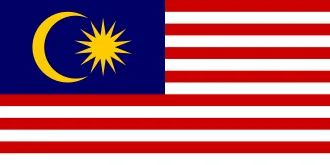
The country has its origins in the Malay kingdoms, which, from the 18th century on, became subject to the British Empire, along with the British Straits Settlements protectorate. During World War II, British Malaya, along with other nearby British and American colonies, was occupied by the Empire of Japan. Following three years of occupation, Malaya was briefly unified as the Malayan Union in 1946 until 1948 when it was restructured as the Federation of Malaya.
The country achieved independence on 31 August 1957. On 16 September 1963, independent Malaya united with the then British crown colonies of North Borneo, Sarawak, and Singapore to become Malaysia. In August 1965, Singapore was separated from the federation and became an independent country.
Malaysia is tropical and is one of 17 megadiverse countries; it is home to numerous endemic species. The country is multiethnic and multicultural, which has a significant effect on its politics. About half the population is ethnically Malay, with minorities of Chinese, Indians, and indigenous peoples. The Bumiputra policy grants the Malay majority a constitutionally enshrined privileged status over Malaysian citizens who are Chinese or Indians via affirmative action measures.
The official language is Malaysian Malay, a standard form of the Malay language. English remains an active second language. While recognising Islam as the official religion, the constitution grants freedom of religion to non-Muslims though conversion out of Islam is forbidden while conversion to it is allowed. The government is modelled on the Westminster parliamentary system, and the legal system is based on common law.
The head of state is an elected monarch, chosen among the nine state rulers every five years. The head of government is the prime minister.
The country's economy was once heavily reliant on agriculture and primary commodities but is now driven by the services and manufacturing sectors. Malaysia ranks highly in peacefulness and passport strength and has a newly industrialised economy that is relatively open and state-oriented. The country is a founding member of the Organisation of Islamic Cooperation (OIC), the East Asia Summit (EAS), and the Association of Southeast Asian Nations (ASEAN), as well as a member of the Non-Aligned Movement (NAM), the Commonwealth of Nations, and the Asia-Pacific Economic Cooperation (APEC).
Etymology
The name Malaysia is a combination of the word Malays and the Latin-Greek suffix -ia/-ία, which can be translated as 'land of the Malays'. Similar-sounding variants have also appeared in accounts older than the 11th century, as toponyms for areas in Sumatra or referring to a larger region around the Strait of Malacca.
The Sanskrit text Vayu Purana, thought to have been in existence since the first millennium CE, mentioned a land named 'Malayadvipa', which was identified by certain scholars as the modern Malay Peninsula. Other notable accounts are by Ptolemy's 2nd-century Geographia, which used the name Malayu Kulon for the west coast of Golden Chersonese, and the 7th-century Yijing's account of Malayu.
At some point, the Melayu Kingdom took its name from the Sungai Melayu. Melayu then became associated with Srivijaya, and remained associated with various parts of Sumatra, especially Palembang, where the founder of the Malacca Sultanate is thought to have come from. It is only thought to have developed into an ethnonym as Malacca became a regional power in the 15th century.
Islamisation established an ethnoreligious identity in Malacca, with the term Melayu beginning to appear as interchangeable with Melakans. It may have specifically referred to local Malay speakers who were loyal to the Malaccan Sultan. The initial Portuguese use of Malayos reflected this, referring only to the ruling people of Malacca.
The prominence of traders from Malacca led Melayu to be associated with Muslim traders, and from there became associated with the wider cultural and linguistic group. Malacca and later Johor claimed they were the centre of Malay culture, a position supported by the British which led to the term Malay becoming more usually linked to the Malay peninsula rather than Sumatra.
Before the onset of European colonisation, the Malay Peninsula was known natively as Tanah Melayu ('Malay Land'). Under a racial classification created by German scholar Johann Friedrich Blumenbach, the natives of maritime Southeast Asia were grouped into a single category, the Malay race. Following the expedition of French navigator Jules Dumont d'Urville to Oceania in 1826, he later proposed the terms of Malaysia, Micronesia, and Melanesia to the Société de Géographie in 1831, distinguishing these Pacific cultures and island groups from the existing term Polynesia. Dumont d'Urville described Malaysia as "an area commonly known as the East Indies".
In 1850, the English ethnologist George Samuel Windsor Earl, writing in the Journal of the Indian Archipelago and Eastern Asia, proposed naming the islands of Southeast Asia as "Melayunesia" or "Indunesia", favouring the former. The name Malaysia gained some use to label what is now the Malay Archipelago. In modern terminology, Malay remains the name of an ethnoreligious group of Austronesian people predominantly inhabiting the Malay Peninsula and portions of the adjacent islands of Southeast Asia, including the east coast of Sumatra, the coast of Borneo, and smaller islands that lie between these areas.
The state that gained independence from the United Kingdom in 1957 took the name the Federation of Malaya, chosen in preference to other potential names such as Malaysia and Langkasuka, after the historic kingdom located at the upper section of the Malay Peninsula in the first millennium CE.
In 1963, the name Malaysia was adopted when the existing states of the Federation of Malaya, plus Singapore, North Borneo, and Sarawak, formed a new federation. One theory posits the name was chosen so that si represented the inclusion of Singapore, North Borneo, and Sarawak. Politicians in the Philippines contemplated renaming their state Malaysia before the modern country took the name.
History
Evidence of modern human habitation in Malaysia dates back 40,000 years. In the Malay Peninsula, the first inhabitants are thought to be Negritos. Areas of Malaysia participated in the Maritime Jade Road between 2000 BC to 1000 AD. Traders and settlers from India and China arrived as early as the first century AD, establishing trading ports and coastal towns in the second and third centuries.
Their presence resulted in strong Indian and Chinese influences on the local cultures, and the people of the Malay Peninsula adopted the religions of Hinduism and Buddhism. Sanskrit inscriptions appear as early as the fourth or fifth century. The Kingdom of Langkasuka arose around the second century in the northern area of the Malay Peninsula, lasting until about the 15th century.
Between the 7th and 13th centuries, much of the southern Malay Peninsula was part of the maritime Srivijayan empire. By the 13th and the 14th century, the Majapahit empire had successfully wrested control over most of the peninsula and the Malay Archipelago from Srivijaya. In the early 15th century, Parameswara, a runaway king of the former Kingdom of Singapura linked to the old Srivijayan court, founded the Malacca Sultanate.
The spread of Islam increased following Parameswara's conversion to that religion. Malacca was an important commercial centre during this time, attracting trade from around the region.
In 1511, Malacca was conquered by Portugal, after which it was taken by the Dutch in 1641. In 1786, the British Empire established a presence in Malaya, when the Sultan of Kedah leased Penang Island to the British East India Company. The British obtained the town of Singapore in 1819, and in 1824 took control of Malacca following the Anglo-Dutch Treaty.
By 1826, the British directly controlled Penang, Malacca, Singapore, and the island of Labuan, which they established as the crown colony of the Straits Settlements. By the 20th century, the states of Pahang, Selangor, Perak, and Negeri Sembilan, known together as the Federated Malay States, had British residents appointed to advise the Malay rulers, to whom the rulers were bound to defer by treaty.
The remaining five states on the peninsula, known as the Unfederated Malay States, while not directly under British rule, also accepted British advisers around the turn of the 20th century. Development on the peninsula and Borneo were generally separate until the 19th century. Under British rule the immigration of Chinese and Indians to serve as labourers was encouraged.
The area that is now Sabah came under British control as North Borneo when both the Sultan of Brunei and the Sultan of Sulu transferred their respective territorial rights of ownership, between 1877 and 1878. In 1842, Sarawak was ceded by the Sultan of Brunei to James Brooke, whose successors ruled as the White Rajahs over an independent kingdom until 1946, when it became a crown colony.
The Klang War (1867–1874) began as a dispute between Raja Abdullah and Raja Mahadi over the Klang chieftaincy, with Mahadi rejecting Abdullah's appointment by Sultan Abdul Samad of Selangor. The conflict drew in rival Chinese secret societies—the Ghee Hin Kongsi largely backing Mahadi and the Hai San Secret Society supporting Abdullah—as well as Bugis-descended and Malay chiefs who viewed Mahadi as more legitimate.
Fighting spread after Mahadi captured the Klang Fort and Abdullah fled to Malacca, disrupting tin production, trade routes, and British commercial interests in the Klang Valley. At the same time, the neighbouring Larut Wars (1861–1874) between the Hai San and Ghee Hin in Perak similarly destabilised tin-rich districts and alarmed British merchants.
Appeals from Malay chiefs for mediation combined with British concerns over regional disorder paved the way for formal intervention, culminating in the Pangkor Treaty of 1874 which established a system of British residents in the Malay states. As Frank Swettenham later wrote, "It is that though the circumstances demanded intervention, we came into the Malay States at the invitation of the Malay Rulers, to teach them a better form of administration."
In the Second World War, the Japanese Army invaded and occupied Malaya, North Borneo, Sarawak, and Singapore for over three years. During this time, ethnic tensions were raised and nationalism grew. Popular support for independence increased after Malaya was reconquered by Allied forces. Post-war British plans to unite the administration of Malaya under a single crown colony called the Malayan Union met with strong opposition from the Malays, who opposed the weakening of the Malay rulers and the granting of citizenship to the ethnic Chinese.
The Malayan Union, established in 1946, and consisting of all the British possessions in the Malay Peninsula except for Singapore, was quickly dissolved and replaced on 1 February 1948 by the Federation of Malaya, which restored the autonomy of the rulers of the Malay states under British protection.
During this time, the mostly ethnically Chinese rebels under the leadership of the Malayan Communist Party launched guerrilla operations designed to force the British out of Malaya. The Malayan Emergency (1948–1960) involved a long anti-insurgency campaign by Commonwealth troops in Malaya. On 31 August 1957, Malaya became an independent member of the Commonwealth of Nations.
Subsequently, a comprehensive plan was devised to unite Malaya with the crown colonies of North Borneo (known as Sabah upon joining), Sarawak, and Singapore. The envisioned federation was originally intended to take place on 31 August 1963, to coincide with the commemoration of Malayan independence. However, due to the necessity of conducting a survey on the level of support for the federation in Sabah and Sarawak by the United Nations, as requested by opponents of the federation such as Indonesia's Sukarno and the Sarawak United Peoples' Party, the date of the federation was postponed until 16 September 1963.
The federation brought heightened tensions including a conflict with Indonesia as well as continual conflicts against the Communists in Borneo and the Malay Peninsula, which escalated to the Sarawak Communist Insurgency and Second Malayan Emergency together with several other issues such as the cross-border attacks into Sabah by Moro pirates from the southern islands of the Philippines, Singapore being separated from the Federation in 1965, and racial strife.
This strife culminated in the 13 May race riots in 1969. After the riots, the controversial New Economic Policy was launched by Prime Minister Tun Abdul Razak, trying to increase the share of the economy held by the bumiputera. Under Prime Minister Mahathir Mohamad there was a period of rapid economic growth and urbanisation beginning in the 1980s.
The economy shifted from being agriculturally based to one based on manufacturing and industry. Numerous mega-projects were completed, such as the Petronas Towers, the North–South Expressway, the Multimedia Super Corridor, and the new federal administrative capital of Putrajaya.
In the late 1990s, the Asian financial crisis impacted the country, nearly causing their currency, stock, and property markets to crash; however, they later recovered. The 1MDB scandal was a major global corruption scandal that implicated then-Prime Minister Najib Razak in 2015. The scandal contributed to the first change in the ruling political party since independence in the 2018 general election.
In the 2020s, the country was gripped by a political crisis that coincided with health and economic crises caused by the COVID-19 pandemic. This was then followed by an earlier general election in November 2022, which resulted in the first hung parliament in the nation's history. On 24 November 2022, Anwar Ibrahim was sworn in as the 10th Prime Minister of Malaysia, leading a grand coalition government.
Government and politics
Malaysia is a federal constitutional elective monarchy and the only federal country in Southeast Asia. The system of government is closely modelled on the Westminster parliamentary system, a legacy of British rule. The head of state is the King, whose official title is the Yang di-Pertuan Agong. The King is elected to a five-year term by and from among the nine hereditary rulers of the Malay states.
The other four states, which have titular Governors, do not participate in the selection. By informal agreement the position is rotated among the nine, and has been held by Ibrahim Iskandar of Johor since 31 January 2024. The King's role has been largely ceremonial since changes to the constitution in 1994, picking ministers and members of the upper house.
Legislative power is divided between federal and state legislatures. The bicameral federal parliament consists of the lower house, the House of Representatives and the upper house, the Senate. The 222-member House of Representatives is elected for a maximum term of five years from single-member constituencies. All 70 senators sit for three-year terms; 26 are elected by the 13 state assemblies, and the remaining 44 are appointed by the King upon the Prime Minister's recommendation.
The parliament follows a multi-party system and the government is elected through a first-past-the-post system. Parliamentary elections are held at least once every five years. Before 2018, only registered voters aged 21 and above could vote for the members of the House of Representatives and, in most of the states, for the state legislative chamber.
Voting is not mandatory. In July 2019, a bill to lower the voting age to 18 years old was officially passed.