II. The club, which appointed Matt Busby as head of the team after World War II, built a very good squad and won two league championships in a row in 1956 and 1957. However, a shocking development occurred and the team's plane crashed in Munich. As a result of this disaster that occurred on February 6, 1958, eight players of the team died and many were injured.
While everyone thought that the team would collapse, Busby rebuilt a team from injured players and young people, became the English champion twice in 1965 and 1967, and became the first English team to win the Champion Clubs' Cup in 1968.
Alex Ferguson, who was the head of the team from November 1986 until the end of the 2012-13 season, is one of the most important names of the club and English football. Ferguson, who has been in charge of the team for 27 years and has the title of Sir, won 26 major trophies while managing United.
Manchester United is one of the most successful clubs in the history of English football, having won the English championship 20 times, 13 of which are the Premier League, the EFL Cup 6 times, the FA Cup 13 times and the FA Community Shield championship 21 times. The team, which has won the UEFA Champions League title three times, also made the Treble by winning the Premier League, Federation Cup and UEFA Champions League in the 1998-99 season.
Manchester United is one of the richest and most popular football clubs in the world. 734.25 miles. €, the club is the 10th most expensive team in the world.
The club, which went public on the London Stock Exchange in 1991, was purchased by Malcolm Glazer in May 2005 for £800,000,000.
History
Early years (1878-1945)
Manchester United was founded in Newton Heath as "Newton Heath LYR Football Club" by workers of the Lancashire and Yorkshire Railway Company. The first recorded match of the team, which played in small matches between railway companies in the days of its establishment, was against the Bolton Wanderers reserve team.
In this match, Newton Heath LYR FC, who played in green and gold jerseys, the colors of the railway company, lost 6-0 to its opponent. In 1888, he became one of the founding members of The Combination, a regional football league. The "LYR" part in the name of the team, which started to compete in the First Division in the 1892-93 season, was removed.
The team competed in this league for only two seasons, then was relegated and started to take part in the Second Division.
In January 1902, with debts of £2,670 (£210,000 today), the club was on the verge of closure. Team captain Harry Stafford held meetings with local businessmen, especially John Henry Davies, and provided £500 to the club. The name of the club changed hands on April 24, 1902, and Manchester United was officially born.
The club won its first league championship under the management of Ernest Mangnall, who took office in 1903. MUFC, which was promoted to the top league by finishing second in the Second Division in 1906, won the championship in the First Division in 1908. The following year, the club started the season with the Charity Shield championship and finished the season with the Federation Cup championship.
The club won the First Division championship again with Mangnall in 1911, and at the beginning of the following season, Mangnall left the club to transfer to Manchester City.
Due to World War I, the league could not be organized between the 1915/16 and 1918/19 seasons, and the team was relegated two seasons after it was reorganized, that is, in the 1921-22 season. In 1925, they were promoted to the First Division again. The team was relegated again in 1931, and finished 20th in the Second Division in 1934, the worst position in its history.
With the death of owner J. H. Davies in October 1927, the club became indebted again and its financial situation began to deteriorate. James W. Gibson invested £2,000 in the club, which was drifting towards bankruptcy in December 1931, and the club was saved from bankruptcy once again. II. In the 1938-39 season, a year before the leagues were stopped again due to World War II, the club finished the First Division in 14th place.
Busby era (1945-1969)
A new era began in October 1945 when Matt Busby took office as manager of the club. During the Busby period, the profile of the football players and technical staff in the team increased, the training facilities were modernized, and stability and sporting success began to come. Busby; It finished second in the league in 1947, 1948 and 1949, and won the Federation Cup in 1948.
In 1952, he brought the club its first First Division championship in 41 years. Because the average age of Busby's Manchester United was 22, the media nicknamed the team "Busby's Babies". In 1957, the team that finished the league in first place became the first English team to compete in the Champion Clubs' Cup. The team reached the semi-finals in its first season in the tournament, but was eliminated by Milan in the semi-finals, but showed a successful performance compared to its first season.
The following season, on the way to Crvena zvezda away for the quarter-finals of the Champion Clubs' Cup, the plane carrying the players, technical management, officials and journalists crashed while refueling in the skies of Munich. This incident, which took place on February 6, 1958, went down in history as the Munich air disaster.
Among the football players on the plane, Geoff Bent, Roger Byrne, Eddie Colman, Duncan Edwards, Mark Jones, David Pegg, Tommy Taylor and Billy Whelan died, and many were injured.
Busby survived this incident, but was away from duty for a while due to treatment. In the 1958 FA Cup final against Bolton Wanderers, Jimmy Murphy was the acting coach of the team. The club finished the league in the middle ranks that year, and the champions were Wolverhampton Wanderers. In addition to Wolverhampton Wanderers, UEFA also invited Manchester United to take part in the 1958-59 season of the Champion Clubs' Cup.
However, despite the approval of the English Football Federation, the club could not take part in the tournament due to official obstacles.
In the 1960s, under Busby's leadership, the club began to be restructured. Renewed with the popular young football players of the period such as George Best, Denis Law and Pat Crerand, Manchester United reached the Federation Cup in 1963. With the same generation, the team finished the league in second place the following season and won the championship in 1965 and 1967.
MUFC defeated Benfica 4-1 in the Champion Clubs' Cup final in 1968 and became the first English team to win the Champion Clubs' Cup. Bobby Charlton, Denis Law and George Best, who were in the champion squad, were nominated for the best football player in Europe awards that year, Best won the award and Charlton came second.
When Matt Busby left his position as manager of the club in 1969, he was replaced by reserve team coach Wilf McGuinness, thus ending the Busby era at United.
Unstable years (1969-1986)
United, under the management of Wilf McGuinness, had a bad start in the 1969-70 season and was in eighth place at the end of the season. When the results did not change the following season, Busby returned to the team from management for a short period, while McGuinness returned to his duty in the reserve team. In June 1971, Frank O'Farrell took over the team, but was fired after 18 months and replaced by Tommy Docherty in December 1972.
In the 1973-74 season, during which Docherty spent his second year in charge of the team, the team was relegated, and Best, Law and Charlton left the club. The team returned to the Firts Division the following year and reached the final of the 1976 FA Cup, but was defeated by Southampton. The following year, they faced Liverpool in the final of the Federation Cup and won the championship with a score of 2-1.
Docherty was dismissed shortly after his illicit relationship with the club physiotherapist's wife was revealed.
In the summer of 1977, Docherty was replaced by Dave Sexton. Sexton's United, which finished second in the league in the 1979-80 season with a squad that included important football players of the period such as Joe Jordan, Gordon McQueen, Gary Bailey and Ray Wilkins, also lost to Arsenal in the 1979 Federation Cup and ended the season without a trophy, and after his unsuccessful management, he was dismissed in 1981.
Then, Ron Atkinson took over as the head of the team, and Atkinson's first transfer was Bryan Robson, who was brought from West Bromwich Albion for a record fee. Two FA Cups were won during Atkinson's reign. In addition, the team, which won 13 wins in the first 15 weeks of the 1985-86 season, was shown as the favorite of the league, but finished the season in 4th place. The following season, Atkinson was fired because the team was in the relegation zone.
Ferguson era (1986-2013)
Alex Ferguson and his assistant Archie Knox came to United from Aberdeen after Atkinson, who finished the league in 11th place, was dismissed. Under the leadership of Ferguson, United won the UEFA Cup Winners' Cup for the first time in the 1990-91 season, and faced the Champion Clubs' Cup champion Crvena zvezda in the 1991 UEFA Super Cup, winning 1-0 and taking this cup to its museum for the first time.
In the 1992 League Cup played at Wembley, he defeated Nottingham Forest 1-0 and brought this cup to the club for the second time. In 1993, he brought his club its first championship since 1967. A year later, he achieved a "Double" by winning both the Premier League and the Federation Cup.
Manchester United made the "Treble" by winning the Premier League, the Federation Cup and the UEFA Champions League in the 1998-99 season and went down in English football history. Losing 0-1 in extra time against Bayern Munich in the 1999 UEFA Champions League final, United achieved one of the most glorious comebacks in football history by winning 2-1 with the goals scored in extra time by Teddy Sheringham and Ole Gunnar Solskjær, who entered the game in the second half of the match.
The club also won the Intercontinental Cup by beating Palmeiras 1-0 in Tokyo. Ferguson was later knighted and given the title of Sir for his services to English football.
In 2000, Manchester United took part in the first FIFA Club World Cup in Brazil. United won the Premier League championship again in the 1999-2000 and 2000-01 seasons. The team finished third in the league in the 2001-02 season and regained the championship title the following year. In the 2003-04 season of the Federation Cup, they defeated Millwall 3-0 in the final match and won the cup championship again.
United, who were unable to take part in the UEFA Champions League groups for the first time in ten years in the 2005-06 season, avoided the danger of ending the season without a trophy by winning the League Cup in the same year. The team, which won consecutive league championships in the 2006-07 and 2007-08 seasons, achieved the "Double" again by beating Chelsea on penalties in the 2008 UEFA Champions League final.
With this match, Ryan Giggs broke Bobby Charlton's record by playing for United for the 759th time. The club won the FIFA Club World Cup in December 2008 and made the "Treble" again by winning the Premier League and League Cup in the same season. At the end of its successful season, the club sold Cristiano Ronaldo to Real Madrid for a transfer fee of £80,000,000, making it the most expensive football player sale of its time.
By winning the League Cup with a score of 2-1 against Aston Villa in 2010, Manchester United won its first trophy of the season.
The team finished second in the 2009-10 season after Chelsea and won its 19th Premier League championship in the 2010-11 season. In the 2011-12 season, the team competed with its arch-rival Manchester City for the league championship, but lost this competition with a 1-1 draw with Blackburn Rovers in the last week.
Crest, jersey and colors
The club's first crest was derived from that of Manchester City Council. In the 1970s, a devil figure holding a rake was added to the team's crest, which was described by the media as "Red Devils". Since those years, only color tone changes and minor adjustments have been made to the coat of arms.
According to a photo taken in 1892, the team's first uniform was a red and white jersey with blue shorts underneath. The team wore green and gold jerseys between 1894-96, and started to wear blue shorts under white jerseys from 1896 onwards. After the name of the club changed in 1902, the uniforms also changed and the team started to play in red jerseys, white shorts and black socks.
This jersey is still worn in Manchester United's home matches today and has become a tradition. In the 1909 Federation Cup final, an additional "V" figure was added to the neck of the jersey. After this addition, no changes were made to the jersey until 1922. In 1934, the colors were changed to cherry and white, which was reverted the following season as the club finished 20th in the Second Division, their worst finish in their history. The current home kit is the traditional design consisting of a red jersey, white shorts and black socks.
Although Manchester United's away kit consists of a standard white jersey, black shorts and white socks, there are exceptions. For example, in the 1999-00 season, the navy blue jersey with horizontal silver stripes and white shorts can be given. The half-gray, half-dark blue jersey worn in 1995-96 and the white jersey specially issued to celebrate the 100th anniversary of "Manchester United" in 2001 can be cited as examples of this.
Stadium
During the Newton Heath years, the club's matches were played on North Road, close to the railway. This area, with an original capacity of 12,000 people, was deemed insufficient by club officials for the club aiming to join the Football League. In 1891 Newton Heath used the railway company's financial reserves to purchase two stands, each seating 1,000 spectators.
The first matches at North Road are not recorded. The first match recorded is the First Division match against Sunderland played in front of 15,000 fans on 4 March 1893.
After North Road was evacuated by the club owners, in June 1893, club secretary A. H. Albut arranged for Bank Street in Clayton to be built as a new stadium. Newton Heath's first league match was played at Bank Street, and Alf Farman, who scored a hat-trick in the match against Burnley on 1 September 1893, brought Newton Heath a 3-2 victory.
Bank Street was temporarily closed by bailiffs in 1902, with team captain Harry Stafford temporarily renting ground for the club in Padiham. New club president J.H. After Davies' investments, he returned to Bank Street. With the investments in the next four years, the stadium reached a capacity of 50,000 people.
Manchester United won their first league title in 1908 and the FA Cup a year later, and it was decided by Davies that Bank Street could not meet the club's needs. In February 1909, Old Trafford was chosen as the club's new stadium and land was purchased for £60,000. The club commissioned architect Archibald Leitch to build the new stadium with a capacity of 100,000 people, and allocated a budget of £ 30,000 for this work.
The opening of the stadium was held on 25 March 1939, with a record attendance of 76,962 spectators, during the Federation Cup semi-final match between Wolverhampton Wanderers and Grimsby Town.
II. Bombings during World War II destroyed most of the stadium. After the war the club received compensation of £22,278 from the War Damage Commission. During the reconstruction process of the stadium, the team played its home matches at Manchester City's Maine Road.
Following the Taylor Report's ban on standing spectators watching matches in all stadiums in England, the capacity of Old Trafford was reduced to 44,000 people in 1993 and the entire stadium was seated. In 1995, the capacity was increased to 55,000 people. With the end of the 1998-99 season, the capacity was increased to 67,000 people.
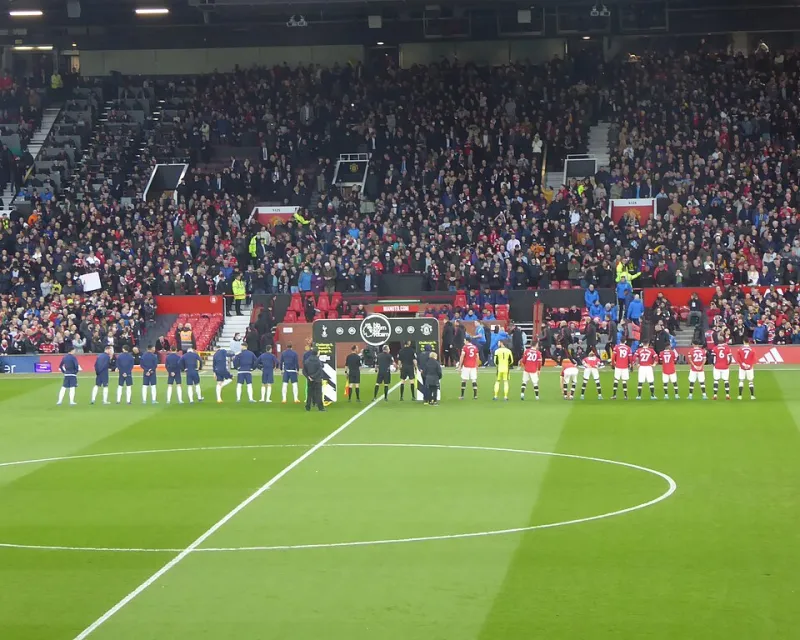
Additions to the stadium continued later. In the match between Manchester United and Blackburn Rovers on 31 March 2007, watched by 76,098 spectators, only 114 seats remained empty. This is a Premier League record. With the last reorganization in 2009, the capacity was reduced by 255 people to 75,957 spectators.
Supporter
Manchester United is the most popular football club in the world and the club that plays its home matches with the highest average attendance in Europe. The club has more than 200 official Manchester United Supporters Clubs in 24 countries around the world. The club organizes a worldwide tour every summer during the summer months and meets the football clubs of the countries visited.
According to Deloitte, an accounting and management consultancy company, United has 75,000,000 fans worldwide, and according to other research companies, 333,000,000.
Fans also cluster independently of the club. Independent Manchester United Supporters' Association and Manchester United Supporters' Trust are some of them. Additionally, many fan forums on the internet are examples of this clustering. Following the Glazer family's purchase of the club in 2005, a group of United fans founded FC United of Manchester. The stand of Old Trafford, named Stretford End, is the stand where passionate United fans are located.
Rivalries
Manchester United has historically had a great rivalry with three clubs: Liverpool, Manchester City and Leeds United. The biggest of these rivalries is the Liverpool rivalry, which is the most successful and popular club in English football, along with United. While this rivalry was initially limited to a North-West conflict, with industrial times it turned into a rivalry between Liverpool, one of the world's most distinguished port cities, and Manchester, one of the important cities of the textile industry.
There have also been various violent incidents in the history of this rivalry. The most famous of these is the spitting of a Liverpool fan at Manchester United football player Eric Cantona in the 1996 FA Cup final and the events that followed. Additionally, Alan Smith[disambiguation required] also suffered a broken leg after being attacked by Liverpool fans during an FA Cup match in 2006.
MUFC's rivalry with Leeds United is known as the "Rivalry of the Roses" in reference to the War of the Roses. According to Football Fans Census, an independent research company, Leeds and Manchester United fans are the fiercest and most loyal fans in England.
Brand value
Manchester United is a global brand. According to a report in 2009, the club's brand value is £329,000,000 and its brand rating is AAA, meaning it is extremely strong. According to Forbes magazine's 2010 report, the club's brand value is $285,000,000. With this amount, it is the second most valuable sports club in the world.
The only club ahead of United on the list is the American baseball club New York Yankees. As of 2010, the club is in third place in the Deloitte Football Money League, behind Real Madrid and Barcelona.
The architect of Manchester United's current global brand value is Matt Busby, the pioneer of the reconstruction after the Munich air disaster. Bobby Charlton, Nobby Stiles, Denis Law and George Best, who are part of Matt Busby's team, are also important figures in this new structure. The football philosophy of this team was established to play aggressive football, unlike the catenaccio tactic of the Italian teams of the period. This created sympathy for the club.
The club went public on the London Stock Exchange in 1991, and was the first British football club to go public. This move brought significant profit to the club focused on commercial and sports success. Manchester United has gained its brand power and media attention through team success and often the individual popularity of its players such as David Beckham and Cristiano Ronaldo.
This great interest has resulted in worldwide opportunities and therefore sponsorship opportunities. In particular, Beckham's popularity in Asia during his time at the club was a commercial part of the club. All kinds of products that could generate commercial income, such as Beckham jerseys, bed linens, souvenirs, footballs, and snacks, were marketed under the Beckham name and provided the club with both great income and greater popularity.
Success in all areas generates greater income for the club. If success is achieved, a larger share of the television revenue pie will be received, which will bring more financial power to the club. Since the Premier League launched, Manchester United has received the largest share of BSkyB broadcast deal revenue. Manchester United also generated the highest commercial revenue of any English club in a single season.
In the 2005-06 season, United earned £51,000,000, Chelsea £42,500,000, Liverpool £39,300,000, Arsenal £34,000,000 and Newcastle United £27,900,000. The club's most important sponsorship relationship was established with Nike in 2002. Nike will manage the club's merchandising operation as part of a 13-year partnership, which will generate revenues of £303,000,000 for the club.
Additionally, Manchester United branded media services have enabled the club to expand its fan base beyond Old Trafford.
Sponsors
The club's first sponsorship deal was worth £500,000 and was with Sharp Electronics. The first jersey sponsor was Vodafone, with the agreement at the beginning of the 1982-83 season. This agreement lasted until the 1999-00 season, and at the end of this period, the agreement was extended for another four years. For these four years, the club earned an income of £30,000,000.
At the beginning of the 2006-07 season, American insurance company AIG became the club's main sponsor for four years, paying £56,500,000. This agreement is the most valuable sponsorship agreement in the world. At the beginning of the 2010-11 season, the American reinsurance company Aon became the main sponsor of the club for four years, paying £ 80,000,000, the highest fee in football history.