Matteo Renzi
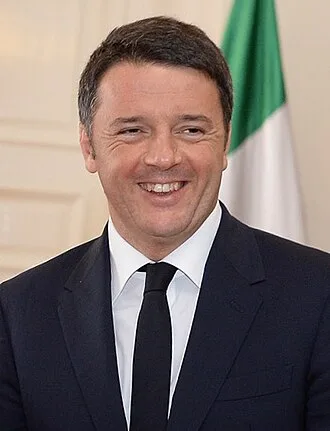
After serving as the president of the province of Florence from 2004 to 2009 and the mayor of Florence from 2009 to 2014, Renzi was elected secretary of the PD in 2013, becoming prime minister the following year. At the age of 39 years, Renzi, who was at the time the youngest leader in the G7 and also the first-serving mayor to become prime minister, became the youngest person to have served as prime minister.
While in power, Renzi's government implemented numerous reforms, including changes to the Italian electoral law, a relaxation of labour and employment laws with the intention of boosting economic growth, a thorough reformation of the public administration, the simplification of civil trials, the introduction of same-sex civil unions, and the abolition of many small taxes.
After the rejection of his constitutional reform in the 2016 Italian constitutional referendum, Renzi formally resigned as prime minister on 12 December; his Foreign Minister Paolo Gentiloni was appointed his replacement. He resigned as secretary of the PD following defeat in the 2018 Italian general election. In September 2019, he left the PD and founded the Italia Viva party.
In January 2021, Renzi revoked his party's support to the Conte II Cabinet headed by Prime Minister Giuseppe Conte, which brought down the government and resulted in the 2021 Italian government crisis. In February 2021, Renzi's IV supported Prime Minister Mario Draghi's national unity government. Renzi has been described as a centrist and as a liberal by political observers.
Early life
Renzi was born on 11 January 1975 in Florence, the second of four children. His father Tiziano Renzi was a small business owner and Christian Democracy (DC) municipal councillor in Rignano sull'Arno. Renzi grew up in an observant Catholic family in Rignano sull'Arno. He studied in Florence at the classical lyceum (liceo classico) Dante Alighieri, where he passed his final exam with the grade of 60/60 but was nearly expelled because, as the students' representative, he refused to withdraw a school newspaper in which there was criticism of a maths teacher. During this time, he was a Scout in the Association of Catholic Guides and Scouts of Italy.
In 1999, Renzi graduated in law from the University of Florence with a thesis on Giorgio La Pira, the former DC mayor of Florence. He then went on to work for CHIL Srl, a marketing company focusing on leafleting owned by his family, co-ordinating the sales service of La Nazione. During this time, Renzi was also an association football referee at amateur level and a futsal player.
In 1994, he participated as a competitor for five consecutive episodes in the television program La ruota della fortuna (a localised version of the United States game show Wheel of Fortune) hosted by Mike Bongiorno, winning Lit.48 million.
Early political career
Renzi's interest in politics began in high school. He was one of the founders of the committee in support of Romano Prodi's candidature as Prime Minister of Italy in the 1996 Italian general election; that same year, Renzi joined the centrist Italian People's Party (PPI), and became its provincial secretary in 1999. He also married Agnese Landini, with whom he later had three children. In 2001, Renzi joined Francesco Rutelli's Daisy party, composed by members of the disbanded PPI.
On 13 June 2004, Renzi was elected president of the province of Florence with 59% of the vote, as the candidate of the centre-left coalition. He was the youngest person to become president of an Italian province. In the years as president of Florence province, Renzi expressed his ideas against "the political caste" and during his mandate reduced taxes and decreased the number of the province's employees and managers.
Mayor of Florence
After five years as the president of Florence province, Renzi announced that he would seek election as the mayor of Florence. On 9 June 2009, Renzi, by now a member of the Democratic Party (PD), won the election on a second round vote with 60% of the votes, compared to 40% for his opponent Giovanni Galli. As the mayor, he halved the number of city councillors, installed 500 free WiFi access points across the city, reduced kindergarten waiting lists by 90%, and increased spending on social welfare programs and schools.
One year after being sworn in as mayor and with his popularity in national opinion polls increasing, Renzi organised a public meeting with another young party administrator Debora Serracchiani at Leopolda Station in Florence to discuss Italian politics, after stating that a complete change was also necessary in his party. Other prominent PD members who aligned themselves with Renzi's programme were Matteo Richetti, president of the Regional Council of Emilia-Romagna, Davide Faraone, a regional councillor from the Sicilian Regional Assembly, and Giuseppe Civati, a prominent member of the PD in Lombardy and a member of the Regional Council of Lombardy.
Following this public meeting in August 2010, the Italian media gave Renzi the nickname il rottamatore ("The Scrapper" or "The Wrecker"). In October 2011, Renzi organised a second public meeting, also in Florence, where he wrote down one hundred topics of discussion. During this time, he began to be strongly criticised by other members of his party closer to then-PD secretary Pier Luigi Bersani, after his suggestion that Italian politicians of the same generation as then-Prime Minister Silvio Berlusconi should retire.
In September 2012, Renzi announced that he would seek to lead the centre-left coalition in the 2013 Italian general election; the other four candidates for that position were Pier Luigi Bersani, the PD secretary, Nichi Vendola, leader of Left Ecology Freedom, Laura Puppato, a PD deputy from Veneto and Bruno Tabacci, leader of the Democratic Centre.
His candidacy was criticised by some prominent PD members and to the party's left, among them Rosy Bindi, Massimo D'Alema, Stefano Fassina, and Vendola.
After the first round of the 2012 Italian centre-left primary election, Renzi gained 35.5% of the vote, finishing second behind Bersani and qualifying for the second ballot. Renzi eventually gained a total of 39% of the vote, against Bersani's 61%. During the 2013 general election campaign, Renzi backed Bersani by organising large public rallies in his support in Florence.
In the election, the PD only gained 25.5% of the vote, despite opinion polls placing the party at almost 30%. In the 2013 Italian presidential election, Renzi caused a minor controversy by openly criticising the candidacies of both Franco Marini and Anna Finocchiaro, two long-standing PD members.
Secretary of the Democratic Party
Following the resignation of Pier Luigi Bersani in April 2013, Renzi announced that he would stand for the position of secretary of the Democratic Party (PD), causing his rivals to scrutinize him. The PD's loss of seats led to party members' doubts concerning Bersani's leadership abilities. Renzi's impressive resume at such a young age, in combination with his reputation as a political outsider thanks to his "Scrapper" moniker, made him very electable in comparison.
He was supported by a number of his former political opponents, such as former party secretaries Walter Veltroni and Dario Franceschini, deputy Marina Sereni, member of the European Parliament David Sassoli, and Turin mayor Piero Fassino. Other supporters of his included deputies like Gianni Pietro Dal Moro, Francesco Sanna, Francesco Boccia, Lorenzo Basso, and Enrico Borghi, all of whom were considered close to the newly elected Prime Minister Enrico Letta.
The other two candidates for party secretary were Gianni Cuperlo, a member of the Chamber of Deputies and former secretary of the Italian Communist Youth Federation, and Giuseppe Civati, a left-wing-oriented deputy from Lombardy and a former supporter of Renzi. In the 2013 PD leadership election, Renzi was elected with 68% of the popular vote, compared to 18% for Cuperlo and 14% for Civati.
He became the new PD secretary and the centre-left coalition's prospective candidate for Prime Minister of Italy. When comparing it with the 2012 centre-left primary election, Renzi moved to the left and his electorate was not much different from that of the party's average primary.
Renzi's victory was welcomed by Prime Minister Letta, who had been the vice-secretary of the party under Bersani's leadership. Throughout January and February 2014, there were multiple reports of persistent leadership tensions between Renzi and Prime Minister Letta. Many said that Renzi was pressuring Letta to resign in his favour, arguing that he should be given the right to become prime minister, as he was the PD's leader.
On 12 February, Letta acknowledged these rumours for the first time, publicly demanded that Renzi make his position clear. Renzi subsequently called a meeting of the PD leadership for the following evening. Just before the meeting took place, Renzi publicly called on Letta to resign and allow him to form a new government.
Letta initially resisted the demand; following a vote in favour of Renzi's proposal during the meeting, which Letta did not attend, he announced that he would tender his resignation as prime minister on 14 February.
Under Renzi's leadership, the PD officially joined the Party of European Socialists (PES) as a full-time member on 28 February 2014.
Prime Minister of Italy (2014–2016)
On 17 January 2014, while on air at Le invasioni barbariche on La7 TV channel, interviewed about the tensions between him and the Prime Minister Enrico Letta, Renzi tweeted #enricostaisereno ("Enrico don't worry") to reassure his party colleague that he was not plotting anything against him. At a meeting on 13 February, the PD leadership voted heavily in favour of Renzi's call for "a new government, a new phase and a radical programme of reform".
Minutes after the party backed the Renzi proposal by 136 votes to 16, with two abstentions, Palazzo Chigi, the official residence of the Prime Minister, announced that Letta would travel to the Quirinale the following day to tender his resignation to President Giorgio Napolitano. On 17 February, in his last act as the mayor of Florence, Renzi appointed Dario Nardella as Deputy Mayor Regent of Florence with the task of leading the city until the mayoral elections in May that same year.
In an earlier speech, Renzi had paid tribute to Letta, saying that he did not intend to put him "on trial". Without directly proposing himself as the next prime minister, he said the eurozone's third-largest economy urgently needed "a new phase" and "radical programme" to push through badly needed reforms. The motion he put forward made clear "the necessity and urgency of opening a new phase with a new executive".
Speaking privately to party leaders, Renzi said that Italy was "at a crossroads" and faced either holding fresh elections or a new government without a return to the polls. On 14 February, President Napolitano accepted Letta's resignation from the office of Prime Minister.
Following Letta's resignation, Renzi formally received the task of forming a new government from President Napolitano on 17 February. Renzi held several days of talks with party leaders, all of which he broadcast live on the internet, before unveiling the Renzi Cabinet on 21 February, which contained members of the PD, the New Centre-Right, the Union of the Centre, and the Civic Choice (SC).
His cabinet became Italy's youngest government to date, with an average age of 47. It was also the first in which the number of female ministers was equal to the number of male ministers, excluding the Prime Minister.
On 22 February, Renzi was formally sworn in as prime minister, becoming the fourth prime minister in four years and the youngest prime minister in the history of Italy. His rise to become the PD's secretary and eventual prime minister was seen as a sign of much-needed generational change; at the time he took office, Renzi enjoyed by far the highest approval rating of any politician in the country.
On 25 February, Renzi won a vote of confidence in the Italian Parliament, with 169 votes in the Senate of the Republic and 378 in the Chamber of Deputies.
On 7 February 2015, after just under a year in power, five senators and two deputies from the SC defected to the PD, citing the leadership of Renzi as Prime Minister as the primary reason for their decision to change parties. On 20 March, Prime Minister Renzi briefly became ad interim Minister of Infrastructure and Transport following the resignation of Maurizio Lupi due to a corruption scandal, involving public works on infrastructure, in which his name had been cited several times.
Renzi held the office on an unofficial basis until 2 April, when Graziano Delrio was appointed as the new minister.
On 4 December 2016, after the failure of the referendum he proposed, Renzi announced his resignation. On 7 December, he officially handed over the resignation to the President Sergio Mattarella.
Domestic policy
Labour reform
Upon becoming prime minister, Renzi said that labour market reform, which was thought to be "long overdue", and was opposed by major trade unions and organised labour, to introduce labour market flexibility, would be at the top of his agenda to improve the state of the Italian economy. On 12 March 2014, the Renzi Cabinet issued a law-decree on fixed-term contracts, called the Poletti Decree, from the name of the Labour Minister Giuliano Poletti, as well as a bill proposing major reforms to the Italian labour market called the Jobs Act.
A reduction in the tax burden of about €80 was announced for those earning less than €1,500 per month. On 30 April, Renzi and Marianna Madia, the Minister for the Public Administration, presented the guidelines for the reform of the public administration, which was approved by the Renzi Cabinet on 13 June, before becoming law on 7 August.
In September 2014, the government sought approval for the Jobs Act, which provided for, among other things, the abolition of Article 18 of the Workers' Statute, which protected workers from unjustified dismissal. The proposal was criticised by organised labour, especially the largest trade union, the Italian General Confederation of Labour (CGIL), and its leaders Susanna Camusso and Maurizio Landini.
Moreover, the left wing of the Democratic Party (PD), by then led by Renzi's rival and former PD secretary Pier Luigi Bersani, criticised the government for the reform, threatening to vote against it.
On 29 September, the National Committee of the PD voted to support the Jobs Act, despite the disagreements within the party, with 130 votes in favour, 20 against, and 11 abstaining. On 9 October, the Senate voted to approve the Jobs Act, and the landmark reform passed with 165 votes in favour to 111 against, marking the first step for the most ambitious economic legislation of the eight-month-old government.
Before the vote, Labour Minister Poletti was forced to cut his speech short due to the loud protests of the Five Star Movement (M5S) and Lega Nord (Lega) oppositions, some of whom threw coins and papers. German chancellor Angela Merkel, who was visiting Milan and had been among the most vocal politicians regarding Italy's need for speedy economic reforms, said the labour law marked an "important step" to reduce "employment barriers" in the eurozone's third-largest economy.
On 25 October, almost one million people took part in a mass protest in Rome, organised by the CGIL in opposition to the labour reforms of the government. Some high-profile members of the left-wing faction of the PD, including Gianni Cuperlo, Stefano Fassina, and Giuseppe Civati, also participated in the protest. On 8 November, more than 100,000 public employees protested in Rome in a demonstration organised by the three largest trade unions in the country, the CGIL, the CISL, and the UIL.
On 25 November, the Chamber of Deputies approved the Jobs Act with 316 votes; the M5S, Lega, and almost forty members of the PD abstained from the vote to protest against the reform. On 3 December, the Senate gave the final approval it needed to become law.
In January 2017, the Jobs Act was taken to the Constitutional Court of Italy; Renzi and his supporters said that the law was necessary for job creation and to attract investors, while its critics responded that it diminished workers' rights without generating new jobs. The court rejected a petition, which received 3.3. million signatures, for a referendum to be held about the Job Acts.
In September 2018, the Jobs Acts was partially repealed after the same court declared the compensation rules for claims of unlawful dismissal to be unconstitutional, on the grounds that these rules were not in line with the principles of "reasonableness and equality" and conflicted with the concept of "protection of work" as granted by Articles 4 and 35.
In July 2020, the court accepted the questions raised from the tribunals of Bari and Rome about the same matter, ruling the compensation rules to be in violation of the constitutional principles of equality, reasonableness, and job protection; it was the first time that a ruling was signed by three women.
Economic policies
In March 2014, the Renzi Cabinet approved the auctioning of a large number of luxury cars that were used to transport heads of state, including nine Maseratis, two Jaguar Cars, and various other cars such as BMWs and Alfa Romeos. Out of the 1,500 cars put up for sale, 170 sold immediately over eBay. In April, as part of his wider industrial reforms, Renzi forced the chief executives of Italy's biggest state-owned companies, including Eni, Terna, Finmeccanica, Enel, and Poste italiane, to resign, citing a lack of public confidence in their leadership.
He subsequently appointed women to the majority of new positions, making it the first time any woman had served as a chief executive of a state-owned company in Italy. In April 2014, Renzi's cabinet introduced the so-called "Renzi bonus", a monthly allowance of €80, recognised to holders of a total annual income not exceeding €24,600.
The bonus, whose aim was to relaunch expenditures, was heavily criticised by the opposition, which labelled it as an "electoral bakshish" for the 2014 European Parliament election.
On 1 August, Renzi launched a law decree called Unblock Italy, which was intended to facilitate the implementation of major projects, civil works, and infrastructure that were suspended at the time, and achieve further administrative simplification. The centre of this was the Millegiorni, or the Thousand Days Programme.
On 1 September, Renzi launched the website passodopopasso.italia.it, which allowed citizens to monitor the progress of the Millegiorni. On 9 October, Renzi presented his first Finance Bill (Legge di Stabilità), which was approved by the European Commission on 28 October. A €36 billion bill, it included the largest tax cuts in a year (€18 billion), as well as tax evasion fight, plus the €80 bonus; it was criticised by trade unions like the CGIL, the CISL, and FIOM, while the UIL was more positive and Confindustria supported it.
In February 2015, with the economy continuing to stagnate, the government announced a plan to abolish rules that limit cooperative lenders' shareholders to one vote each at shareholder meetings regardless of the size of their holdings. The European Commission subsequently forecast that the Italian economy would begin to grow by the spring.
The government also announced the abolition of IRAP, a regional tax on production activities; discussing the 2016 Finance Bill, Renzi further promised to cancel IRPEF, IMU, and TASI, respectively taxes on individuals, public services, and residence, which was a flagship policy of the centre-right former prime minister Silvio Berlusconi, and its tax-cutting 2016 budget was passed on 22 December despite concerns from the European Commission.
Additionally, Renzi raised the threshold for cash payments three times with the intention to boost the economy, promising that it would not help tax evasion, and described it as "a simple, fair, and liberal measure" that "simplifies" and "encourages consumption". In 2018, Minister of Economy and Finance Pier Carlo Padoan admitted that it was a mistake.
A 2021 study by the Bank of Italy concluded that the decision "increased the share of the illegal economy by 0.5 percentage points" and "a 1% increase in the use of cash leads to growth between 0.8% and 1.8%" of the black economy.
In May 2015, the economy recorded growth of 0.3%, finally ending the Italian triple-dip recession. In January 2016, Renzi highlighted an additional 500,000 jobs that he said had been created through his policies. In October 2016, the Renzi government's proposed 2017 Finance Bill, an expansionary budget including deficit raising to cope with the earthquake and migrants emergencies, was seen as an increasing anti-Brussels rhetoric, having warned of disaster if it was rejected.
In an interview with la Repubblica on 23 October, Padoan said: "Europe must choose which side to take. They can accept the fact that our deficit goes up from 2% to 2.3% (of gross domestic product) to tackle the earthquake and the migrant emergencies. Or they can choose the Hungarian way, which puts up walls against the migrants and must be rejected.
That would be the beginning of the end." On 24 October, defending the budget law, Renzi said: "We want to address the needs of Italian citizens, not Brussels technocracy."
📚 Source: Wikipedia