














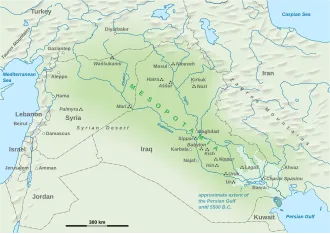
Mesopotamia is the site of the earliest developments of the Neolithic Revolution from around 10,000 BC. It has been identified as having "inspired some of the most important developments in human history, including the invention of the wheel, the planting of the first cereal crops, the development of cursive script, mathematics, astronomy, and agriculture." It is recognised as the cradle of some of the world's earliest civilizations.
The Sumerians and Akkadians, each originating from different areas, dominated Mesopotamia from the beginning of recorded history (c. 3100 BC) to the fall of Babylon in 539 BC. The rise of empires, beginning with Sargon of Akkad around 2350 BC, characterized the subsequent 2,000 years of Mesopotamian history, marked by the succession of kingdoms and empires such as the Akkadian Empire.
The early second millennium BC saw the polarization of Mesopotamian society into Assyria in the north and Babylonia in the south. From 900 to 612 BC, the Neo-Assyrian Empire asserted control over much of the ancient Near East. Subsequently, the Babylonians, who had long been overshadowed by Assyria, seized power, dominating the region for a century as the final independent Mesopotamian realm until the modern era.
In 539 BC, Mesopotamia was conquered by the Achaemenid Empire under Cyrus the Great. The area was next conquered by Alexander the Great in 332 BC. After his death, it was fought over by the various Diadochi (successors of Alexander), of whom the Seleucids emerged victorious.
Around 150 BC, Mesopotamia was under the control of the Parthian Empire. It became a battleground between the Romans and Parthians, with western parts of the region coming under ephemeral Roman control. In 226 AD, the eastern regions of Mesopotamia fell to the Sassanid Persians under Ardashir I. The division of the region between the Roman Empire and the Sassanid Empire lasted until the 7th century Muslim conquest of the Sasanian Empire and the Muslim conquest of the Levant from the Byzantines.
A number of primarily neo-Assyrian and Christian native Mesopotamian states existed between the 1st century BC and 3rd century AD, including Adiabene, Osroene, and Hatra.
Present
In the broader sense, the historical region of Mesopotamia also includes parts of present-day Iran (southwest), Turkey (southeast), Syria (northeast), and Kuwait. Modern Assyrians remain direct descendants of the native Mesopotamians.
Etymology
The regional toponym Mesopotamia (/ˌmɛsəpəˈteɪmiə/, Ancient Greek: Μεσοποταμία '[land] between rivers'; Arabic: بِلَاد ٱلرَّافِدَيْن Bilād ar-Rāfidayn or بَيْن ٱلنَّهْرَيْن Bayn an-Nahrayn; Persian: میانرودان miyân rudân; Syriac: ܒܝܬ ܢܗܪ̈ܝܢ Beth Nahrain "(land) between the (two) rivers") comes from the ancient Greek root words μέσος (mesos, 'middle') and ποταμός (potamos, 'river') and translates to '(land) between rivers'.
It is used throughout the Greek Septuagint (c. 250 BC) to translate the Hebrew and Aramaic equivalent Naharaim. An even earlier Greek usage of the name Mesopotamia is evident from The Anabasis of Alexander, which was written in the late 2nd century AD but specifically refers to sources from the time of Alexander the Great. In the Anabasis, Mesopotamia was used to designate the land east of the Euphrates in north Syria.
The Akkadian term biritum/birit narim corresponded to a similar geographical concept. Later, the term Mesopotamia was more generally applied to all the lands between the Euphrates and the Tigris, thereby incorporating not only parts of Syria but also almost all of Iraq and southeastern Turkey.
The neighbouring steppes to the west of the Euphrates and the western part of the Zagros Mountains are also often included under the wider term Mesopotamia.
A further distinction is usually made between Northern or Upper Mesopotamia and Southern or Lower Mesopotamia. Upper Mesopotamia, also known as the Jazira, is the area between the Euphrates and the Tigris from their sources down to Baghdad. Lower Mesopotamia is the area from Baghdad to the Persian Gulf and includes Kuwait and parts of western Iran.
In modern academic usage, the term Mesopotamia often also has a chronological connotation. It is usually used to designate the area until the Muslim conquests, with names like Syria, Jazira, and Iraq being used to describe the region after that date. It has been argued[by whom?] that these later euphemisms[clarification needed] are Eurocentric terms attributed to the region in the midst of various 19th-century Western encroachments.
Geography
Mesopotamia encompasses the land between the Euphrates and Tigris rivers, both of which have their headwaters in the neighboring Armenian highlands. Both rivers are fed by numerous tributaries, and the entire river system drains a vast mountainous region. Overland routes in Mesopotamia usually follow the Euphrates because the banks of the Tigris are frequently steep and difficult.
The climate of the region is semi-arid with a vast desert expanse in the north which gives way to a 15,000-square-kilometre (5,800 sq mi) region of marshes, lagoons, mudflats, and reed banks in the south. In the extreme south, the Euphrates and the Tigris unite and empty into the Persian Gulf.
The arid environment ranges from the northern areas of rain-fed agriculture to the south where irrigation of agriculture is essential. This irrigation is aided by a high water table and by melting snows from the high peaks of the northern Zagros Mountains and from the Armenian Highlands, the source of the Tigris and Euphrates Rivers that give the region its name.
The usefulness of irrigation depends upon the ability to mobilize sufficient labor for the construction and maintenance of canals, and this, from the earliest period, has assisted the development of urban settlements and centralized systems of political authority.
Agriculture throughout the region has been supplemented by nomadic pastoralism, where tent-dwelling nomads herded sheep and goats (and later camels) from the river pastures in the dry summer months, out into seasonal grazing lands on the desert fringe in the wet winter season. The area is generally lacking in building stone, precious metals, and timber, and so historically has relied upon long-distance trade of agricultural products to secure these items from outlying areas.
In the marshlands to the south of the area, a complex water-borne fishing culture has existed since prehistoric times and has added to the cultural mix.
Periodic breakdowns in the cultural system have occurred for a number of reasons. The demands for labor have from time to time led to population increases that push the limits of the ecological carrying capacity; should a period of climatic instability ensue, central government can collapse and populations can decline.
Alternatively, military vulnerability to invasion from marginal hill tribes or nomadic pastoralists has led to periods of trade collapse and neglect of irrigation systems. Equally, centripetal tendencies amongst city-states have meant that central authority over the whole region, when imposed, has tended to be ephemeral, and localism has fragmented power into tribal or smaller regional units. These trends have continued to the present day in Iraq.
History
The prehistory of the Ancient Near East begins in the Lower Paleolithic period. Therein, writing emerged with a pictographic script, Proto-cuneiform, in the Uruk IV period (c. late 4th millennium BC). The documented record of actual historical events—and the ancient history of lower Mesopotamia—commenced in the early-third millennium BC with cuneiform records of early dynastic kings.
This entire history ends with either the arrival of the Achaemenid Empire in the late 6th century BC or with the Muslim conquest and the establishment of the Caliphate in the late 7th century AD, from which point the region came to be known as Iraq. In the long span of this period, Mesopotamia housed some of the world's most ancient highly developed, and socially complex states.
The region was home to one of the four riverine civilizations where writing was invented, along with the Nile valley in Ancient Egypt, the Indus Valley civilization in the Indian subcontinent, and the Yellow River in Ancient China. Mesopotamia housed historically important cities such as Uruk, Nippur, Nineveh, Assur and Babylon, as well as major territorial states such as the city of Eridu, the Akkadian kingdoms, the Third Dynasty of Ur, and the various Assyrian empires.
Some of the important historical Mesopotamian leaders were Ur-Nammu (king of Ur), Sargon of Akkad (who established the Akkadian Empire), Hammurabi (who established the Old Babylonian state), Ashur-uballit I and Tiglath-Pileser I (who established the Assyrian Empire).
Scientists analysed DNA from the 8,000-year-old remains of early farmers found at an ancient graveyard in Germany. They compared the genetic signatures to those of modern populations and found similarities with the DNA of people living in today's Turkey and Iraq.
Periodization
- Pre- and protohistory
- Pre-Pottery Neolithic A (10,000–8700 BC)
- Pre-Pottery Neolithic B (8700–6800 BC)
- Jarmo (7500–5000 BC)
- Hassuna (~6000 BC)
- Samarra (~5700–4900 BC)
- Halaf cultures (~6000–5300 BC)
- Ubaid period (~6500–4000 BC)
- Uruk period (~4000–3100 BC)
- Jemdet Nasr period (~3100–2900 BC)
- Early Bronze Age
- Early Dynastic period (~2900–2350 BC)
- Akkadian Empire (~2350–2100 BC)
- Third Dynasty of Ur (2112–2004 BC)
- Middle Bronze Age
- Isin-Larsa period (19th to 18th century BC)
- First Babylonian dynasty (18th to 17th century BC)
- Minoan eruption (c. 1620 BC)
- Late Bronze Age
- Old Assyrian period (16th to 11th century BC)
- Middle Assyrian period (c. 1365–1076 BC)
- Kassites in Babylon, (c. 1595–1155 BC)
- Late Bronze Age collapse (12th to 11th century BC)
- Iron Age
- Syro-Hittite states (11th to 7th century BC)
- Neo-Assyrian Empire (911 BC – 612 BC)
- Neo-Babylonian Empire (626 BC – 539 BC)
- Classical antiquity
- Fall of Babylon (539 BC)
- Achaemenid Babylonia, Achaemenid Assyria (539 BC – 331 BC)
- Seleucid Mesopotamia (4th to 3rd century BC)
- Parthian Babylonia (141 BC – 226 AD)
- Meshan (141 BC – 222 AD)
- Osroene (2nd century BC to 3rd century AD)
- Adiabene (1st to 2nd century AD)
- Hatra (1st to 2nd century AD)
- Roman Mesopotamia (2nd to 7th century AD), Roman Assyria (2nd century AD)
- Late Antiquity
- Asōristān (3rd to 7th century AD)
- Arbāyistān (3rd to 7th century AD)
- Muslim conquest (mid-7th century AD)
Language and writing
The earliest language written in Mesopotamia was Sumerian, an agglutinative language isolate. Along with Sumerian, Semitic languages were also spoken in early Mesopotamia. Subartuan, a language of the Zagros possibly related to the Hurro-Urartuan language family, is attested in personal names, rivers and mountains and in various crafts.
Akkadian came to be the dominant language during the Akkadian Empire and the Assyrian empires, but Sumerian was retained for administrative, religious, literary and scientific purposes.
Different varieties of Akkadian were used until the end of the Neo-Babylonian period. Old Aramaic, which had already become common in Mesopotamia, then became the official provincial administration language of first the Neo-Assyrian Empire, and then the Achaemenid Empire: the official lect is called Imperial Aramaic. Akkadian fell into disuse, but both it and Sumerian were still used in temples for some centuries. The last Akkadian texts date from the late 1st century AD.
Early in Mesopotamia's history, around the mid-4th millennium BC, cuneiform was invented for the Sumerian language. Cuneiform literally means "wedge-shaped", due to the triangular tip of the stylus used for impressing signs on wet clay. The standardized form of each cuneiform sign appears to have been developed from pictograms.
The earliest texts, 7 archaic tablets, come from the É, a temple dedicated to the goddess Inanna at Uruk, from a building labeled as Temple C by its excavators.
The early logographic system of cuneiform script took many years to master. Thus, only a limited number of individuals were hired as scribes to be trained in its use. It was not until the widespread use of a syllabic script was adopted under Sargon's rule that significant portions of the Mesopotamian population became literate.
Massive archives of texts were recovered from the archaeological contexts of Old Babylonian scribal schools, through which literacy was disseminated.
Akkadian gradually replaced Sumerian as the spoken language of Mesopotamia somewhere around the turn of the 3rd and the 2nd millennium BC. The exact dating is a matter of debate. Sumerian continued to be used as a sacred, ceremonial, literary, and scientific language in Mesopotamia until the 1st century AD.
Literature
Libraries were extant in towns and temples during the Babylonian Empire. An old Sumerian proverb averred that "he who would excel in the school of the scribes must rise with the dawn." Women as well as men learned to read and write, and for the Semitic Babylonians, this involved knowledge of the extinct Sumerian language, and a complicated and extensive syllabary.
A considerable amount of Babylonian literature was translated from Sumerian originals, and the language of religion and law long continued to be the old agglutinative language of Sumer. Vocabularies, grammars, and interlinear translations were compiled for the use of students, as well as commentaries on the older texts and explanations of obscure words and phrases. The characters of the syllabary were all arranged and named, and elaborate lists were drawn up.
Many Babylonian literary works are still studied today. One of the most famous of these was the Epic of Gilgamesh, in twelve books, translated from the original Sumerian by a certain Sîn-lēqi-unninni, and arranged upon an astronomical principle. Each division contains the story of a single adventure in the career of Gilgamesh.
The whole story is a composite product, although it is probable that some of the stories are artificially attached to the central figure.
Science and technology
Mathematics
Mesopotamian mathematics and science was based on a sexagesimal (base 60) numeral system. This is the source of the 60-minute hour, the 24-hour day, and the 360-degree circle. The Sumerian calendar was lunisolar, with three seven-day weeks of a lunar month. This form of mathematics was instrumental in early map-making.
The Babylonians also had theorems on how to measure the area of shapes and solids. They measured the circumference of a circle as three times the diameter and the area as one-twelfth the square of the circumference, which would be correct if π were fixed at 3.
The volume of a cylinder was taken as the product of the area of the base and the height; however, the volume of the frustum of a cone or a square pyramid was incorrectly taken as the product of the height and half the sum of the bases. Also, there was a recent discovery in which a tablet used π as 25/8 (3.125 instead of 3.14159~).
The Babylonians are also known for the Babylonian mile, which was a measure of distance equal to about seven modern miles (11 km). This measurement for distances eventually was converted to a time-mile used for measuring the travel of the Sun, therefore, representing time.
Algebra
The roots of algebra can be traced to the ancient Babylonia who developed an advanced arithmetical system with which they were able to do calculations in an algorithmic fashion.
The Babylonian clay tablet YBC 7289 (c. 1800–1600 BC) gives an approximation of √2 in four sexagesimal figures, 1 24 51 10, which is accurate to about six decimal digits, and is the closest possible three-place sexagesimal representation of √2:

The Babylonians were not interested in exact solutions, but rather approximations, and so they would commonly use linear interpolation to approximate intermediate values. One of the most famous tablets is the Plimpton 322 tablet, created around 1900–1600 BC, which gives a table of Pythagorean triples and represents some of the most advanced mathematics prior to Greek mathematics.
Astronomy
From Sumerian times, temple priesthoods had attempted to associate current events with certain positions of the planets and stars. This continued to Assyrian times, when Limmu lists were created as a year by year association of events with planetary positions, which, when they have survived to the present day, allow accurate associations of relative with absolute dating for establishing the history of Mesopotamia.