
















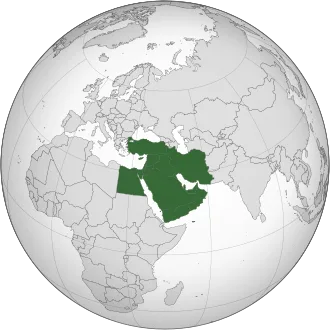
Today, the bulk of Middle Eastern countries (13 out of 18) are part of the Arab world. The three most populous Middle Eastern countries are Egypt, Iran, and Turkey, while Saudi Arabia is the largest Middle Eastern country by area. Arabs are the most widespread ethnic group in the region, followed by Turks, Persians, Kurds, Jews, and Assyrians.
Significant geographical features or regions that constitute the Middle East are the Arabian Peninsula, Anatolia, the Levant and Mesopotamia (together comprising the Fertile Crescent), and the Iranian plateau.
The history of the Middle East is among the richest ever recorded as it was the first region to be settled by modern humans outside of Africa and the first region in which writing systems were developed. Situated at the intersection of Africa, Europe, and Asia, the Middle East was home to several cradles of civilization and has been recognized by both local and foreign populations as a region of great strategic importance for millennia.
All of the core Abrahamic religions (Judaism, Christianity, and Islam) originated and have their holiest sites in the Middle East.
Most parts of the Middle East exhibit a hot and arid climate, especially in the Arabian and Egyptian regions. However, a number of major rivers provide irrigation to support agriculture in certain areas, such as the Nile in Egypt, the Tigris and the Euphrates in Mesopotamia, and the Jordan River in the Levant. Conversely, the Levantine coast and most of Turkey collectively boast a relatively temperate Mediterranean climate, which yields dry summers with cool and wet winters.
A group of Middle Eastern countries that are located along the Persian Gulf—commonly called the Gulf Arab states—have vast reserves of petroleum, which has served as a critical economic resource and accordingly influenced regional politics. Owing to the Middle East's aridity and pervasive dependence on the fossil fuel industry, it is one of the most vulnerable regions to climate change and water scarcity.
Terminology
The term "Middle East" may have originated with the India Office of the United Kingdom in the 1850s. However, it became more widely known through the United States, particularly after American naval strategist Alfred Thayer Mahan used the term to "designate the area between Arabia and India" in 1902. During this period, the United Kingdom was vying for influence in Central Asia as part of the "Great Game" against the Russian Empire, which was in the process of conquering the entire region.
Realizing the "Middle East" to be a region of immense strategic value centred around the Persian Gulf, Mahan took the view that, beyond the Suez Canal in British-ruled Egypt, the Persian Gulf was the most important passage for the United Kingdom in the context of keeping in check any possible Russian advance towards British-ruled India. Mahan first used the term in his September 1902 article "The Persian Gulf and International Relations" for the British journal National Review in London.
The Middle East, if I may adopt a term which I have not seen, will some day need its Malta, as well as its Gibraltar; it does not follow that either will be in the Persian Gulf. Naval force has the quality of mobility which carries with it the privilege of temporary absences; but it needs to find on every scene of operation established bases of refit, of supply, and in case of disaster, of security.
The British Navy should have the facility to concentrate in force if occasion arise, about Aden, India, and the Persian Gulf.
Mahan's article was reprinted in the British newspaper The Times and followed by a 20-article series entitled "The Middle Eastern Question" by British historian and diplomat Valentine Chirol. In this series, which began in October 1902, he would expand the definition of "Middle East" to include "those regions of Asia which extend to the borders of India or command the approaches to India." After the series ended in 1903, The Times removed quotation marks from subsequent uses of the term.
Until World War II, it was customary to refer to areas centred on Turkey and the Eastern Mediterranean as the "Near East" in juxtaposition with the "Far East" centred on China, India, and Japan. The Middle East was then defined as the area from Mesopotamia to Burma—namely, the area between the Near East and the Far East—which now broadly corresponds with South Asia.
In the late 1930s, the Cairo-based Middle East Command was established for the British Armed Forces. After that time, the term "Middle East" gained broader usage across both Europe and the United States. The Middle East Institute, for example, was founded in Washington, D.C. in 1946.
While "Southwest Asia" or "Swasia" have been presented sparsely as alternatives, the inclusion of Egypt (located entirely in North Africa except for the Sinai Peninsula) among those countries that are counted as part of the Middle East challenges the usefulness of such terms. Furthermore, the core term "Asia" itself is Eurocentric, having been expanded upon from a term coined by the ancient Greeks to refer to contemporary Anatolia.
Usage and criticism
The description Middle has also led to some confusion over changing definitions. Before the First World War, "Near East" was used in English to refer to the Balkans and the Ottoman Empire, while "Middle East" referred to the Caucasus, Persia, and Arabian lands, and sometimes Afghanistan, India and others. In contrast, "Far East" referred to the countries of East Asia (e.g. China, Japan, and Korea).
With the collapse of the Ottoman Empire in 1918, "Near East" largely fell out of common use in English, while "Middle East" came to be applied to the emerging independent countries of the Islamic world. However, the usage "Near East" was retained by a variety of academic disciplines, including archaeology and ancient history.
In their usage, the term describes an area identical to the term Middle East, which is not used by these disciplines (see ancient Near East).[citation needed]
The first official use of the term "Middle East" by the United States government was in the 1957 Eisenhower Doctrine, which pertained to the Suez Crisis. Secretary of State John Foster Dulles defined the Middle East as "the area lying between and including Libya on the west and Pakistan on the east, Syria and Iraq on the North and the Arabian peninsula to the south, plus the Sudan and Ethiopia." In 1958, the State Department explained that the terms "Near East" and "Middle East" were interchangeable, and defined the region as including only Egypt, Syria, Israel, Lebanon, Jordan, Iraq, Saudi Arabia, Kuwait, Bahrain, and Qatar.
Since the late 20th century, scholars and journalists from the region, such as journalist Louay Khraish and historian Hassan Hanafi have criticized the use of "Middle East" as a Eurocentric and colonialist term.
The Associated Press Stylebook of 2004 says that Near East formerly referred to the farther west countries while Middle East referred to the eastern ones, but that now they are synonymous. It instructs:
Use Middle East unless Near East is used by a source in a story. Mideast is also acceptable, but Middle East is preferred.
Translations
European languages have adopted terms similar to Near East and Middle East. Since these are based on a relative description, the meanings depend on the country and are generally different from the English terms. In German the term Naher Osten (Near East) is still in common use (nowadays the term Mittlerer Osten is more and more common in press texts translated from English sources, albeit having a distinct meaning).
In Slavic languages like Russian Ближний Восток (Blizhniy Vostok), Bulgarian Близкия Изток, Polish Bliski Wschód or Croatian Bliski istok, (terms meaning Near East are the only appropriate ones for the region).
However, some European languages do have "Middle East" equivalents, such as French Moyen-Orient, Swedish Mellanöstern, Spanish Oriente Medio or Medio Oriente, Greek is Μέση Ανατολή (Mesi Anatoli), and Italian Medio Oriente.
Perhaps because of the political influence of the United States and Europe, and the prominence of Western press, the Arabic equivalent of Middle East (Arabic: الشرق الأوسط ash-Sharq al-Awsaṭ) has become standard usage in the mainstream Arabic press. It comprises the same meaning as the term "Middle East" in North American and Western European usage.
The designation, Mashriq, also from the Arabic root for East, also denotes a variously defined region around the Levant, the eastern part of the Arabic-speaking world (as opposed to the Maghreb, the western part). Even though the term originated in the West, countries of the Middle East that use languages other than Arabic also use that term in translation.
For instance, the Persian equivalent for Middle East is خاورمیانه (Khāvar-e miyāneh), the Hebrew is המזרח התיכון (hamizrach hatikhon), and the Turkish is Orta Doğu.
Countries and territories
Common definition of the Middle East
Traditionally included within the Middle East are Arabia, Asia Minor, East Thrace, Egypt, Iran, the Levant, Mesopotamia, and the Socotra Archipelago. The region includes 17 UN-recognized countries and one British Overseas Territory.
Other definitions of the Middle East
Various concepts are often paralleled to the Middle East, most notably the Near East, Fertile Crescent, and Levant. These are geographical concepts, which refer to large sections of the modern-day Middle East, with the Near East being the closest to the Middle East in its geographical meaning. Due to it primarily being Arabic speaking, the Maghreb region of North Africa is sometimes included.
"Greater Middle East" is a political term coined by the second Bush administration in the first decade of the 21st century to denote various countries, pertaining to the Muslim world, specifically Afghanistan, Iran, Pakistan, and Turkey. Various Central Asian countries are sometimes also included.
History
The Middle East lies at the juncture of Africa and Eurasia and of the Indian Ocean and the Mediterranean Sea (see also: Indo-Mediterranean). It is the birthplace and spiritual center of religions such as Christianity, Islam, Judaism, Manichaeism, Yezidi, Druze, Yarsan, and Mandeanism, and in Iran, Mithraism, Zoroastrianism, Manicheanism, and the Baháʼí Faith.
Throughout its history the Middle East has been a major center of world affairs; a strategically, economically, politically, culturally, and religiously sensitive area. The region is one of the regions where agriculture was independently discovered, and from the Middle East it was spread, during the Neolithic, to different regions of the world such as Europe, the Indus Valley and Eastern Africa.
Prior to the formation of civilizations, advanced cultures formed all over the Middle East during the Stone Age. The search for agricultural lands by agriculturalists, and pastoral lands by herdsmen meant different migrations took place within the region and shaped its ethnic and demographic makeup.
The Middle East is widely and most famously known as the cradle of civilization. The world's earliest civilizations, Mesopotamia (Sumer, Akkad, Assyria, and Babylonia), ancient Egypt and Kish in the Levant, all originated in the Fertile Crescent and Nile Valley regions of the ancient Near East. These were followed by the Hittite, Greek, Hurrian and Urartian civilisations of Asia Minor; Elam, Persia and Median civilizations in Iran, as well as the civilizations of the Levant (such as Ebla, Mari, Nagar, Ugarit, Canaan, Aramea, Mitanni, Phoenicia, and Israel) and the Arabian Peninsula (Magan, Sheba, Ubar).
The Near East was first largely unified under the Neo Assyrian Empire, then the Achaemenid Empire followed later by the Macedonian Empire and after this to some degree by the Iranian empires (namely the Parthian and Sasanian Empires), the Roman Empire, and the Byzantine Empire. The region served as the intellectual and economic center of the Roman Empire and played an exceptionally important role due to its periphery on the Sasanian Empire.
Thus, the Romans stationed up to five or six of their legions in the region for the sole purpose of defending it from Sasanian and Bedouin raids and invasions.
From the 4th century CE onward, the Middle East became the center of the two main powers at the time, the Byzantine Empire and the Sasanian Empire. However, it would be the later Islamic Caliphates of the Middle Ages, or Islamic Golden Age which began with the Islamic conquest of the region in the 7th century AD, that would first unify the entire Middle East as a distinct region and create the dominant Islamic Arab ethnic identity that largely (but not exclusively) persists today.
The 4 caliphates that dominated the Middle East for more than 600 years were the Rashidun Caliphate, the Umayyad Caliphate, the Abbasid Caliphate, and the Fatimid Caliphate. Additionally, the Mongols would come to dominate the region, the Kingdom of Armenia would incorporate parts of the region to their domain, the Seljuks would rule the region and spread Turko-Persian culture, and the Franks would found the Crusader states that would stand for roughly two centuries.
Josiah Russell estimates the population of what he calls "Islamic territory" as roughly 12.5 million in 1000 – Anatolia 8 million, Syria 2 million, and Egypt 1.5 million. From the 16th century onward, the Middle East came to be dominated, once again, by two main powers: the Ottoman Empire and Safavid Iran.
The modern Middle East began after World War I, when the Ottoman Empire, which was allied with the Central Powers, was defeated by the Allies and partitioned into a number of separate nations, initially under British and French Mandates. Other defining events in this transformation included the establishment of Israel in 1948 and the eventual departure of European powers, notably Britain and France by the end of the 1960s. They were supplanted in some part by the rising influence of the United States from the 1970s onward.
In the 20th century, the region's significant stocks of crude oil gave it new strategic and economic importance. Mass production of oil began around 1945, with Saudi Arabia, Iran, Kuwait, Iraq, and the United Arab Emirates having large quantities of oil. Estimated oil reserves, especially in Saudi Arabia and Iran, are some of the highest in the world, and the international oil cartel OPEC is dominated by Middle Eastern countries.