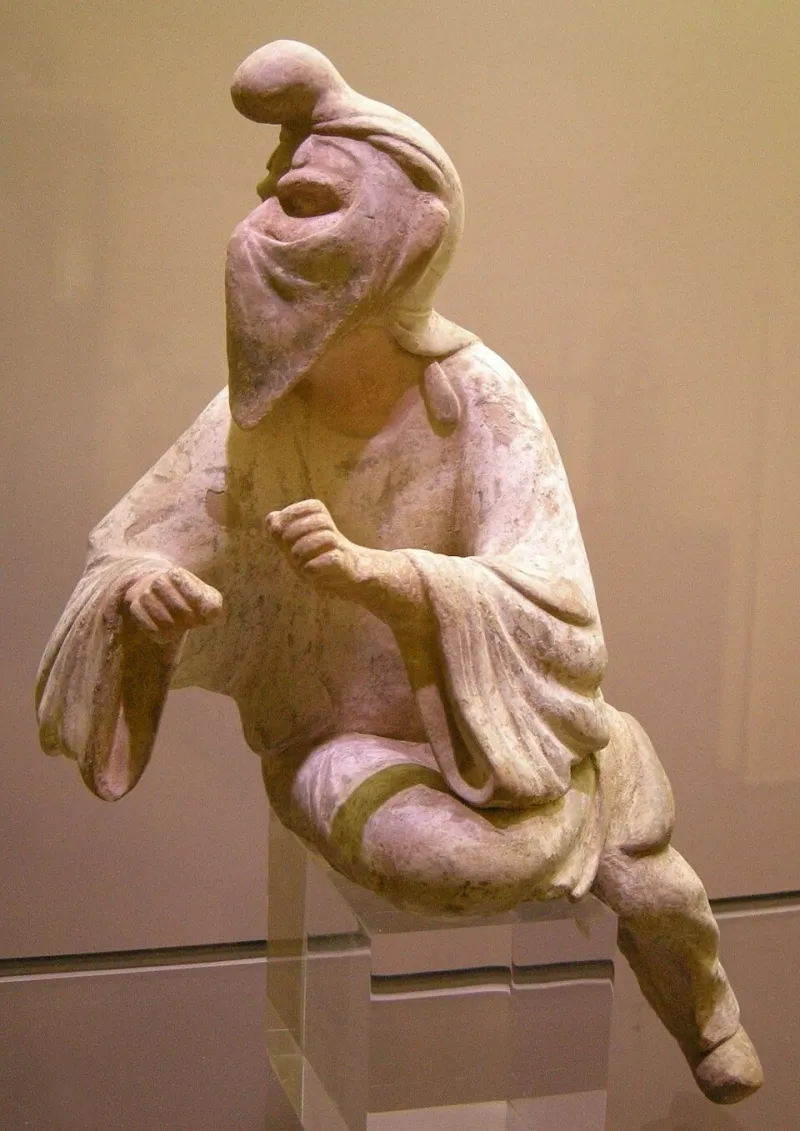
The Ming dynasty's founder, the Hongwu Emperor (r. 1368–1398), attempted to create a society of self-sufficient rural communities ordered in a rigid, immobile system that would guarantee and support a permanent class of soldiers for his dynasty: the empire's standing army exceeded one million troops and the navy's dockyards in Nanjing were the largest in the world.
He also took great care breaking the power of the court eunuchs and unrelated magnates, enfeoffing his many sons throughout China and attempting to guide these princes through the Huang-Ming Zuxun, a set of published dynastic instructions. This failed when his teenage successor, the Jianwen Emperor, attempted to curtail his uncle's power, prompting the Jingnan campaign, an uprising that placed the Prince of Yan upon the throne as the Yongle Emperor in 1402.
The Yongle Emperor established Yan as a secondary capital and renamed it Beijing, constructed the Forbidden City, and restored the Grand Canal and the primacy of the imperial examinations in official appointments. He rewarded his eunuch supporters and employed them as a counterweight against the Confucian scholar-bureaucrats.
One eunuch, Zheng He, led seven enormous voyages of exploration into the Indian Ocean as far as Arabia and the eastern coasts of Africa. Hongwu and Yongle emperors had also expanded the empire's rule into Inner Asia.
The rise of new emperors and new factions diminished such extravagances; the capture of the Emperor Yingzong of Ming during the 1449 Tumu Crisis ended them completely. The imperial navy was allowed to fall into disrepair while forced labor constructed the Liaodong palisade and connected and fortified the Great Wall into its modern form.
Wide-ranging censuses of the entire empire were conducted decennially, but the desire to avoid labor and taxes and the difficulty of storing and reviewing the enormous archives at Nanjing hampered accurate figures. Estimates for the late-Ming population vary from 160 to 200 million, but necessary revenues were squeezed out of smaller and smaller numbers of farmers as more disappeared from the official records or "donated" their lands to tax-exempt eunuchs or temples. Haijin laws intended to protect the coasts from Japanese pirates instead turned many into smugglers and pirates themselves.
By the 16th century, the expansion of European trade—though restricted to islands near Guangzhou such as Macau—spread the Columbian exchange of crops, plants, and animals into China, introducing chili peppers to Sichuan cuisine and highly productive maize and potatoes, which diminished famines and spurred population growth.
The growth of Portuguese, Spanish, and Dutch trade created new demand for Chinese products and produced a massive influx of South American silver. This abundance of specie re-monetized the Ming economy, whose paper money had suffered repeated hyperinflation and was no longer trusted. While traditional Confucians opposed such a prominent role for commerce and the newly rich it created, the heterodoxy introduced by Wang Yangming permitted a more accommodating attitude.
Zhang Juzheng's initially successful reforms proved devastating when a slowdown in agriculture was produced by the Little Ice Age. The value of silver rapidly increased because of a disruption in the supply of imported silver from Spanish and Portuguese sources, making it impossible for Chinese farmers to pay their taxes.
Combined with crop failure, floods, and an epidemic, the dynasty collapsed in 1644 as Li Zicheng's rebel forces entered Beijing. Li then established the Shun dynasty, but it was defeated shortly afterwards by the Manchu-led Eight Banner armies of the Qing dynasty, with the help of the defecting Ming general Wu Sangui.
History
Founding
Revolt and rebel rivalry
The Mongol-led Yuan dynasty (1271–1368) ruled before the establishment of the Ming. Explanations for the demise of the Yuan include institutionalized ethnic discrimination against the Han people that stirred resentment and rebellion, overtaxation of areas hard-hit by inflation, and massive flooding of the Yellow River as a result of the abandonment of irrigation projects.
Consequently, agriculture and the economy were in shambles, and rebellion broke out among the hundreds of thousands of peasants called upon to work on repairing the levees of the Yellow River. A number of Han groups revolted, including the Red Turbans in 1351. The Red Turbans were affiliated with the White Lotus, a Buddhist secret society.
Zhu Yuanzhang was a penniless peasant and Buddhist monk who joined the Red Turbans in 1352; he soon gained a reputation after marrying the foster daughter of a rebel commander. In 1356, Zhu's rebel force captured the city of Nanjing, which he would later establish as the capital of the Ming dynasty.
With the Yuan dynasty crumbling, competing rebel groups began fighting for control of the country and thus the right to establish a new dynasty. In 1363, Zhu Yuanzhang eliminated his archrival and leader of the rebel Han faction, Chen Youliang, in the Battle of Lake Poyang, arguably the largest naval battle in history.
Known for its ambitious use of fire ships, Zhu's force of 200,000 Ming sailors were able to defeat a Han rebel force over triple their size, claimed to be 650,000-strong. The victory destroyed the last opposing rebel faction, leaving Zhu Yuanzhang in uncontested control of the bountiful Yangtze valley and cementing his power in the south.
After the dynastic head of the Red Turbans suspiciously died in 1367 while a guest of Zhu, there was no one left who was remotely capable of contesting his march to the throne, and he made his imperial ambitions known by sending an army toward the Yuan capital Dadu (present-day Beijing) in 1368. The last Yuan emperor fled north to the upper capital Shangdu, and Zhu declared the founding of the Ming dynasty after razing the Yuan palaces in Dadu to the ground; the city was renamed Beiping in the same year. Zhu Yuanzhang took Hongwu, or "Vastly Martial", as his era name.
Reign of the Hongwu Emperor
The Hongwu Emperor made an immediate effort to rebuild state infrastructure. He built a 48-kilometre-long (30 mi) wall around Nanjing, as well as new palaces and government halls. The History of Ming—the official dynastic history compiled in 1739 by the subsequent Qing dynasty (1644–1912)—states that as early as 1364 Zhu Yuanzhang had begun drafting a new Confucian law code, the Great Ming Code, which was completed by 1397 and repeated certain clauses found in the old Tang Code of 653.
The Hongwu Emperor organized a military system known as the weisuo, which was similar to the fubing system of the Tang dynasty (618–907).
In 1380 the Hongwu Emperor had the Chancellor Hu Weiyong executed upon suspicion of a conspiracy plot to overthrow him; after that the Hongwu Emperor abolished the Chancellery and assumed this role as chief executive and emperor, a precedent mostly followed throughout the Ming period. With a growing suspicion of his ministers and subjects, the Hongwu Emperor established the Embroidered Uniform Guard, a network of secret police drawn from his own palace guard. Some 100,000 people were executed in a series of purges during his rule.
The Hongwu Emperor issued many edicts forbidding Mongol practices and proclaiming his intention to purify China of barbarian influence. However, he also sought to use the Yuan legacy to legitimize his authority in China and other areas ruled by the Yuan. He continued policies of the Yuan dynasty such as continued request for Korean concubines and eunuchs, Mongol-style hereditary military institutions, Mongol-style clothing and hats, promoting archery and horseback riding, and having large numbers of Mongols serve in the Ming military.
Until the late 16th century, Mongols still constituted one-third of officers serving in capital forces like the Embroidered Uniform Guard, and other peoples such as Jurchens were also prominent. He frequently wrote to Mongol, Japanese, Korean, Jurchen, Tibetan, and Southwest frontier rulers offering advice on their governmental and dynastic policy, and insisted on leaders from these regions visiting the Ming capital for audiences.
He resettled 100,000 Mongols into his territory, with many serving as guards in the capital. The emperor also strongly advertised the hospitality and role granted to Chinggisid nobles in his court.
The Hongwu Emperor insisted that he was not a rebel, and he attempted to justify his conquest of the other rebel warlords by claiming that he was a Yuan subject and had been divinely-appointed to restore order by crushing rebels. Most Chinese elites did not view the Yuan's Mongol ethnicity as grounds to resist or reject it.
The Hongwu Emperor emphasised that he was not conquering territory from the Yuan dynasty but rather from the rebel warlords. He used this line of argument to attempt to persuade Yuan loyalists to join his cause. The Ming used the tribute they received from former Yuan vassals as proof that the Ming had taken over the Yuan's legitimacy. Tribute missions were regularly celebrated with music and dance in the Ming court.
South-Western frontier
In 1381, the Ming dynasty annexed the areas of the southwest that had once been part of the Kingdom of Dali following the successful effort by Hui Muslim Ming armies to defeat Mongol and Hui Muslim troops loyal to the Yuan holding out in Yunnan. The Hui troops under General Mu Ying, who was appointed Governor of Yunnan, were resettled in the region as part of a colonization effort.
By the end of the 14th century, some 200,000 military colonists settled some 2,000,000 mu (350,000 acres) of land in what is now Yunnan and Guizhou. Roughly half a million more Chinese settlers came in later periods; these migrations caused a major shift in the ethnic make-up of the region, since formerly more than half of the population were non-Han peoples.
Resentment over such massive changes in population and the resulting government presence and policies sparked more Miao and Yao revolts in 1464 to 1466, which were crushed by an army of 30,000 Ming troops (including 1,000 Mongols) joining the 160,000 local Guangxi. After the scholar and philosopher Wang Yangming (1472–1529) suppressed another rebellion in the region, he advocated single, unitary administration of Chinese and indigenous ethnic groups in order to bring about sinicisation of the local peoples.
Campaign in the North-East
After the overthrow of the Yuan dynasty in 1368, Manchuria remained under control of the Northern Yuan based in Mongolia. Naghachu, a former Yuan official and a Uriankhai general of the Northern Yuan, won hegemony over the Mongol tribes in Manchuria (the former Yuan province of Liaoyang). He grew strong in the northeast, with forces large enough (numbering hundreds of thousands) to threaten invasion of the newly founded Ming dynasty in order to restore the Mongols to power in China.
The Ming decided to defeat him instead of waiting for the Mongols to attack. In 1387 the Ming sent a military campaign to attack Naghachu, which concluded with the surrender of Naghachu and Ming conquest of Manchuria.
The early Ming court could not, and did not, aspire to the control imposed upon the Jurchens in Manchuria by the Mongols, yet it created a norm of organization that would ultimately serve as the main instrument for the relations with peoples along the northeast frontiers. By the end of the Hongwu Emperor's reign, the essentials of a policy toward the Jurchens had taken shape.
Most of the inhabitants of Manchuria, except for the Wild Jurchens, were at peace with China. In 1409, under the Yongle Emperor, the Ming established the Nurgan Regional Military Commission on the banks of the Amur River, and Yishiha, a eunuch of Haixi Jurchen origin, was ordered to lead an expedition to the mouth of the Amur to pacify the Wild Jurchens.
After the death of Yongle Emperor, the Nurgan Regional Military Commission was abolished in 1435, and the Ming court ceased to have substantial activities there, although the guards continued to exist in Manchuria. Throughout its existence, the Ming established a total of 384 guards (衛, wei) and 24 battalions (所, suo) in Manchuria, but these were probably only nominal offices and did not necessarily imply political control. By the late Ming period, Ming's political presence in Manchuria has declined significantly.
Relations with Tibet
The History of Ming states that the Ming established itinerant commanderies overseeing Tibetan administration while also renewing titles of ex-Yuan dynasty officials from Tibet and conferring new princely titles on leaders of Tibetan Buddhist sects. However, Turrell V. Wylie states that censorship in the History of Ming in favor of bolstering the Ming emperor's prestige and reputation at all costs obfuscates the nuanced history of Sino-Tibetan relations during the Ming era.
Modern scholars debate whether the Ming had sovereignty over Tibet. Some believe it was a relationship of loose suzerainty that was largely cut off when the Jiajing Emperor (r. 1521–1567) persecuted Buddhism in favor of Taoism at court. Others argue that the significant religious nature of the relationship with Tibetan lamas is underrepresented in modern scholarship. Others note the Ming need for Central Asian horses and the need to maintain the tea-horse trade.
The Ming sporadically sent armed forays into Tibet during the 14th century, which the Tibetans successfully resisted. Several scholars point out that unlike the preceding Mongols, the Ming did not garrison permanent troops in Tibet. The Wanli Emperor (r. 1572–1620) attempted to reestablish Sino-Tibetan relations in the wake of a Mongol–Tibetan alliance initiated in 1578, an alliance which affected the foreign policy of the subsequent Qing dynasty in their support for the Dalai Lama of the Yellow Hat sect.
By the late 16th century, the Mongols proved to be successful armed protectors of the Yellow Hat Dalai Lama after their increasing presence in the Amdo region, culminating in the conquest of Tibet by Güshi Khan (1582–1655) in 1642, establishing the Khoshut Khanate.
Reign of the Yongle Emperor
Rise to power
The Hongwu Emperor specified his grandson Zhu Yunwen as his successor, and he assumed the throne as the Jianwen Emperor (r. 1398–1402) after the Hongwu Emperor's death in 1398. The Jianwen Emperor's uncle Zhu Di, the most powerful of the Hongwu Emperor's sons, opposed his ascension and soon came into conflict with the young emperor.
After the Jianwen Emperor arrested many of Zhu Di's associates, Zhu Di plotted a rebellion that sparked a three-year civil war. Under the pretext of rescuing the Jianwen Emperor from corrupting officials, Zhu Di personally led forces in the revolt; the palace in Nanjing was burned to the ground, along with the Jianwen Emperor himself, his wife, mother, and courtiers.
Zhu Di assumed the throne as the Yongle Emperor (r. 1402–1424); his reign is universally viewed by scholars as a "second founding" of the Ming dynasty since he reversed many of his father's policies.
New capital and foreign engagement
The Yongle Emperor demoted Nanjing to a secondary capital and in 1403 announced the new capital of China was to be at his power base in Beijing. Construction of a new city there lasted from 1407 to 1420, employing hundreds of thousands of workers daily. At the center was the political node of the Imperial City, and at the center of this was the Forbidden City, the palatial residence of the emperor and his family.
By 1553, the Outer City was added to the south, which brought the overall size of Beijing to 6.5 by 7 kilometres (4 by 4+1⁄2 miles).
Beginning in 1405, the Yongle Emperor entrusted his favored eunuch commander Zheng He (1371–1433) as the admiral for a gigantic new fleet of ships designated for international tributary missions. Among the kingdoms visited by Zheng He, the Yongle Emperor proclaimed the Kingdom of Cochin to be its protectorate. The Chinese had sent diplomatic missions over land since the Han dynasty (202 BCE – 220 CE) and engaged in private overseas trade, but these missions were unprecedented in grandeur and scale.
To service seven different tributary voyages, the Nanjing shipyards constructed two thousand vessels from 1403 to 1419, including treasure ships measuring 112 to 134 m (367 to 440 ft) in length and 45 to 54 m (148 to 177 ft) in width.
The Yongle Emperor used woodblock printing to spread Chinese culture. He also used the military to expand China's borders. This included the brief occupation of Vietnam, from the initial invasion in 1406 until the Ming withdrawal in 1427 as a result of protracted guerrilla warfare led by Lê Lợi, the founder of the Vietnamese Lê dynasty.
Tumu Crisis and the Ming Mongols
The Oirat leader Esen Tayisi launched an invasion into Ming China in July 1449. The chief eunuch Wang Zhen encouraged the Zhengtong Emperor (r. 1435–1449) to lead a force personally to face the Oirats after a recent Ming defeat; the emperor left the capital and put his half-brother Zhu Qiyu in charge of affairs as temporary regent.
On 8 September, Esen routed Zhengtong's army, and Zhengtong was captured—an event known as the Tumu Crisis. The Oirats held the Zhengtong Emperor for ransom. However, this scheme was foiled once the emperor's younger brother assumed the throne under the era name Jingtai (r. 1449–1457); the Oirats were also repelled once the Jingtai Emperor's confidant and defense minister Yu Qian (1398–1457) gained control of the Ming armed forces.
Holding the Zhengtong Emperor in captivity was a useless bargaining chip for the Oirats as long as another sat on his throne, so they released him back into Ming China. The former emperor was placed under house arrest in the palace until the coup against the Jingtai Emperor in 1457 known as the "Wresting the Gate Incident". The former emperor retook the throne under the new era name Tianshun (r. 1457–1464).
Tianshun proved to be a troubled time and Mongol forces within the Ming military structure continued to be problematic. On 7 August 1461, the Chinese general Cao Qin and his Ming troops of Mongol descent staged a coup against the Tianshun Emperor out of fear of being next on his purge-list of those who aided him in the Wresting the Gate Incident.
Cao's rebel force managed to set fire to the western and eastern gates of the Imperial City (doused by rain during the battle) and killed several leading ministers before his forces were finally cornered and he was forced to commit suicide.
While the Yongle Emperor had staged five major offensives north of the Great Wall against the Mongols and the Oirats, the constant threat of Oirat incursions prompted the Ming authorities to fortify the Great Wall from the late 15th century to the 16th century; nevertheless, John Fairbank notes that "it proved to be a futile military gesture but vividly expressed China's siege mentality." Yet the Great Wall was not meant to be a purely defensive fortification; its towers functioned rather as a series of lit beacons and signalling stations to allow rapid warning to friendly units of advancing enemy troops.
Decline
Reign of the Wanli Emperor
The reign of the Wanli Emperor (1572–1620) featured many problems, some of them fiscal in nature. In the beginning of his reign, Wanli surrounded himself with able advisors and made a conscientious effort to handle state affairs. His Grand Secretary Zhang Juzheng (1572–1582) built up an effective network of alliances with senior officials.
However, there was no one after him skilled enough to maintain the stability of these alliances; officials soon banded together in opposing political factions. Over time Wanli grew tired of court affairs and frequent political quarreling amongst his ministers, preferring to stay behind the walls of the Forbidden City and out of his officials' sight.
Scholar-officials lost prominence in administration as eunuchs became intermediaries between the aloof emperor and his officials; any senior official who wanted to discuss state matters had to persuade powerful eunuchs with a bribe simply to have his demands or message relayed to the emperor. There were several military campaigns during the Wanli Emperor's reign, Ordos campaign, the response to the Bozhou rebellion, and the Imjin War.
Role of eunuchs
The Hongwu Emperor forbade eunuchs to learn how to read or engage in politics. Whether or not these restrictions were carried out with absolute success in his reign, eunuchs during the Yongle Emperor's reign (1402–1424) and afterwards managed huge imperial workshops, commanded armies, and participated in matters of appointment and promotion of officials.
The Yongle Emperor put 75 eunuchs in charge of foreign policy; they traveled frequently to vassal states including Annam, Mongolia, the Ryukyu Islands, and Tibet and less frequently to farther-flung places like Japan and Nepal. In the later 15th century, however, eunuch envoys generally only traveled to Korea.
The eunuchs developed their own bureaucracy that was organized parallel to but was not subject to the civil service bureaucracy. Although there were several dictatorial eunuchs throughout the Ming, such as Wang Zhen, Wang Zhi, and Liu Jin, excessive tyrannical eunuch power did not become evident until the 1590s when the Wanli Emperor increased their rights over the civil bureaucracy and granted them power to collect provincial taxes.
The eunuch Wei Zhongxian (1568–1627) dominated the court of the Tianqi Emperor (r. 1620–1627) and had his political rivals tortured to death, mostly the vocal critics from the faction of the Donglin Society. He ordered temples built in his honor throughout the Ming Empire, and built personal palaces created with funds allocated for building the previous emperor's tombs.
His friends and family gained important positions without qualifications. Wei also published a historical work lambasting and belittling his political opponents. Constant changes at court became the norm, and there was also an intensification of natural disasters, epidemics, rebellions, and foreign invasions. Although the Chongzhen Emperor (r. 1627–1644) dismissed Wei, who later committed suicide, problems involving palace eunuchs persisted until the fall of the dynasty, which occurred less than twenty years later.