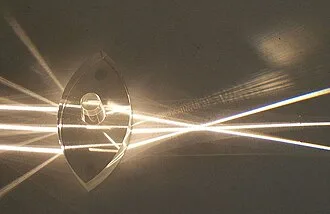
A mirror is a wave reflector. Light consists of waves, and when light waves reflect from the flat surface of a mirror, those waves retain the same degree of curvature and vergence, in an equal yet opposite direction, as the original waves. This allows the waves to form an image when they are focused through a lens, just as if the waves had originated from the direction of the mirror.
The light can also be pictured as rays (imaginary lines radiating from the light source, that are always perpendicular to the waves). These rays are reflected at an equal yet opposite angle from which they strike the mirror (incident light). This property, called specular reflection, distinguishes a mirror from objects that diffuse light, breaking up the wave and scattering it in many directions (such as flat-white paint).
Thus, a mirror can be any surface in which the texture or roughness of the surface is smaller (smoother) than the wavelength of the waves.
When looking at a mirror, one will see a mirror image or reflected image of objects in the environment, formed by light emitted or scattered by them and reflected by the mirror towards one's eyes. This effect gives the illusion that those objects are behind the mirror, or (sometimes) in front of it. When the surface is not flat, a mirror may behave like a reflecting lens.
A plane mirror yields a real-looking undistorted image, while a curved mirror may distort, magnify, or reduce the image in various ways, while keeping the lines, contrast, sharpness, colors, and other image properties intact.
A mirror is commonly used for inspecting oneself, such as during personal grooming; hence the old-fashioned name "looking glass". This use, which dates from prehistory, overlaps with uses in decoration and architecture. Mirrors are also used to view other items that are not directly visible because of obstructions; examples include rear-view mirrors in vehicles, security mirrors in or around buildings, and dentist's mirrors.
Mirrors are also used in optical and scientific apparatus such as telescopes, lasers, cameras, periscopes, and industrial machinery.
According to superstitions breaking a mirror is said to bring seven years of bad luck.
The terms "mirror" and "reflector" can be used for objects that reflect any other types of waves. An acoustic mirror reflects sound waves. Objects such as walls, ceilings, or natural rock-formations may produce echos, and this tendency often becomes a problem in acoustical engineering when designing houses, auditoriums, or recording studios.
Acoustic mirrors may be used for applications such as parabolic microphones, atmospheric studies, sonar, and seafloor mapping. An atomic mirror reflects matter waves and can be used for atomic interferometry and atomic holography.
History
Prehistory
The first mirrors used by humans were most likely pools of still water, or shiny stones. The requirements for making a good mirror are a surface with a very high degree of flatness (preferably but not necessarily with high reflectivity), and a surface roughness smaller than the wavelength of the light.
The earliest manufactured mirrors were pieces of polished stone such as obsidian, a naturally occurring volcanic glass. Examples of obsidian mirrors found at Çatalhöyük in Anatolia (modern-day Turkey) have been dated to around 6000 BCE. Mirrors of polished copper were crafted in Mesopotamia from 4000 BCE, and in ancient Egypt from around 3000 BCE. Polished stone mirrors from Central and South America date from around 2000 BCE onwards.
Bronze Age to Early Middle Ages
By the Bronze Age most cultures were using mirrors made from polished discs of bronze, copper, silver, or other metals. The people of Kerma in Nubia were skilled in the manufacturing of mirrors. Remains of their bronze kilns have been found within the temple of Kerma. In China, bronze mirrors were manufactured from around 2000 BC, some of the earliest bronze and copper examples being produced by the Qijia culture.
Such metal mirrors remained the norm through to Greco-Roman Antiquity and throughout the Middle Ages in Europe. During the Roman Empire silver mirrors were in wide use by servants.
Speculum metal is a highly reflective alloy of copper and tin that was used for mirrors until a couple of centuries ago.[when?][vague] Up until the mid-19th century, many astronomical telescopes used speculum metal mirrors.
Isaac Newton's reflecting telescope of 1668 used speculum metal, as did Australia's Great Melbourne Telescope, installed in 1869. Speculum metal mirrors may have originated in China and India. Mirrors of speculum metal or any precious metal were hard to produce and were only owned by the wealthy.
Common metal mirrors tarnished and required frequent polishing. Bronze mirrors had low reflectivity and poor color rendering, and stone mirrors were much worse in this regard. These defects explain the New Testament reference in 1 Corinthians 13 to seeing "as in a mirror, darkly."
The Greek philosopher Socrates urged young people to look at themselves in mirrors so that, if they were beautiful, they would become worthy of their beauty, and if they were ugly, they would know how to hide their disgrace through learning.
Glass began to be used for mirrors in the 1st century CE, with the development of soda–lime glass and glass blowing. The Roman scholar Pliny the Elder claims that artisans in Sidon (modern-day Lebanon) were producing glass mirrors coated with lead or gold leaf in the back. The metal provided good reflectivity, and the glass provided a smooth surface and protected the metal from scratches and tarnishing. However, there is no archeological evidence of glass mirrors before the third century.
These early glass mirrors were made by blowing a glass bubble, and then cutting off a small circular section from 10 to 20 cm in diameter. Their surface was either concave or convex, and imperfections tended to distort the image. Lead-coated mirrors were very thin to prevent cracking by the heat of the molten metal. Due to the poor quality, high cost, and small size of glass mirrors, solid-metal mirrors (primarily of steel) remained in common use until the late nineteenth century.
Silver-coated metal mirrors were developed in China as early as 500 CE. The bare metal was coated with an amalgam, then heated until the mercury boiled away.
Middle Ages and Renaissance
The evolution of glass mirrors in the Middle Ages followed improvements in glassmaking technology. Glassmakers in France made flat glass plates by blowing glass bubbles, spinning them rapidly to flatten them, and cutting rectangles out of them. A better method, developed in Germany and perfected in Venice by the 16th century, was to blow a cylinder of glass, cut off the ends, slice it along its length, and unroll it onto a flat hot plate.
Venetian glassmakers also adopted lead glass for mirrors, because of its crystal-clarity and its easier workability.
During the early European Renaissance, a fire-gilding technique developed to produce an even and highly reflective tin coating for glass mirrors. The back of the glass was coated with a tin–mercury amalgam, and the mercury was then evaporated by heating the piece. This process caused less thermal shock to the glass than the older molten-lead method.
The date and location of the discovery is unknown, but by the 16th century Venice was a center of mirror production using this technique. These Venetian mirrors were up to 40 inches (100 cm) square.
Venice retained its monopoly on the tin amalgam technique for a century. Venetian mirrors in richly decorated frames served as luxury decorations for palaces throughout Europe, and were very expensive. For example, in the late seventeenth century, the Countess de Fiesque was reported to have traded an entire wheat farm for a mirror, considering it a bargain.
However, by the end of that century the secret was leaked through industrial espionage. French workshops succeeded in large-scale industrialization of the process, eventually making mirrors affordable to the masses, in spite of the toxicity of mercury's vapor.
Industrial Revolution
The invention of the ribbon machine in the late Industrial Revolution allowed modern glass panes to be produced in bulk. The Saint-Gobain factory, founded by royal initiative in France, was an important manufacturer, and Bohemian and German glass, often rather cheaper, was also important.
The invention of the silvered-glass mirror is credited to German chemist Justus von Liebig in 1835. His wet deposition process involved the deposition of a thin layer of metallic silver onto glass through the chemical reduction of silver nitrate. This silvering process was adapted for mass manufacturing and led to the greater availability of affordable mirrors.
Contemporary technologies
Mirrors are often produced by the wet deposition of silver, or sometimes nickel or chromium (the latter used most often in automotive mirrors) via electroplating directly onto the glass substrate.
Glass mirrors for optical instruments are usually produced by vacuum deposition methods. These techniques can be traced to observations in the 1920s and 1930s that metal was being ejected from electrodes in gas discharge lamps and condensed on the glass walls forming a mirror-like coating. The phenomenon, called sputtering, was developed into an industrial metal-coating method with the development of semiconductor technology in the 1970s.
A similar phenomenon had been observed with incandescent light bulbs: the metal in the hot filament would slowly sublimate and condense on the bulb's walls. This phenomenon was developed into the method of evaporation coating by Pohl and Pringsheim in 1912. John D. Strong used evaporation coating to make the first aluminium-coated telescope mirrors in the 1930s. The first dielectric mirror was created in 1937 by Auwarter using evaporated rhodium.
The metal coating of glass mirrors is usually protected from abrasion and corrosion by a layer of paint applied over it. Mirrors for optical instruments often have the metal layer on the front face, so that the light does not have to cross the glass twice. In these mirrors, the metal may be protected by a thin transparent coating of a non-metallic (dielectric) material.
The first metallic mirror to be enhanced with a dielectric coating of silicon dioxide was created by Hass in 1937. In 1939 at the Schott Glass company, Walter Geffcken invented the first dielectric mirrors to use multilayer coatings.
Burning mirrors
The Greek in Classical Antiquity were familiar with the use of mirrors to concentrate light. Parabolic mirrors were described and studied by the mathematician Diocles in his work On Burning Mirrors. Ptolemy conducted a number of experiments with curved polished iron mirrors, and discussed plane, convex spherical, and concave spherical mirrors in his Optics.
Parabolic mirrors were also described by the Caliphate mathematician Ibn Sahl in the tenth century.
Types of mirrors
Mirrors can be classified in many ways; including by shape, support, reflective materials, manufacturing methods, and intended application.
By shape
Typical mirror shapes are planar and curved mirrors.
The surface of curved mirrors is often a part of a sphere. Mirrors that are meant to precisely concentrate parallel rays of light into a point are usually made in the shape of a paraboloid of revolution instead; they are used in telescopes (from radio waves to X-rays), in antennas to communicate with broadcast satellites, and in solar furnaces.
A segmented mirror, consisting of multiple flat or curved mirrors, properly placed and oriented, may be used instead.
Mirrors that are intended to concentrate sunlight onto a long pipe may be a circular cylinder or of a parabolic cylinder.
By structural material
The most common structural material for mirrors is glass, due to its transparency, ease of fabrication, rigidity, hardness, and ability to take a smooth finish.
Back-silvered mirrors
The most common mirrors consist of a plate of transparent glass, with a thin reflective layer on the back (the side opposite to the incident and reflected light) backed by a coating that protects that layer against abrasion, tarnishing, and corrosion. The glass is usually soda–lime glass, but lead glass may be used for decorative effects, and other transparent materials may be used for specific applications.
A plate of transparent plastic may be used instead of glass, for lighter weight or impact resistance. Alternatively, a flexible transparent plastic film may be bonded to the front and/or back surface of the mirror, to prevent injuries in case the mirror is broken. Lettering or decorative designs may be printed on the front face of the glass, or formed on the reflective layer. The front surface may have an anti-reflection coating.
Front-silvered mirrors
Mirrors which are reflective on the front surface (the same side of the incident and reflected light) may be made of any rigid material. The supporting material does not necessarily need to be transparent, but telescope mirrors often use glass anyway. Often a protective transparent coating is added on top of the reflecting layer, to protect it against abrasion, tarnishing, and corrosion, or to absorb certain wavelengths.
Flexible mirrors
Thin flexible plastic mirrors are sometimes used for safety, since they cannot shatter or produce sharp flakes. Their flatness is achieved by stretching them on a rigid frame. These usually consist of a layer of evaporated aluminium between two thin layers of transparent plastic.
By reflective material
In common mirrors, the reflective layer is usually some metal like silver, tin, nickel, or chromium, deposited by a wet process; or aluminium, deposited by sputtering or evaporation in vacuum. The reflective layer may also be made of one or more layers of transparent materials with suitable indices of refraction.
The structural material may be a metal, in which case the reflecting layer may be just the surface of the same. Metal concave dishes are often used to reflect infrared light (such as in space heaters) or microwaves (as in satellite TV antennas). Liquid metal telescopes use a surface of liquid metal such as mercury.
Mirrors that reflect only part of the light, while transmitting some of the rest, can be made with very thin metal layers or suitable combinations of dielectric layers. They are typically used as beamsplitters. A dichroic mirror, in particular, has surface that reflects certain wavelengths of light, while letting other wavelengths pass through.
A cold mirror is a dichroic mirror that efficiently reflects the entire visible light spectrum while transmitting infrared wavelengths. A hot mirror is the opposite: it reflects infrared light while transmitting visible light. Dichroic mirrors are often used as filters to remove undesired components of the light in cameras and measuring instruments.
In X-ray telescopes, the X-rays reflect off a highly precise metal surface at almost grazing angles, and only a small fraction of the rays are reflected. In flying relativistic mirrors conceived for X-ray lasers, the reflecting surface is a spherical shockwave (wake wave) created in a low-density plasma by a very intense laser-pulse, and moving at an extremely high velocity.
Nonlinear optical mirrors
A phase-conjugating mirror uses nonlinear optics to reverse the phase difference between incident beams. Such mirrors may be used, for example, for coherent beam combination. The useful applications are self-guiding of laser beams and correction of atmospheric distortions in imaging systems.