
















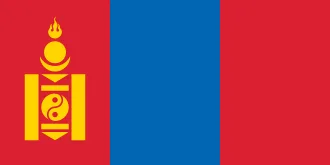
The territory of modern-day Mongolia has been ruled by various nomadic empires, including the Xiongnu, the Xianbei, the Rouran, the First Turkic Khaganate, the Second Turkic Khaganate, the Uyghur Khaganate and others. In 1206, Genghis Khan founded the Mongol Empire, which became the largest contiguous land empire in history.
His grandson Kublai Khan conquered China proper and established the Yuan dynasty. After the collapse of the Yuan, the Mongols retreated to Mongolia and resumed their earlier pattern of factional conflict, except during the era of Dayan Khan and Tumen Zasagt Khan.
In the 16th century, Tibetan Buddhism spread to Mongolia. The Qing dynasty absorbed the country in the 17th century. By the early 20th century, almost one-third of the adult male population were Buddhist monks. After the collapse of the Qing dynasty in 1911, Mongolia declared independence and achieved actual independence from the Republic of China in 1921.
Shortly thereafter, the country became a satellite state of the Soviet Union. In 1924, the Mongolian People's Republic was founded as a socialist state. After the anti-communist revolutions of 1989, Mongolia conducted its own peaceful democratic revolution in 1990. This led to a multi-party system, a new constitution of 1992, and transition to a market economy.
Approximately 30% of the population is nomadic or semi-nomadic; horse culture remains integral. Mahayana Buddhism is the majority religion (51.7%), with the irreligious being the second-largest group (40.6%). Islam is the third-largest religious identification (3.2%), concentrated among ethnic Kazakhs. The vast majority of citizens are ethnic Mongols, with roughly 5% of the population being Kazakhs, Tuvans, and other ethnic minorities, who are especially concentrated in the western regions.
Mongolia is a member of the United Nations, Asia Cooperation Dialogue, G77, Asian Infrastructure Investment Bank, Non-Aligned Movement and a NATO global partner. Mongolia joined the World Trade Organization in 1997 and seeks to expand its participation in regional economic and trade groups.
Etymology
The name Mongolia means the "Land of the Mongols" in Latin. The Mongolian word "Mongol" (монгол) is of uncertain etymology. Sükhbataar (1992) and de la Vaissière (2021) propose it is a derivation from Mugulü, the 4th-century founder of the Rouran Khaganate, first attested as the 'Mungu', (Chinese: 蒙兀, Měngwù, Muwngu), a branch of the Shiwei in an 8th-century Tang dynasty list of northern tribes, presumably related to the Liao-era Mungku (Chinese: 蒙古, Měnggǔ, MuwngkuX).
After the fall of the Liao dynasty in 1125, the Khamag Mongols became a leading tribe on the Mongolian Plateau. However, their wars with the Jurchen-ruled Jin dynasty and the Tatar confederation had weakened them. The last head of the tribe was Yesügei, whose son Temüjin (Genghis Khan) eventually united all the Shiwei tribes as the Mongol Empire (Yekhe Monggol Ulus).
In the 13th century, the word Mongol grew into an umbrella term for a large group of Mongolic-speaking tribes united under the rule of Genghis Khan.
Since the adoption of the Constitution of Mongolia in 1992, the official name of the state is "Mongolia" (Mongol Uls).
History
Prehistory and antiquity
The Khoit Tsenkher Cave in Khovd Province shows lively pink, brown, and red ocher paintings (dated to 20,000 years ago) of mammoths, lynx, bactrian camels, and ostriches, earning it the nickname "the Lascaux of Mongolia". The Venus figurines of Mal'ta (21,000 years ago) testify to the level of Upper Paleolithic art in northern Mongolia; Mal'ta is now part of Russia.
Neolithic agricultural settlements (c. 5500–3500 BC), such as those at Norovlin, Tamsagbulag, Bayanzag, and Rashaan Khad, predate the introduction of horse-riding nomadism, a pivotal event in the history of Mongolia which became the dominant culture. The ethnogenesis of Mongolic peoples is largely linked with the expansion of Ancient Northeast Asians.
The pastoralist lifestyle may in part be derived from the Western Steppe Herders but without much geneflow between these two groups, suggesting cultural transmission.
Horse-riding nomadism has been documented during the Copper and Bronze Age Afanasevo culture (3500–2500 BC); this Indo-European culture was active to the Khangai Mountains in central Mongolia. The wheeled vehicles found in the burials of the Afanasevans have been dated to before 2200 BC. Pastoral nomadism and metalworking became more developed with the Okunev culture (2nd millennium BC), Andronovo culture (2300–1000 BC) and Karasuk culture (1500–300 BC), culminating with the Iron Age Xiongnu Empire in 209 BC.
Monuments of the pre-Xiongnu Bronze Age include deer stones, khirigsuur kurgans, square slab tombs, and rock paintings.
Although cultivation of crops has continued since the Neolithic period, agriculture has always remained small in scale compared to pastoral nomadism. Agriculture may have first been introduced from the west or arose independently in the region. The population during the Copper Age has been described as mongoloid in the east of what is now Mongolia, and as europoid in the west.
Tocharians (Yuezhi) and Scythians inhabited western Mongolia during the Bronze Age. The mummy of a Scythian warrior, which is believed to be about 2,500 years old, was a 30- to 40-year-old man with blond hair; it was found in the Altai Mountains. As equine nomadism was introduced, the political center of the Eurasian Steppe shifted to Mongolia, where it remained until the 18th century.
The intrusions of northern pastoralists (e.g. the Guifang, Shanrong, and Donghu) into China during the Shang dynasty (1600–1046 BC) and Zhou dynasty (1046–256 BC) presaged the age of nomadic empires.[citation needed]
Early states
Since prehistoric times, Mongolia has been inhabited by nomads who, from time to time, formed great confederations that rose to power and prominence. Common institutions were the office of the Khan, the Kurultai (Supreme Council), left and right wings, imperial army (Kheshig) and the decimal military system. The first of these empires, the Xiongnu of undetermined ethnicity, were brought together by Modu Shanyu to form a confederation in 209 BC.
They emerged as the greatest threat to the Qin dynasty, forcing the latter to construct the Great Wall of China. It was guarded by up to almost 300,000 soldiers during Marshal Meng Tian's tenure, as a means of defense against the destructive Xiongnu raids. The vast Xiongnu empire (209 BC–93 AD) was followed by the Mongolic Xianbei empire (93–234), which also ruled more than the entirety of present-day Mongolia.
The Rouran Khaganate (330–555) of Xianbei provenance was the first to use "Khagan" as an imperial title. It ruled a massive empire before being defeated by the Göktürks (555–745), an even larger empire.
The Göktürks laid siege to Panticapaeum, present-day Kerch, in 576. They were succeeded by the Uyghur Khaganate (745–840) who were defeated by the Kyrgyz. The Mongolic Khitans, descendants of the Xianbei, ruled Mongolia during the Liao dynasty (907–1125), after which the Khamag Mongol (1125–1206) rose to prominence.
Lines 3–5 of the memorial inscription of Bilge Khagan (684–737) in central Mongolia summarizes the time of the Khagans:
In battles they subdued the nations of all four sides of the world and suppressed them. They made those who had heads bow their heads, and who had knees genuflect them. In the east up to the Kadyrkhan common people, in the west up to the Iron Gate they conquered... These Khagans were wise. These Khagans were great. Their servants were wise and great too.
Officials were honest and direct with people. They ruled the nation this way. This way they held sway over them. When they died ambassadors from Bokuli Cholug (Baekje Korea), Tabgach (Tang China), Tibet (Tibetan Empire), Avar (Avar Khaganate), Rome (Byzantine Empire), Kirgiz, Uch-Kurykan, Otuz-Tatars, Khitans, Tatabis came to the funerals. So many people came to mourn over the great Khagans. They were famous Khagans.
Mongol Empire and Yuan dynasty
In the chaos of the late 12th century, a chieftain named Temüjin finally succeeded in uniting the Mongol tribes between Manchuria and the Altai Mountains. In 1206, he took the title Genghis Khan and waged a series of military campaigns – renowned for their brutality and ferocity – sweeping through much of Asia and forming the Mongol Empire, the largest contiguous land empire in world history.
Under his successors it stretched from present-day Poland in the west to Korea in the east, and from parts of Siberia in the north to the Gulf of Oman and Vietnam in the south, covering some 33,000,000 square kilometers (13,000,000 sq mi), (22% of Earth's land area) and had a population of over 100 million people (about a quarter of Earth's population at the time). The emergence of Pax Mongolica also significantly eased trade and commerce across Asia during its height.
After Genghis Khan's death, the empire was subdivided into four khanates. These eventually became quasi-independent after the Toluid Civil War (1260–1264), which broke out in a battle for power following Möngke Khan's death in 1259. One of the khanates, the "Great Khanate", consisting of the Mongol homeland and most of modern-day China, became known as the Yuan dynasty under Kublai Khan, the grandson of Genghis Khan.
He set up his capital in present-day Beijing. After more than a century of power, the Yuan dynasty was overthrown by the Ming dynasty in 1368, and the Yuan court fled to the north, thus becoming the Northern Yuan dynasty. As the Ming armies pursued the Mongols into their homeland, they successfully sacked and destroyed the Mongol capital Karakorum and other cities. Some of these attacks were repelled by the Mongols under Ayushridar and his general Köke Temür.
Northern Yuan
After the expulsion of the Yuan rulers from China proper, the Mongols continued to rule their homeland, known in historiography as the Northern Yuan dynasty. With the division of the Mongol tribes, it was subsequently also known as "The Forty and the Four" (Döčin dörben) among them. The next centuries were marked by violent power struggles among various factions, notably the Genghisids and the non-Genghisid Oirats, as well as by several Ming invasions (such as the five expeditions led by the Yongle Emperor).
In the early 16th century, Dayan Khan and his khatun Mandukhai reunited all Mongol groups under the Genghisids. In the mid-16th century, Altan Khan of the Tümed, a grandson of Dayan Khan – but not a hereditary or legitimate khan – became powerful. He founded Hohhot in 1557. After he met with the Dalai Lama in 1578, he ordered the introduction of Tibetan Buddhism to Mongolia. (It was the second time this had occurred.) Abtai Khan of the Khalkha converted to Buddhism and founded the Erdene Zuu Monastery in 1585.
His grandson Zanabazar became the first Jebtsundamba Khutughtu in 1640. Following the leaders, the entire Mongolian population embraced Buddhism. Each family kept scriptures and Buddha statues on an altar at the north side of their yurt. Mongolian nobles donated land, money and herders to the monasteries. As was typical in states with established religions, the top religious institutions, the monasteries, wielded significant temporal power in addition to spiritual power.
The last khagan of the Northern Yuan was Ligden Khan in the early 17th century. He came into conflict with the Manchus over the looting of Chinese cities and alienated most Mongol tribes. After his death in 1634, most Inner Mongolian tribes had submitted to the Manchus by 1636, when they founded the Qing dynasty. The Khalkha followed in 1691, bringing most of present-day Mongolia under Manchu rule as the Khalkha, unable to resist the Dzungars, also submitted in the late 17th century.
After several Dzungar–Qing Wars, the Dzungars were virtually annihilated during the Qing conquest of Dzungaria in 1755 and 1758.
Qing period
Outer Mongolia was given relative autonomy, being administered by the hereditary Genghisid khanates of Tüsheet Khan, Sechen Khan, Zasagt Khan and Sain Noyon. The Jebtsundamba Khutuktu had immense de facto authority. The Manchu forbade mass Chinese immigration into the area, which allowed the Mongols to keep their culture.
The main trade route during this period was the Tea Road through Siberia; it had permanent stations located every 25 to 30 kilometers (16 to 19 mi), each of which was staffed by 5–30 chosen families.[citation needed]
Until 1911, the Qing dynasty maintained control of Mongolia with a series of alliances and intermarriages, as well as military and economic measures. Ambans (Manchu "high officials") were installed in Khüree, Uliastai, and Khovd, and the country was divided into numerous feudal and ecclesiastical fiefdoms (which also placed people in power with loyalty to the Qing).
Over the course of the 19th century, the feudal lords attached more importance to representation and less importance to the responsibilities towards their subjects. The behavior of Mongolia's nobility, together with usurious practices by Chinese traders and the collection of imperial taxes in silver instead of animals, resulted in widespread poverty among the nomads.
By 1911 there were 700 monasteries in Outer Mongolia; their 115,000 monks made up 21% of the population. Apart from the Jebtsundamba Khutuktu, there were 13 other reincarnating high lamas, called 'seal-holding saints' (tamgatai khutuktu), in Outer Mongolia.
Modern history
Bogd Khanate
With the fall of the Qing dynasty in 1911, Mongolia under the Bogd Khaan declared its independence. However, the newly established Republic of China considered Mongolia to be part of its own territory. Yuan Shikai, the president of the Republic of China, considered the republic to be the successor of the Qing. Bogd Khaan said that both Mongolia and China had been administered by the Manchu during the Qing, and after the fall of the Qing dynasty the contract of Mongolian submission to the Manchu had become invalid.
The area controlled by the Bogd Khaan was approximately that of the former Outer Mongolia during the Qing period. In 1919, after the October Revolution in Russia, Chinese troops led by warlord Xu Shuzheng occupied Mongolia. Warfare erupted on the northern border. As a result of the Russian Civil War, the White Russian Lieutenant General Baron Ungern led his troops into Mongolia in October 1920, defeating the Chinese forces in Niislel Khüree (now Ulaanbaatar) in early February 1921 with Mongol support.
To eliminate the threat posed by Ungern, Bolshevik Russia decided to support the establishment of a communist Mongolian government and army. This Mongolian army took the Mongolian part of Kyakhta from Chinese forces on 18 March 1921, and on 6 July Russian and Mongolian troops arrived in Khüree. Mongolia declared its independence again on 11 July 1921. As a result, Mongolia was closely aligned with the Soviet Union over the next seven decades.
Mongolian People's Republic
In 1924, after the Bogd Khaan died, the country's political system was changed. The Mongolian People's Republic was established. In 1928, Khorloogiin Choibalsan rose to power. The early leaders of the Mongolian People's Republic included many with Pan-Mongolist ideals. However, changing global politics and increased Soviet pressure led to the decline of Pan-Mongol aspirations in the following period.
Khorloogiin Choibalsan instituted collectivization of livestock, began the destruction of the Buddhist monasteries, and carried out Stalinist purges, which resulted in the murders of numerous monks and other leaders. During the 1920s, approximately one-third of the male population were monks. By the beginning of the 20th century, 750 monasteries were functioning in Mongolia, and by the end of the 1930s almost all had been looted or razed.
In 1930, the Soviet Union stopped Buryat migration to the Mongolian People's Republic to prevent Mongolian reunification. All leaders of Mongolia who did not fulfill Stalin's demands to perform Red Terror against Mongolians were executed, including Peljidiin Genden and Anandyn Amar. The Stalinist purges in Mongolia, which began in 1937, killed more than 30,000 people.
Under Stalinist influence, an estimated 17,000 monks were killed. Choibalsan died suspiciously in the Soviet Union in 1952. Comintern leader Bohumír Šmeral said, "People of Mongolia are not important, the land is important. Mongolian land is larger than England, France and Germany".[page needed]
After the Japanese invasion of neighboring Manchuria in 1931, Mongolia was threatened on this front. During the Soviet-Japanese Border War of 1939, the Soviet Union successfully defended Mongolia against Japanese expansionism. Mongolia fought against Japan during the Battles of Khalkhin Gol in 1939 and during the Soviet–Japanese War in August 1945 to liberate Inner Mongolia from Japan and Mengjiang.
Cold War
The February 1945 Yalta Conference provided for the Soviet Union's participation in the Pacific War. One of the Soviet conditions for its participation, put forward at Yalta, was that after the war Outer Mongolia would retain its independence. The referendum took place on 20 October 1945, with (according to official numbers) 100% of the electorate voting for independence.