
















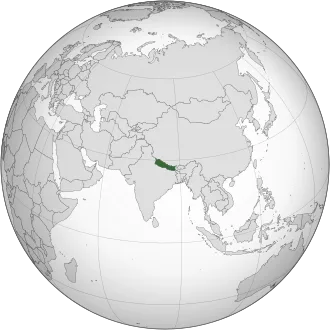
Parts of northern Nepal were intertwined with the culture of Tibet. The centrally located Kathmandu Valley is intertwined with the culture of Indo-Aryans, and was the seat of the prosperous Newar confederacy known as Nepal Mandala. The Himalayan branch of the ancient Silk Road was dominated by the valley's traders. The cosmopolitan region developed distinct traditional art and architecture.
By the 18th century, the Gorkha Kingdom achieved the unification of Nepal. The Shah dynasty established the Kingdom of Nepal and later formed an alliance with the British Empire, under its Rana dynasty of premiers. The country was never colonised but served as a buffer state between Imperial China and British India. Parliamentary democracy was introduced in 1951 but was twice suspended by Nepalese monarchs, in 1960 and 2005.
The Nepalese Civil War in the 1990s and early 2000s resulted in the establishment of a secular republic in 2008, ending the world's last Hindu monarchy. The Constitution of Nepal, adopted in 2015, affirms the country as a federal parliamentary republic divided into seven provinces. In September 2025, protests against economic inequality and corruption caused riots, resulting in casualties and the resignation of the prime minister.
Nepal's foreign policy focuses on neutrality, sovereignty, and multilateral cooperation. Nepal was admitted to the United Nations in 1955, and friendship treaties were signed with India in 1950 and China in 1960. Nepal hosts the permanent secretariat of the South Asian Association for Regional Cooperation (SAARC), of which it is a founding member.
Nepal is also a member of the Non-Aligned Movement and the Bay of Bengal Initiative. Nepal's foreign relations also emphasise development assistance, trade partnerships, and promoting peace and stability in South Asia.
Etymology
Before the unification of Nepal, the Kathmandu Valley was known as Nepal. The precise origin of the term Nepāl is uncertain. Nepal appears in ancient Indian literary texts dated as far back as the fourth century AD. An absolute chronology cannot be established, as even the oldest texts may contain anonymous contributions dating as late as the early modern period.
Academic attempts to provide a plausible theory are hindered by the lack of a complete picture of history and insufficient understanding of linguistics or relevant Indo-European and Tibeto-Burman languages.
According to Hindu mythology, Nepal derives its name from an ancient Hindu sage called Ne, referred to variously as Ne Muni or Nemi. According to Pashupati Purāna, as a place protected by Ne, the country in the heart of the Himalayas came to be known as Nepāl. According to Nepāl Mahātmya, Nemi was charged with protection of the country by Pashupati.
According to Buddhist mythology, Manjushri Bodhisattva drained a primordial lake of serpents to create the Nepal valley and proclaimed that Adi-Buddha Ne would take care of the community that would settle it. As the cherished of Ne, the valley would be called Nepāl. According to Gopalarājvamshāvali, compiled c. 1380s, Nepal is named after Nepa the cowherd, the founder of the Nepali scion of the Abhiras.
In this account, the cow that issued milk to the spot, at which Nepa discovered the Jyotirlinga of Pashupatināth upon investigation, was also named Ne.
The Ne Muni etymology was dismissed by the early European visitors. Norwegian indologist Christian Lassen proposed that Nepāla was a compound of Nipa (foot of a mountain) and -ala (short suffix for alaya meaning abode), and so Nepāla meant "abode at the foot of the mountain".
Indologist Sylvain Levi found Lassen's theory untenable but had no theories of his own, only suggesting that either Newara is a vulgarism of Sanskritic Nepala, or Nepala is Sanskritisation of the local ethnic; his view has found some support though it does not answer the question of etymology. It has also been proposed that Nepa is a Tibeto-Burman stem consisting of ne (cattle) and pa (keeper), reflecting the fact that early inhabitants of the valley were gopalas (cowherds) and mahispalas (buffalo-herds).
Suniti Kumar Chatterji believed Nepal originated from Tibeto-Burman roots – Ne, of uncertain meaning (as multiple possibilities exist), and pala or bal, whose meaning is lost entirely.
History
Prehistory
By 55,000 years ago, the first modern humans had arrived on the Indian subcontinent from Africa. The earliest known modern human remains in South Asia date to about 30,000 years ago. The oldest discovered archaeological evidence of human settlements in Nepal dates to around the same time.
After 6500 BC, evidence for the domestication of food crops and animals, construction of permanent structures, and storage of agricultural surplus appeared in Mehrgarh and other sites in what is now Balochistan. These gradually developed into the Indus Valley Civilisation, the first urban culture in South Asia. Prehistoric sites of palaeolithic, mesolithic and neolithic origins have been discovered in the Siwalik hills of Dang district.
The earliest inhabitants of modern Nepal and adjoining areas are believed to be people from the Indus Valley Civilisation. It is possible that the Dravidian people whose history predates the onset of the Bronze Age in the Indian subcontinent (around 6300 BC) inhabited the area before the arrival of other ethnic groups like the Tibeto-Burmans and Indo-Aryans.
By 4000 BC, the Tibeto-Burmese people had reached Nepal either directly across the Himalayas from Tibet or via Myanmar and north-east India or both. Stella Kramrisch (1964) mentions a substratum of pre-Dravidians and Dravidians, who were in Nepal even before the Newars, who formed the majority of the ancient inhabitants of the valley of Kathmandu.
Ancient
Around 600 BC, small kingdoms and confederations of clans arose in the southern regions of Nepal and northern India. From one of these, the Shakya polity, arose a prince who later renounced his status to lead an ascetic life, and came to be known as Gautama Buddha (traditionally dated 563–483 BC). Nepal came to be established as a land of spirituality and refuge in the intervening centuries, played an important role in transmitting Buddhism to East Asia via Tibet, and helped preserve Hindu and Buddhist manuscripts.
By 250 BC, the southern regions had come under the influence of the Maurya Empire. Mauryan emperor Ashoka made a pilgrimage to Lumbini, the Buddha's birthplace according to Buddhist traditions, and erected a pillar, the inscriptions on which mark the starting point for properly recorded history of Nepal. Ashoka also visited the Kathmandu valley and built monuments commemorating Gautama Buddha's visit there. By the 4th century AD, much of Nepal was under the influence of the Gupta Empire.
In the Kathmandu valley, the Kiratas were pushed eastward by the Licchavis, and the Licchavi dynasty came into power c. 400 AD. The Lichchhavis built monuments and left a series of inscriptions; Nepal's history of the period is pieced together almost entirely from them. In 641, Songtsen Gampo of the Tibetan Empire sends Narendradeva back to Licchavi with an army and subjugates Nepal.
Parts of Nepal and Licchavi was later under the direct influences of the Tibetan empire. The Licchavi dynasty went into decline in the late 8th century and was followed by Thakuri rule. Thakuri kings ruled over the country up to the middle of the 11th century AD; not much is known of this period that is often called the dark period.
Medieval
In the 11th century, a powerful empire of Khas people emerged in western Nepal whose territory at its greatest extent included much of western Nepal as well as parts of western Tibet and Uttarakhand of India. By the 14th century, the empire had splintered into loosely associated Baise rajyas (literally: 22 states).
The rich culture and language of the Khas people spread throughout Nepal and as far as Indo-China in the intervening centuries; their language, later renamed the Nepali language, became the lingua franca of Nepal as well as adjoining regions of India.
In south-eastern Nepal on the border with Bihar, Simraungadh was the capital of the Karnats of Mithila or Tirhut around 1100 AD, and stood as a powerful kingdom for more than 200 years, even ruling over Kathmandu for a time. After another 300 years of Muslim rule, Tirhut came under the control of the Senas of Makwanpur. In the eastern hills, a confederation of Kirat principalities ruled the area between Kathmandu and Bengal.
In the Kathmandu valley, the Mallas, who make several appearances in Nepalese history since ancient times, had established themselves in Kathmandu and Patan by the middle of the 14th century. The Mallas ruled the valley first under the suzerainty of Tirhut but established independent reign by late 14th century as Tirhut went into decline.
In the late 14th century, Jayasthiti Malla introduced widespread socio-economic reforms. By the middle of the 15th century, Kathmandu had become a powerful empire which, according to Kirkpatrick, extended from Digarchi or Shigatse in Tibet to Tirhut and Gaya in India.
In the late 15th century, Malla princes divided their kingdom into four – Kathmandu, Patan and Bhaktapur in the valley and Banepa to the east. The competition for prestige among these brotherly kingdoms saw the flourishing of art and architecture in central Nepal, and the building of famous Kathmandu, Patan and Bhaktapur Durbar Squares; their division and mistrust led to their fall in the late 18th century, and ultimately, the unification of Nepal into a modern state.
Apart from one destructive sacking of Kathmandu valley in the mid 14th century, Nepal remained largely untouched by the Muslim invasion of India that began in the 11th century. The Mughal period saw an influx of high-caste Hindus from India into Nepal. They soon intermingled with the Khas people and by the 16th century, there were about 50 Rajput-ruled principalities in Nepal, including the 22 (Baisi) states and, to their east in west-central Nepal, 24 Chaubisi states.
There emerged a view that Nepal remained the true bastion of unadulterated Hinduism at a time when Indian culture had been influenced by centuries of Mughal, followed by British rule. Gorkha, one of the Baisi states, emerged as an influential and ambitious kingdom with a reputation for justice, after it codified the first Hinduism-based laws in the Nepalese hills.
Kingdom of Nepal (1768–2008)
Unification, expansion and consolidation (1768–1846)
In the mid-18th century, Prithvi Narayan Shah, the king of Gorkha, set out to put together what would become present-day Nepal. He embarked on his mission by securing the neutrality of the bordering mountain kingdoms. After several bloody battles and sieges, notably the Battle of Kirtipur, he managed to conquer the Kathmandu Valley in 1769.
The Gorkha control reached its height when the Kumaon and Garhwal Kingdoms in the west to Sikkim in the east came under Nepalese control. A dispute with Tibet over the control of mountain passes and inner Tingri valleys of Tibet prompted the Qing Emperor of China to start the Sino-Nepali War compelling the Nepali to retreat to their own borders in the north.
The rivalry between the Kingdom of Nepal and the East India Company over the control of states bordering Nepal eventually led to the Anglo-Nepali War (1815–16). At first, the British underestimated the Nepali and were soundly defeated until committing more military resources than they had anticipated needing. Thus began the reputation of Gurkhas as fierce and ruthless soldiers. The war ended in the Sugauli Treaty, under which Nepal ceded recently captured lands.
Rana regime (1846–1951)
Factionalism inside the royal family led to a period of instability. In 1846, a plot was discovered revealing that the reigning queen had planned to overthrow Bir Narsingh Kunwar, a fast-rising military leader. This led to the Kot massacre; armed clashes between military personnel and administrators loyal to the queen led to the execution of several hundred princes and chieftains around the country.
Bir Narsingh Kunwar emerged victoriously and founded the Rana dynasty, and came to be known as Jung Bahadur Rana. The king was made a titular figure, and the post of prime minister was made powerful and hereditary. The Ranas were staunchly pro-British and assisted them during the Indian Rebellion of 1857 (and later in both World Wars).
In 1860 some parts of the western Terai region were gifted to Nepal by the British as a friendly gesture because of its military help to sustain British control in India during the rebellion (known as Naya Muluk, new country). In 1923, the United Kingdom and Nepal formally signed an agreement of friendship that superseded the Sugauli Treaty of 1816.
The Hindu practice of Sati, in which a widow sacrificed herself in the funeral pyre of her husband, was banned in 1919, and slavery was officially abolished in 1924. Rana rule was marked by tyranny, debauchery, economic exploitation and religious persecution.
Absolute monarchy, democratisation and civil war (1951–2008)
By the late 1940s, pro-democracy movements and political parties in Nepal were critical of the Rana autocracy. Following the success of Indian independence movement which Nepalese activists had taken part in, with India's support and cooperation of King Tribhuvan, Nepali Congress was successful in toppling the Rana regime, establishing a parliamentary democracy.
After a decade of power wrangling between the king and the government, King Mahendra (ruled 1955–1972) scrapped the democratic experiment in 1960, and a "partyless" panchayat system was made to govern Nepal. The political parties were banned and politicians imprisoned or exiled. The panchayat rule modernised the country, introducing reforms and developing infrastructure, but curtailed liberties and imposed heavy censorship.
In 1990, the People's Movement forced King Birendra (ruled 1972–2001) to accept constitutional reforms and to establish a multiparty democracy.
In 1996, the Maoist Party started a violent bid to replace the royal parliamentary system with a people's republic. This led to the long Nepalese Civil War and more than 16,000 deaths. With the death of both King Birendra and the Crown Prince Dipendra in a massacre in the royal palace perpetrated by Dipendra, King Birendra's brother Gyanendra inherited the throne in 2001 and subsequently assumed full executive powers aiming to quash the Maoist insurgency himself.
The Maoist Party joined mainstream politics following the success of the peaceful democratic revolution of 2006.
Federal Democratic Republic of Nepal (2008–present)
Nepal became a secular state, and on 28 May 2008, it was declared a federal republic, ending its time-honoured status as the world's only Hindu kingdom. After a decade of instability and internal strife which saw two constituent assembly elections, the new constitution was promulgated on 20 September 2015, making Nepal a federal democratic republic divided into seven provinces.
Between March and June 2025, a half-dozen pro-monarchy protests took place in Kathmandu, in favour of restoring the old Kingdom of Nepal, with the former King Gyanendra as its head.
On 19 February 2025, a public holiday commemorating the 1951 revolution, Gyanendra delivered a video speech which discussed widespread frustrations with the ruling communist government. While he stopped short of explicitly calling for a restoration of the monarchy, the speech's emphasis on unity and sacrifice was interpreted by some as hinting at a possible royal revival.
On 9 March 2025, thousands of supporters welcomed Gyanendra as he arrived in Kathmandu. A spokesperson for the pro-monarchy Rastriya Prajatantra Party stated the turnout "shows how frustrated the people are with the present government, and they are in search of an alternative to the present system."
In September 2025, widespread protests over a social media ban and economic inequality led to rioting that killed or injured dozens of people, damaged Parliament and other buildings, and brought about the resignation of prime minister K. P. Sharma Oli, who fled Kathmandu and sought refuge with the Nepali Army. In response to the crisis, the army assumed control of nationwide security and engaged in talks with protest leaders, who selected former chief justice Sushila Karki as interim prime minister.
On 27 March 2026, Balendra Shah was sworn in as Nepal's prime minister after a landslide victory of his party, Rastriya Swatantra Party (RSP), in the March general election.
Geography
Nepal is of roughly trapezoidal shape, about 800 kilometres (500 mi) long and 200 kilometres (120 mi) wide, with an area of 147,516 km2 (56,956 mi2). It lies between latitudes 26° and 31°N, and longitudes 80° and 89°E. Nepal's defining geological processes began 75 million years ago when the Indian plate, then part of the southern supercontinent Gondwana, began a north-eastward drift caused by seafloor spreading to its south-west, and later, south and south-east.
Simultaneously, the vast Tethyn oceanic crust, to its northeast, began to subduct under the Eurasian Plate. These dual processes, driven by convection in the Earth's mantle, both created the Indian Ocean and caused the Indian continental crust eventually to under-thrust Eurasia and to uplift the Himalayas.
The rising barriers blocked the paths of rivers creating large lakes, which only broke through as late as 100,000 years ago, creating fertile valleys in the middle hills like the Kathmandu Valley. In the western region, rivers which were too strong to be hampered, cut some of the world's deepest gorges. Immediately south of the emerging Himalayas, plate movement created a vast trough that rapidly filled with river-borne sediment and now constitutes the Indo-Gangetic Plain.
Nepal lies almost completely within this collision zone, occupying the central sector of the Himalayan arc, nearly one-third of the 2,400 km (1,500 mi)-long Himalayas, with a small strip of southernmost Nepal stretching into the Indo-Gangetic plain and two districts in the northwest stretching up to the Tibetan plateau.