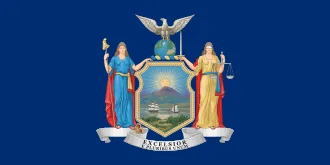
New York has a varied geography. The southeastern part of the state, known as Downstate, encompasses New York City, the most populous city in the United States; Long Island, with approximately 40% of the state's population, the nation's most populous island; and the cities, suburbs, and wealthy enclaves of the lower Hudson Valley.
These areas are the center of the expansive New York metropolitan area and account for approximately two-thirds of the state's population. The larger Upstate area spreads from the Great Lakes to Lake Champlain and includes the Adirondack Mountains and the Catskill Mountains (part of the wider Appalachian Mountains). The east–west Mohawk River Valley bisects the more mountainous regions of Upstate and flows into the north–south Hudson River valley near the state capital of Albany.
Western New York, which is sometimes considered to be a separate region from the Upstate, is home to the cities of Buffalo and Rochester, and is part of the Great Lakes region, bordering Lake Ontario and Lake Erie. Central New York is anchored by the city of Syracuse; between the central and western parts of the state, the Finger Lakes are a prominent landmark and tourist destination.
To the south, along the state border with Pennsylvania, the Southern Tier sits atop the Allegheny Plateau, representing some of the northernmost reaches of Appalachia.
New York was one of the original Thirteen Colonies that went on to form the United States. The area of present-day New York had been inhabited by tribes of the Algonquians and the Haudenosaunee Native Americans for several thousand years by the time the earliest Europeans arrived. Stemming from Henry Hudson's expedition in 1609, the Dutch established the multiethnic colony of New Netherland in 1621.
England seized the colony from the Dutch in 1664, renaming it the Province of New York. Upstate New York was fought over between the British and the French during the French and Indian War from 1754 to 1763. During the American Revolutionary War, a group of colonists eventually succeeded in establishing independence, and the state ratified the then new United States Constitution in 1788.
From the early 19th century, New York's development of its interior, beginning with the construction of the Erie Canal, gave it incomparable advantages over other regions of the United States. The state built its political, cultural, and economic ascendancy over the next century, earning it the nickname of the "Empire State".
Although deindustrialization eroded a portion of the state's economy in the second half of the 20th century, New York in the 21st century continues to be considered as a global node of creativity and entrepreneurship, social tolerance, and environmental sustainability.
The state attracts visitors from all over the globe, with the highest count of any U.S. state in 2022. Many of its landmarks are well known, including four of the world's ten most-visited tourist attractions in 2013: Times Square, Central Park, Niagara Falls, and Grand Central Terminal. New York is home to approximately 200 colleges and universities, including Ivy League members Columbia University and Cornell University, and the expansive State University of New York, which is among the largest university systems in the nation.
New York City is home to the headquarters of the United Nations, and it is sometimes described as the world's most important city, the cultural, financial, and media epicenter, and the capital of the world.
History
Native American history
The Native American tribes in what is now New York were predominantly Haudenosaunee and Algonquian. Long Island was divided roughly in half between the Algonquian Wampanoag and Lenape peoples. The Lenape also controlled most of the region surrounding New York Harbor. North of the Lenape was a third Algonquian nation, the Mohicans.
Starting north of them, from east to west, were two Iroquoian nations: the Mohawk—part of the original Five Nations of the Haudenosaunee, and the Petun. South of them, divided roughly along Appalachia, were the Susquehannock and the Erie.
Many of the Wampanoag and Mohican peoples were caught up in King Philip's War, a joint effort of many New England tribes to push Europeans off their land. After the death of their leader, Chief Philip Metacomet, most of those peoples fled inland, splitting into the Abenaki and the Schaghticoke. Many of the Mohicans remained in the region until the 1800s, however, a small group known as the Ouabano migrated southwest into West Virginia at an earlier time. They may have merged with the Shawnee.
The Mohawk and Susquehannock were the most militaristic. Trying to corner trade with the Europeans, they targeted other tribes. The Mohawk were also known for refusing European settlement on their land and discriminating against any of their people who converted to Christianity. They posed a major threat to the Abenaki and Mohicans, while the Susquehannock briefly conquered the Lenape in the 1600s. The most devastating event of the century, however, was the Beaver Wars.
From approximately 1640–1680, the Haudenosaunee peoples waged campaigns which extended from modern-day Michigan to Virginia against Algonquian and Siouan tribes, as well as each other. The aim was to control more land for animal trapping, a career most natives had turned to in hopes of trading with Europeans first. This completely changed the ethnography of the region, and most large game was hunted out before Europeans ever fully explored the land.
Still, afterward, the Haudenosaunee Confederacy offered shelter to refugees of the Mascouten, Erie, Chonnonton, Tutelo, Saponi, and Tuscarora nations. The Tuscarora became the sixth nation of the Haudenosaunee in around 1720.
In the 1700s, the Haudenosaunee would take in the remaining Susquehannock of Pennsylvania after they were decimated in the French and Indian War. Most of these other groups assimilated and eventually ceased to exist as separate tribes. Then, after the American Revolution, a large group of Seneca split off and returned to Ohio, becoming known as the Mingo Seneca.
The current Six Nations of the Haudenosaunee Confederacy include the Seneca, Cayuga, Onondaga, Oneida, Tuscarora and Mohawk. The Haudenosaunee fought for both sides during the Revolutionary War; afterwards many pro-British Haudenosaunee migrated to Canada. Today, the Haudenosaunee still live in several enclaves across New York and Ontario.
Meanwhile, the Lenape formed a close relationship with William Penn. However, upon Penn's death, his sons managed to take over much of their lands and banish them to Ohio. When the U.S. drafted the Indian Removal Act, the Lenape were further moved to Missouri, and the Mohicans were sent to Wisconsin.
In 1778, the United States relocated the Nanticoke from the Delmarva Peninsula to the former Haudenosaunee lands south of Lake Ontario, though they did not stay long. Mostly, they chose to migrate into Canada and merge with the Haudenosaunee, although some moved west and merged with the Lenape.
16th century
In 1524, Giovanni da Verrazzano, an Italian explorer in the service of the French crown, explored the Atlantic coast of North America between the Carolinas and Newfoundland, including New York Harbor and Narragansett Bay. On April 17, 1524, Verrazzano entered New York Bay, by way of the strait now called the Narrows into the northern bay which he named Santa Margherita, in honor of the King of France's sister.
Verrazzano described it as "a vast coastline with a deep delta in which every kind of ship could pass" and he adds: "that it extends inland for a league and opens up to form a beautiful lake. This vast sheet of water swarmed with native boats." He landed on the tip of Manhattan and possibly on the furthest point of Long Island. Verrazzano's stay was interrupted by a storm which pushed him north towards Martha's Vineyard.
In 1540, French traders from New France built a chateau on Castle Island, within present-day Albany; it was abandoned the following year due to flooding. In 1614, the Dutch, under the command of Hendrick Corstiaensen, rebuilt the French chateau, which they called Fort Nassau. Fort Nassau was the first Dutch settlement in North America, and was located along the Hudson River, also within present-day Albany.
The small fort served as a trading post and warehouse. Located on the Hudson River flood plain, the rudimentary fort was washed away by flooding in 1617, and abandoned for good after Fort Orange (New Netherland) was built nearby in 1623.
17th century
Henry Hudson's 1609 voyage marked the beginning of European involvement in the area. Sailing for the Dutch East India Company and looking for a passage to Asia, he entered the Upper New York Bay on September 11 of that year. Word of his findings encouraged Dutch merchants to explore the coast in search of profitable fur trading with local Native American tribes.
During the 17th century, the Dutch established trading posts in the colony of New Netherland to acquire pelts from the Lenape, Haudenosaunee, and other tribes in exchange for European goods. The first of these trading posts were Fort Nassau (1614, near present-day Albany); Fort Orange (1624, on the Hudson River just south of the current city of Albany and created to replace Fort Nassau), developing into settlement Beverwijck (1647), and into what became Albany; Fort Amsterdam (1625, to develop into the town New Amsterdam, which is present-day New York City); and Esopus (1653, now Kingston).
The success of the patroonship of Rensselaerswyck (1630), which surrounded Albany and lasted until the mid-19th century, was also a key factor in the early success of the colony. The English captured the colony during the Second Anglo-Dutch War and governed it as the Province of New York. The city of New York was recaptured by the Dutch in 1673 during the Third Anglo-Dutch War (1672–1674) and renamed New Orange. It was returned to the English under the terms of the Treaty of Westminster a year later.
18th century
French and Indian War
Upstate New York was a battleground between Britain and France during the Seven Years' War. Notable battles include the battles at Fort William Henry and Fort Ticonderoga. At the outbreak of hostilities in 1754, representatives from the 13 colonies met in New York for the Albany Congress to discuss joint defense against the French. It was one of the first times the colonies debated joining together.
American Revolution
The Sons of Liberty were organized in New York City during the 1760s, largely in response to the oppressive Stamp Act passed by the British Parliament in 1765. The Stamp Act Congress met in the city on October 19 of that year, composed of representatives from across the Thirteen Colonies who set the stage for the Continental Congress to follow.
The Stamp Act Congress resulted in the Declaration of Rights and Grievances, which was the first written expression by representatives of the Americans of many of the rights and complaints later expressed in the United States Declaration of Independence. This included the right to representative government. At the same time, given strong commercial, personal and sentimental links to Britain, many New York residents were Loyalists.
The Capture of Fort Ticonderoga provided the cannon and gunpowder necessary to force a British withdrawal from the siege of Boston in 1775.
New York was the only colony not to vote for independence, as the delegates were not authorized to do so. New York then endorsed the Declaration of Independence on July 9, 1776. The New York State Constitution was framed by a convention which assembled at White Plains on July 10, 1776, and after repeated adjournments and changes of location, finished its work at Kingston on Sunday evening, April 20, 1777, when the new constitution drafted by John Jay was adopted with but one dissenting vote.
It was not submitted to the people for ratification. On July 30, 1777, George Clinton was inaugurated as the first Governor of New York at Kingston.
Approximately a third of the battles of the American Revolutionary War took place in New York; the first major one and largest of the entire war was the Battle of Long Island, also known as the Battle of Brooklyn, in August 1776. After their victory, the British occupied present-day New York City, making it their military and political base of operations in North America for the duration of the conflict, and consequently the focus of General George Washington's intelligence network.
On the notorious British prison ships of Wallabout Bay, more American combatants died than were killed in combat in every battle of the war combined. Both sides of combatants lost more soldiers to disease than to outright wounds. The first of two major British armies were captured by the Continental Army at the Battle of Saratoga in 1777, a success that influenced France to ally with the revolutionaries; the state constitution was enacted in 1777. New York became the 11th state to ratify the United States Constitution, on July 26, 1788.
In an attempt to retain their sovereignty and remain an independent nation positioned between the new United States and British North America, four of the Haudenosaunee Nations fought on the side of the British; only the Oneida and their dependents, the Tuscarora, allied themselves with the Americans. In retaliation for attacks on the frontier led by Joseph Brant and Loyalist Mohawk forces, the Sullivan Expedition of 1779 destroyed nearly 50 Haudenosaunee villages, adjacent croplands and winter stores, forcing many refugees to British-held Niagara.
As allies of the British, the Haudenosaunee were forced out of New York, although they had not been part of treaty negotiations. They resettled in Canada after the war and were given land grants by the Crown. In the treaty settlement, the British ceded most Indian lands to the new United States. Because New York made a treaty with the Haudenosaunee without getting Congressional approval, some of the land purchases have been subject to land claim suits since the late 20th century by the federally recognized tribes.
New York put up more than 5 million acres (20,000 km2) of former Haudenosaunee territory for sale in the years after the Revolutionary War, leading to rapid development in Upstate New York. As per the Treaty of Paris, the last vestige of British authority in the former Thirteen Colonies—their troops in New York City—departed in 1783, which was long afterward celebrated as Evacuation Day.
Confederation period and 1790s
New York City was the national capital under the Articles of Confederation and Perpetual Union, the first national government. That organization was found to be inadequate, and prominent New Yorker Alexander Hamilton advocated for a new government that would include an executive, national courts, and the power to tax.
Hamilton led the Annapolis Convention (1786) that called for the Philadelphia Convention, which drafted the United States Constitution, in which he also took part. The new government was to be a strong federal national government to replace the relatively weaker confederation of individual states. Following heated debate, which included the publication of The Federalist Papers as a series of installments in New York City newspapers, New York was the 11th state to ratify the United States Constitution, on July 26, 1788.
New York City remained the national capital under the new constitution until 1790 when it was moved to Philadelphia until 1800, when it was relocated to its current location in Washington, D.C. and was the site of the inauguration of President George Washington, In the first session of the Supreme Court of the United States, the United States Bill of Rights were drafted.
19th and 20th centuries
Transportation in Western New York was by expensive wagons on muddy roads before canals opened up the rich farmlands to long-distance traffic. Governor DeWitt Clinton promoted the Erie Canal, which connected New York City to the Great Lakes by the Hudson River, the new canal, and the rivers and lakes. Work commenced in 1817, and the Erie Canal opened eight years later, in 1825.
Packet boats pulled by horses on tow paths traveled slowly over the canal carrying passengers and freight. Farm products came in from the Midwest, and finished manufactured goods moved west. It was an engineering marvel which opened up vast areas of New York to commerce and settlement. It enabled Great Lakes port cities such as Buffalo and Rochester to grow and prosper.
It also connected the burgeoning agricultural production of the Midwest and shipping on the Great Lakes, with the port of New York City. Improving transportation, it enabled additional population migration to territories west of New York. After 1850, railroads largely replaced the canal.
The connectivity offered by the canal, and subsequently the railroads, led to an economic boom across the entire state through the 1950s. Major corporations that got their start in New York during this time include American Express, AT&T, Bristol Myers Squibb, Carrier, Chase, General Electric, Goldman Sachs, IBM, Kodak, Macy's, NBC, Pfizer, Random House, RCA, Tiffany & Co., Wells Fargo, Western Union, and Xerox.