















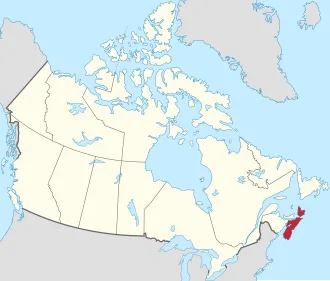
Nova Scotia's capital and largest city is Halifax, which is home to over 45% of the province's population as of the 2021 census. Halifax is the twelfth-largest census metropolitan area in Canada, the largest municipality in Atlantic Canada, and Canada's second-largest coastal municipality after Vancouver.
The land that makes up what is now Nova Scotia was inhabited by the Mi'kmaq people at the time of European colonization. In 1605, Acadia—France's first New France colony—was founded with the creation of Acadia's capital, Port Royal. The Scots, English, then British, fought France for the territory on numerous occasions for over a century afterwards, having gained it from them in the 1713 Peace of Utrecht, which ended the War of the Spanish Succession.
Port Royal was renamed Annapolis Royal and the settlement served as the capital of Nova Scotia until the founding of Halifax in 1749.
In subsequent years, the British began settling "foreign Protestants" in the region and deported the French-speaking Acadians en masse. There was ambivalence in Nova Scotia over whether the colony should join the Americans in the war against Britain. During the American Revolutionary War (1775–1783), thousands of Loyalists settled in Nova Scotia.
In 1848, Nova Scotia became the first British colony to achieve responsible government. In July 1867, Nova Scotia joined in Confederation with New Brunswick and the Province of Canada (now Ontario and Quebec), forming Canada.
Etymology
Nova Scotia is Latin for 'New Scotland' and is the recognized Canadian English name for the province. Just prior to receiving this name, it was referred to as Nova Francia.
Nova Scotia also appears on some older maps as New Caledonia. In both Canadian French and Canadian Gaelic, the province is directly translated as 'New Scotland' (French: Nouvelle-Écosse; Gaelic: Alba Nuadh). In general, Romance and Slavic languages use translations of 'New Scotland' to their language, while most other languages use transliterations of the Latin (which is the same as English) name,[citation needed] including the native language Mi'kmaq (No’pa Sko’sia).[verification needed]
The province was first named in the 1621 Royal Charter granting to Sir William Alexander the right to settle lands as a Scottish colony, including modern Nova Scotia, Cape Breton Island, Prince Edward Island, New Brunswick and the Gaspé Peninsula.
History
Nova Scotia includes regions of the Mi'kmaq nation of Mi'kma'ki (mi'gama'gi), the territory of which extends across the Maritimes, parts of Maine, Newfoundland and the Gaspé Peninsula. The Mi'kmaq people are part of the large Algonquian-language family and inhabited Nova Scotia at the time the first European colonists arrived.
Research published in 1871 as well as Silas Tertius Rand's work from 1894 showed that some Mi'kmaq believed they had emigrated from the west, and then lived alongside the Kwēdĕchk, the original inhabitants. According to these accounts, the two tribes engaged in a war that lasted "many years", and involved the "slaughter of men, women, and children, and torture of captives", and the eventual displacement of the Kwēdĕchk by the victorious Mi’kmaq.
European settlement
The first Europeans to settle the area were the French, who sailed into the Annapolis Basin in 1604, but chose to settle at Saint Croix Island in Maine instead. They abandoned the Maine settlement the following year and, in 1605, established a settlement at Port Royal, which grew into modern-day Annapolis Royal. This would be the first permanent European settlement in what would later become Canada.
The settlement was in the Mi'kmaw district of Kespukwitk and was the founding settlement of what would become Acadia.
In 1621, King James VI of Scotland granted a charter to allow a Scottish colony to be founded in North America. The charter which was granted by the King covered the area of the Maritime Provinces and the Gaspé peninsula, whilst the French had claimed territory in Acadia. The charter granted Sir William Alexander, a Scottish noble, powers to establish a system of government, full rights over fishing and minerals and the power to execute law in the new colony.
A Scottish colony was eventually established in 1629 following the arrival of around seventy Scots to settle in the area known as "New Scotland".
"New Scotland" was captured by the French in 1632, with the Scots who had colonised the area forced to return to Scotland after the French occupation. Following a prolonged period of conflict between the Scots, French and English, Nova Scotia ultimately fell to British rule. As a result, many Scots grasped the opportunity to once again settle in Nova Scotia.
Warfare was common in Nova Scotia during the 17th and 18th centuries. During the first 80 years the French and Acadians lived in Nova Scotia, nine significant military clashes took place as the English, Dutch, French and Mi'kmaq fought for possession of the area. These encounters happened at Port Royal, Saint John, Cap de Sable (present-day Pubnico to Port La Tour, Nova Scotia), Jemseg (1674 and 1758) and Baleine (1629).
The Acadian Civil War took place from 1640 to 1645. Beginning with King William's War in 1688, a series of six wars took place between the English and the French, with Nova Scotia being a consistent theatre of conflict between the two powers.
18th century
Hostilities between France and England, (from 1707, France and the Kingdom of Great Britain after the Acts of Union), in North America resumed from 1702 to 1713, known as Queen Anne's War. The siege of Port Royal took place in 1710, ending French rule in peninsular Acadia. The subsequent signing of the Treaty of Utrecht in 1713 formally recognized British rule in the region, while returning Cape Breton Island (Île Royale) and Prince Edward Island (Île Saint-Jean) to the French.
Despite the British conquest of Acadia in 1710, Nova Scotia remained primarily occupied by Catholic Acadians and Mi'kmaq, who confined British forces to Annapolis and to Canso. Present-day New Brunswick formed a part of the French colony of Acadia. Immediately after the capture of Port Royal in 1710, Francis Nicholson announced it would be renamed Annapolis Royal in honour of Queen Anne.
As a result of Father Rale's War (1722–1725), the Mi'kmaq signed a series of treaties with the British in 1725. The Mi'kmaq signed a treaty of submission to the British crown. However, conflict between the Acadians, Mi'kmaq, French and the British persisted in the following decades with King George's War (1744–1748).
Father Le Loutre's War (1749–1755) began when Edward Cornwallis arrived to establish Halifax with 13 transports on 21 June 1749. A General Court, made up of the governor and the council, was the highest court in the colony at the time. Jonathan Belcher was sworn in as chief justice of the Nova Scotia Supreme Court on 21 October 1754. The first legislative assembly in Halifax, under the Governorship of Charles Lawrence, met on 2 October 1758.
During the French and Indian War of 1754–1763 (the North American theatre of the Seven Years' War), the British deported the Acadians and recruited New England Planters to resettle the colony. The 75-year period of war ended with the Halifax Treaties between the British and the Mi'kmaq (1761). After the war, some Acadians were allowed to return.
In 1763, most of Acadia (Cape Breton Island, St. John's Island (now Prince Edward Island), and New Brunswick) became part of Nova Scotia. In 1765, the county of Sunbury was created. This included the territory of present-day New Brunswick and eastern Maine as far as the Penobscot River. In 1769, St. John's Island became a separate colony.
The American Revolution (1775–1783) had a significant impact on shaping Nova Scotia, with the colony initially displaying ambivalence over whether the colony should join the revolution; Rebellion flared at the Battle of Fort Cumberland (1776) and at the Siege of Saint John (1777). Throughout the war, American privateers devastated the maritime economy by capturing ships and looting almost every community outside of Halifax. These American raids alienated many sympathetic or neutral Nova Scotians into supporting the British.
By the end of the war, Nova Scotia had outfitted numerous privateers to attack American shipping. British military forces based at Halifax succeeded in preventing an American occupation of Nova Scotia, though the Royal Navy failed to establish naval supremacy in the region. While the British captured many American privateers in battles such as the Naval battle off Halifax (1782), many more continued attacks on shipping and settlements until the final months of the war.
The Royal Navy struggled to maintain British supply lines, defending British convoys from American and French attacks as in the fiercely fought convoy battle, the Naval battle off Cape Breton (1781).
After the Americans and their French allies won at the siege of Yorktown in 1781, approximately 33,000 Loyalists, the King's Loyal Americans, allowed to place "United Empire Loyalist" after their names, settled in Nova Scotia, 14,000 of them in what became New Brunswick, on lands granted by the Crown as some compensation for their losses.
The British administration divided Nova Scotia and hived off Cape Breton and New Brunswick in 1784. The Loyalist exodus created new communities across Nova Scotia, including Shelburne, which briefly became one of the larger British settlements in North America, and infused Nova Scotia with additional capital and skills.
The migration caused political tensions between Loyalist leaders and the leaders of the existing New England Planters settlement. The Loyalist influx also pushed Nova Scotia's 2000 Mi'kmaq People to the margins as Loyalist land grants encroached on ill-defined native lands. As part of the Loyalist migration, about 3,000 Black Loyalists arrived; they founded the largest free Black settlement in North America at Birchtown, near Shelburne.
There are several Black Loyalists buried in unmarked graves in the Old Burying Ground in Halifax. Many Nova Scotian communities were settled by British regiments that fought in the war.
In 1786, during the tenure of Lt. Gen. John Parr as governor, the Colony of Nova Scotia transitioned to being the Province of Nova Scotia, with the populace gaining a higher degree of autonomy and self-governance.
19th century
During the War of 1812, Nova Scotia's contribution to the British war effort involved communities either purchasing or building various privateer ships to attack U.S. vessels. Perhaps the most dramatic moment in the war for Nova Scotia occurred when HMS Shannon escorted the captured American frigate USS Chesapeake into Halifax Harbour in 1813. Many of the U.S. prisoners were kept at Deadman's Island.
Nova Scotia became the first colony in British North America and in the British Empire to achieve responsible government in January–February 1848 and become self-governing through the efforts of Joseph Howe. Nova Scotia had established representative government in 1758, an achievement later commemorated by the erection of Dingle Tower in 1908.
Nova Scotians fought in the Crimean War of 1853–1856. The 1860 Welsford-Parker Monument in Halifax is the second-oldest war monument in Canada and the only Crimean War monument in North America. It commemorates the 1854–55 Siege of Sevastopol.
Thousands of Nova Scotians fought in the American Civil War (1861–1865), primarily on behalf of the North. The British Empire (including Nova Scotia) declared itself neutral in the conflict. As a result, Britain (and Nova Scotia) continued to trade with both the South and the North. Nova Scotia's economy boomed during the Civil War.
Post-Confederation history
Soon after the American Civil War, Pro-Canadian Confederation premier Charles Tupper led Nova Scotia into Canadian Confederation on 1 July 1867, along with New Brunswick and the Province of Canada. The Anti-Confederation Party was led by Joseph Howe. Almost three months later, in the election of 18 September 1867, the Anti-Confederation Party won 18 out of 19 federal seats, and 36 out of 38 seats in the provincial legislature.
Throughout the 19th century, numerous businesses developed in Nova Scotia became of pan-Canadian and international importance: the Starr Manufacturing Company (first ice skate manufacturer in Canada), the Bank of Nova Scotia, Cunard Line, Alexander Keith's Brewery, Morse's Tea Company (first tea company in Canada), among others.
Nova Scotia became a world leader in both building and owning wooden sailing ships in the second half of the 19th century. Nova Scotia produced internationally recognized shipbuilders Donald McKay and William Dawson Lawrence. The fame Nova Scotia achieved from sailors was assured in 1895 when Joshua Slocum became the first man to sail single-handedly around the world.
International attention continued into the following century with the many racing victories of the Bluenose schooner. Nova Scotia was also the birthplace and home of Samuel Cunard, a British shipping magnate (born at Halifax, Nova Scotia) who founded the Cunard Line.
In December 1917, at least 1,782 people were killed in the Halifax Explosion, which was the largest human-made explosion at the time.
In April 2004, the Nova Scotia legislature adopted a resolution explicitly inviting the government of the Turks and Caicos Islands to explore the possibility of joining Canada as part of that Province.
In April 2020, a man committed a killing spree across the province that became the deadliest rampage in Canada's history.
Geography
Nova Scotia is Canada's second-smallest province in area, after Prince Edward Island. It is surrounded by four major bodies of water: the Gulf of Saint Lawrence to the north, the Bay of Fundy to the west, the Gulf of Maine to the southwest, and the Atlantic Ocean to the east. The province's mainland is the Nova Scotia peninsula and includes numerous bays and estuaries.
Nowhere in Nova Scotia is more than 67 km (42 mi) from the ocean. Cape Breton Island, a large island to the northeast of the Nova Scotia mainland, is also part of the province, as is Sable Island, a small island notorious for being the site of offshore shipwrecks, approximately 175 km (110 mi) from the province's southern coast.
Nova Scotia has many ancient fossil-bearing rock formations. These formations are particularly rich on the Bay of Fundy's shores. Blue Beach near Hantsport, Joggins Fossil Cliffs, on the Bay of Fundy's shores, has yielded an abundance of Carboniferous-age fossils. Wasson's Bluff, near the town of Parrsboro, has yielded both Triassic- and Jurassic-age fossils.
The highest point is White Hill at 533 metres (1,749 ft) above sea level, situated amongst the Cape Breton Highlands in the far north of the province.
Nova Scotia is located along the 45th parallel north, so it is midway between the Equator and the North Pole. The province contains 5,400 lakes.
Climate
Nova Scotia lies in the mid-temperate zone and, although the province is almost surrounded by water, the climate is closer to continental climate rather than maritime. The winter and summer temperature extremes of the continental climate are moderated by the ocean. Winters are cold enough to be classified as continental—still being nearer the freezing point than inland areas to the west.
The Nova Scotian climate is in many ways similar to the central Baltic Sea coast in Northern Europe, only wetter and snowier. This is true although Nova Scotia is some fifteen parallels further south. Areas not on the Atlantic coast experience warmer summers more typical of inland areas, and winter lows are a little colder. On 12 August 2020, the community of Grand Étang recorded an overnight low of 23.3 °C (73.9 °F).
Demography
Ethnicity
According to the 2016 Canadian census the largest ethnic group in Nova Scotia is Scottish (30.0%), followed by English (28.9%), Irish (21.6%), French (16.5%), German (10.7%), First Nations (5.4%), Dutch (3.5%), Métis (2.9%), and Acadian (2.6%). 42.6% of respondents identified their ethnicity as "Canadian".
Language
As of the 2021 Canadian Census, the ten most spoken languages in the province included English (951,945 or 99.59%), French (99,300 or 10.39%), Arabic (11,745 or 1.23%), Hindi (10,115 or 1.06%), Spanish (8,675 or 0.91%), Mandarin (8,525 or 0.89%), Punjabi (6,730 or 0.7%), German (6,665 or 0.7%), Miꞌkmaq (5,650 or 0.59%), and Tagalog (5,595 or 0.59%). The question on knowledge of languages allows for multiple responses.
Nova Scotia is home to the largest Scottish Gaelic-speaking community outside of Scotland, with a small number of native speakers in Pictou County and Antigonish County, and on Cape Breton Island, and the language is taught in a number of secondary schools throughout the province. In 2018 the government launched a new Gaelic vehicle licence plate to raise awareness of the language and help fund Gaelic language and culture initiatives. They estimated that there were 2,000 Gaelic speakers in the province.
In 2022, the Government of Nova Scotia introduced legislation recognizing Mi'kmaq as the province's first language, and committed to protecting and promoting the language.
Religion
According to the 2011 census, the largest denominations by number of adherents were Christians with 78.2%. About 21.18% were non-religious and 1% were Muslims. Jews, Hindus, and Sikhs constitute around 0.20%.
In 1871, the largest religious denominations were Presbyterian with 103,500 (27%); Roman Catholic with 102,000 (26%); Baptist with 73,295 (19%); Anglican with 55,124 (14%); Methodist with 40,748 (10%), Lutheran with 4,958 (1.3%); and Congregationalist with 2,538 (0.65%).
Economy
Nova Scotia's per capita GDP in 2016 was CA$44,924, significantly lower than the national average per capita GDP of CA$57,574. GDP growth has lagged behind the rest of the country for at least the past decade. In 2017, the median family income in Nova Scotia was $85,970, below the national average of $92,990; in Halifax the figure rises to $98,870.
The province's export value of fish exceeds $1 billion, and fish products are received by 90 countries around the world. Nevertheless, the province's imports far exceed its exports. While these numbers were roughly equal from 1992 until 2004, since that time the trade deficit has ballooned. In 2012, exports from Nova Scotia were 12.1% of provincial GDP, while imports were 22.6%.