















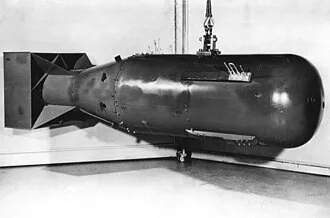
The majority of nuclear weapons have energy yields between 100 and 1,000 kilotons of TNT. Yields in the low kilotons can destroy cities. The effects of nuclear weapons include extreme blast damage, heat, ionizing radiation, and firestorms, followed by radioactive nuclear fallout, an electromagnetic pulse, radar blackout, and acute or chronic radiation syndrome in humans and animals. Hundreds of nuclear explosions would likely cause nuclear winter and nuclear famine.
The first nuclear weapons were developed by the United States in collaboration with the United Kingdom and Canada during World War II in the Manhattan Project. Production requires a large scientific-industrial complex, primarily for fissile material, either nuclear reactors and reprocessing plants producing plutonium, or uranium enrichment facilities.
Nuclear weapons have been used twice in war, in the 1945 atomic bombings of Hiroshima and Nagasaki that killed between 150,000 and 246,000 people. Nuclear deterrence, including mutually assured destruction, aims to prevent nuclear warfare via the threat of unacceptable damage and the danger of escalation to nuclear holocaust.
A nuclear arms race for weapons and their delivery systems was a defining component of the Cold War. Nuclear weapons have had yields between 50 megatons for the Tsar Bomba, and 10 tons for the W54.
Strategic nuclear weapons are targeted against civilian, industrial, and military infrastructure, while tactical nuclear weapons are intended for battlefield use. Strategic weapons led to the development of dedicated intercontinental ballistic missiles, submarine-launched ballistic missile, and nuclear strategic bombers, collectively known as the nuclear triad.
Tactical weapons options included shorter-range ground-, air-, and sea-launched missiles, artillery, demolition munitions, torpedoes, and depth charges, but they have become less salient since the end of the Cold War.
Two nuclear-armed states have nuclear sharing arrangements, stationing their weapons in six other countries: US weapons are deployed in Belgium, Germany, Italy, Netherlands, and Turkey; Russian weapons are deployed in Belarus. Roughly 40 countries have defense policies based on nuclear deterrence, including more than 30 non-nuclear-weapon states under extended deterrence (also known as nuclear umbrella) agreements such as the North Atlantic Treaty Organization.
Nuclear weapons are weapons of mass destruction, and their control is a focus of international security through measures to prevent nuclear proliferation, arms control, or nuclear disarmament. The total global stockpile peaked at more than 64,000 weapons in 1986, and is around 9,600 as of 2025[update].
Key international agreements and organizations include the Treaty on the Non-Proliferation of Nuclear Weapons, the Comprehensive Nuclear-Test-Ban Treaty and Organization, the International Atomic Energy Agency, nuclear-weapon-free zones, and the Treaty on the Prohibition of Nuclear Weapons.
Testing and deployment
Nuclear weapons have only twice been used in warfare, both times by the United States against Japan at the end of World War II. On 6 August 1945, the United States Army Air Forces (USAAF) detonated a uranium gun-type fission bomb nicknamed "Little Boy" over the Japanese city of Hiroshima; three days later, on 9 August, the USAAF detonated a plutonium implosion-type fission bomb nicknamed "Fat Man" over the Japanese city of Nagasaki.
These bombings caused injuries that resulted in the deaths of approximately 200,000 civilians and military personnel. The ethics of these bombings and their role in Japan's surrender are to this day still subjects of debate.
Since the atomic bombings of Hiroshima and Nagasaki, nuclear weapons have been detonated more than 2,000 times for testing and demonstration. Only a few nations possess such weapons or are suspected of seeking them. The only countries known to have detonated nuclear weapons—and acknowledge possessing them—are (chronologically by date of first test) the United States, the Soviet Union (succeeded as a nuclear power by Russia), the United Kingdom, France, China, India, Pakistan and North Korea.
Israel is believed to possess nuclear weapons, though, in a policy of deliberate ambiguity, it does not acknowledge having them. Germany, Italy, Turkey, Netherlands, Belgium, and Belarus are nuclear weapons sharing states. South Africa is the only country to have independently developed and then renounced and dismantled its nuclear weapons.
On the 30 October 2025, US President Donald Trump called for renewed nuclear weapons testing in order to keep pace with other nuclear armed states such as Russia and China, but did not make clear whether he referred to nuclear explosive testing or testing of delivery systems for nuclear warheads.
Types
There are two basic types of nuclear weapons: those that derive the majority of their energy from nuclear fission reactions alone, and those that use fission reactions to begin nuclear fusion reactions that produce a large amount of the total energy output.
Fission weapons
All existing nuclear weapons derive some of their explosive energy from nuclear fission reactions. Weapons whose explosive output is exclusively from fission reactions are commonly referred to as atomic bombs or atom bombs (abbreviated as A-bombs). This has long been noted as something of a misnomer, as their energy comes from the nucleus of the atom, just as it does with fusion weapons.
In fission weapons, a mass of fissile material (enriched uranium or plutonium) is forced into supercriticality—allowing an exponential growth of nuclear chain reactions—either by shooting one piece of sub-critical material into another (the "gun" method) or by compression of a sub-critical sphere or cylinder of fissile material using chemically fueled explosive lenses. The latter approach, the "implosion" method, is more sophisticated and more efficient (smaller, less massive, and requiring less of the expensive fissile fuel) than the former.
A major challenge in all nuclear weapon designs is to ensure that a significant fraction of the fuel is consumed before the weapon destroys itself. The amount of energy released by fission bombs can range from the equivalent of just under a ton to upwards of 500,000 tons (500 kilotons) of TNT (4.2 to 2.1×10⁶ GJ).
All fission reactions generate fission products, the remains of the split atomic nuclei. Many fission products are either highly radioactive (but short-lived) or moderately radioactive (but long-lived), and as such, they are a serious form of radioactive contamination. Fission products are the principal radioactive component of nuclear fallout.
Another source of radioactivity is the burst of free neutrons produced by the weapon. When they collide with other nuclei in the surrounding material, the neutrons transmute those nuclei into other isotopes, altering their stability and making them radioactive.
The most commonly used fissile materials for nuclear weapons applications have been uranium-235 and plutonium-239. Less commonly used has been uranium-233. Neptunium-237 and some isotopes of americium may be usable for nuclear explosives as well, but it is not clear that this has ever been implemented, and their plausible use in nuclear weapons is a matter of dispute.
Fusion weapons
The other basic type of nuclear weapon produces a large proportion of its energy in nuclear fusion reactions. Such fusion weapons are generally referred to as thermonuclear weapons or more colloquially as hydrogen bombs (abbreviated as H-bombs), as they rely on fusion reactions between isotopes of hydrogen (deuterium and tritium).
All such weapons derive a significant portion of their energy from fission reactions used to "trigger" fusion reactions, and fusion reactions can themselves trigger additional fission reactions.
Only six countries—the United States, Russia, the United Kingdom, China, France, and India—have conducted thermonuclear weapon tests. Whether India has detonated a "true" multi-staged thermonuclear weapon is controversial. North Korea claims to have tested a fusion weapon as of January 2016[update], though this claim is disputed.
Thermonuclear weapons are considered much more difficult to successfully design and execute than primitive fission weapons. Almost all deployed nuclear weapons use the thermonuclear design because it results in an explosion hundreds of times stronger than that of a fission bomb of similar weight.
Thermonuclear bombs use the energy of a fission bomb to compress and heat fusion fuel. In the Teller-Ulam design, which accounts for all multi-megaton yield hydrogen bombs, this is accomplished by placing a fission bomb and fusion fuel (tritium, deuterium, or lithium deuteride) in proximity within a special, radiation-reflecting container.
When the fission bomb is detonated, gamma rays and X-rays emitted first compress the fusion fuel, then heat it to thermonuclear temperatures. The ensuing fusion reaction creates enormous numbers of high-speed neutrons, which can then induce fission in materials not normally prone to it, such as depleted uranium. Each of these components is known as a "stage", with the fission bomb as the "primary" and the fusion capsule as the "secondary".
In large, megaton-range hydrogen bombs, about half of the yield comes from the final fissioning of depleted uranium.
Virtually all deployed thermonuclear weapons use this "two-stage" design, but it is possible to add additional fusion stages—each stage igniting a larger amount of fusion fuel in the next stage. This technique can be used to construct thermonuclear weapons of arbitrarily large yield. This is in contrast to fission bombs, which are limited in their explosive power due to criticality danger (premature nuclear chain reaction caused by too-large amounts of pre-assembled fissile fuel).
The largest nuclear weapon ever detonated, the Tsar Bomba of the USSR, which released an energy equivalent of more than 50 megatons of TNT (210 PJ), was a three-stage weapon. Most thermonuclear weapons are considerably smaller than this, due to practical constraints from missile warhead space and weight requirements.
In the early 1950s the Livermore Laboratory in the United States had plans for the testing of two massive bombs, Gnomon and Sundial, 1 gigaton of TNT and 10 gigatons of TNT respectively.
Fusion reactions do not create fission products, and thus contribute far less to the creation of nuclear fallout than fission reactions, but because all thermonuclear weapons contain at least one fission stage, and many high-yield thermonuclear devices have a final fission stage, thermonuclear weapons can generate at least as much nuclear fallout as fission-only weapons. Furthermore, high yield thermonuclear explosions (most dangerously ground bursts) have the force to lift radioactive debris upwards past the tropopause into the stratosphere, where the calm non-turbulent winds permit the debris to travel great distances from the burst, eventually settling and unpredictably contaminating areas far removed from the target of the explosion.
Other types
There are other types of nuclear weapons as well. For example, a boosted fission weapon is a fission bomb that increases its explosive yield through a small number of fusion reactions, but it is not a fusion bomb. In the boosted bomb, the neutrons produced by the fusion reactions serve primarily to increase the efficiency of the fission bomb.
There are two types of boosted fission bomb: internally boosted, in which a deuterium-tritium mixture is injected into the bomb core, and externally boosted, in which concentric shells of lithium-deuteride and depleted uranium are layered on the outside of the fission bomb core. The external method of boosting enabled the USSR to field the first partially thermonuclear weapons, but it is considered obsolete because it demands a spherical bomb geometry, which was adequate during the 1950s arms race when bomber aircraft were the only available delivery vehicles.
The detonation of any nuclear weapon is accompanied by a blast of neutron radiation. Surrounding a nuclear weapon with suitable materials (such as cobalt or gold) creates a weapon known as a salted bomb. This device can produce exceptionally large quantities of long-lived radioactive contamination. It has been conjectured that such a device could serve as a "doomsday weapon" because such a large quantity of radioactivities with half-lives of decades, lifted into the stratosphere where winds would distribute it around the globe, would make all life on the planet extinct.
In connection with the Strategic Defense Initiative, research into the nuclear pumped laser was conducted under the DOD program Project Excalibur but this did not result in a working weapon. The concept involves the tapping of the energy of an exploding nuclear bomb to power a single-shot laser that is directed at a distant target.
During the Starfish Prime high-altitude nuclear test in 1962, an unexpected effect was produced which is called a nuclear electromagnetic pulse. This is an intense flash of electromagnetic energy produced by a rain of high-energy electrons which in turn are produced by a nuclear bomb's gamma rays. This flash of energy can permanently destroy or disrupt electronic equipment if insufficiently shielded.
It has been proposed to use this effect to disable an enemy's military and civilian infrastructure as an adjunct to other nuclear or conventional military operations. By itself it could as well be useful to terrorists for crippling a nation's economic electronics-based infrastructure. Because the effect is most effectively produced by high altitude nuclear detonations (by military weapons delivered by air, though ground bursts also produce EMP effects over a localized area), it can produce damage to electronics over a wide, even continental, geographical area.
Research has been done into the possibility of pure fusion bombs: nuclear weapons that consist of fusion reactions without requiring a fission bomb to initiate them. Such a device might provide a simpler path to thermonuclear weapons than one that required the development of fission weapons first, and pure fusion weapons would create significantly less nuclear fallout than other thermonuclear weapons because they would not disperse fission products.
In 1998, the United States Department of Energy divulged that the United States had "...made a substantial investment," in the past to develop pure fusion weapons, but that "The U.S. does not have and is not developing a pure fusion weapon," and that "No credible design for a pure fusion weapon resulted from the DOE investment".
Nuclear isomers provide a possible pathway to fissionless fusion bombs. These are naturally occurring isotopes (178m2Hf being a prominent example) which exist in an elevated energy state. Mechanisms to release this energy as bursts of gamma radiation (as in the hafnium controversy) have been proposed as possible triggers for conventional thermonuclear reactions.
Antimatter, which consists of particles resembling ordinary matter particles in most of their properties but having opposite electric charge, has been considered as a trigger mechanism for nuclear weapons. A major obstacle is the difficulty of producing antimatter in large enough quantities, and there is no evidence that it is feasible beyond the military domain.
However, the US Air Force funded studies of the physics of antimatter in the Cold War, and began considering its possible use in weapons, not just as a trigger, but as the explosive itself. A fourth generation nuclear weapon design is related to, and relies upon, the same principle as antimatter-catalyzed nuclear pulse propulsion.
Most variation in nuclear weapon design is for the purpose of achieving different yields for different situations, and in manipulating design elements to attempt to minimize weapon size, radiation hardness or requirements for special materials, especially fissile fuel or tritium.
Tactical nuclear weapons
Some nuclear weapons are designed for special purposes; most of these are for non-strategic (decisively war-winning) purposes and are referred to as tactical nuclear weapons.