Most optical phenomena can be accounted for by using the classical electromagnetic description of light, however, complete electromagnetic descriptions of light are often difficult to apply in practice. Practical optics is usually done using simplified models. The most common of these, geometric optics, treats light as a collection of rays that travel in straight lines and bend when they pass through or reflect from surfaces.
Physical optics is a more comprehensive model of light, which includes wave effects such as diffraction and interference that cannot be accounted for in geometric optics. Historically, the ray-based model of light was developed first, followed by the wave model of light. Progress in electromagnetic theory in the 19th century led to the discovery that light waves were in fact electromagnetic radiation.
Some phenomena depend on light having both wave-like and particle-like properties. Explanation of these effects requires quantum mechanics. When considering light's particle-like properties, the light is modelled as a collection of particles called "photons". Quantum optics deals with the application of quantum mechanics to optical systems.
Optical science is relevant to and studied in many related disciplines including astronomy, various engineering fields, photography, and medicine, especially in radiographic methods such as beam radiation therapy and CT scans, and in the physiological optical fields of ophthalmology and optometry. Practical applications of optics are found in a variety of technologies and everyday objects, including mirrors, lenses, telescopes, microscopes, lasers, and fibre optics. Often, these elements are often rotationally symmetric; freeform optics have no such symmetry.
History
Optics began with the development of lenses by the ancient Egyptians and Mesopotamians. The earliest known lenses, made from polished crystal, often quartz, date from as early as 2000 BC from Crete (Archaeological Museum of Heraclion, Greece). Lenses from Rhodes date around 700 BC, as do Assyrian lenses such as the Nimrud lens.
The ancient Romans and Greeks filled glass spheres with water to make lenses. These practical developments were followed by the development of theories of light and vision by ancient Greek and Indian philosophers, and the development of geometrical optics in the Greco-Roman world. The word optics comes from the ancient Greek word ὀπτική, optikē 'appearance, look'.
Greek philosophy on optics broke down into two opposing theories on how vision worked, the intromission theory and the emission theory. The intromission approach saw vision as coming from objects casting off copies of themselves (called eidola) that were captured by the eye. With many propagators including Democritus, Epicurus, Aristotle and their followers, this theory seems to have some contact with modern theories of what vision really is, but it remained only speculation lacking any experimental foundation.
Plato first articulated the emission theory, the idea that visual perception is accomplished by rays emitted by the eyes. He also commented on the parity reversal of mirrors in Timaeus. Some hundred years later, Euclid (4th–3rd century BC) wrote a treatise entitled Optics where he linked vision to geometry, creating geometrical optics.
He based his work on Plato's emission theory wherein he described the mathematical rules of perspective and described the effects of refraction qualitatively, although he questioned that a beam of light from the eye could instantaneously light up the stars every time someone blinked. Euclid stated the principle of the shortest trajectory of light, and considered multiple reflections on flat and spherical mirrors.
Ptolemy, in his treatise Optics, held an extramission-intromission theory of vision: the rays (or flux) from the eye formed a cone, the vertex being within the eye, and the base defining the visual field. The rays were sensitive, and conveyed information back to the observer's intellect about the distance and orientation of surfaces.
He summarized much of Euclid and went on to describe a way to measure the angle of refraction, though he failed to notice the empirical relationship between it and the angle of incidence. Plutarch (1st–2nd century AD) described multiple reflections on spherical mirrors and discussed the creation of magnified and reduced images, both real and imaginary, including the case of chirality of the images.
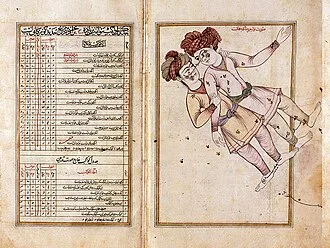
During the Middle Ages, Greek ideas about optics were resurrected and extended by writers in the Muslim world. One of the earliest of these was Al-Kindi (c. 801–873) who wrote on the merits of Aristotelian and Euclidean ideas of optics, favouring the emission theory since it could better quantify optical phenomena.
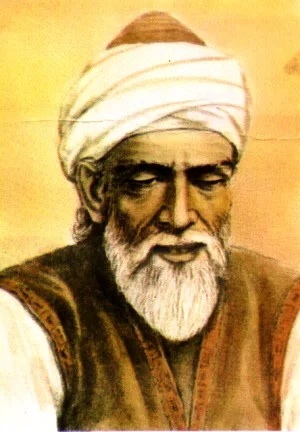
In 984, the Persian mathematician Ibn Sahl wrote the treatise "On burning mirrors and lenses", correctly describing a law of refraction equivalent to Snell's law. He used this law to compute optimum shapes for lenses and curved mirrors. In the early 11th century, Alhazen (Ibn al-Haytham) wrote the Book of Optics (Kitab al-manazir) in which he explored reflection and refraction and proposed a new system for explaining vision and light based on observation and experiment.
He rejected the "emission theory" of Ptolemaic optics with its rays being emitted by the eye, and instead put forward the idea that light reflected in all directions in straight lines from all points of the objects being viewed and then entered the eye, although he was unable to correctly explain how the eye captured the rays.
Alhazen's work was largely ignored in the Arabic world but it was anonymously translated into Latin around 1200 A.D. and further summarised and expanded on by the Polish monk Witelo making it a standard text on optics in Europe for the next 400 years.
In the 13th century in medieval Europe, English bishop Robert Grosseteste wrote on a wide range of scientific topics, and discussed light from four different perspectives: an epistemology of light, a metaphysics or cosmogony of light, an etiology or physics of light, and a theology of light, basing it on the works of Aristotle and Platonism.
Grosseteste's most famous disciple, Roger Bacon, wrote works citing a wide range of recently translated optical and philosophical works, including those of Alhazen, Aristotle, Avicenna, Averroes, Euclid, al-Kindi, Ptolemy, Tideus, and Constantine the African. Bacon was able to use parts of glass spheres as magnifying glasses to demonstrate that light reflects from objects rather than being released from them.
The first wearable eyeglasses were invented in Italy around 1286. This was the start of the optical industry of grinding and polishing lenses for these "spectacles", first in Venice and Florence in the thirteenth century, and later in the spectacle making centres in both the Netherlands and Germany. Spectacle makers created improved types of lenses for the correction of vision based more on empirical knowledge gained from observing the effects of the lenses rather than using the rudimentary optical theory of the day (theory which for the most part could not even adequately explain how spectacles worked).
This practical development, mastery, and experimentation with lenses led directly to the invention of the compound optical microscope around 1595, and the refracting telescope in 1608, both of which appeared in the spectacle making centres in the Netherlands.
In the early 17th century, Johannes Kepler expanded on geometric optics in his writings, covering lenses, reflection by flat and curved mirrors, the principles of pinhole cameras, inverse-square law governing the intensity of light, and the optical explanations of astronomical phenomena such as lunar and solar eclipses and astronomical parallax.
He was also able to correctly deduce the role of the retina as the actual organ that recorded images, finally being able to scientifically quantify the effects of different types of lenses that spectacle makers had been observing over the previous 300 years. After the invention of the telescope, Kepler set out the theoretical basis on how they worked and described an improved version, known as the Keplerian telescope, using two convex lenses to produce higher magnification.
Optical theory progressed in the mid-17th century with treatises written by philosopher René Descartes, which explained a variety of optical phenomena including reflection and refraction by assuming that light was emitted by objects which produced it. This differed substantively from the ancient Greek emission theory.
In the late 1660s and early 1670s, Isaac Newton expanded Descartes's ideas into a corpuscle theory of light, famously determining that white light was a mix of colours that can be separated into its component parts with a prism. In 1690, Christiaan Huygens proposed a wave theory for light based on suggestions that had been made by Robert Hooke in 1664.
Hooke himself publicly criticised Newton's theories of light and the feud between the two lasted until Hooke's death. In 1704, Newton published Opticks and, at the time, partly because of his success in other areas of physics, he was generally considered to be the victor in the debate over the nature of light.
Newtonian optics was generally accepted until the early 19th century when Thomas Young and Augustin-Jean Fresnel conducted experiments on the interference of light that firmly established light's wave nature. Young's famous double slit experiment showed that light followed the superposition principle, which is a wave-like property not predicted by Newton's corpuscle theory.
This work led to a theory of diffraction for light and opened an entire area of study in physical optics. Wave optics was successfully unified with electromagnetic theory by James Clerk Maxwell in the 1860s.
The next development in optical theory came in 1899 when Max Planck correctly modelled blackbody radiation by assuming that the exchange of energy between light and matter only occurred in discrete amounts he called quanta. In 1905, Albert Einstein published the theory of the photoelectric effect that firmly established the quantization of light itself.
In 1913, Niels Bohr showed that atoms could only emit discrete amounts of energy, thus explaining the discrete lines seen in emission and absorption spectra. The understanding of the interaction between light and matter that followed from these developments not only formed the basis of quantum optics but also was crucial for the development of quantum mechanics as a whole.
The ultimate culmination, the theory of quantum electrodynamics, explains all optics and electromagnetic processes in general as the result of the exchange of real and virtual photons. Quantum optics gained practical importance with the inventions of the maser in 1953 and of the laser in 1960.
Following the work of Paul Dirac in quantum field theory, George Sudarshan, Roy J. Glauber, and Leonard Mandel applied quantum theory to the electromagnetic field in the 1950s and 1960s to gain a more detailed understanding of photodetection and the statistics of light.
Classical optics
Classical optics is divided into two main branches: geometrical (or ray) optics and physical (or wave) optics. In geometrical optics, light is considered to travel in straight lines, while in physical optics, light is considered as an electromagnetic wave.
Geometrical optics can be viewed as an approximation of physical optics that applies when the wavelength of the light used is much smaller than the size of the optical elements in the system being modelled.
Geometrical optics
Geometrical optics, or ray optics, describes the propagation of light in terms of "rays" which travel in straight lines, and whose paths are governed by the laws of reflection and refraction at interfaces between different media. These laws were discovered empirically as far back as 984 AD and have been used in the design of optical components and instruments from then until the present day. They can be summarised as follows:
When a ray of light hits the boundary between two transparent materials, it is divided into a reflected and a refracted ray.
- The law of reflection says that the reflected ray lies in the plane of incidence, and the angle of reflection equals the angle of incidence.
- The law of refraction says that the refracted ray lies in the plane of incidence, and the sine of the angle of incidence divided by the sine of the angle of refraction is a constant: where n is a constant for any two materials and a given wavelength of light. If the first material is air or vacuum, n is the refractive index of the second material.

The laws of reflection and refraction can be derived from Fermat's principle which states that the path taken between two points by a ray of light is the path that can be traversed in the least time.
Approximations
Geometric optics is often simplified by making the paraxial approximation, or "small angle approximation". The mathematical behaviour then becomes linear, allowing optical components and systems to be described by simple matrices. This leads to the techniques of Gaussian optics and paraxial ray tracing, which are used to find basic properties of optical systems, such as approximate image and object positions and magnifications.
Reflections
Reflections can be divided into two types: specular reflection and diffuse reflection. Specular reflection describes the gloss of surfaces such as mirrors, which reflect light in a simple, predictable way. This allows for the production of reflected images that can be associated with an actual (real) or extrapolated (virtual) location in space.
Diffuse reflection describes non-glossy materials, such as paper or rock. The reflections from these surfaces can only be described statistically, with the exact distribution of the reflected light depending on the microscopic structure of the material. Many diffuse reflectors are described or can be approximated by Lambert's cosine law, which describes surfaces that have equal luminance when viewed from any angle. Glossy surfaces can give both specular and diffuse reflection.
In specular reflection, the direction of the reflected ray is determined by the angle the incident ray makes with the surface normal, a line perpendicular to the surface at the point where the ray hits. The incident and reflected rays and the normal lie in a single plane, and the angle between the reflected ray and the surface normal is the same as that between the incident ray and the normal. This is known as the Law of Reflection.
For flat mirrors, the law of reflection implies that images of objects are upright and the same distance behind the mirror as the objects are in front of the mirror. The image size is the same as the object size. The law also implies that mirror images are parity inverted, which we perceive as a left-right inversion. Images formed from reflection in two (or any even number of) mirrors are not parity inverted.
Corner reflectors produce reflected rays that travel back in the direction from which the incident rays came. This is called retroreflection.
Mirrors with curved surfaces can be modelled by ray tracing and using the law of reflection at each point on the surface. For mirrors with parabolic surfaces, parallel rays incident on the mirror produce reflected rays that converge at a common focus. Other curved surfaces may also focus light, but with aberrations due to the diverging shape causing the focus to be smeared out in space.
In particular, spherical mirrors exhibit spherical aberration. Curved mirrors can form images with a magnification greater than or less than one, and the magnification can be negative, indicating that the image is inverted. An upright image formed by reflection in a mirror is always virtual, while an inverted image is real and can be projected onto a screen.
Refractions
Refraction occurs when light travels through an area of space that has a changing index of refraction; this principle allows for lenses and the focusing of light. The simplest case of refraction occurs when there is an interface between a uniform medium with index of refraction n1 and another medium with index of refraction n2. In such situations, Snell's Law describes the resulting deflection of the light ray:

where θ1 and θ2 are the angles between the normal (to the interface) and the incident and refracted waves, respectively.
The index of refraction of a medium is related to the speed, v, of light in that medium by where c is the speed of light in vacuum.

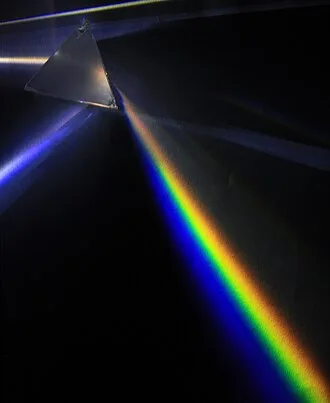
Snell's Law can be used to predict the deflection of light rays as they pass through linear media as long as the indexes of refraction and the geometry of the media are known. For example, the propagation of light through a prism results in the light ray being deflected depending on the shape and orientation of the prism.
In most materials, the index of refraction varies with the frequency of the light, known as dispersion. Taking this into account, Snell's Law can be used to predict how a prism will disperse light into a spectrum. The discovery of this phenomenon when passing light through a prism is famously attributed to Isaac Newton.
Some media have an index of refraction which varies gradually with position and, therefore, light rays in the medium are curved. This effect is responsible for mirages seen on hot days: a change in index of refraction air with height causes light rays to bend, creating the appearance of specular reflections in the distance (as if on the surface of a pool of water).
Optical materials with varying indexes of refraction are called gradient-index (GRIN) materials. Such materials are used to make gradient-index optics.
For light rays travelling from a material with a high index of refraction to a material with a low index of refraction, Snell's law predicts that there is no θ2 when θ1 is large. In this case, no transmission occurs; all the light is reflected.
This phenomenon is called total internal reflection and allows for fibre optics technology. As light travels down an optical fibre, it undergoes total internal reflection allowing for essentially no light to be lost over the length of the cable.
Lenses
A device that produces converging or diverging light rays due to refraction is known as a lens. Lenses are characterized by their focal length: a converging lens has positive focal length, while a diverging lens has negative focal length. Smaller focal length indicates that the lens has a stronger converging or diverging effect. The focal length of a simple lens in air is given by the lensmaker's equation.
Ray tracing can be used to show how images are formed by a lens. For a thin lens in air, the location of the image is given by the simple equation