With 61 official trophies, including 60 major honours, PSG is the most successful club in French football. The club has won a record 14 Ligue 1 titles, one Ligue 2 title, a record 16 Coupes de France, a record 9 Coupes de la Ligue, and a record 14 Trophée des Champions. Internationally, PSG is the most decorated French club, having won six major trophies: a French-record two UEFA Champions League titles, the UEFA Cup Winners' Cup, two UEFA Super Cup, the UEFA Intertoto Cup, and the FIFA Intercontinental Cup.
Before the Qatar Sports Investments (QSI) takeover of PSG in 2011, the club had won 18 major trophies, including one UEFA Cup Winners' Cup, two Ligue 1 titles and eight Coupes de France, making it the joint third-most successful club in French football at the time. After the acquisition by QSI, the club finished just three points behind the 2011–12 Ligue 1 champions before entering a period of sustained domestic dominance, attracting numerous high-profile players and becoming the country's most successful club.
Under the stewardship of Luis Enrique, the club won 13 honours, including in 2025 the continental treble consisting of Ligue 1, Coupe de France and UEFA Champions League titles, and also became the third European football club to win six competitions in a single year, before successfully defending the UEFA Champions League in 2026.
Since 2011, PSG has been majority-owned by Qatar Sports Investments, with Arctos Partners acquiring a minority stake in 2023 and Boardroom in 2025. As of May 2026, the club is the wealthiest in France and ranks among the richest and most valuable football clubs in the world. In addition to its men's football team, PSG operates a youth academy, a women's football team, and sections in handball, judo, and esports. The club has also previously fielded teams in basketball, volleyball, boxing, and rugby league.
History
Formation, split and early successes (1970–1991)
By the late 1960s, Paris lacked a club in the top division of French football. With support from the French Football Federation (FFF), Parisian businessmen Guy Crescent and Pierre-Étienne Guyot founded Paris FC in 1969 and later brought in Henri Patrelle, president of Stade Saint-Germain. The two clubs merged on 12 August 1970 to form Paris Saint-Germain.
The club began in Ligue 2 and won the title in its first season, securing promotion to Ligue 1 for 1971–72. The club's early years were affected by financial difficulties and disagreements over its future structure. In 1972, Paris FC and PSG split. Paris FC retained its place in Ligue 1, while PSG was administratively relegated to Division 3 and continued under its existing name. PSG won back-to-back promotions and returned to Ligue 1 in 1974, moving into the Parc des Princes.
During the second half of the 1970s, Daniel Hechter became a driving force behind PSG's development and its establishment in the top flight. He became club president in 1974 and remained in the position until January 1978. Hechter was then replaced by Francis Borelli following the double-ticketing scandal at the Parc des Princes.
Under Borelli, PSG won its first major trophies. The club reached its first Coupe de France final in 1982, where it faced Saint-Étienne at the Parc des Princes. After a 2–2 draw following extra time, PSG won the final on penalties to claim its first major trophy. The club retained the Coupe de France the following year by defeating Nantes 3–2 in the final.
PSG continued to develop as a leading French club during the 1980s and featured several notable players, including Jean-Pierre Dogliani, Mustapha Dahleb, Safet Sušić, Luis Fernandez and Dominique Rocheteau. In 1986, under manager Gérard Houllier, the club won its first French championship. PSG finished three points ahead of Nantes and lost only three matches during the season.
The championship was followed by a sporting decline and increasing financial difficulties. PSG struggled to maintain its position among the leading French clubs, with declining league performances and growing financial problems affecting the club during the latter part of Borelli's presidency.
First golden era and decline (1991–2011)
Canal+ took control of PSG in 1991, beginning a period of increased investment in the club. Michel Denisot became president, while the new ownership strengthened the squad and appointed prominent coaches. PSG recruited several high-profile players during the 1990s, including Raí, George Weah, David Ginola, Bernard Lama and Valdo.
The club won the Coupe de France in 1993, defeating Nantes 3–0 in the final, and won its second French championship in 1994.
PSG also became a regular participant in European competition. In the 1994–95 UEFA Champions League, the club won its group and advanced to the semi-finals, where it was eliminated by AC Milan. In 1996, PSG won its first European trophy by defeating Rapid Wien 1–0 in the UEFA Cup Winners' Cup final in Brussels, with Bruno Ngotty scoring the only goal.
PSG reached the same competition's final again in 1997 but lost 1–0 to Barcelona. The club continued to win domestic trophies during the late 1990s. PSG won the Coupe de la Ligue in 1998 and defeated Lens in the Coupe de France final later that year to complete a domestic cup double.
Despite having notable players such as Jay-Jay Okocha, Ronaldinho and Pauleta, PSG's results became less consistent after the end of the 1990s. Changes in management, sporting directors and ownership were accompanied by a decline in league performances. PSG remained capable of winning domestic trophies, taking the Coupe de France in 2004, 2006 and 2010 and the Coupe de la Ligue in 2008, but spent several seasons outside the upper positions of Ligue 1.
The club finished 15th in 2006–07 and 16th in 2007–08, its lowest league finishes during this period. In 2008, Colony Capital became PSG's majority shareholder. The club subsequently improved its league position, finishing sixth in 2008–09, 13th in 2009–10 and fourth in 2010–11. PSG also won the Coupe de France in 2010, defeating Monaco 1–0 after extra time.
Rise to European dominance (2011–present)
In 2011, Qatar Sports Investments (QSI) acquired a majority stake in PSG and subsequently became the club's sole owner. Nasser Al-Khelaifi became president, and the new ownership significantly increased investment in the playing squad. The club's first major signing was promising young Argentine player Javier Pastore from Serie A club Palermo, who signed for €42 million — a French transfer record fee at the time.
With Pastore and numerous other new signings, PSG were able to finish as runners-up in the 2011–12 Ligue 1 season, just three points behind the champions Montpellier. Further notable signings by the club included Zlatan Ibrahimović, Thiago Silva, Edinson Cavani and Marco Verratti. PSG won Ligue 1 in 2013, its first league title since 1994, and successfully defended the title in 2014.
The club subsequently established sustained domestic dominance, winning multiple Ligue 1 championships and cup titles. In 2014–15, PSG became the first French club to win all four major domestic trophies in a single season: Ligue 1, the Coupe de France, the Coupe de la Ligue and the Trophée des Champions. The club repeated the feat in 2015–16, when it also set a Ligue 1 record with 96 points.
PSG then built a squad around superstars, signing Neymar from Barcelona and Kylian Mbappé from Monaco in 2017, before Lionel Messi joined the club in 2021. The trio helped PSG win further domestic trophies but did not deliver a Champions League title. During this period, PSG reached the Champions League final in 2020, losing 1–0 to Bayern Munich, and the semi-finals in 2021 and 2024. Neymar left the club in 2023, followed by Messi later that year, while Mbappé departed in 2024.
Following the departures of Neymar, Messi and Mbappé, PSG moved away from a squad centered on high-profile individual forwards. Under Luis Enrique, who became manager in 2023, the club placed greater emphasis on collective play, positional movement and contributions across the squad. PSG won its first Champions League title in 2025, defeating Inter Milan 5–0 in the final in Munich.
Achraf Hakimi, Désiré Doué, Khvicha Kvaratskhelia and Senny Mayulu scored in the final. The victory made PSG the second French club to win the Champions League, after Marseille in 1993. PSG also claimed the 2025 UEFA Super Cup and the 2025 FIFA Intercontinental Cup, achieving an unprecedented sextuple.
PSG retained the Champions League title in 2026. After finishing 11th in the league phase, the club defeated Monaco in the knockout play-offs, Chelsea in the round of 16, Liverpool in the quarter-finals and Bayern Munich in the semi-finals. In the final at the Puskás Aréna in Budapest, PSG drew 1–1 with Arsenal before winning 4–3 on penalties.
Ousmane Dembélé scored PSG's goal in normal time, while goalkeeper Matvey Safonov made the decisive save in the shootout. PSG became only the second club in the Champions League era to win consecutive titles, after Real Madrid's three consecutive victories from 2016 to 2018.
Identity
Colours and mascot
Since their foundation, Paris Saint-Germain have represented both the city of Paris and the nearby royal town of Saint-Germain-en-Laye. As a result, red, blue and white are the club's traditional colours. The red and blue are Parisian colours, a nod to revolutionary figures Lafayette and Jean Sylvain Bailly, and the white is a symbol of French royalty and Saint-Germain-en-Laye.
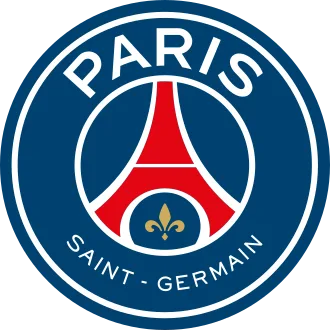
On the club's crest, the Eiffel Tower in red and the blue background represent Paris, while the fleur de lys in white is a hint to the coat of arms of Saint-Germain-en-Laye. The fleur de lys is a royal symbol as well and recalls that French King Louis XIV was born in the town. Throughout its history, PSG have brandished several crests, but all of them have featured the club's three historical colours.
Likewise, PSG's most distinctive shirts have been predominantly red, blue or white, with the remaining two colours included as well. The club's official mascot, Germain the Lynx, also sports PSG's traditional colours. It was unveiled during the 2010 Tournoi de Paris in commemoration of the club's 40th anniversary, and can be seen entertaining kids in the stands of the Parc des Princes or near the pitch with the players during the warm-up.
Anthems and mottos
"Allez Paris!", recorded by Belgian actress and singer Annie Cordy in 1971, was the club's first official anthem. A dedicated PSG supporter from the very beginning, Cordy was part of an association of hundreds of celebrities who contributed to the club's founding in 1970. At that time, an appeal was made to the public to purchase season tickets at newsstands. A year later, Cordy was named PSG's official godmother and recorded the aforementioned anthem.
The club's second anthem, "Allez Paris‑Saint‑Germain!" by Les Parisiens, was recorded in 1977, replacing Annie Cordy's original version. It was produced and released by long-time PSG leader and music producer Charles Talar. The chorus became a popular chant among PSG fans during matches. A new version of the anthem, retaining the same title, was recorded in 2010 as part of the club's 40th anniversary celebrations.
Performed to the tune of "Go West" by Village People, the lyrics were rewritten with input from the fans. This version serves as the club's current official anthem.
"Ô Ville Lumière", set to the tune of "Flower of Scotland", is another official club anthem for PSG fans. This chant was created by the former KoB ultra group Boulogne Boys. Other notable chants include "Le Parc est à nous" ("The Parc is ours"), "Ici, c'est Paris" ("This is Paris"), and "Paris est magique" ("Paris is magical"). "Who Said I Would" by English musician Phill Collins is also a traditional fan anthem.
The song has accompanied the players' entrance onto the field since 1992. Collins was preceded by French singer Michel Fugain and his 1972 song "Attention, Ladies and Gentlemen."
"Ici, c'est Paris" and "Paris est magique" are also the club's most iconic mottos. The "Ici, c'est Paris" slogan was created by the former VA ultra group Supras Auteuil, which registered it as a trademark in 2008. PSG began incorporating the slogan into their marketing, resulting in a legal dispute with the Supras. In February 2016, the group rejected the club's offer of €2,000 for the rights to the slogan.
An agreement was reached in August 2019, allowing the club to continue using the slogan in advertising while fans retained the right to use it freely.
Iconic shirts

For its first three seasons, Paris Saint-Germain's home shirt was red with blue and white detailing on the sleeves and collar to unify the club's three colours: the red and blue of Paris and the white of Saint-Germain-en-Laye. During the 2010–11 season, PSG wore a red shirt for home matches to mark its 40th anniversary.
French fashion designer Daniel Hechter took over as president of PSG in 1973, and designed the club's traditional home kit that same year: a blue shirt with a red vertical stripe flanked by two thinner white stripes (blue–white–red–white–blue).
First worn in the 1973–74 season, the so-called "Hechter shirt" has remained PSG's classic identity ever since. The famous shirt was debuted against Red Star in November 1973. This was also the club's first match at the Parc des Princes. PSG won 3–1 with Othniel Dossevi scoring the club's first goal in a Hechter shirt.
PSG stars from the 1990s and 2000s such as Raí, Ronaldinho and Pauleta are associated with this kit. In it, the club reached five consecutive European semi-finals between 1993 and 1997, lifted the UEFA Cup Winners' Cup in 1996 and achieved eight consecutive victories against arch-rivals Olympique de Marseille between 2002 and 2004.
It is commonly believed that Hechter based his design on the red-and-white jersey worn by Ajax, the dominant European club at the time. Hechter himself denied this, stating that he was inspired by the Ford Mustang, transposing the car's hood stripes onto the jersey and using the club's three colors. The design has two alternate versions: the "Reverse Hechter" (red–white–blue–white–red), introduced in the 1974–75 season, and the "White Hechter" (white–blue–red–blue–white), which debuted in the 1994–95 season.
However, it was in the club's most distinctive away kit that fans saw PSG's first great team, who won their first Coupe de France titles in 1982 and 1983, enjoyed their first European campaign in 1983, and clinched their first Ligue 1 crown in 1986. The shirt was white with blue and red vertical stripes down the left side.
Like Hechter's shirt, it debuted in the 1973–74 season as the away kit. Promoted by PSG president Francis Borelli, the white shirt was the club's home identity from 1981 to 1990. Now known as the "Borelli shirt", it is synonymous with 1980s PSG legends such as Safet Sušić, Luis Fernández and Dominique Bathenay.
Crest evolution
Following the merger of Paris FC (PFC) and Stade Saint-Germain to create Paris Saint-Germain, the club's first crest was the same as the original PFC logo. It featured a blue football and a red sailing ship with its sails billowing in the wind. This ship is a historical symbol of Paris and is present on the city's coat of arms with its motto "Fluctuat nec mergitur" ("[She] is tossed [by the waves], but does not sink").
After separating from PFC in 1972, PSG needed a new crest. Representing both Paris and Saint-Germain-en-Laye, the club's second crest became the basis of the one fans know today, featuring the Eiffel Tower in red against a blue background and, below, two symbols of Saint-Germain in white: a fleur-de-lis and the cradle of Louis XIV.
This crest was first used in 1972 and was created by Christian Lentretien, a former PSG director and advertising professional.
In 1982, an image of the club's stadium, the Parc des Princes, was added to the bottom of the crest, remaining there until 1990, when it was removed and the crest reverted to its original form. Two years later, in 1992, the crest was radically modified by the club's owners, Canal+. The new design featured the initials "PSG" in white on a blue, white, red, white, and blue background, mimicking the design of the Hechter shirt, with "Paris Saint-Germain" below, also in white on a black background.
Following pressure from the fans, the traditional crest returned in 1995 with "Paris Saint-Germain" above the tower and "1970" below the cradle. In 2002, it underwent a minor modification, primarily the addition of a darker shade of blue.
At the request of the club's Qatari owners, the traditional crest was significantly redesigned in 2013. Now, the word "Paris" is written in large, bold white letters above the Eiffel Tower, clearly emphasizing the "Paris" brand rather than "Paris Saint-Germain". Below, "Saint-Germain" is written in smaller letters beneath the fleur-de-lis.
The cradle of Louis XIV and the club's founding year, "1970", have been omitted. PSG deputy general manager Jean-Claude Blanc stated: "We are called Paris Saint-Germain but, above all, we are called Paris".
Friendly tournaments
Paris Saint-Germain used to host two famous invitational competitions: the Tournoi de Paris and the Tournoi Indoor de Paris-Bercy. Considered the most prestigious friendly tournament in French football, the Tournoi de Paris is regarded as the precursor to both the Intercontinental Cup and the FIFA Club World Cup. PSG began organizing it in 1975 and have been crowned champions a record seven times.
Held at the Parc des Princes, the Tournoi de Paris was last organized in 2012. The Tournoi Indoor de Paris-Bercy was an indoor football tournament founded by PSG in 1984 and held annually until 1991 at the Accor Arena. The Parisians have lifted the trophy twice, more than any other club.
Grounds
Stadiums
Since its inception, Paris Saint-Germain have played in five main stadiums: the Stade Jean-Bouin, the Stade Georges Lefèvre, the Stade Bauer, the Stade Yves-du-Manoir, and the Parc des Princes, their current home ground. PSG took on Ligue 2 promotion rivals Red Star on 10 November 1973, for the club's first match at the Parc des Princes.
PSG moved into the ground upon its return to Ligue 1 in July 1974, the same year that rivals Paris FC were relegated. Up until that point it had hosted Paris FC.
From that moment on, the Parc des Princes has been the home stadium of PSG. Its most prolific season in terms of average attendance was 2024–25, during which an average of 47,639 spectators went to the stadium for each match. The attendance record for a PSG match dates back to 13 March 1983, with 49,575 spectators present in the stands of the Parc des Princes.
This match pitted PSG against Belgian side Waterschei for the UEFA Cup Winners' Cup quarterfinals. The final score was a 2–0 victory for the Parisians.
The club played at the Stade Jean-Bouin, concurrently with the Stade Georges Lefèvre, in 1970–71, as it attracted significantly higher levels of fan support. The Georges Lefèvre regularly hosted PSG matches from 1972 to 1974 as well. Between 1904 and 1970, it was the home of Stade Saint-Germain, club which merged with Paris FC to form PSG in 1970.
PSG played again at the Jean-Bouin in 1973–74, alternating their home games with the Georges Lefèvre and the Parc des Princes. PSG played at the Stade Bauer for the first time in 1971–72. It was used again by the club once in 1976–77 and 1977–78, and twice in 1978–79 due to construction work on the lawn of the Parc des Princes.
Similarly, the Stade Yves-du-Manoir welcomed PSG for three matches in 1971–72, once more in 1974–75, and one last time in 1975–76 because the Parc des Princes was under renovation.