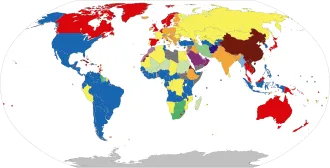
Countries with parliamentary systems may be constitutional monarchies, where a monarch is the head of state, or parliamentary republics, where a mostly ceremonial president is the head of state, while the head of government, commonly referred to as prime minister, is almost always a member of parliament. In some countries, the head of government is also head of state but is elected by the legislature.
In bicameral parliaments, the head of government is generally, though not always, a member of the lower house. Typically, the head of state in a parliamentary republic is elected by popular vote; however, in some cases they are elected by an electoral college (e.g. Germany) or by members of parliament (e.g. Italy) in a special process.
Parliamentary systems are the predominant form of government in the European Union, Oceania, and throughout the former British Empire, with other users scattered throughout Africa and Asia. A similar system, called a council–manager government, is used by many local governments in the United States.
History
The first parliaments date back to Europe in the Middle Ages. The earliest example of a parliament is disputed, especially depending how the term is defined. For example, the Icelandic Althing consisting of prominent individuals among the free landowners of the various districts of the Icelandic Commonwealth first gathered around the year 930 (it conducted its business orally, with no written record allowing an exact date).
The first written record of a parliament, in particular in the sense of an assembly separate from the population called in presence of a king was in 1188, when Alfonso IX of León convened the three states in the Cortes of León. The Corts of Catalonia were the first parliament of Europe that officially obtained the power to pass legislation, apart from the custom.
An early example of parliamentary government also occurred in today's Netherlands and Belgium during the Dutch revolt (1581), when the sovereign, legislative and executive powers were taken over by the States General of the Netherlands from the monarch, King Philip II of Spain.[citation needed]
In England, Simon de Montfort is remembered as one of the figures relevant later for convening two famous parliaments. The first, in 1258, stripped the king of unlimited authority and the second, in 1265, included ordinary citizens from the towns. Later, in the 17th century, the Parliament of England pioneered some of the ideas and systems of liberal democracy culminating in the Glorious Revolution and passage of the Bill of Rights 1689.
In the Kingdom of Great Britain, the monarch in theory chaired the cabinet and chose ministers. In practice, King George I's inability to speak English led to the responsibility for chairing cabinet to go to the leading minister, literally the prime or first minister, Robert Walpole. The gradual democratisation of Parliament with the broadening of the voting franchise increased Parliament's role in controlling government, and in deciding whom the king could ask to form a government.
By the 19th century, the Great Reform Act 1832 led to parliamentary dominance, with its choice deciding who was prime minister and the complexion of the government.
Other countries gradually adopted what came to be called the Westminster system of government, with an executive answerable to the lower house of a bicameral parliament, and exercising, in the name of the head of state, powers nominally vested in the head of state – hence the use of phrases such as His Majesty's government (in constitutional monarchies) or His Excellency's government (in parliamentary republics).
Such a system became particularly prevalent in older British dominions, many of which had their constitutions enacted by the British parliament; such as Australia, New Zealand, Canada, the Irish Free State and the Union of South Africa. Some of these parliaments were reformed from, or were initially developed as distinct from their original British model: the Australian Senate, for instance, has since its inception more closely reflected the U.S.
Senate than the British House of Lords. Some of these countries, such as Trinidad and Tobago and Barbados, have severed institutional ties to Great Britain by becoming republics with their own ceremonial presidents, but still retaining the Westminster system. The idea of parliamentary accountability and responsible government spread with these systems.
Democracy and parliamentarianism became increasingly prevalent in Europe in the years after World War I. This was partially imposed by the occupation and later the laws made by democratic victors—the U.S., Great Britain and France—on the defeated countries and their successors, notably Germany's Weimar Republic and the First Austrian Republic.
Nineteenth-century urbanisation, the Industrial Revolution and modernism had already made the parliamentarist demands of the radicals and the emerging movement of social democrats increasingly difficult to ignore; these forces came to dominate many states that transitioned to parliamentarism, particularly in the French Third Republic where the Radical Party and its centre-left allies dominated the government for several decades.
The rise of fascism in the 1930s put an end to parliamentary democracy in Italy and Germany, among others. After the World War II, the defeated Axis powers were occupied by the victorious Allies. In those countries occupied by the Allied democracies (the United States, United Kingdom, and France) parliamentary constitutions were implemented, resulting in the Constitutions of Italy, Germany, and Japan.
The experiences of the war in the occupied nations where the legitimate democratic governments were allowed to return strengthened the public commitment to parliamentary principles; in Denmark, a new constitution was written in 1953, while a long and acrimonious debate in Norway resulted in no changes being made to the Constitution of Norway, a strongly entrenched democratic constitution.[citation needed]
Characteristics
A parliamentary system may be either bicameral, with two chambers of parliament (or houses) or unicameral, with just one parliamentary chamber. A bicameral parliament usually consists of a directly elected lower house with the power to determine the executive government, and an upper house which may be appointed or elected through a different mechanism from the lower house.
A 2019 peer-reviewed meta-analysis based on 1,037 regressions in 46 studies finds that presidential systems generally seem to favor revenue cuts, while parliamentary systems would rely more on fiscal expansion characterized by a higher level of spending before an election.
Types
Scholars of democracy such as Arend Lijphart distinguish two types of parliamentary democracies: the Westminster and Consensus systems. Other variations exist, which scholars occasionally treat as variations of parliamentary systems, hybrids or sui generis forms of government.
Westminster system
The Westminster system is usually found in the Commonwealth of Nations and countries which were influenced by the British political tradition. These parliaments tend to have a more adversarial style of debate and the plenary session of parliament is more important than committees. Some parliaments in this model are elected using a plurality voting system, such as the United Kingdom, Canada, India and Malaysia, while others use some form of proportional representation, such as Ireland and New Zealand.
The Australian House of Representatives is elected using instant-runoff voting, while the Senate is elected using proportional representation through single transferable vote. Regardless of which system is used, the voting systems tend to allow the voter to vote for a named candidate rather than a closed list. Most Westminster systems employ strict monism, where ministers must be members of parliament simultaneously; while some Westminster systems, such as Bangladesh, permit the appointment of extra-parliamentary ministers, and others (such as Jamaica) allow outsiders to be appointed to the ministry through an appointed upper house, although a majority of ministers (which, by necessity, includes the prime minister) must come from within (the lower house of) the parliament.
Consensus system
The Western European parliamentary model (e.g., Spain, Germany) tends to have a more consensual debating system and usually has semi-circular debating chambers. Consensus systems have more of a tendency to use proportional representation with open party lists than the Westminster Model legislatures. The committees of these parliaments tend to be more important than the plenary chamber.
Most Western European countries do not employ strict monism, and allow extra-parliamentary ministers as a matter of course. The Netherlands, Slovakia and Sweden outright implement the principle of dualism, where Members of Parliament have to resign their place in Parliament upon being appointed (or elected) minister, as a form of separation of powers.
Atypical parliamentary systems
The semi-presidential system is the most common variant of the parliamentary system. Widely adopted after the 1950s, it is modelled after the Fifth Republic of France. The French model (termed "premier-presidential") retains the principle that the cabinet is de jure only politically responsible to parliament, however by also placing the president of the republic in the executive, who, unlike the prime minister, is not subject to parliamentary confidence (dual executive) it creates a hybrid of presidential and parliamentary models.
Another model of semi-presidentialism is the "president-parliamentary" model, where the prime-minister and cabinet may also be dismissed be the president. Semi-presidential countries pose a challenge to political scientists as practice often differs from constitutional text. For example the French Republic is considered more presidentialized (president-parliamentary) in practice as presidents have been able to dismiss prime ministers at will.
In the semi-parliamentary system, the legislature is split into two parts that are both directly elected, but only one has the power to select and remove the members of the executive by a vote of no confidence. This exists in Australia and Japan.
In the (elected) prime-ministerial system voters vote for both members of legislature and the prime minister. It is possible under a constitutional monarchy, but has only existed in republics.
A parliamentary republic with an executive presidency is a form of parliamentary republic in which the executive derives its democratic legitimacy from its ability to command the confidence of the legislature to which it is held accountable, but is characterized by a combined head of state–head of government office in the form of an executive president who carries out both functions.
Appointment of the head of government
Implementations of the parliamentary system can also differ as to how the prime minister and government are appointed and whether the government needs the explicit approval of the parliament, rather than just the absence of its disapproval. While most parliamentary systems such as India require the prime minister and other ministers to be a member of the legislature, in other countries like Canada and the United Kingdom this only exists as a convention, some other countries including Norway, Sweden and the Benelux countries require a sitting member of the legislature to resign such positions upon being appointed to the executive.