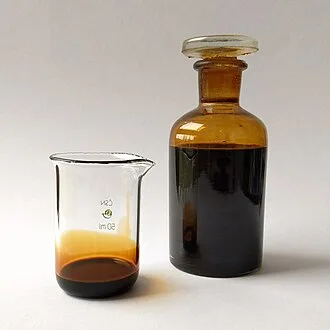
Petroleum is a fossil fuel formed over millions of years from anaerobic decay of organic materials from buried prehistoric organisms, particularly plankton and algae. It is estimated that 70% of the world's oil deposits were formed during the Mesozoic, 20% were formed in the Cenozoic, and only 10% were formed in the Paleozoic.
Conventional reserves of petroleum are primarily recovered by drilling, which is performed after studying the relevant structural geology, analysis of the sedimentary basin, and characterization of the petroleum reservoir. There are also unconventional reserves such as oil sands and oil shale which are recovered using methods such as fracking.
Once extracted, oil is refined and separated, most easily by distillation, into numerous products for direct use or use in manufacturing. Petroleum products include fuels such as gasoline (petrol), diesel, kerosene and jet fuel; bitumen, paraffin wax and lubricants; reagents used to make plastics; solvents, textiles, refrigerants, paint, synthetic rubber, fertilizers, pesticides, pharmaceuticals, and thousands of other petrochemicals.
Petroleum is used to manufacture a wide variety of materials essential for modern life, and it is estimated that the world consumes about 100 million barrels (16 million cubic metres) each day. Petroleum production played a key role in industrialization and economic development, especially after the Second Industrial Revolution.
Some petroleum-rich countries, known as petrostates, gained significant economic and international influence during the latter half of the 20th century due to their control of oil production and trade.
Petroleum is a non-renewable natural resource, and its exploitation is damaging to the natural environment, climate system and human health. Extraction, refining and burning of petroleum fuels counteract carbon sinks by releasing large quantities of greenhouse gases back into the Earth's atmosphere, making petroleum one of the major contributors to anthropogenic climate change.
Other negative environmental effects, at almost all stages of use, include direct release—such as oil spills—and secondary pollution of air and water sources.
Proximity to petroleum deposits, and subsequent access to and pricing of oil have historically fueled both domestic and geopolitical conflicts, state-sanctioned oil wars, diplomatic and trade frictions, energy policy disputes and other resource conflicts. While production is estimated to reach peak oil before 2035, global economic focus on climate change mitigation in the transition to renewable energy sources and increased electrification will greatly reduce dependency on petroleum.
Etymology
The word petroleum comes from Medieval Latin petroleum (literally 'rock oil'), which comes from Latin petra 'rock' (from Greek pétra πέτρα) and oleum 'oil' (from Greek élaion ἔλαιον).
The origin of the term stems from monasteries in southern Italy where it was in use by the end of the first millennium as an alternative for the oldest term "naphtha". After that, the term was used in numerous manuscripts and books, such as in the treatise De Natura Fossilium, published in 1546 by German mineralogist Georg Bauer.
After the advent of the oil industry during the second half of the 19th century, the term became commonly known for the liquid form of hydrocarbons.
History
Early
Petroleum in some form has been used since ancient times. More than 4,300 years ago, bitumen was mentioned when the Sumerians used it to make boats. A tablet of the legend of the birth of Sargon of Akkad mentions a basket which was closed by straw and bitumen. More than 4,000 years ago, according to Herodotus and Diodorus Siculus, asphalt (bitumen) was used in the construction of the walls and towers of Babylon; there were oil pits near Ardericca and Babylon and a pitch spring on Zakynthos. In Babylon, petroleum was used for road construction, ship caulking, and medicine.
The use of petroleum in ancient China dates back more than 2,000 years. The I Ching, one of the earliest Chinese writings, cites that oil in its raw state, without refining, was first discovered, extracted, and used in China in the 1st century BCE. In addition, the Chinese were the first to record the use of petroleum as fuel as early as the 4th century BCE. By 347 CE, oil was produced from bamboo-drilled wells in China.
In the 7th century, petroleum was among the essential ingredients for Greek fire, an incendiary projectile weapon that was used by Byzantine Greeks against Arab ships attacking Constantinople. Crude oil was distilled by Persian chemists, with clear descriptions given in Arabic handbooks such as those of Abu Bakr al-Razi.
In the 9th century, oil fields were exploited in the area around modern Baku, Azerbaijan. These fields were described by Abu Bakr al-Razi in the 10th century and by Marco Polo in the 13th century, who describes the output of those wells as hundreds of shiploads. Arab and Persian chemists distilled crude oil to produce flammable products for military purposes.
Through Islamic Spain, distillation became available in Western Europe by the 12th century. It was present in Romania since the 13th century, being recorded as păcură.
Sophisticated oil pits, 4.5 to 6 metres (15 to 20 ft) deep, were dug by the Seneca people and other Iroquois in Western Pennsylvania as early as 1415–1450. The French General Louis-Joseph de Montcalm encountered Seneca using petroleum for ceremonial fires and as a healing lotion during a visit to Fort Duquesne in 1750.
Early British explorers to Myanmar documented a flourishing oil extraction industry based in Yenangyaung that, in 1795, had hundreds of hand-dug wells under production. Merkwiller-Pechelbronn is said to be the first European site where petroleum has been explored and used.
19th century
In the mid-19th century, oil wells developed quickly in various parts of the world, though the title of the "first oil well" depends on the criteria. In 1846, a group of Russian Imperial engineers directed by Major Alexeyev of the Bakinskii Corps of Mining Engineers accidentally struck oil while hand-drilling with a primitive percussion rig in Bibi-Heybat, near Baku (now Azerbaijan), though they were not specifically searching for oil.
In 1853, Ignacy Łukasiewicz, who discovered how to distill kerosene from seep crude oil and invented the modern kerosene lamp, hand-dug the first intentional well for commercial oil extraction in Bóbrka, Poland, to supply fuel for lighting (still operational as of 2025[update]).
A hand-dug well and another refinery followed in 1857 near Ploiești, Romania. Romania (then a vassal of the Ottoman Empire) was the first country in the world to have its annual crude oil output officially recorded in international statistics – 275 tonnes for 1857.
In 1858, Georg Christian Konrad Hunäus found a significant amount of petroleum while drilling for lignite in Wietze, Germany. Wietze later provided about 80% of German consumption in the Wilhelmine Era. The production stopped in 1963, but Wietze has hosted a petroleum museum since 1970. Oil sands have been mined since the 18th century.
In Wietze, natural asphalt/bitumen has been explored since the 18th century. Both in Pechelbronn as in Wietze, the coal industry dominated the petroleum technologies.
Chemist James Young in 1847 noticed a natural petroleum seepage in the coal mine at Riddings, Derbyshire, from which he distilled a light thin oil suitable for use as lamp oil, at the same time obtaining a more viscous oil suitable for lubricating machinery. In 1848, Young set up a small business refining crude oil. Young eventually succeeded (by distilling cannel coal at low heat) in creating a fluid resembling petroleum, which when treated in the same way as the seep oil gave similar products.
Young found that by slow distillation he could obtain several useful liquids from it, one of which he named "paraffine oil" because at low temperatures it congealed into a substance resembling paraffin wax. The production of these oils and solid paraffin wax from coal formed the subject of his patent dated October 17, 1850.
In 1850, Young & Meldrum and Edward William Binney entered into partnership under the title of E.W. Binney & Co. at Bathgate in West Lothian and E. Meldrum & Co. at Glasgow; their works at Bathgate were completed in 1851 and became the first truly commercial oil-works in the world with the first modern oil refinery.[clarification needed]
The demand for petroleum as a fuel for lighting in North America and around the world quickly grew. The first oil well in the Americas was drilled in 1859 by Edwin Drake at what is now called the Drake Well in Cherrytree Township, Pennsylvania. There also was a company associated with it, and it sparked an oil boom and rapid expansion of the global petroleum industry. The same year, engine-drilled wells appeared in West Virginia.
The first commercial oil well in Canada became operational in 1858 at Oil Springs, Ontario. Businessman James Miller Williams dug several wells between 1855 and 1858 before discovering a rich reserve of oil four metres below ground.[specify] Williams extracted 1.5 million litres of crude oil by 1860, refining much of it into kerosene lamp oil.
Williams's well became commercially viable a year before Drake's Pennsylvania operation and could be argued to be the first commercial oil well in North America. The discovery at Oil Springs touched off an oil boom which brought hundreds of speculators and workers to the area. Advances in drilling continued into 1862 when local driller Shaw reached a depth of 62 metres using the spring-pole drilling method.
On January 16, 1862, after an explosion of natural gas, Canada's first oil gusher came into production, shooting into the air at a recorded rate of 480 cubic metres (3,000 bbl) per day. By the end of the 19th century the Russian Empire, particularly the Branobel company in Azerbaijan, had taken the lead in production.
20th century
In the 1930s, Alfred Treibs determined the biological origin of petroleum, which was previously controversial.
Access to oil was a major factor in several military conflicts of the 20th century, including World War II, during which oil facilities were a major strategic asset and were extensively bombed. The German invasion of the Soviet Union included the goal to capture the Baku oilfields, as it would provide much-needed oil supplies for the German military which was suffering from blockades.
Oil exploration in North America during the early 20th century led to the U.S. becoming the leading producer by mid-century. As petroleum production in the U.S. peaked during the 1960s, the United States was surpassed by Saudi Arabia and the Soviet Union in total output.
During the 1973 oil crisis, Saudi Arabia and other Arab nations imposed an oil embargo against the United States, the United Kingdom, Japan and other Western nations which supported Israel in the Yom Kippur War. This was followed by the 1979 oil crisis, which was caused by a drop in oil production in the wake of the Iranian Revolution and caused oil prices to more than double.
The two oil price shocks had many short and long-term effects on global politics and the global economy. They led to sustained reductions in demand as a result of substitution to other fuels, especially coal and nuclear, and improvements in energy efficiency, facilitated by government policies. High oil prices also induced investment in oil production by non-OPEC countries, including Prudhoe Bay in Alaska, the North Sea offshore fields of the United Kingdom and Norway, the Cantarell offshore field of Mexico, and oil sands in Canada.
21st century
About 89 percent of vehicular fuel needs are met by oil. Petroleum makes up 38 percent of total energy consumption in the United States, but is responsible for only 0.4 percent of electricity generation. Petroleum's worth as a portable, dense energy source powering the vast majority of vehicles and as the base of many industrial chemicals makes it one of the world's most important commodities.
The top three oil-producing countries as of 2018 are the United States, Russia, and Saudi Arabia. In 2018, due in part to developments in hydraulic fracturing and horizontal drilling, the United States became the world's largest producer.
About 80 percent of the world's readily accessible reserves are located in the Middle East, with 62.5 percent coming from the Arab five: Saudi Arabia, United Arab Emirates, Iraq, Qatar, and Kuwait. A large portion of the world's total oil exists as unconventional sources, such as bitumen in Athabasca oil sands and extra heavy oil in the Orinoco Belt.
While significant volumes of oil are extracted from oil sands, particularly in Canada, logistical and technical hurdles remain, as oil extraction requires large amounts of heat and water, making its net energy content quite low relative to conventional crude oil. Thus, Canada's oil sands are not expected to provide more than a few million barrels per day in the foreseeable future.
Many modern geopolitical conflicts are to do with petroleum.
Composition
Petroleum consists of a variety of liquid, gaseous, and solid components. Lighter hydrocarbons are the gases methane, ethane, propane and butane. Otherwise the bulk of the liquid and solids are largely heavier organic compounds, often hydrocarbons (C and H only). The proportion of light hydrocarbons in a petroleum mixture varies among oil fields.
An oil well produces predominantly crude oil. Because the pressure is lower at the surface than underground, some of the gas will come out of solution and be recovered (or burned) as associated gas or solution gas. A gas well produces predominantly natural gas. However, because the underground temperature is higher than at the surface, the gas may contain heavier hydrocarbons such as pentane, hexane, and heptane ("natural-gas condensate", often shortened to condensate.) Condensate resembles gasoline in appearance and is similar in composition to some volatile light crude oils.
The hydrocarbons in crude oil are mostly alkanes, cycloalkanes and various aromatic hydrocarbons, while the other organic compounds contain nitrogen, oxygen, and sulfur, and traces of metals such as iron, nickel, copper and vanadium. Many oil reservoirs contain live bacteria. The molecular composition of crude oil varies widely from formation to formation, but the proportion of chemical elements varies over fairly narrow limits as follows:
Four different types of hydrocarbon appear in crude oil. The relative percentage of each varies, determining the properties of each oil.
The alkanes from pentane (C5H12) to octane (C8H18) are refined into gasoline, the ones from nonane (C9H20) to hexadecane (C16H34) into diesel fuel, kerosene and jet fuel. Alkanes with more than 16 carbon atoms can be refined into fuel oil and lubricating oil.
At the heavier end of the range, paraffin wax is an alkane with approximately 25 carbon atoms, while asphalt has 35 and up, although these are usually cracked in modern refineries into more valuable products. The lightest fraction, the so-called petroleum gases, are subjected to diverse processing depending on cost. These gases are either flared off, sold as liquefied petroleum gas, or used to power the refinery's own burners.
During the winter, butane (C4H10) is blended into the gasoline pool at high rates because its high vapour pressure assists with cold starts. The aromatic hydrocarbons are unsaturated hydrocarbons that have one or more benzene rings. They tend to burn with a sooty flame, and many have a sweet aroma. Some are carcinogenic.
These different components are separated by fractional distillation at an oil refinery to produce gasoline, jet fuel, kerosene, and other hydrocarbon fractions. The components in an oil sample can be determined by gas chromatography and mass spectrometry. Due to the large number of co-eluted hydrocarbons within oil, many cannot be resolved by traditional gas chromatography.
This unresolved complex mixture (UCM) of hydrocarbons is particularly apparent when analysing weathered oils and extracts from tissues of organisms exposed to oil.
Crude oil varies greatly in appearance depending on its composition. It is usually black or dark brown (although it may be yellowish, reddish, or even greenish). In the reservoir it is usually found in association with natural gas (which being lighter forms a "gas cap" over the petroleum) and saline water (which being heavier than most forms of crude oil, generally sinks beneath it).
Crude oil may also be found in a semi-solid form mixed with sand and water, as in the Athabasca oil sands in Canada, where it is usually referred to as crude bitumen. In Canada, bitumen is considered a sticky, black, tar-like form of crude oil which is so thick and heavy that it must be heated or diluted before it will flow.
Venezuela also has large amounts of oil in the Orinoco oil sands, although the hydrocarbons trapped in them are less viscous than in Canada and are usually called extra heavy oil. Oil sands resources are called unconventional oil to distinguish them from oil which can be extracted using traditional oil well methods. Between them, Canada and Venezuela contain an estimated 3.6 trillion barrels (570×109 m3) of bitumen and extra heavy oil, about twice the volume of the world's reserves of conventional oil.
Formation
Fossil petroleum
Petroleum is a fossil fuel derived from fossilized organic materials, such as zooplankton and algae. Vast amounts of these remains settled to sea or lake bottoms where they were covered in stagnant water (water with no dissolved oxygen) or sediments (such as mud and silt) faster than they could decompose aerobically. Approximately 1 m below this sediment, water oxygen concentration was low, below 0.1 mg/L, and anoxic conditions existed. Temperatures also remained constant.
As further layers settled into the sea or lake bed, intense heat and pressure built up in the lower regions. This process caused the organic matter to change, first into a waxy material known as kerogen (found in various oil shales around the world) and then with more heat into liquid and gaseous hydrocarbons via a process known as catagenesis.
Formation of petroleum occurs from hydrocarbon pyrolysis in a variety of mainly endothermic reactions at high temperatures or pressures, or both. These phases are described in detail below.