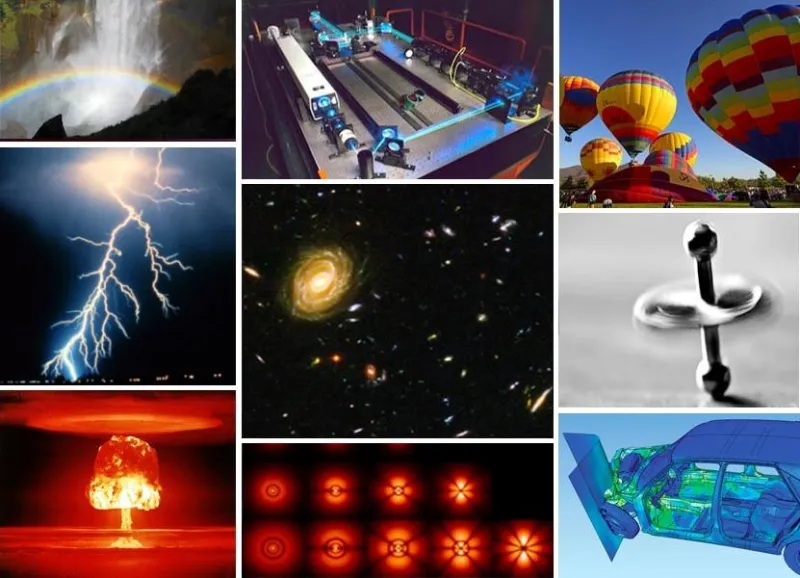
Physics is one of the oldest academic disciplines. Over much of the past two millennia, physics, chemistry, biology, and certain branches of mathematics were part of natural philosophy, but during the Scientific Revolution in the 17th century, these natural sciences branched into separate research endeavors. Physics intersects with many interdisciplinary areas of research, such as biophysics and quantum chemistry, and the boundaries of physics are not rigidly defined.
New ideas in physics often explain the fundamental mechanisms studied by other sciences and suggest new avenues of research in these and other academic disciplines, such as mathematics and philosophy.
Advances in physics often enable new technologies. For example, advances in the understanding of electromagnetism, solid-state physics, and nuclear physics led directly to the development of technologies that have transformed modern society, such as television, computers, domestic appliances, and nuclear weapons; advances in thermodynamics led to the development of industrialization; and advances in mechanics inspired the development of calculus.
History
The word physics comes from the Latin physica ('study of nature'), which itself is a borrowing of the Greek φυσική (phusikḗ 'natural science'), a term derived from φύσις (phúsis 'origin, nature, property').
Ancient astronomy
Astronomy is one of the oldest natural sciences. Early civilizations dating before 3000 BCE, such as the Sumerians, ancient Egyptians, and the Indus Valley Civilization, had a predictive knowledge and a basic awareness of the motions of the Sun, Moon, and stars. The stars and planets, believed to represent gods, were often worshipped.
While the explanations for the observed positions of the stars were often unscientific and lacking in evidence, these early observations laid the foundation for later astronomy, as the stars were found to traverse great circles across the sky, which could not explain the positions of the planets.
According to Asger Aaboe, the origins of Western astronomy can be found in Mesopotamia, and all Western efforts in the exact sciences are descended from late Babylonian astronomy. Egyptian astronomers left monuments showing knowledge of the constellations and the motions of the celestial bodies, while Greek poet Homer wrote of various celestial objects in his Iliad and Odyssey; later Greek astronomers provided names, which are still used today, for most constellations visible from the Northern Hemisphere.
Natural philosophy
Natural philosophy has its origins in Greece during the Archaic period (650 BCE – 480 BCE), when pre-Socratic philosophers like Thales rejected non-naturalistic explanations for natural phenomena and proclaimed that every event had a natural cause. They proposed ideas verified by reason and observation, and many of their hypotheses proved successful in experiment; for example, atomism was found to be correct approximately 2000 years after it was proposed by Leucippus and his pupil Democritus.
Aristotle and Hellenistic physics
During the classical period in Greece (6th, 5th and 4th centuries BCE) and in Hellenistic times, natural philosophy developed along many lines of inquiry. Aristotle (Greek: Ἀριστοτέλης, Aristotélēs) (384–322 BCE), a student of Plato, wrote on many subjects, including a substantial treatise on "Physics" – in the 4th century BC.
Aristotelian physics was influential for about two millennia. His approach mixed some limited observation with logical deductive arguments, but did not rely on experimental verification of deduced statements. Aristotle's foundational work in Physics, though very imperfect, formed a framework against which later thinkers further developed the field. His approach is entirely superseded today.[citation needed]
He explained ideas such as motion (and gravity) with the theory of four elements. Aristotle believed that each of the four classical elements (air, fire, water, earth) had its own natural place. Because of their differing densities, each element will revert to its own specific place in the atmosphere. So, because of their weights, fire would be at the top, air underneath fire, then water, then lastly earth.
He also stated that when a small amount of one element enters the natural place of another, the less abundant element will automatically go towards its own natural place. For example, if there is a fire on the ground, the flames go up into the air in an attempt to go back into its natural place where it belongs. His laws of motion included: that heavier objects will fall faster, the speed being proportional to the weight and the speed of the object that is falling depends inversely on the density object it is falling through (e.g. density of air).
He also stated that, when it comes to violent motion (motion of an object when a force is applied to it by a second object), the speed that object moves will only be as fast or strong as the measure of force applied to it. The problem of motion and its causes was studied carefully, leading to the philosophical notion of a "prime mover" as the ultimate source of all motion in the world (Book 8 of his treatise Physics).
Medieval European and Islamic
The Western Roman Empire fell to invaders and internal decay in the fifth century, resulting in a decline in intellectual pursuits in western Europe. By contrast, the Eastern Roman Empire (usually known as the Byzantine Empire) resisted the attacks from invaders and continued to advance various fields of learning, including physics.
In the sixth century, John Philoponus challenged the dominant Aristotelian approach to science although much of his work was focused on Christian theology.
In the sixth century, Isidore of Miletus created an important compilation of Archimedes' works that are copied in the Archimedes Palimpsest. Islamic scholarship inherited Aristotelian physics from the Greeks and during the Islamic Golden Age developed it further.
The most notable innovations under Islamic scholarship were in the field of optics and vision, which came from the works of many scientists like Ibn Sahl, Al-Kindi, Ibn al-Haytham, Al-Farisi and Avicenna. In his Book of Optics (also known as Kitāb al-Manāẓir) Ibn al-Haytham presented the idea of light rays as an alternative to the ancient Greek idea about visual rays.
Like Ptolemy, Ibn al-Haytham applied controlled experiments, verifying the laws of refraction and reflection with the new concept of light rays, but still lacking the concept of image formation.
Scientific Revolution
Physics became a separate science when early modern Europeans used experimental and quantitative methods to discover what are now considered to be the laws of physics.[page needed]
Major developments in this period include the replacement of the geocentric model of the Solar System with the heliocentric Copernican model, the laws governing the motion of planetary bodies (determined by Johannes Kepler between 1609 and 1619), Galileo's pioneering work on telescopes and observational astronomy in the 16th and 17th centuries, and Isaac Newton's discovery and unification of the laws of motion and universal gravitation (that would come to bear his name). Newton, and separately Gottfried Wilhelm Leibniz, developed calculus, the mathematical study of continuous change, and Newton applied it to solve physical problems.
19th century
The discovery of laws in thermodynamics, chemistry, and electromagnetics resulted from research efforts during the Industrial Revolution as energy needs increased. By the end of the 19th century, theories of thermodynamics, mechanics, and electromagnetics matched a wide variety of observations. Taken together these theories became the basis for what would later be called classical physics.
A few experimental results remained inexplicable. Classical electromagnetism presumed a medium, an luminiferous aether to support the propagation of waves, but this medium could not be detected. The intensity of light from hot glowing blackbody objects did not match the predictions of thermodynamics and electromagnetism.
The character of electron emission of illuminated metals differed from predictions. These failures, seemingly insignificant in the big picture would upset the physics world in first two decades of the 20th century.
20th century
Modern physics began in the early 20th century with the work of Max Planck in quantum theory and Albert Einstein's theory of relativity. Both of these theories came about due to inaccuracies in classical mechanics in certain situations. Classical mechanics predicted that the speed of light depends on the motion of the observer, which could not be resolved with the constant speed predicted by Maxwell's equations of electromagnetism.
This discrepancy was corrected by Einstein's theory of special relativity, which replaced classical mechanics for fast-moving bodies and allowed for a constant speed of light. Black-body radiation provided another problem for classical physics, which was corrected when Planck proposed that the excitation of material oscillators is possible only in discrete steps proportional to their frequency.
This, along with the photoelectric effect and a complete theory predicting discrete energy levels of electron orbitals, led to the theory of quantum mechanics improving on classical physics at very small scales.
Quantum mechanics would come to be pioneered by Werner Heisenberg, Erwin Schrödinger and Paul Dirac. From this early work, and work in related fields, the Standard Model of particle physics was derived. Following the discovery of a particle with properties consistent with the Higgs boson at CERN in 2012, all fundamental particles predicted by the Standard Model, and no others, appear to exist; however, physics beyond the Standard Model, with theories such as supersymmetry, is an active area of research.
Areas of mathematics in general are important to this field, such as the study of probabilities and groups.
Core theories
Physics deals with a wide variety of systems, although certain theories are used by all physicists. Each of these theories was experimentally tested numerous times and found to be an adequate approximation of nature. These central theories are important tools for research into more specialized topics, and any physicist, regardless of their specialization, is expected to be literate in them.
These include classical mechanics, quantum mechanics, thermodynamics and statistical mechanics, electromagnetism, and special relativity.
Distinction between classical and modern physics
In the first decades of the 20th century physics was revolutionized by the discoveries of quantum mechanics and relativity. The changes were so fundamental that these new concepts became the foundation of "modern physics", with other topics becoming "classical physics". The majority of applications of physics are essentially classical.
The laws of classical physics accurately describe systems whose important length scales are greater than the atomic scale and whose motions are much slower than the speed of light. Outside of this domain, observations do not match predictions provided by classical mechanics.
Classical theory
Classical physics includes the traditional branches and topics that were recognized and well-developed before the beginning of the 20th century—classical mechanics, thermodynamics, and electromagnetism. Classical mechanics is concerned with bodies acted on by forces and bodies in motion and may be divided into statics (study of the forces on a body or bodies not subject to an acceleration), kinematics (study of motion without regard to its causes), and dynamics (study of motion and the forces that affect it); mechanics may also be divided into solid mechanics and fluid mechanics (known together as continuum mechanics), the latter include such branches as hydrostatics, hydrodynamics and pneumatics.
Acoustics is the study of how sound is produced, controlled, transmitted and received. Important modern branches of acoustics include ultrasonics, the study of sound waves of very high frequency beyond the range of human hearing; bioacoustics, the physics of animal calls and hearing; and electroacoustics, the manipulation of audible sound waves using electronics.
Optics, the study of light, is concerned not only with visible light but also with infrared and ultraviolet radiation, which exhibit all of the phenomena of visible light except visibility, e.g., reflection, refraction, interference, diffraction, dispersion, and polarization of light. Heat is a form of energy, the internal energy possessed by the particles of which a substance is composed; thermodynamics deals with the relationships between heat and other forms of energy.
Electricity and magnetism have been studied as a single branch of physics since the intimate connection between them was discovered in the early 19th century; an electric current gives rise to a magnetic field, and a changing magnetic field induces an electric current. Electrostatics deals with electric charges at rest, electrodynamics with moving charges, and magnetostatics with magnetic poles at rest.
Modern theory
The discovery of relativity and of quantum mechanics in the first decades of the 20th century transformed the conceptual basis of physics without reducing the practical value of most of the physical theories developed up to that time. Consequently the topics of physics have come to be divided into "classical physics" and "modern physics", with the latter category including effects related to quantum mechanics and relativity.
Classical physics is generally concerned with matter and energy on the normal scale of observation, while much of modern physics is concerned with the behavior of matter and energy under extreme conditions or on a very large or very small scale. For example, atomic and nuclear physics study matter on the smallest scale at which chemical elements can be identified.
The physics of elementary particles is on an even smaller scale since it is concerned with the most basic units of matter; this branch of physics is also known as high-energy physics because of the extremely high energies necessary to produce many types of particles in particle accelerators. On this scale, ordinary, commonsensical notions of space, time, matter, and energy are no longer valid.
The two chief theories of modern physics present a different picture of the concepts of space, time, and matter from that presented by classical physics. Classical mechanics approximates nature as continuous, while quantum theory is concerned with the discrete nature of many phenomena at the atomic and subatomic level and with the complementary aspects of particles and waves in the description of such phenomena.
The theory of relativity is concerned with the description of phenomena that take place in a frame of reference that is in motion with respect to an observer; the special theory of relativity is concerned with motion in the absence of gravitational fields and the general theory of relativity with motion and its connection with gravitation. Both quantum theory and the theory of relativity find applications in many areas of modern physics.
Fundamental concepts in modern physics include:
- Action
- Causality
- Covariance
- Particle
- Physical field
- Physical interaction
- Quantum
- Statistical ensemble
- Symmetry
- Wave
Research
Scientific method
Physicists use the scientific method to test the validity of a physical theory. By using a methodical approach to compare the implications of a theory with the conclusions drawn from its related experiments and observations, physicists are better able to test the validity of a theory in a logical, unbiased, and repeatable way.
To that end, experiments are performed and observations are made in order to determine the validity or invalidity of a theory.
A scientific law is a concise verbal or mathematical statement of a relation that expresses a fundamental principle of some theory, such as Newton's law of universal gravitation.
Theory and experiment
Theorists seek to develop mathematical models that both agree with existing experiments and successfully predict future experimental results, while experimentalists devise and perform experiments to test theoretical predictions and explore new phenomena. Although theory and experiment are developed separately, they strongly affect and depend upon each other.
Progress in physics frequently comes about when experimental results defy explanation by existing theories, prompting intense focus on applicable modeling, and when new theories generate experimentally testable predictions, which inspire the development of new experiments (and often related equipment).
Physicists who work at the interplay of theory and experiment are called phenomenologists, who study complex phenomena observed in experiment and work to relate them to a fundamental theory.
Theoretical physics has historically taken inspiration from philosophy; electromagnetism was unified this way. Beyond the known universe, the field of theoretical physics also deals with hypothetical issues, such as parallel universes, a multiverse, and higher dimensions. Theorists invoke these ideas in hopes of solving particular problems with existing theories; they then explore the consequences of these ideas and work toward making testable predictions.
Experimental physics expands, and is expanded by, engineering and technology. Experimental physicists who are involved in basic research design and perform experiments with equipment such as particle accelerators and lasers, whereas those involved in applied research often work in industry, developing technologies such as magnetic resonance imaging (MRI) and transistors. Feynman has noted that experimentalists may seek areas that have not been explored well by theorists.
Scope and aims
Physics covers a wide range of phenomena, from elementary particles (such as quarks, neutrinos, and electrons) to the largest superclusters of galaxies. Included in these phenomena are the most basic objects composing all other things. Therefore, physics is sometimes called the "fundamental science". Physics aims to describe the various phenomena that occur in nature in terms of simpler phenomena.
Thus, physics aims to both connect the things observable to humans to root causes, and then connect these causes together.
For example, the ancient Chinese observed that certain rocks (lodestone and magnetite) were attracted to one another by an invisible force. This effect was later called magnetism, which was first rigorously studied in the 17th century. But even before the Chinese discovered magnetism, the ancient Greeks knew of other objects such as amber, that when rubbed with fur would cause a similar invisible attraction between the two.
This was also first studied rigorously in the 17th century and came to be called electricity. Thus, physics had come to understand two observations of nature in terms of some root cause (electricity and magnetism). However, further work in the 19th century revealed that these two forces were just two different aspects of one force—electromagnetism.
This process of "unifying" forces continues today, and electromagnetism and the weak nuclear force are now considered to be two aspects of the electroweak interaction. Physics hopes to find an ultimate reason (theory of everything) for why nature is as it is (see section Current research below for more information).
Current research
Research in physics is continually progressing on a large number of fronts.