Pier Paolo Pasolini
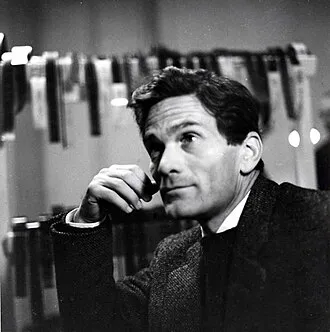
A controversial personality due to his straightforward style, Pasolini's legacy remains contentious. Openly homosexual, while also a vocal advocate for heritage language revival, cultural conservatism, and Christian values in his youth, Pasolini became an avowed Marxist shortly after the end of World War II. He began voicing extremely harsh criticism of Italian petite bourgeoisie and what he saw as the Americanization, cultural degeneration, and greed-driven consumerism taking over Italian culture.
As a filmmaker, Pasolini often juxtaposed socio-political polemics with an extremely graphic and critical examination of taboo sexual activity. A prominent protagonist of the Roman intellectual scene during the post-war era, Pasolini became an established and major figure in European literature and cinema.
Pasolini's unsolved and extremely brutal abduction, torture, and murder at Ostia in November 1975 prompted an outcry in Italy, where it continues to be a matter of heated debate. Recent leads by Italian cold case investigators suggest a contract killing by the Banda della Magliana, a criminal organisation with close links to the Propaganda Due masonic lodge and far-right terrorism, as the most likely cause.
Biography
Early life
Pier Paolo Pasolini was born in Bologna, the elder son of Susanna Colussi, a Friulian elementary school teacher who would outlive both of her children, and Carlo Alberto Pasolini, a lieutenant in the Royal Italian Army who belonged to the cadet branch of an aristocratic family from Ravenna. They married in 1921. Pasolini was born in 1922 and named after a paternal uncle.
The family moved to Conegliano in 1923, then to Belluno in 1925, where their second son, Guidalberto, was born. In 1926, Pasolini's father was arrested for gambling debts. His mother moved with the children to her family's home in Casarsa della Delizia, in the Friuli-Venezia Giulia region. Carlo Alberto reportedly became persuaded of the virtues of Italian fascism.
Pasolini began writing poems at age seven, inspired by the natural beauty of Casarsa. One of his early influences was the work of Arthur Rimbaud. His father was transferred to Idria in the Julian March (now in Slovenia) in 1931.
In 1933, they moved again to Cremona in Lombardy, and later to Scandiano and Reggio Emilia. Pasolini found it difficult to adapt to all these dislocations, although he enlarged his poetry and literature readings (Dostoyevsky, Tolstoy, Shakespeare, Coleridge, Novalis) and left behind the religious fervour of his early years.
In the Reggio Emilia high school, he met his first true friend, Luciano Serra. The two met again in Bologna, where Pasolini spent seven years completing high school. Here he cultivated new passions, including football.[citation needed]
In 1939, Pasolini graduated and entered the Literature College of the University of Bologna, discovering new themes such as philology and aesthetics of figurative arts. He also frequented the local cinema club. Pasolini always showed his friends a virile and strong exterior, totally hiding his interior turmoil. In his poems of this period, Pasolini started to include fragments in Friulan, a minority language he did not speak but learned after he had begun to write poetry in it. "I learnt it as a sort of mystic act of love, a kind of félibrisme, like the Provençal poets."
In 1943, he would found the Academiuta della lenga furlana (Academy of the Friulan Language) with fellow students. As a young adult, Pasolini identified as an atheist.
In the waning years of World War II, Pasolini was drafted into the Italian Army. After his regiment was captured by the Germans following Italy's surrender, he escaped and fled to the small town of Casarsa where he remained for several years.
Early poetry
In 1942, Pasolini published at his own expense a collection of poems in Friulan, Poesie a Casarsa, which he had written at the age of eighteen. The work was noted and appreciated by such intellectuals and critics as Gianfranco Contini, Alfonso Gatto and Antonio Russi. Pasolini's pictures had also been well received.
He was chief editor of a magazine called Il Setaccio ('The Sieve'), but was fired after conflicts with the director, who was aligned with the Fascist regime. A trip to Germany also helped him to perceive the "provincial" status of Italian culture in that period. These experiences led Pasolini to revise his opinion about the cultural politics of Fascism and to switch gradually to a communist position.
Pasolini's family took shelter in Casarsa, considered a more tranquil place to wait for the conclusion of the Second World War, a decision common among Italian military families. Here he joined a group of other young enthusiasts of the Friulan language who wanted to give Casarsa Friulan a status equal to that of Udine, the official regional standard.
From May 1944, they issued a magazine entitled Stroligùt di cà da l'aga. In the meantime, Casarsa suffered Allied bombardments and forced enlistments by the Italian Social Republic, as well as partisan activity.
Pasolini tried to distance himself from these events. Starting in October 1943, Pasolini, his mother and other colleagues taught students unable to reach the schools in Pordenone or Udine. This educational workshop was considered illegal and was broken up in February 1944. His brother Guidalberto, aged 19, joined the Party of Action and their Brigate Osoppo, taking to the bush near Slovenia.
On 12 February 1945, Guido was killed in an ambush planted by the Brigate Garibaldi serving in the lines of Josip Broz Tito's Yugoslavian guerrillas. This devastated Pasolini and his mother.
Six days after his brother's death, Pasolini and others founded the Friulan Language Academy (Academiuta di lenga furlana). Meanwhile, on account of Guido's death, Pasolini's father returned to Italy from his detention period in November 1945, settling in Casarsa. That same month, Pasolini graduated from university after completing a final thesis about the work of Giovanni Pascoli (1855–1912), an Italian poet and classical scholar.
In 1946, Pasolini published a small poetry collection, I Diarii ('The Diaries'), with the Academiuta. In October, he travelled to Rome. The following May he began the so-called Quaderni Rossi, handwritten in old school exercise books with red covers. He completed a drama in Italian, Il Cappellano. His poetry collection, I Pianti ('The cries'), was also published by the Academiuta.
Rome
In January 1950, Pasolini moved to Rome with his mother Susanna, to start a new life. He was acquitted of two indecency charges in 1950 and 1952. After one year sheltered in a maternal uncle's flat next to Piazza Mattei, Pasolini and his 59-year-old mother moved to a run-down suburb called Rebibbia, next to a prison, living there for three years.
He transferred his Friulan countryside inspiration to this Roman suburb, one of the infamous borgate where poor proletarian immigrants lived, often in horrendous sanitary and social conditions. Instead of asking for help from other writers, Pasolini preferred to go his own way.
Pasolini found a job working in the Cinecittà film studios and sold his books in the bancarelle ('sidewalk shops') of Rome. In 1951, with the help of the Abruzzese-language poet Vittorio Clemente, he found a job as a secondary school teacher in Ciampino, just outside the capital. He had a long commute involving two train changes and earned a meagre salary of 27,000 lire.
Career
Writing
In 1954, Pasolini, who now worked for the literary section of Cinecittà, left his teaching job and moved to the Monteverde quarter. At this point, his cousin Graziella moved in. They also accommodated Pasolini's ailing, cirrhotic father Carlo Alberto, who died in 1958. Pasolini published La meglio gioventù, his first important collection of Friulan poems.
His first novel, Ragazzi di vita (English: Hustlers), which dealt with the Roman lumpenproletariat, was published in 1955. The work had great success but was poorly received by the Italian Communist Party (PCI) establishment and, most importantly, by the Italian government. It initiated a lawsuit for "obscenity" against Pasolini and his publisher, Garzanti. Although exonerated, Pasolini became a target of insinuations, especially in the tabloid press.
In 1955, together with Francesco Leonetti, Roberto Roversi and others, Pasolini edited and published a poetry magazine called Officina. The magazine closed in 1959 after fourteen issues. That year he also published his second novel, Una vita violenta, which unlike his first was embraced by the Communist cultural sphere: he subsequently wrote a column titled Dialoghi con Passolini (meaning Passolini in Dialogue), for the PCI magazine Vie Nuove from May 1960 to September 1965, which were published in book form in 1977 as Le belle bandiere (The Beautiful Flags). In the late 1960s Pasolini edited an advice column in the weekly news magazine Tempo.
In 1966, Pasolini wrote a screenplay for a never-produced film about the apostle Saint Paul, which he subsequently revised. Pasolini's screenplay was intended to depict Paul as a modern contemporary without modifying any of Paul's statements. In Pasolini's story, Paul is a fascist Vichy France collaborator who becomes illuminated while traveling to Franco's Spain and joins the antifascist French resistance, an event which serves as the modern analogue for the Pauline conversion.
The screenplay follows Paul as he preaches resistance in Italy, Spain, Germany, and New York (where he is betrayed, arrested, and executed). As philosopher Alain Badiou writes, "The most surprising thing in all this is the way in which Paul's texts are transplanted unaltered, and with an almost unfathomable naturalness, into the situations in which Pasolini deploys them: war, fascism, American capitalism, the petty debates of Italian intelligentsia[.]"
In 1970, Pasolini bought an old castle near Viterbo, several miles north of Rome, where he began to write his last novel, Il Petrolio, in which he denounced obscure dealing in the highest levels of government and the corporate world (Eni, CIA, the Mafia, etc). The novel-documentary was left incomplete at his death.
In 1972, Pasolini started to collaborate with the far-left organization Lotta Continua, producing a documentary, 12 dicembre, concerning the Piazza Fontana bombing. The following year he began a collaboration for Italy's most renowned newspaper, Il Corriere della Sera. At the beginning of 1975, Garzanti published a collection of his critical essays, Scritti corsari.[citation needed]
Narrative
- Ragazzi di vita (The Ragazzi, 1955)
- Una vita violenta (A Violent Life, 1959)
- Il sogno di una cosa (1962)
- Amado Mio—Atti Impuri (1982, originally written in 1948)
- Alì dagli occhi azzurri (1965)
- Teorema (1968)
- Reality (The Poets' Encyclopedia, 1979)
- Petrolio (1992, incomplete)
Poetry
- La meglio gioventù (1954)
- Le ceneri di Gramsci (1957)
- L'usignolo della chiesa cattolica (1958)
- La religione del mio tempo (1961)
- Poesia in forma di rosa (1964)
- Trasumanar e organizzar (1971)
- La nuova gioventù (1975)
- Roman Poems. Pocket Poets No. 41 (1986)
- The Selected Poetry of Pier Paolo Pasolini: A Bilingual Edition (2014)
Essays
- Passione e ideologia (1960)
- Canzoniere italiano, poesia popolare italiana (1960)
- Empirismo eretico (1972)
- Lettere luterane (1976)
- Le belle bandiere (1977)
- Descrizioni di descrizioni (1979)
- Il caos (1979)
- La pornografia è noiosa (1979)
- Scritti corsari (1975)
- Lettere (1940–1954) (Letters, 1940–54, 1986)
Theatre
- Orgia (1968)
- Porcile (1968)
- Calderón (1973)
- Affabulazione (1977)
- Pilade (1977)
- Bestia da stile (1977)
Films
In 1957, together with Sergio Citti, Pasolini collaborated on Federico Fellini's film Nights of Cabiria, writing dialogue for the Roman dialect sections. Fellini also asked him to work on dialogue for some episodes of La dolce vita.
Pasolini made his debut as an actor in The Hunchback of Rome in 1960, and co-wrote Long Night in 1943. Along with Ragazzi di vita, he had his celebrated poem Le ceneri di Gramsci published, where Pasolini voiced tormented tensions between reason and heart, as well as the existing ideological dialectics within communism, a debate over artistic freedom, socialist realism and commitment.
Pasolini's first film as director and screenwriter was Accattone in 1961, again set among Rome's marginal communities, a story of pimps, prostitutes, and thieves that contrasted with Italy's postwar economic recovery. Although Pasolini tried to distance himself from neorealism, it is considered to be a type of second neorealism.
Nick Barbaro, a critic writing in the Austin Chronicle, stated it "may be the grimmest movie" he has ever seen. The film aroused controversy and scandal, with conservatives demanded stricter censorship by the government. In 1963, the episode "La ricotta", included in the anthology film Ro.Go.Pa.G., was censored, and Pasolini was tried for "offence to the Italian state and religion".
During this period, Pasolini frequently travelled abroad: in 1961, with Elsa Morante and Alberto Moravia to India (where he went again seven years later); in 1962, to Sudan and Kenya; in 1963, to Ghana, Nigeria, Guinea, Jordan and Israel (where he shot the documentary Sopralluoghi in Palestina). In 1970 he travelled again to Africa to shoot another documentary, Appunti per un'Orestiade africana.
Pasolini was a member of the jury at the 16th Berlin International Film Festival in 1966. In 1967, in Venice, he met and interviewed American poet Ezra Pound. They discussed the Italian movement neoavanguardia, and Pasolini read some verses from the Italian translation of Pound's Pisan Cantos.
The late 1960s and early 1970s was the era of the student movement. Pasolini, although acknowledging the students' ideological motivations, and referring to himself as a "Catholic Marxist", thought them "anthropologically middle-class" and therefore destined to fail in their attempts at revolutionary change. Regarding the Battle of Valle Giulia, which took place in Rome in March 1968, he said that he sympathized with the police, as they were "children of the poor", while the young militants were exponents of what he called "left-wing fascism".[citation needed]
He wrote and directed the black-and-white film The Gospel According to Matthew (1964). It is based on scripture, but adapted by Pasolini, and he is credited as a writer. Jesus, a barefoot peasant, is played by Enrique Irazoqui. In his 1966 film Uccellacci e uccellini (literally "Bad Birds and Little Birds" but translated in English as The Hawks and the Sparrows), a picaresque—and at the same time mystic—fable, Pasolini hired great Italian comedian Totò to work with Ninetto Davoli, the director's lover at the time and one of his preferred "naif" actors.
It was a unique opportunity for Totò to demonstrate that he was a great dramatic actor as well.[citation needed] In Teorema (Theorem, 1968), starring Terence Stamp as a mysterious stranger, Pasolini depicted the sexual coming-apart of a bourgeois family.
Later films are comedies centred on sex-laden folklore, such as Giovanni Boccaccio's Decameron (1971), Geoffrey Chaucer's The Canterbury Tales (1972), and Il fiore delle mille e una notte (literally The Flower of 1001 Nights, released in English as Arabian Nights, 1974). These sex comedies are usually grouped as the Trilogy of Life.
In Salò, humans are not only seen as commodities under authoritarian or totalitarian control but are viewed merely as cyphers for its whims.
His final work, Salò o le 120 giornate di Sodoma (Salò, or the 120 Days of Sodom, 1975), exceeded what most viewers could accept at the time in its explicit scenes of sexual perversity and intensely sadistic violence. Based on the novel 120 Days of Sodom by Marquis de Sade, it is considered Pasolini's most controversial film.
In May 2006, Time Out's Film Guide named it the "Most Controversial Film" of all time. Salò was intended as the first film of his Trilogy of Death, followed by an aborted biopic film about Gilles de Rais.