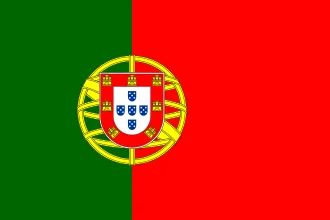
The western Iberian Peninsula has been inhabited since prehistory, with the earliest signs of settlement dating to between 5500 BC and 5300 BC. Muslims had occupied the Iberian Peninsula since 711. As a result of the Reconquista against them, Portugal was established as a county of the Kingdom of León in 868 and formally as a kingdom in 1179.
During the Age of Discovery, the kingdom made several advancements in nautical science and maritime exploration to discover new territories and sea routes, which led to the establishment of the Portuguese Empire. The kingdom became a republic in 1910, before becoming a dictatorship in 1926, whose 1974 overthrow enabled democracy to be established in 1976.
Portugal is a unitary republic and multi-party representative democracy with four separate sovereignty organs: president, government, parliament, and judiciary. It has a unicameral national legislature known as the Assembly of the Republic (Assembleia da República). Portugal is divided into seven mainland regions and two autonomous overseas regions, though it remains a highly centralised country.
A developed country, Portugal has an advanced economy that chiefly relies upon services, industry, and tourism. Shaped by the various civilisations that have inhabited its territory, such as the Carthaginians and the Romans, Portugal developed a culture with a worldwide influence. This allowed Portuguese to become the world's fifth-most spoken native language, with more than 250 million native speakers.
With a stable foreign policy shaped by its colonial and diplomatic history and location, Portugal is a member of multiple international organisations and forums.
Etymology
The word Portugal derives from Latin Portus Cale, a Roman name meaning 'port of Cale', itself the origin of the name of the Portuguese city of Porto, while Cale was a town on the Douro.
There is no consensus on the etymology of Cale. It could derive from the pre-Indo-European word Kala, meaning 'shelter' or 'refuge', passed into the Celtic language in the form Cale, with the meaning of 'land' or 'mountain'. The ethnonym Calaico/a then came from the Gallaeci, Celtic peoples of northwestern Iberia, and came to mean 'one of the land' or 'one of the place.
During the Middle Ages, the region around Portus Cale became known by the Visigoths as Portucale and by the Suebi as Parochiale. The name Portucale evolved into Portugale; by the 11th and 12th centuries Portugal referred to the region between the Douro and Minho rivers.
History
Prehistory
The region has been inhabited by humans since approximately 400,000 years ago. Neanderthals roamed the southwestern Iberian Peninsula until 37,000 years ago, and anatomically modern humans arrived in what is now Portugal around 40,000 years ago.
The onset of the Neolithic in the area dates to between 5500 BC and 5300 BC. In southern Portugal, Iron Age inscribed stele have been found, representing early evidence of writing in the Iberian Peninsula. Pre-Celtic tribes originally from the Ukrainian steppes inhabited mainland Portugal and the Lusitanians occupied mostly central, inland regions in 1250 BC.
Celts may have spread westwards in Iberia in the latter 1st millennium BC. Phoenicians colonised Portugal during the 7th and 8th centuries BC.
Antiquity and early Middle Ages
The Mediterranean coast was well known to the Carthaginians. Their close relations with Phoenician-Punic settlements and shared cultural ties likely gave them considerable political and economic influence there from the 6th or 5th century BC, alongside the establishment of unequal treaties with Iberian city-states.
After Carthage's defeat by Rome in the First Punic War, it sought new western territories, culminating in the Barcid conquest of the Iberian Peninsula in 237 BC.
The Romans invaded the Iberian Peninsula in 218 BC and expelled the Carthaginians after the Battle of Ilipa in 206 BC. Within 200 years, mainland Portugal had been annexed by the Romans despite resistance from local tribes such as the Lusitanians under the leadership of Viriathus and other leaders.
In 409, with the decline of the Western Roman Empire, the Iberian Peninsula was invaded by Germanic tribes. Western Iberia was integrated into the Suebian Kingdom, with its capital in or near Braga. The Visigoths defeated the Suebi in 585 and ruled the peninsula until the early 8th century.
In 711, the Iberian Peninsula was invaded from the south by the Umayyad Caliphate, which expanded rapidly. By 716, present-day mainland Portugal was part of the Muslim Iberian territories known as al-Andalus. The Umayyad Caliphate ruled al-Andalus as a province until its independence in 756 under the Emirate of Córdoba, which in 929 gave way to a caliphate that lasted until it fragmented into states known as taifas, collapsing in 1031, and most of what is now central and southern Portugal falling under the Taifa of Badajoz.
The taifas were conquered by Muslim forces from North Africa, first completely by the Almoravids by 1115, who were in turn followed by the Almohads in the 1140s. Northern incursions also occurred during this period, with Viking raids recorded from 844 into the 11th century.
Reconquista and independence
The Reconquista was a series of military and cultural campaigns by northern Iberian Christian polities against al-Andalus. The death of the Umayyad emir Abd ar-Rahman II in 852 brought an end to Umayyad efforts to extend authority northward. The discovery in the 830s of a tomb believed to be that of James the Great gave the Christians a powerful patron, and the elevation of Alfonso III of Asturias in the 860s ended a period of uncertain leadership, thereby providing the command required to channel this energy into a wave of expansionism southward.
In 868, the region between the Minho and Douro rivers was secured from the Moors by Christian forces under Vímara Peres and constituted as the County of Portugal under him. The first county of Portugal lasted until 1071. In 1096, Alfonso VI of León refounded the county and bestowed it on Henry of Burgundy, who married Alfonso's illegitimate daughter, Teresa of León.
After Count Henry's death in 1112, Teresa ruled Portugal as queen. Her close association from 1121 with Fernão Peres de Trava, a Galician noble, displeased the local nobility, who sided with her son, Afonso Henriques and defeated her and her supporters at the Battle of São Mamede in 1128. The following year, Afonso claimed sole authority over the entire county, free from foreign influence.
According to legend, he won the Battle of Ourique and took the title of King in 1139. Afonso's claim was implicitly recognised by Alfonso VII of León at the Conference of Zamora in 1143, and by Pope Alexander III in 1179 through the papal bull Manifestis Probatum.
With the support of north-European crusaders and Christian military and religious orders, Afonso Henriques and his successors continued pushing south until the capture of Algarve, the southernmost region of mainland Portugal, which was recognised by the Kingdom of Castile as Portuguese territory in 1267. With minor readjustments, Portugal's borders have largely remained the same since the signing of the Treaty of Alcañices between Denis of Portugal and Fernando IV of Castile in 1297.
Between the 14th and early 15th century, Portugal was struck by several outbreaks of the plague, civil wars, invasions, famines, and natural disasters that led to a population decrease, labour shortages, and rise in antisemitism.
Age of Discovery
After King Ferdinand I’s death in 1383, his minor daughter Beatrice became his legal successor under the regency of Leonor Teles. Leonor's unpopularity triggered a crisis compounded by fears that the marriage between Beatrice and John I of Castile could lead to the loss of Portugal's independence.
In 1385, John of Aviz, a royal bastard and brother of Ferdinand, was elected king and later defeated the Castilians in the Battle of Aljubarrota consolidating the House of Aviz's rule over the country. In 1386, during his reign, Portugal cemented its alliance with England with the signing of the Treaty of Windsor, making it the oldest standing alliance in the world.
The dynasty contributed to the conditions for Portugal's maritime expansion, elevating it in European politics and culture. Portugal acquired its first colonies by conquering Ceuta in North Africa in 1415. Portugal was among the first to start the Age of Discovery, and its scientific advances influenced other European countries' overseas expansions.
Portugal was the first and the last colonial power in the era of modern European colonialism, and by the mid-16th century it controlled a network of possessions stretching from Lisbon to Japan and Timor through Brazil. Throughout the 15th and 16th centuries, Portuguese explorers sailed the coast of Africa, established trading posts [[Economic history of Portugal#Expansion of the Portuguese empire (15th and 16th centuries)|for commodities]] especially gold and slaves, explored the Indian Ocean and eastern Asia, and established trade routes in most of southern Asia, taxing most trade criss-crossing the Indian Ocean.
However, by the 16th century its enterprise in Asia was already in decline. The 1494 Treaty of Tordesillas divided newly encountered non-European territories between Portugal and Spain along a meridian west of Cape Verde, while the 1529 Treaty of Zaragoza extended this partition to the Pacific Ocean.
In 1498, Vasco da Gama reached India by sea, and two years later Pedro Álvares Cabral landed in Brazil and claimed it for Portugal. During the 15th century, Portugal established the transatlantic slave-trade circuits and, by the mid-19th century, had become one of the longest-active and a significant participant in the Atlantic slave trade.
Iberian Union and Restoration
The 1578 death of King Sebastian in battle and the subsequent 1580 death of King Henry without a named heir, precipitated a succession crisis. Philip II of Spain, whose mother was Isabella of Portugal, was one of the candidates for the throne. In 1581 he was acclaimed king of Portugal, creating a personal union between the two kingdoms. This deprived Portugal of an independent foreign policy and led to the Dutch-Portuguese War.
In 1641, John, Duke of Braganza, was proclaimed king by the Cortes after an uprising led by some nobles in the year before, ending the Iberian Union under the House of Habsburg, and beginning the rule of the House of Braganza. Following the Portuguese Restoration War, Spain recognised Afonso VI as king of Portugal. During the reign of John V, the large influx of Brazilian gold into the royal treasury, chiefly through the royal fifth, produced a resource curse that weakened industry and cereal production, created a gold rush from Portugal to Brazil, and led to prolonged economic stagnation, permanent reduction of income growth, and the interruption of the institutional and economic progress achieved in the 17th century.
After the depletion of gold revenues, Portugal was left with a weak industrial base and backward institutional and educational structures. This condition was exacerbated by Sebastião José de Carvalho e Melo, 1st Marquis of Pombal, who emerged as the country's de facto ruler in the aftermath of the 1755 earthquake and tsunami, one of the kingdom's worst recorded natural disaster.
Pombal's industrialisation efforts failed, and his education policies weakened human-capital formation. The expulsion of the Jesuits reduced student numbers and contributed to Portugal's decline in literacy. Pombal's instrumentalisation of the Inquisition for political purposes helped to entrench an extractive system that outlasted his rule.
The nature of the existing political institutions contributed to Portugal's sustained divergence from Western Europe despite comparable family values and high state capacity, with partial recovery beginning from around the mid-20th century alongside the continuation of colonialism.
Constitutional monarchy
In 1807, Portugal refused Napoleon's demand to join the Continental System of embargo against the United Kingdom; an invasion led by General Junot followed, and Lisbon was captured in 1807. During the Napoleonic invasions, the Portuguese royal family transferred the court to Rio de Janeiro, in Brazil, making it the capital between 1808 and 1821.
British intervention in the Peninsular War helped support Portuguese independence, and all French troops were expelled by 1812.
In 1820, an uprising in Porto sought to establish a constitution for Portugal and led to the return of King John VI and his court to mainland Portugal in 1821. Although the 1822 Constitution was adopted, the process was marked by compromise and efforts at consensus, which allowed absolutist forces to regain strength, culminating in Miguelist counter-revolts against liberalism, prompting Prince Miguel's exile.
After John VI's death in 1826, his eldest son, Pedro I of Brazil, briefly reigned as Pedro IV of Portugal, granted the 1826 Charter, and abdicated in favour of his minor daughter, Maria da Glória, on the condition that she marry Miguel, who was appointed regent. Although Miguel's return was under the condition of swearing allegiance to the Charter, he soon dismantled liberal institutions and was proclaimed king in 1828, leading to the Liberal Wars, after which Pedro forced Miguel's abdication in favour of Maria and his exile causing absolutist ideology to wane.
Under the constitutional monarchy, the country faced economic crises, political instability, and several coups d'état. Portugal's African colonial expansion culminated in the 1890 British Ultimatum, which thwarted its ambitions. The ultimatum and the 1891 Anglo-Portuguese Treaty, compounded by existing turmoil, led to political erosion and weakened the monarchy.
First Republic and Estado Novo
In 1908, King Carlos I and Luís Filipe, Prince Royal, were assassinated by republican partisans. In 1910, the monarchy was replaced with a republic. During World War I, Portugal fought for the Allies. The war increased political instability and deepened the economic crisis creating further chaos and unrest during the First Republic.
These conditions led to the overthrow of the Republic in 1926 and the establishment of the Ditadura Militar, later the Ditadura Nacional, which evolved into the authoritarian nationalist corporative dictatorship of the Estado Novo, under António de Oliveira Salazar.