
















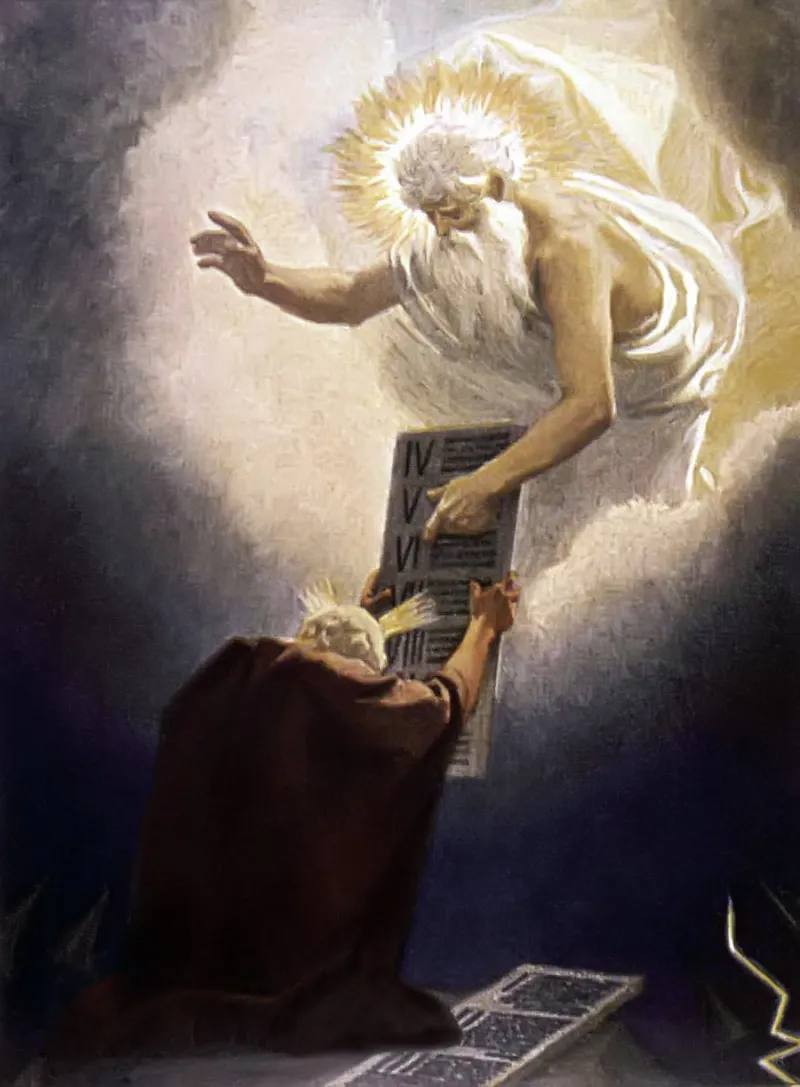
Prophethood has existed in many cultures and religions throughout history, including Mesopotamian religion, Zoroastrianism, Buddhism, the Abrahamic religions, Mandaeism, Manichaeism, and Thelema.
Etymology
The English word prophet is the transliteration of a compound Greek word derived from pro (before/toward) and phesein (to tell); thus, a προφήτης (prophḗtēs) is someone who conveys messages from the divine to humans, including occasionally foretelling future events. In a different interpretation, it means advocate or speaker.
It is used to translate the Hebrew word נָבִיא (nāvî) in the Septuagint and the Arabic word نبي (nabī). W.F. Albright points to the Akkadian Nabu for the origin of these Hebrew (נָבִיא (nāvî) and the Arabic نبي (nabī) words.
The Akkadian nabû means "announcer" or "authorised person", derived from the Semitic root n-b-y or nbʾ. It is cognate with Classical Syriac: ܢܒܝܐ, nəḇiyyā, Arabic: نبي, nabiyy, and Hebrew: נביא, nāḇī, all meaning 'prophet'.
In Hebrew, the word נָבִיא (nāvî), "spokesperson", traditionally translates as "prophet". The second subdivision of the Tanakh, Nevi'im, is devoted to the Hebrew prophets. The meaning of navi is perhaps described in Deuteronomy 18:18, where God said, "...and I will put My words in his mouth, and he shall speak unto them all that I shall command him." Thus, a navi was thought to be the "mouth" of God.
A Jewish tradition was that the root nun-bet-alef ("navi") is based on the two-letter root nun-bet which denotes hollowness or openness; to receive transcendental wisdom, one must make oneself "open".
Mesopotamian origins
Before the advent of Zoroastrianism and the prophetic tradition established by Zoroaster, various ancient civilizations had individuals who served as intermediaries between humanity and the divine. In ancient Sumer, for instance, figures such as the "ensi" or "lugal" fulfilled roles akin to prophets, offering guidance and interpreting divine will through rituals, omens, and prayers.
The ensi was considered a representative of the city-state's patron deity. The functions of a lugal would include certain ceremonial and cultic activities, arbitration in border disputes, and military defence against external enemies. The ensis of Lagash would sometimes refer to the city's patron deity, Ningirsu, as their lugal ("master").
All of the above is connected to the possibly priestly or sacral character of the titles ensi and especially en (the latter term continuing to designate priests in subsequent times).
These prophets, while lacking the systematic theological framework found in later traditions, laid the groundwork for the concept of prophethood by demonstrating a connection with the divine and providing spiritual leadership within their communities. Despite the absence of codified scripture or organized religious institutions, these pre-Zoroastrian prophetic figures played a crucial role in shaping early religious thought and practices, paving the way for the structured prophetic tradition that emerged with Zoroaster and subsequent religious traditions.
Zoroastrianism
Zoroastrianism holds a significant position in shaping the concept of prophets and prophecy. Founded by the revered figure Zoroaster (or Zarathustra) in ancient Persia around the 6th century BCE, Zoroastrianism introduced fundamental ideas that profoundly influenced subsequent religious and philosophical traditions, particularly in its portrayal of prophetic figures.
At the heart of Zoroastrian belief lies the concept of a singular supreme deity, Ahura Mazda, engaged in an eternal struggle against the forces of darkness and chaos, embodied by Angra Mainyu. Zoroaster, as the primary prophet of this faith, received divine revelations and visions from Ahura Mazda, which formed the basis of the Avesta, the sacred scripture of Zoroastrianism.
Zoroaster's role as a prophet established a template for future religious leaders and visionaries. He articulated monotheistic principles, ethical dualism, and the idea of a cosmic battle between good and evil, influencing not only the religious landscape of ancient Persia but also later traditions such as Judaism, Christianity, Islam, and Thelema.
The legacy of Zoroastrianism in shaping the understanding of prophets is profound. Zoroaster's direct communication with the divine, his role as a mediator between humanity and the divine will, and his teachings about moral righteousness laid the groundwork for the concept of prophethood as it evolved in subsequent religious traditions.
Influence from Zoroastrian thought can be seen in the characterization of prophets as individuals chosen by a single supreme deity to convey divine messages, guide communities, and uphold moral principles. The structured prophetic tradition established by Zoroaster set a precedent for future prophets, shaping how societies perceive and interact with visionary figures throughout history.
While other ancient civilizations may have had individuals who served similar functions, Zoroastrianism's systematic approach to prophecy and its enduring influence on subsequent religious thought solidified its place in history as a foundational example of prophetic tradition, enriching humanity's understanding of the divine and the role of prophets in conveying its will.
Judaism
Some examples of prophets in the Tanakh include Abraham, Moses, Miriam, Isaiah, Samuel, Ezekiel, Malachi, and Job. Moses is considered the most important prophet in Judaism. On one occasion during the Exodus journey, "the spirit which was upon Moses" was passed to seventy elders, who were also able to prophesy for one time only, but mostly they could not prophesy again.
Moses expressed the hope that "all the LORD's people" could be prophets. In addition to writing and speaking messages from God, Israelite or Judean nevi'im ("spokespersons", "prophets") often acted out prophetic parables in their life. For example, in order to contrast the people's disobedience with the obedience of the Rechabites, God has Jeremiah invite the Rechabites to drink wine, in disobedience to their ancestor's command.
The Rechabites refuse, for which God commends them. Other prophetic parables acted out by Jeremiah include burying a linen belt so that it gets ruined to illustrate how God intends to ruin Judah's pride. Likewise, Jeremiah buys a clay jar and smashes it in the Valley of Ben Hinnom in front of elders and priests to illustrate that God will smash the nation of Judah and the city of Judah beyond repair.
God instructs Jeremiah to make a yoke from wood and leather straps and to put it on his own neck to demonstrate how God will put the nation under the yoke of Nebuchadnezzar, king of Babylon. In a similar way, the prophet Isaiah had to walk stripped and barefoot for three years to illustrate the coming captivity, and the prophet Ezekiel had to lie on his side for 390 days and to eat measured food to illustrate the coming siege.
Prophetic assignment is usually portrayed as rigorous and exacting in the Hebrew Bible, and prophets were often the target of persecution and opposition. God's personal prediction for Jeremiah, "And they shall fight against thee; but they shall not prevail against thee," was performed many times in the biblical narrative as Jeremiah warned of destruction of those who continued to refuse repentance and accept more moderate consequences.
In return for his adherence to God's discipline and speaking God's words, Jeremiah was attacked by his own brothers, beaten and put into the stocks by a priest and false prophet, imprisoned by the king, threatened with death, thrown into a cistern by Judah's officials, and opposed by a false prophet. Likewise, Isaiah was told by his hearers who rejected his message, "Leave the way!
Get off the path! Let us hear no more about the Holy One of Israel!" The life of Moses being threatened by Pharaoh is another example.
According to I Samuel 9:9, the old name for navi is ro'eh, רֹאֶה, which literally means "seer". That could document an ancient shift, from viewing prophets as seers for hire to viewing them as moral teachers. L. C. Allen (1971) comments that in the First Temple Era, there were essentially seer-priests belonging to a guild, who performed divination, rituals, and sacrifices, and were scribes; and beside these were canonical prophets, who did none of these things (and condemned divination), but came to deliver a message.
The seer-priests were usually attached to a local shrine or temple, such as Shiloh, and initiated others into that priesthood, acting as a mystical craft-guild with apprentices and recruitment. Canonical prophets were not organised this way.
A Jewish tradition suggests that there were twice as many prophets as the number which left Egypt, which would make 1,200,000 prophets. The Talmud recognizes 48 male prophets who bequeathed permanent messages to humankind. According to the Talmud, there were also seven women counted as prophetesses whose message bears relevance for all generations: Sarah, Miriam, Devorah, Hannah (mother of the prophet Samuel), Abigail (a wife of King David), Huldah (from the time of Jeremiah), and Esther.
The Talmudic and Biblical commentator Rashi points out that Rebecca, Rachel, and Leah were also prophets. Isaiah 8:3-4 refers to Isaiah's wife, who bore his son Maher-shalal-hash-baz as "the prophetess"; she is not referred to elsewhere.
Prophets in the Tanakh are not always Jews; note for example the non-Jewish prophet Balaam in Numbers 22. According to the Talmud, Obadiah is said to have been a convert to Judaism.
The last nevi'im mentioned in the Jewish Bible are Haggai, Zechariah, and Malachi, all of whom lived at the end of the 70-year Babylonian exile of c. 586 to 539 BCE. The Talmud (Sanhedrin 11a) states that Haggai, Zachariah, and Malachi were the last prophets, and later times have known only the "Bath Kol" (בת קול, lit. daughter of a voice, "voice of God").
Christianity
Traditional definitions
In Christianity, a prophet (or seer) is one inspired by God through the Holy Spirit to deliver a message. This includes Jewish prophets active before the church began and the prophets active in the Christian church. Some Christian denominations limit a prophet's message to words intended only for active members of a congregation, excluding social or political messages.
However, the Bible has several occasions in which prophets were called to deliver social or political messages. The reception of a message is termed revelation and the delivery of the message is termed prophecy.
The term "prophet" applies to those who receive public or private revelation. Public revelation, in Catholicism, is part of the Deposit of faith, the revelation of which was completed by Jesus; whereas private revelation does not add to the Deposit. The term "deposit of faith" refers to the entirety of Jesus Christ's revelation, and is passed to successive generations through scripture and the traditions of the church.
The Bible applies the appellation 'false prophet' to anyone who preaches a Gospel contrary to that delivered to the apostles and recorded in Sacred Scripture. One Old Testament text in Deuteronomy contains a warning against those who prophesy events which do not come to pass and says they should be put to death. Elsewhere a false prophet may be someone who is purposely trying to deceive, is delusional, under the influence of Satan or is speaking from his own spirit.
Catholicism
Six of the Minor Prophets are commemorated in December. Each encouraged people to return to God, to repent of past sins, and to recognize God's presence even in their difficulties.
"Jesus Christ is the one whom the Father anointed with the Holy Spirit and established as priest, prophet, and king. The whole People of God participates in these three offices of Christ and bears the responsibilities for mission and service that flow from them." The laity act prophetically when they speak the truth, and live the Gospel by example before their families, neighbors, and co-workers.
The Old Testament prophets defended the poor and powerless "and inspire Catholic Social Teaching on the preferential option for the poor, workers’ rights, and justice and peace."
Ongoing prophecy
Christians who believe that the Holy Spirit continues to give spiritual gifts to Christians are known as continuationists. These charismata may include prophecy, tongues, miraculous healing ability, and discernment (Matthew 12:32 KJV "Whosoever speaketh a word against the Son of Man, it shall be forgiven him: but whosoever speaketh against the Holy Ghost, it shall not be forgiven him, neither in this world, neither in the world to come.").
Cessationists believe that these gifts were given only in New Testament times and that they ceased after the last apostle died.
The last prophet of the Old Covenant before the arrival of Jesus is John the Baptist. New Testament passages that explicitly discuss prophets existing after the death and resurrection of Christ include Revelation 11:10, Matthew 10:40–41 and 23:34, John 13:20 and 15:20 and Acts 11:25–30, 13:1 and 15:32.
The Didache gives extensive instruction in how to distinguish between true and false prophets, as well as commands regarding tithes to prophets in the church. Irenaeus, wrote of 2nd-century believers with the gift of prophecy, while Justin Martyr argued in his Dialogue with Trypho that prophets were not found among the Jews in his time, but that the church had prophets. The Shepherd of Hermas describes revelation in a vision regarding the proper operation of prophecy in the church.
Eusebius mentions that Quadratus and Ammia of Philadelphia were both prominent prophets following the age of the Twelve Apostles. Tertullian, writing of the church meetings of the Montanists (to whom he belonged), described in detail the practice of prophecy in the 2nd-century church.
A number of later Christian saints were said to have powers of prophecy, such as Columba of Iona (521–597), Saint Malachy (1094–1148) or Padre Pio (1887–1968). Marian apparitions like those at Fatima in 1917 or at Kibeho in Rwanda in the 1980s often included prophetic predictions regarding the future of the world as well as of the local areas they occurred in.
Prophetic movements in particular can be traced throughout the Christian Church's history, expressing themselves in (for example) Montanism, Novatianism, Donatism, Franciscanism, Anabaptism, Camisard enthusiasm, Puritanism, Quakerism, Quietism, Lutheranism and Radical Pietism. Modern Pentecostals and Charismatics, members of movements which together comprised approximately 584 million people as of 2011[update], believe in the contemporary function of the gift of prophecy, and some in these movements, especially those within the Apostolic-Prophetic Movement, allow for idea that God may continue to gift the church with some individuals who are prophets.
Some Christian sects recognize the existence of "modern-day" prophets. One such denomination is the Church of Jesus Christ of Latter-day Saints, which teaches that God still communicates with humankind through prophecy.
Latter Day Saint movement
Joseph Smith, who established the Church of Christ in 1830, is considered a prophet by members of the Latter Day Saint movement, of which the Church of Jesus Christ of Latter-day Saints (LDS Church) is the largest denomination. Additionally, many churches within the movement believe in a succession of modern prophets (accepted by Latter Day Saints as "prophets, seers, and revelators") since the time of Joseph Smith, Dallin H. Oaks is the current Prophet and President of the Church of Jesus Christ of Latter-day Saints.
Adventism
Baptist preacher William Miller is credited with beginning the mid-19th century North American religious movement now known as Adventism. He announced a Second Coming, resulting in the Great Disappointment.
Seventh-day Adventist
The Seventh-day Adventist Church, which was established in 1863, believes that Ellen G. White, one of the church's founders, was given the spiritual gift of prophecy.
Branch Davidians
The Branch Davidians are a religious cult which was founded in 1959 by Benjamin Roden as an offshoot of the Seventh-Day Adventist Church. David Koresh, who died in the Waco Siege in 1993, called himself their final prophet and "the Son of God, the Lamb" in 1983.
Manichaeism
Mani (Persian: مانی, c. April AD 216–2 March AD 274 or 26 February AD 277) was an Iranian prophet and the founder of Manichaeism, a religion most prevalent in late antiquity.
Mani was born in or near Seleucia-Ctesiphon (south of modern Baghdad) in Mesopotamia, at the time part of the Parthian Empire. Seven of his major works were written in Syriac, and the eighth, dedicated to the Sasanian emperor Shapur I, was written in Middle Persian. He died in Gundeshapur.
Manichaeism teaches an elaborate dualistic cosmology describing the struggle between a good, spiritual world of light, and an evil, material world of darkness. Through an ongoing process that takes place in human history, light is gradually removed from the world of matter and returned to the world of light, whence it came.
Mani's teaching was intended to "combine", succeed, and surpass the teachings of Christianity, Zoroastrianism, Buddhism, Marcionism, Hellenistic and Rabbinic Judaism, Gnostic movements, Ancient Greek religion, Babylonian and other Mesopotamian religions, and mystery cults. It reveres Mani as the final prophet after Zoroaster, the Gautama Buddha and Jesus Christ.