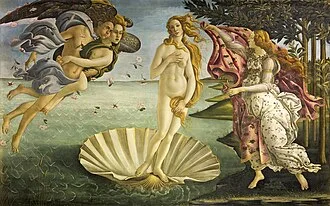
The Renaissance's intellectual basis was founded in its version of humanism, derived from the concept of Roman humanitas and the rediscovery of classical Greek philosophy, such as that of Protagoras, who said that "man is the measure of all things". Although the invention of metal movable type sped the dissemination of ideas from the later 15th century, the changes of the Renaissance were not uniform across Europe: the first traces appear in Italy as early as the late 13th century, in particular with the writings of Dante and the paintings of Giotto.
As a cultural movement, the Renaissance encompassed innovative flowering of literary Latin and an explosion of vernacular literatures, beginning with the 14th-century resurgence of learning based on classical sources, which contemporaries credited to Petrarch; the development of linear perspective and other techniques of rendering a more natural reality in painting; and gradual but widespread educational reform.
It saw myriad artistic developments and contributions from such polymaths as Leonardo da Vinci and Michelangelo, who inspired the term "Renaissance man". In politics, the Renaissance contributed to the development of the customs and conventions of diplomacy. The period also saw revolutions in printing and navigation, as well as the introduction of modern banking and the field of accounting.
Period
The Renaissance began in Italy during the crisis of the Late Middle Ages. It had a different period and characteristics north of the Alps and in Spain. In Italy, the period conventionally ends with the waning of humanism, and the advent of the Reformation (1517), the Sack of Rome (1527) or the Counter-Reformation (1545), and in art, the Baroque period.
Proponents of a "long Renaissance," however, may propose that (outside of Italy) the period extended into the 17th century.
The traditional view focuses more on the Renaissance's early modern aspects and argues that it was a break from the past, but many historians today focus more on its medieval aspects and argue that it was an extension of the Middle Ages.
Italian Renaissance
The beginnings of the period—the early Renaissance of the 15th century and the Italian Proto-Renaissance from around 1250 or 1300—overlap considerably with the Late Middle Ages, conventionally dated to c. 1350–1500, and the Middle Ages themselves were a long period filled with gradual changes, like the modern age; as a transitional period between both, the Renaissance has close similarities to both, especially the late and early sub-periods of either.
The Renaissance began in Florence, one of the many states of Italy. The Italian Renaissance concluded in 1527 when Holy Roman Emperor Charles V launched an assault on Rome during the war of the League of Cognac. Nevertheless, its impact endured in the art of renowned Italian painters like Tintoretto, Sofonisba Anguissola, and Paolo Veronese, who continued their work during the mid-to-late 16th century.
Various theories have been proposed to account for its origins and characteristics, focusing on a variety of factors, including Florence's social and civic peculiarities at the time: its political structure, the patronage of its dominant family, the Medici, and the migration of Greek scholars and their texts to Italy following the fall of Constantinople to the Ottoman Empire.
Other major centers were Venice, Genoa, Milan, Rome during the Renaissance Papacy, and Naples. From Italy, the Renaissance spread throughout Europe and also to American, African and Asian territories ruled by the European colonial powers of the time or where Christian missionaries were active.
The Renaissance has a long and complex historiography, and in line with general skepticism of discrete periodizations, there has been much debate among historians reacting to the 19th-century glorification of the "Renaissance" and individual cultural heroes as "Renaissance men", questioning the usefulness of Renaissance as a term and as a historical delineation.
Some observers have questioned whether the Renaissance was a cultural "advance" from the Middle Ages, instead seeing it as a period of pessimism and nostalgia for classical antiquity, while social and economic historians, especially of the longue durée, have instead focused on the continuity between the two eras, which are linked, as Panofsky observed, "by a thousand ties".
Overview
The Renaissance was a cultural movement that profoundly affected European intellectual life in the early modern period. Beginning in Italy, and spreading to the rest of Europe by the 16th century, its influence was felt in art, architecture, philosophy, literature, music, science, technology, politics, religion, and other aspects of intellectual inquiry.
Renaissance scholars employed the humanist method in study, and searched for realism and human emotion in art.
Renaissance humanists such as Poggio Bracciolini sought out in Europe's monastic libraries the Latin literary, historical, and oratorical texts of antiquity, while the fall of Constantinople (1453) generated a wave of émigré Greek scholars bringing precious manuscripts in ancient Greek, many of which had fallen into obscurity in the West. It was in their new focus on literary and historical texts that Renaissance scholars differed so markedly from the medieval scholars of the Renaissance of the 12th century, who had focused on studying Greek and Arabic works of natural sciences, philosophy, and mathematics, rather than on such cultural texts.[citation needed]
In the revival of neoplatonism, Renaissance humanists did not reject Christianity; on the contrary, many of the Renaissance's greatest works were devoted to it, and the Church patronized many works of Renaissance art. But a subtle shift took place in the way that intellectuals approached religion that was reflected in many other areas of cultural life.[better source needed] In addition, many Greek Christian works, including the Greek New Testament, were brought back from Byzantium to Western Europe and engaged Western scholars for the first time since late antiquity.
This new engagement with Greek Christian works, and particularly the return to the original Greek of the New Testament promoted by humanists Lorenzo Valla and Erasmus, helped pave the way for the Reformation.[citation needed]
Well after the first artistic return to classicism had been exemplified in the sculpture of Nicola Pisano, Florentine painters led by Masaccio strove to portray the human form realistically, developing techniques to render perspective and light more naturally. Political philosophers, most famously Niccolò Machiavelli, sought to describe political life as it really was, that is, to understand it rationally.
A critical contribution to Italian Renaissance humanism, Giovanni Pico della Mirandola wrote De hominis dignitate (Oration on the Dignity of Man, 1486), a series of theses on philosophy, natural thought, faith, and magic defended against any opponent on the grounds of reason. In addition to studying classical Latin and Greek, Renaissance authors also began increasingly to use vernacular languages; combined with the introduction of the printing press, this allowed many more people access to books, especially the Bible.
In all, the Renaissance can be viewed as an attempt by intellectuals to study and improve the secular and worldly, both through the revival of ideas from antiquity and through novel approaches to thought. Political philosopher Hans Kohn describes it as an age where "Men looked for new foundations"; some like Erasmus and Thomas More envisioned new reformed spiritual foundations, others, in the words of Machiavelli, una lunga sperienza delle cose moderne ed una continua lezione delle antiche (a long experience with modern life and a continuous learning from antiquity).
Sociologist Rodney Stark plays down the Renaissance in favor of the earlier innovations of the Italian city-states in the High Middle Ages, which married responsive government, Christianity and the birth of capitalism. This analysis argues that, whereas the great European states (France and Spain) were absolute monarchies, and others were under direct Church control, the independent city-republics of Italy took over the principles of capitalism invented on monastic estates and set off a vast unprecedented Commercial Revolution that preceded and financed the Renaissance.[citation needed]
Historian Leon Poliakov offers a critical view in his seminal study of European racist thought: The Aryan Myth. According to Poliakov, the use of ethnic origin myths are first used by Renaissance humanists "in the service of a new born chauvinism".
Origins
Many argue that the ideas characterizing the Renaissance had their origin in Florence at the turn of the 13th and 14th centuries, in particular with the writings of Dante Alighieri (1265–1321) and Petrarch (1304–1374), as well as the paintings of Giotto di Bondone (1267–1337). Some writers date the Renaissance quite precisely; one proposed starting point is 1401, when the rival geniuses Lorenzo Ghiberti and Filippo Brunelleschi competed for the contract to build the bronze doors for the Baptistery of the Florence Cathedral (Ghiberti won).
Others see more general competition between artists and polymaths such as Brunelleschi, Ghiberti, Donatello, and Masaccio for artistic commissions as sparking the creativity of the Renaissance.
Yet it remains much debated why the Renaissance began in Italy, and why it began when it did. Accordingly, several theories have been put forward to explain its origins. Peter Rietbergen posits that various influential Proto-Renaissance movements started from roughly 1300 onwards across many regions of Europe.
Latin and Greek phases of Renaissance humanism
In stark contrast to the High Middle Ages, when Latin scholars focused almost entirely on studying Greek and Arabic works of natural science, philosophy and mathematics, Renaissance scholars were most interested in recovering and studying Latin and Greek literary, historical, and oratorical texts. Broadly speaking, this began in the 14th century with a Latin phase, when Renaissance scholars such as Petrarch, Coluccio Salutati (1331–1406), Niccolò de' Niccoli (1364–1437), and Poggio Bracciolini (1380–1459) scoured the libraries of Europe in search of works by such Latin authors as Cicero, Lucretius, Livy, and Seneca.
By the early 15th century, the bulk of the surviving such Latin literature had been recovered; the Greek phase of Renaissance humanism was under way, as Western European scholars turned to recovering ancient Greek literary, historical, oratorical and theological texts.
Unlike with Latin texts, which had been preserved and studied in Western Europe since late antiquity, the study of ancient Greek texts was very limited in medieval Western Europe. Ancient Greek works on science, mathematics, and philosophy had been studied since the High Middle Ages in Western Europe and in the Islamic Golden Age (normally in translation), but Greek literary, oratorical and historical works (such as Homer, the Greek dramatists, Demosthenes and Thucydides) were not studied in either the Latin or medieval Islamic worlds; in the Middle Ages these sorts of texts were only studied by Byzantine scholars.
Some argue that the Timurid Renaissance in Samarkand and Herat, whose magnificence toned with Florence as the center of a cultural rebirth, were linked to the Ottoman Empire, whose conquests led to the migration of Greek scholars to Italian cities. One of the greatest achievements of Renaissance scholars was to bring this entire class of Greek cultural works back into Western Europe for the first time since late antiquity.
Muslim logicians, most notably Avicenna and Averroes, had inherited Greek ideas after they had invaded and conquered Egypt and the Levant. Their translations and commentaries on these ideas worked their way through the Arab West into Iberia and Sicily, which became important centers for this transmission of ideas. Between the 11th and 13th centuries, many schools dedicated to the translation of philosophical and scientific works from Classical Arabic to Medieval Latin were established in Iberia, most notably the Toledo School of Translators.
This work of translation from Islamic culture, though largely unplanned and disorganized, constituted one of the greatest transmissions of ideas in history.
The movement to reintegrate the regular study of Greek literary, historical, oratorical, and theological texts back into the Western European curriculum is usually dated to the 1396 invitation from Coluccio Salutati to the Byzantine diplomat and scholar Manuel Chrysoloras (c. 1355–1415) to teach Greek in Florence. This legacy was continued by a number of expatriate Greek scholars, from Basilios Bessarion to Leo Allatius.
Social and political structures in Italy
The unique political structures of Italy during the Late Middle Ages have led some to theorize that its unusual social climate allowed the emergence of a rare cultural efflorescence. Italy did not exist as a political entity in the early modern period. Instead, it was divided into smaller city-states and territories: the Neapolitans controlled the south, the Florentines and the Romans at the center, the Milanese and the Genoese to the north and west respectively, and the Venetians to the north east. 15th-century Italy was one of the most urbanized areas in Europe.
Many of its cities stood among the ruins of ancient Roman buildings; it seems likely that the classical nature of the Renaissance was linked to its origin in the Roman Empire's heartland.
Historian and political philosopher Quentin Skinner points out that Otto of Freising (c. 1114–1158), a German bishop visiting north Italy during the 12th century, noticed a widespread new form of political and social organization, observing that Italy appeared to have exited from feudalism so that its society was based on merchants and commerce.
Linked to this was anti-monarchical thinking, represented in the famous early Renaissance fresco cycle The Allegory of Good and Bad Government by Ambrogio Lorenzetti (painted 1338–1340), whose strong message is about the virtues of fairness, justice, republicanism and good administration. Holding both Church and Empire at bay, these city republics were devoted to notions of liberty.
Skinner reports that there were many defences of liberty such as the Matteo Palmieri (1406–1475) celebration of Florentine genius not only in art, sculpture and architecture, but "the remarkable efflorescence of moral, social and political philosophy that occurred in Florence at the same time".
Even cities and states beyond central Italy, such as the Republic of Florence at this time, were also notable for their merchant republics, especially the Republic of Venice. Although in practice these were oligarchical, and bore little resemblance to a modern democracy, they did have democratic features and were responsive states, with forms of participation in governance and belief in liberty.
The relative political freedom they afforded was conducive to academic and artistic advancement. Likewise, the position of Italian cities such as Venice as great trading centres made them intellectual crossroads. Merchants brought with them ideas from far corners of the globe, particularly the Levant. Venice was Europe's gateway to trade with the East, and a producer of fine glass, while Florence was a capital of textiles.
The wealth such business brought to Italy meant large public and private artistic projects could be commissioned and individuals had more leisure time for study.
Black Death
One theory that has been advanced is that the devastation in Florence caused by the Black Death, which hit Europe between 1348 and 1350, resulted in a shift in the world view of people in 14th century Italy. Italy was particularly badly hit by the plague, and it has been speculated that the resulting familiarity with death caused thinkers to dwell more on their lives on Earth, rather than on spirituality and the afterlife.
It has also been argued that the Black Death prompted a new wave of piety, manifested in the sponsorship of religious works of art. However, this does not fully explain why the Renaissance occurred specifically in Italy in the 14th century. The Black Death was a pandemic that affected all of Europe in the ways described, not only Italy.
The Renaissance's emergence in Italy was most likely the result of the complex interaction of the above factors.